
Karuizawa in Autumn Foliage: A Complete Guide to Nagano’s Highland Fall
Head up in October to chase golden and crimson foliage across the highlands: mist-covered Kumoba-ike Pond, Shiraito Falls, Usui Pass, what to wear for the temperatures, and how to get there from Tokyo by train in just over an hour.
Aug 12, 2026·✍️ olablog·⏱ 14 min read
Head up in October to chase golden and crimson foliage across the highlands: mist-covered Kumoba-ike Pond, Shiraito Falls, Usui Pass, what to wear for the temperatures, and how to get there from Tokyo by train in just over an hour.
Tap a region to browse articles
By late October, while Tokyo is still green and you may still be wearing short sleeves to work, Karuizawa—just over an hour away by Shinkansen—has already turned red and gold. This is one of Japan’s most enjoyable “geographical time cheats”: Karuizawa sits on a plateau roughly 900–1,000 m above sea level, so autumn arrives here a full month earlier than in Tokyo. In other words, if you’re eager to see autumn foliage but haven’t managed to take enough time off for a trip to Tohoku or Hokkaido, Karuizawa is the closest and fastest answer.
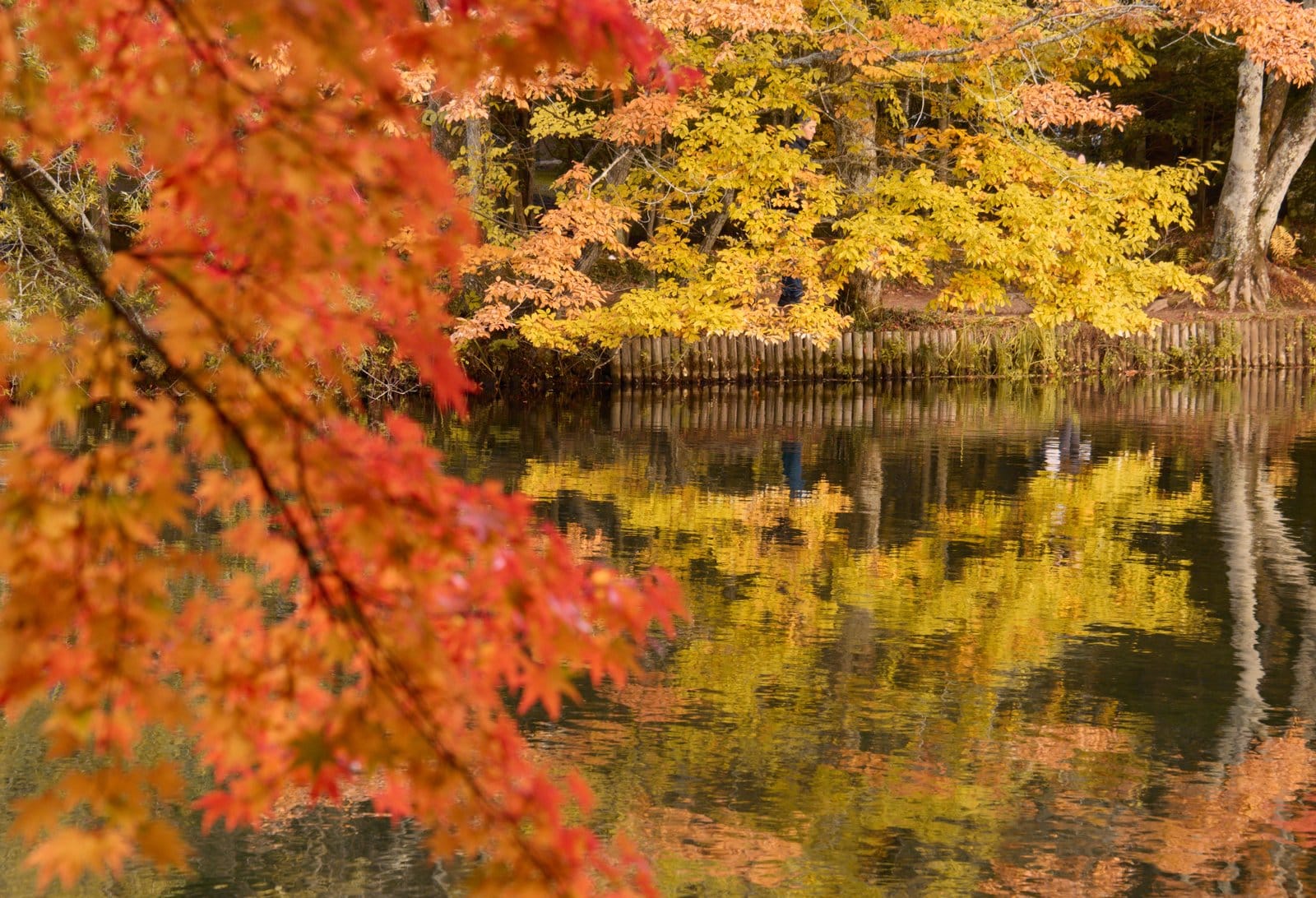
I used to think Karuizawa was simply where wealthy Tokyo residents escaped the summer heat, until I visited in mid-October one year. That morning, mist still hovered over Kumoba-ike Pond, while red maple leaves and golden karamatsu (deciduous larch) reflected across the glassy water—a scene you often see on Japanese travel posters, which turned out to be only a short nap on the train from Tokyo Station. Since then, I’ve tried to return at least once every autumn foliage season.
This article is an overview of OlaChill’s entire Karuizawa autumn series: why the area is worth visiting, what the climate is like from September–November, where the main foliage-viewing areas are in relation to one another, what to wear, and a list of 9 detailed articles to help you explore each spot further. If you read only one article about autumn in Karuizawa, start with this one and branch out from there.
Why Karuizawa is the best “beautiful, affordable, and close” autumn foliage destination from Tokyo
These are the three reasons I always put Karuizawa at the top of the koyo list for people based in Tokyo or travelers using Tokyo as their base:
First, the distance. The Hokuriku Shinkansen from Tokyo or Ueno Station to Karuizawa Station takes just over 1 hour, depending on the service. There’s no need to change trains or get up at 4 a.m. You can easily make it a day trip and still be back in Tokyo in time for dinner. Compared with Nikko (also beautiful, but notorious for seasonal traffic jams on the road up to Irohazaka) or Hakone (packed on weekends), Karuizawa feels much more relaxed.
Second, the altitude creates a “real” autumn. In Tokyo, leaves change color slowly into early December, and on many foliage-viewing days you’re out in 20-degree sunshine with barely a hint of autumn in the air. Karuizawa is different: the air is cold and dry, mornings are often misty, and the day–night temperature difference is substantial—exactly what helps the leaves develop richer, more even colors. In autumn, Karuizawa gives you both the scenery and that crisp seasonal chill.
Third, the high concentration of foliage spots within a small area. Kumoba-ike, the old Kyu-Karuizawa district, Shiraito Falls, and Usui Pass all fit within an area you can explore in 1–2 days by bicycle, local bus, or taxi. It’s not the kind of mountain region where every attraction is “2 hours of driving away” from the next.
If you want to see where Karuizawa fits into Japan’s overall autumn foliage picture, check out the Japan autumn foliage calendar by region—Karuizawa falls into the “peak from mid- to late October” group, around 3–5 weeks earlier than Kyoto and Tokyo.
The September–November highland climate: understand the altitude, understand the foliage season
The first thing to keep in mind: Karuizawa is about 5–7 degrees colder than Tokyo at the same time of year. Many first-time visitors arrive in October dressed for a stroll through Shibuya and start shivering the moment they leave the station. Here’s what each month feels like in practice (the temperatures are only a guide, so check the forecast close to your trip):
September — early autumn, with comfortable weather
Daytime temperatures are around 18–23 degrees, falling to about 10–14 degrees at night. The first leaves begin changing sporadically in the higher areas around Mount Asama, while the town itself remains green. This is a lovely month for walking, cycling, and enjoying coffee outdoors without the crowds of foliage season. Keep in mind that September can still bring typhoons, so check the forecast before finalizing your plans.
October — the golden month of foliage season
At the beginning of the month, daytime temperatures are around 15–18 degrees; by the end of the month, some days reach only 10–13 degrees, and early-morning temperatures of 3–5 degrees are perfectly normal. The colors start becoming noticeably stronger around mid-month, and the period from around the third week of October to early November is usually peak foliage season at major spots such as Kumoba-ike. Golden karamatsu, red maples (momiji), and brown oak create the fullest range of colors during this period. The trade-off is that it’s also the busiest time, especially on weekends that coincide with public holidays.
November — the end of foliage season, the beginning of winter
At the beginning of November, the central areas and lower-elevation spots can still have beautiful foliage, but after about the second week, the leaves fall quickly. Daytime temperatures are around 8–12 degrees, early mornings can hover around 0 degrees, and frost appears occasionally. In return, the crowds thin out, room rates become more affordable, and the golden leaves covering forest roads create a uniquely quiet beauty. I genuinely love the first half of November in Karuizawa—it’s beautiful in a way that suits people who dislike crowds.
Map of the main foliage areas: 4 clusters to remember
Picture Karuizawa as a T: the horizontal stroke is the east–west axis running through Karuizawa Station, while the vertical stroke is the road heading north toward Mount Asama. The 4 main foliage-viewing clusters are laid out as follows:
1. Kumoba-ike — the region’s mirror-like lake
Kumoba-ike Pond (also known as Swan Lake) is about 20 minutes on foot from Karuizawa Station and is the town’s most iconic foliage-viewing spot. The pond itself is small—you can walk all the way around it in about 25–30 minutes—but its fame comes from the still water reflecting the entire red-and-gold forest behind it. It is at its best early in the morning, before the wind picks up and before the crowds arrive. My advice: get there before 8 a.m. and walk counterclockwise for the best backlit view on the north shore. I’ve covered the route, ideal timing, and photo spots in a separate article: autumn foliage at Kumoba-ike Pond.
2. Shiraito Falls — a curtain of water in the autumn forest
Shiraito Falls lies north of town, about 20–25 minutes by car or bus from the station along the Shiraito Highland Way (a toll road for cars). The waterfall isn’t tall, but it spreads into hundreds of thin streams like white threads—exactly what the name “shiraito” means. The water comes from underground springs on Mount Asama, so it remains crystal clear year-round. When the surrounding forest turns gold, the scene looks like a monochrome ink painting brought to life with color. Because the falls are higher than the town center, the leaves here usually change 1–2 weeks earlier than those in town. See the detailed guide: Shiraito Falls in autumn.
3. Kyu-Karuizawa — the old streets, churches, and leafy lanes
Kyu-Karuizawa is the historic district northeast of the station, the heart of the town since Western missionaries began coming here for summer retreats in the late 19th century. The main artery is Kyu-Karuizawa Ginza shopping street, but the most beautiful autumn scenery is found along the smaller roads branching off around it: paths leading to old wooden churches, villas tucked beneath red maple canopies, and cafés with gardens blanketed in leaves. This is the best area for wandering without a fixed plan—turn into any alley that looks inviting. I’ve gathered where to eat, which shops to visit, and the prettiest walking routes in Kyu-Karuizawa’s old streets in autumn.
4. Usui Pass — panoramic views and a legendary mountain road
Continue east from Kyu-Karuizawa to reach Usui Pass, the natural boundary between Nagano and Gunma. The main destination is the Usui Pass Observation Platform, where you can look out over the mountain ranges of Gunma, with the distinctive jagged silhouette of Mount Myogi in the distance. During foliage season, the entire valley below is splashed with red and gold, and the view from above is spectacular. Nearby, Kumano Kotai Shrine straddles the exact border between the two prefectures, making it one of the most uniquely situated shrines in Japan. If you’re driving, the old mountain pass road—with its hundreds of bends—is also a memorable autumn experience (and a guaranteed source of motion sickness for anyone with a weak stomach). The full guide is in Usui Pass in autumn.
Beyond the 4 main clusters: a few bonus spots if you have extra time
- Hoshino area / Harunire Terrace: a row of pleasant wooden buildings along the stream, where golden leaves fall across the wooden deck in a very “chill” setting, near Hoshino Onsen.
- Lake Shiozawa (Karuizawa Taliesin): a lakeside park in the south, less crowded than Kumoba-ike and well suited to families with young children.
- Karuizawa Prince Shopping Plaza: right next to the station, this large outlet mall has lawns and rows of trees changing color—very convenient for end-of-day shopping while you wait for your train home.
What to wear by temperature: a layering formula for the highlands
The general rule for autumn in Karuizawa is to wear several thin layers instead of one thick layer, because the temperature difference between morning, midday, and evening is considerable. A 5-degree morning followed by a sunny 17-degree afternoon is perfectly ordinary.
- Above 15 degrees (September, October afternoons): a long-sleeved T-shirt or shirt, plus a cardigan or light jacket, should be enough. You’ll warm up quickly if you do a lot of walking.
- Around 8–15 degrees (most of October): a thin thermal layer underneath, a sweater or fleece in the middle, and a windbreaker or lightweight wool coat on top. A scarf is well worth bringing—the early-morning breeze across Kumoba-ike can feel biting.
- Below 8 degrees (early October mornings, November): add a lightweight puffer jacket (a packable one is the most convenient), a knit hat, and thin gloves if you plan to watch the sunrise or go up to Usui Pass—the observation platform is windy, so it can feel several degrees colder than the thermometer suggests.
- Shoes: grippy sneakers are essential. The paths around the lake and through the forest are covered with leaves wet from the morning dew and are more slippery than you might expect. Trekking shoes aren’t necessary unless you plan to take a long hike around the pass.
One small tip: cafés and restaurants in Karuizawa tend to be quite warm, so your outermost layer should be easy to remove and carry. Avoid wearing a single “ultra-thick coat” that’s difficult to take off.
How to get around
There are 3 main options, each suited to a different type of traveler:
- Shinkansen: the fastest option, taking just over 1 hour from Tokyo, ideal for day-trippers or anyone who doesn’t want to overthink logistics. Reserve your seat in advance for autumn foliage weekends.
- Highway bus: considerably cheaper, but takes around 3 hours and may get caught in peak-season traffic. Best for travelers on a budget who aren’t in a hurry.
- Driving yourself: the most flexible option, especially if you want to visit Shiraito Falls, Usui Pass, and outlying spots all in the same day. Keep in mind that parking lots at popular attractions fill up early during foliage season, and from mid-November there may be frost on the pass roads in the early morning.
I’ve covered the costs, travel times, ticket purchasing, and getting around town (bicycle rental and the local loop buses) in a separate article: how to get to Karuizawa from Tokyo. If you prefer a leisurely road trip, Karuizawa highland drive offers another perspective on driving around the region in all four seasons.
Should you visit for 1 day or stay overnight?
This is the question I get asked most often. The short answer: a day trip is enough to “see” Karuizawa, but staying one night is what lets you truly “feel” it.
On a day trip, you can fit in Kumoba-ike in the morning, the old town at midday, and one of two options—Shiraito Falls or Usui Pass—in the afternoon. The schedule is fairly tight but doable; I’ve mapped out each time slot in 1-day autumn itinerary for Karuizawa.
Staying one night gives you two things day-trippers never get: Kumoba-ike at 7 a.m., empty and covered in mist, and an evening soaking in an onsen beneath the cold highland sky. The complete 2-day, 1-night itinerary is in 2 days and 1 night in Karuizawa during foliage season, while onsen and autumn accommodation covers where to stay—from ryokan with onsen to hotels near the station.
Food is another reason to linger: Karuizawa has one of Japan’s oldest bread and specialty coffee cultures, a legacy of the Western resort communities, along with Shinshu soba and seasonal dishes made with highland produce. A list of recommended restaurants and cafés by area is in what to eat and where to get coffee in autumnal Karuizawa.
The Karuizawa autumn series: choose what to read next
This overview is your starting point. Depending on what you need, continue with these 9 detailed articles:
- Kumoba-ike Pond in autumn foliage — the best times, walking route around the lake, and reflection photo spots.
- Shiraito Falls in autumn — how to get there, road tolls, and how to combine it with a northern loop.
- Kyu-Karuizawa’s old streets — scenic walking routes, historic churches, and long-established shops.
- Usui Pass and the observation platform — panoramic views, the shrine on the prefectural border, and the old pass road.
- How to get to Karuizawa from Tokyo — Shinkansen, bus, driving, and getting around town.
- 1-day autumn itinerary — a tightly scheduled plan for day-trippers.
- 2-day, 1-night itinerary — a relaxed plan featuring sunrise at Kumoba-ike.
- Onsen and autumn accommodation — ryokan and hotels by budget and location.
- What to eat and where to get coffee — bread, Shinshu soba, and cafés with beautiful foliage views.
Frequently asked questions
When is peak autumn foliage in Karuizawa?
Usually from around mid-October to early November, with the final week of October often considered the prettiest period at central spots such as Kumoba-ike. Higher-elevation areas (Shiraito Falls and Usui Pass) change color around 1–2 weeks earlier. The timing varies slightly each year depending on the weather, so check Japan’s koyo forecasts as your trip approaches.
Is a day trip from Tokyo realistic?
Yes. The Shinkansen takes just over 1 hour each way, and if you leave around 7–8 a.m., you’ll have a full day in Karuizawa. You’ll simply need to limit your itinerary—Kumoba-ike, the old town, and one of Shiraito Falls or Usui Pass is the most practical combination for a single day.
Is Karuizawa crowded in autumn?
It is, especially on the final weekends of October and during the early-November holidays. Still, it’s more comfortable than Nikko or Kyoto during foliage season. To avoid the crowds, go on a weekday, arrive at Kumoba-ike before 8 a.m., and save the shopping street for later in the day rather than visiting at midday.
Is it inconvenient without a car?
Not especially. You can walk to Kumoba-ike and Kyu-Karuizawa or rent a bicycle from the station. Local buses run from the station to Shiraito Falls, while Usui Pass can be reached by bus or taxi. A car only becomes truly worthwhile if you want to combine several distant spots in one day or are traveling in a large group with older adults.
Is Karuizawa suitable for young children and older travelers?
Very much so—it’s one of the gentlest foliage-viewing destinations near Tokyo. The path around Kumoba-ike is flat, the old town has plenty of cafés and shops where you can take breaks, and most attractions require no climbing. Just make sure everyone dresses warmly in the morning and wears shoes with good traction, as the dew-wet leaves can be quite slippery.
What is there to do in Karuizawa after foliage season ends?
From late November, the town shifts into early-winter mode: decorative lights gradually go up, outdoor ice rinks open, and room rates drop considerably compared with foliage season. If you enjoy peace and quiet, this can actually be a pleasant time to visit—just prepare proper winter clothing.
More from this region — Chubu (Nagano, Kanazawa)
View all →
Autumn Leaves Onsen in Karuizawa: Soaking in a Forest Bath at Tombo-no-yu
17 min · tips
Kimono in Gifu: Where to Wear It, Best Photo Spots and How to Plan the Day
7 min · culture
Kimono in Nagano: Where to Wear It, Best Photo Spots and How to Plan the Day
7 min · culture
Kimono in Niigata: Where to Wear It, Best Photo Spots and How to Plan the Day
7 min · culture