
Traveling to Karuizawa from Tokyo by Train and Bus During the Fall Foliage Season
It takes just over an hour by Shinkansen, but should you choose the Tokyo Wide Pass, individual tickets, or an express bus? Plus tips for reserving seats and getting around by bicycle.
Aug 12, 2026·✍️ olablog·⏱ 16 min read
It takes just over an hour by Shinkansen, but should you choose the Tokyo Wide Pass, individual tickets, or an express bus? Plus tips for reserving seats and getting around by bicycle.
Tap a region to browse articles
When people mention Karuizawa, many long-term residents of Japan immediately picture winding drives along tree-lined roads—and yes, we once wrote an entire article about driving around this plateau. But there’s one fact not everyone realizes: Karuizawa is one of the very few destinations for “proper mountain-forest” fall foliage that you can visit without a car. The town sits directly on the Hokuriku Shinkansen line, trains from Tokyo take just over an hour, and Karuizawa Station is right next to the heart of town—not the kind of place where you get off the train and still have to take a 40-minute taxi ride, as is the case in many other destinations.
The fall foliage season—usually from mid-October to early November—is also when public transportation really shows its strengths. On peak weekends, the roads around the Usui-Karuizawa interchange and the famous outlet mall are chronically jammed, with cars inching forward while the Shinkansen continues arriving precisely on schedule. And during this season, you may well want to enjoy a little Nagano wine or Karuizawa craft beer with lunch—something the driver is not allowed to do.
This article fills in the missing piece from our previous self-drive guide: how to visit Karuizawa in autumn smartly by train and bus, whether to buy individual tickets or a JR Tokyo Wide Pass, when an express bus is worth the money, how to secure seats on peak weekends, and how to get around once you arrive. If you’re Vietnamese and living in Tokyo and want to take a day trip, or you’re planning an autumn visit for your parents, this guide should give you everything you need to book your tickets right away.
Why You Should Consider Leaving the Car at Home During Fall Foliage Season
Karuizawa sits at an elevation of around 1.000 meters. Its cool climate means the leaves change color a full month earlier than in Tokyo. And precisely because of its reputation as “an upscale resort just one hour from Tokyo by train,” the entire town can turn into one enormous parking lot on koyo weekends. Here are a few reasons I strongly favor taking the train during this season:
- Traffic jams are practically guaranteed on Saturdays, Sundays, and public holidays toward the end of October. The stretch from the Joshin-etsu Expressway down into town, as well as the area around Karuizawa Prince Shopping Plaza, is frequently backed up.
- Parking lots around Kyu-Karuizawa and Lake Kumoba are limited and fill up quickly, with prices also rising during peak season.
- The Shinkansen runs like clockwork, and there’s something incredibly satisfying about being in Tokyo at 9 a.m. and standing among golden leaves just after 10 a.m.
- The town is compact and relatively flat, making it perfect for cycling and walking—unlike mountainous areas where a car is practically essential.
Of course, if you’re traveling with a large group and small children, or want to detour to Kusatsu Onsen or explore deeper into the mountains, a car still makes sense—in that case, feel free to check out OlaChill’s self-drive article. But if Karuizawa and the surrounding area are your only destinations, the train wins hands down.
Hokuriku Shinkansen from Tokyo/Ueno: Faster Than You Think
Which Trains Stop at Karuizawa
There are several types of trains on the Hokuriku Shinkansen, and this is where first-time travelers often get confused:
- Asama: The ideal choice for Karuizawa travelers. Every Asama service stops at Karuizawa Station, and trains run frequently—if you head to the station, there will almost always be one departing within 30–60 minutes.
- Hakutaka: Most services also stop at Karuizawa, but not all of them—check the departure board or an app before boarding.
- Kagayaki: The fastest train on the line, running directly to Nagano and Kanazawa without stopping at Karuizawa. Board the wrong one and you’ll find yourself enjoying an unplanned morning of “Nagano tourism.”
The journey from Tokyo Station to Karuizawa takes around 60–70 minutes, depending on the service, while departing from Ueno is about 5 minutes faster. That’s quicker than many people’s daily commutes within Tokyo itself.
Which Station Is Most Convenient?
- Tokyo Station: Convenient if you’re staying around Marunouchi or Ginza, or traveling from the eastern side of the Yamanote Line. Since it’s the first station, it’s easier to find room for luggage, and passengers using unreserved seating have the best chance of getting a seat.
- Ueno Station: A lifesaver for those living in northern Tokyo (Nippori, Tabata, Adachi, Kita, and so on). The Shinkansen platforms at Ueno are deep underground, so allow an extra 10 minutes for getting through the station.
- Omiya Station: If you’re in Saitama, there’s no need to detour into Tokyo—all Asama services stop at Omiya.
A small tip for travelers using unreserved seats: because the train originates at Tokyo Station, you’re almost guaranteed to find a seat if you board there. If you board at Ueno or Omiya on a Saturday morning during fall foliage season, be prepared for the possibility of standing.
Individual Tickets, the JR Tokyo Wide Pass, or an Express Bus—which Is the Best Option?
This is the most wallet-painful part, and the answer depends on your itinerary. The figures below are for reference only; fares may change, so check the official JR East website before traveling.
Individual Shinkansen Tickets
A one-way Tokyo–Karuizawa ticket, including the basic fare and Shinkansen supplement, costs around 5.500–6.000 yen, depending on whether you choose an unreserved or reserved seat. A round trip comes to around 11.000–12.000 yen per person. That may sound steep for a day trip, but in return you get complete flexibility: travel whenever you like, with no restrictions.
A money-saving tip for individual tickets: book through Eki-net, JR East’s online ticketing service. It occasionally offers limited-quantity discounted fares on the Hokuriku Shinkansen. The savings can be substantial if you book early, but seats are limited and the change and refund conditions are stricter, so read the terms carefully before purchasing.
JR Tokyo Wide Pass—the “Secret Weapon” for Foreign Passport Holders
Here’s something many Vietnamese residents of Japan don’t know: the JR Tokyo Wide Pass isn’t only for tourists; foreigners living in Japan can also buy it, as long as they use a passport other than a Japanese passport. The pass costs around 15.000 yen, is valid for 3 consecutive days, and provides unlimited travel on JR East trains throughout the wider Kanto area—including the Hokuriku Shinkansen section from Tokyo to Sakudaira, which fully covers Karuizawa.
The calculation is simple: a round trip from Tokyo to Karuizawa with individual tickets already costs nearly 11.000–12.000 yen. If you add another trip during those 3 days—for example, a foliage-viewing trip to Nikko the next day, or a ride to Kawaguchiko on the Fuji Excursion train, which is also covered—the Tokyo Wide Pass offers excellent value. But if Karuizawa is your only round-trip destination, individual tickets are still cheaper.
A few things to remember about the pass:
- The three days must be consecutive; they cannot be split up.
- Reserved-seat bookings are free and unlimited—just use a ticket machine with seat-reservation functions or visit a JR ticket counter. During peak season, this is the pass’s biggest advantage: you can reserve seats as often as needed without paying anything extra.
- The pass cannot be used on certain limited services, but for the Karuizawa route, the Asama and Hakutaka are more than sufficient.
- Buy it at a JR East Travel Service Center or a pass-designated ticket machine at major stations; remember to bring your passport.
For families with parents visiting from Vietnam in autumn, a classic combination is: day 1 in Nikko, day 2 resting or exploring Tokyo, and day 3 in Karuizawa—a single pass covering the two best fall foliage trips in Kanto.
Express Buses: Slow but Cheap
Express buses run directly to Karuizawa from Ikebukuro and several other locations in Tokyo. They cost only around 2.000–3.000 yen one way, less than half the price of the train. The trade-off is a journey of around 3 hours when traffic is clear—and on fall-foliage weekends, “clear traffic” is a fairly optimistic assumption. A bus can arrive a full hour late if traffic backs up on the mountain roads.
Who are buses good for?
- Travelers staying in Karuizawa for 1–2 nights who aren’t in a hurry and want to minimize costs.
- People traveling on weekdays, when the roads are much quieter.
- Students and newcomers who are still on a tight budget—the 6.000–7.000 yen round-trip difference is enough to pay for a very good dinner.
But if you’re taking a day trip on a peak-season Saturday, my honest advice is: don’t try to save money on the train. Spending 2 hours stuck in traffic each way means losing half the day you could have spent enjoying the foliage.
Quick Comparison
| Option | Round-trip cost (approx.) | One-way journey time | Best for |
|---|---|---|---|
| Individual Shinkansen tickets | around 11.000–12.000 yen | 60–70 minutes | Day trips focused solely on Karuizawa |
| JR Tokyo Wide Pass | around 15.000 yen / 3 days | 60–70 minutes | Combining Nikko, Kawaguchiko, and other destinations within 3 days |
| Express bus | around 4.000–6.000 yen | around 3 hours (often delayed) | Overnight stays, weekday trips, tight budgets |
Tips for Reserving Seats on Peak Weekends
Weekends from mid-October to early November are the “harvest season” for this route: Tokyo residents heading out for foliage viewing, outlet shopping, and golf all pile onto the same handful of trains. Here are some hard-earned lessons:
- Reserve your outbound seat as soon as reservations open. Shinkansen seats go on sale 1 month in advance at 10 a.m. Japan time. On clear Saturdays toward the end of October, reserved seats on trains departing at 8–9 a.m. sell out quickly. Booking online through Eki-net is easiest, and you can select your seat directly from the seating chart.
- The return journey is the real challenge. Everyone wants to return to Tokyo between 16–18 on Sunday, so trains in that time slot sell out first. If you’re using the Tokyo Wide Pass, your first task after arriving at Karuizawa Station should be to stop at a ticket machine and reserve your return seat immediately before heading out.
- Shift your travel time: return before 15, or have dinner in Karuizawa and take a train after 19. Autumn evenings in town are crisp and cool; enjoying a bowl of hot soba before boarding a quiet train is far more pleasant than squeezing onto the 17:00 service.
- Unreserved seating is an acceptable backup plan if you board at Tokyo Station, the first station on the line. Joining the queue 15–20 minutes before departure will usually get you a seat. But on Sunday evening trains from Karuizawa to Tokyo, the line for unreserved seats can be so long that you may have to stand for the entire hour—something best avoided if you’re traveling with elderly people or small children.
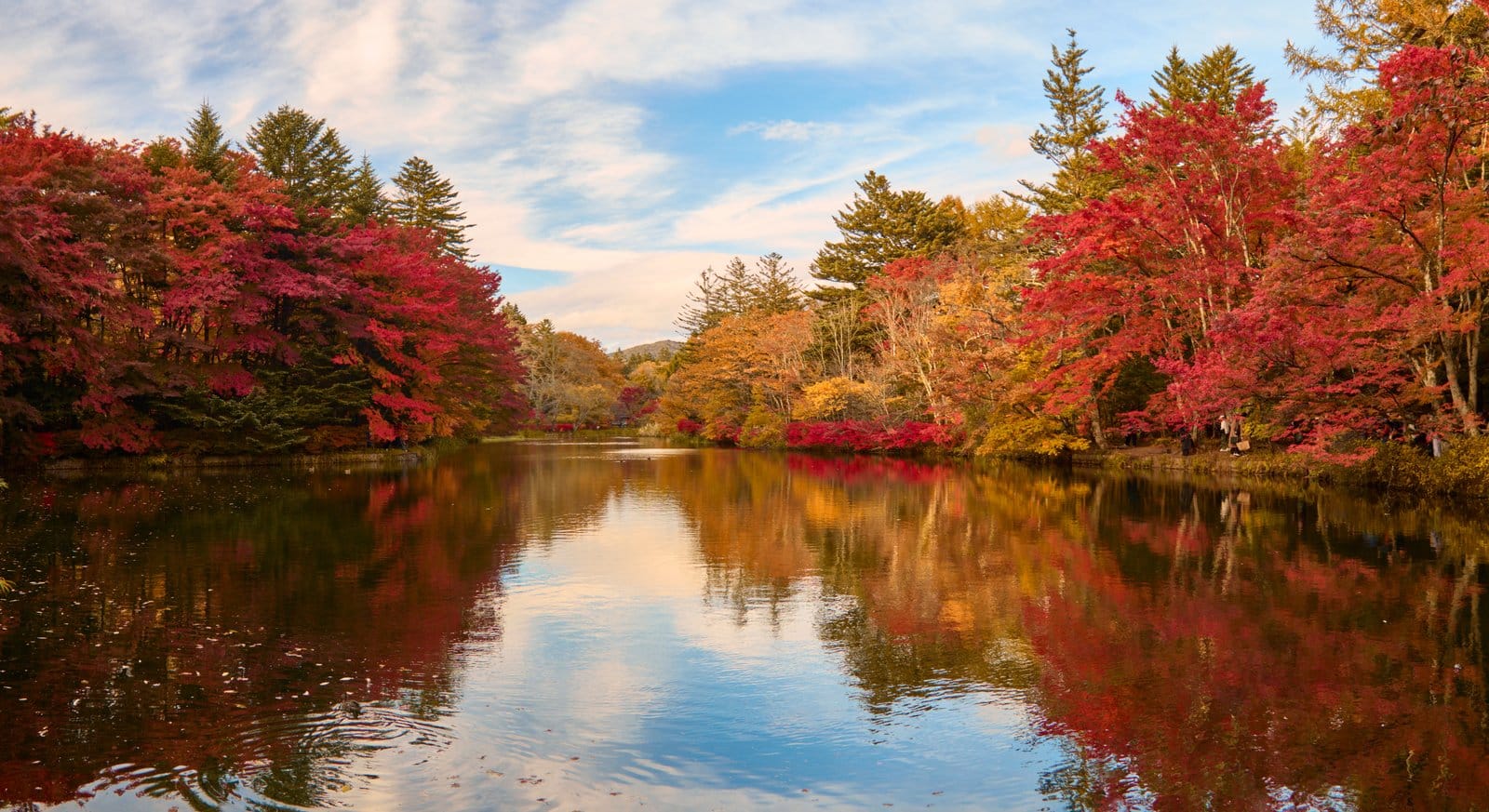
- Leaving early and returning late isn’t just about finding seats—Lake Kumoba is calm in the early morning, when the water reflects the red leaves most beautifully, and it’s also the quietest time of day.
Once You Arrive: Getting Around Karuizawa Without a Car
Karuizawa Station has two exits: the North Exit, facing the old town center, and the South Exit, which leads directly to Prince Shopping Plaza outlet mall. Most of your transportation options are concentrated around the North Exit.
Walking and Renting a Bicycle Near the Station
Karuizawa is flat, scenic, and lined with trees—in fact, it’s no exaggeration to call it one of the most enjoyable towns in Japan for cycling. Around the North Exit, you’ll find numerous bicycle rental shops offering everything from standard bikes to electric-assist models. Rental rates are charged by the hour or day, generally ranging from a few hundred to more than 1.000 yen per hour depending on the bike, and popular models can sell out early on peak weekends. Some shops gradually close for the season in late autumn, so check in advance if you’re visiting after mid-November.
Here are some distances to give you a sense of scale:
- Lake Kumoba: About 20–25 minutes on foot or roughly 10 minutes by bicycle from the station. This is Karuizawa’s most rewarding fall foliage spot—the lake acts like a mirror reflecting the forest’s red and gold colors.
- Kyu-Karuizawa Ginza Street: Around 2 km from the station, 10 minutes by bicycle, or 25–30 minutes on foot. This historic shopping street is known for its snacks, bread, and jams.
- The Hoshino area and forest churches: Farther away, and best reached by the Shinano Railway or bus, as explained below.
Cycling here in autumn is genuinely romantic, but remember that temperatures in Karuizawa are around 5–6 degrees lower than in Tokyo toward the end of October. Early mornings and evenings can drop below 10 degrees. Lightweight gloves and a windbreaker will be your best friends.
Local Buses from the North Exit
The two main operators serving the area are Kusakaru Kotsu and Seibu Kanko Bus, with stops directly in front of the North Exit:
- Shiraito Falls (Shiraito no Taki): Take a Kusakaru Kotsu bus bound for Kita-Karuizawa/Kusatsu; the ride takes about 25 minutes. The slender waterfall looks like a silk curtain amid the golden forest. No train reaches this spot, so the bus or a car is the only way there. It can get crowded during peak season, so take a morning service.
- Naka-Karuizawa / Harunire Terrace area: Buses are available, but the Shinano Railway is more convenient, as explained below.
- Bus services are not nearly as frequent as those in Tokyo—some routes run only one or two times per hour, or even less often. Take a photo of the timetable at the stop as soon as you arrive and keep track of the return service. Don’t miss the last bus in the afternoon.
- Most local buses here require payment when you get off, and not every vehicle accepts IC cards such as Suica—keep some small cash on hand just in case.
Shinano Railway: One Stop to Naka-Karuizawa
From Karuizawa Station, the local Shinano Railway runs toward Komoro and Ueda. Travel exactly one stop (a few minutes) to Naka-Karuizawa, the gateway to the Hoshino Area, with its riverside shops and restaurants at Harunire Terrace, Karuizawa Kogen Church, and Tombo-no-yu hot spring. In autumn, the streamside foliage here turns a brilliant gold. Sitting at a café and listening to the water flow is the very definition of an OlaChill-style “chill” experience.
One small note: this is a private railway, so ticket purchasing and IC card acceptance differ from JR. Bring some cash and check the instructions at the station to be safe. The JR Tokyo Wide Pass does not cover this line, but a short-distance ticket costs only a few hundred yen.
Suggested One-Day Public Transportation Itinerary
- 07:30–08:00: Board the Asama at Tokyo or Ueno Station (with your seat reserved the previous week—remember).
- 09:00–09:15: Arrive at Karuizawa. If you haven’t already reserved your return seat, stop at a ticket machine and do so, then rent a bicycle at the North Exit.
- 09:30: Cycle straight to Lake Kumoba while it’s still quiet, and walk the full loop around the lake (about 20–30 minutes on foot).
- 11:00: Head to Kyu-Karuizawa Ginza for an early lunch—soba, Karuizawa-style toasted bread, or specialty cold cuts and sausages.
- 13:00: Return the bicycle and take a Kusakaru Kotsu bus to Shiraito Falls. Spend about an hour exploring and taking photos, then catch the bus back.
- 15:30: Take the Shinano Railway one stop to Harunire Terrace for an afternoon coffee by the stream. If you like, soak your feet or visit the onsen at Tombo-no-yu.
- 18:00–19:00: Return to Karuizawa Station, have dinner near the station or buy an ekiben, and board your train back to Tokyo for a relaxed evening journey.
This itinerary fits comfortably into a day without feeling rushed, and the entire route relies only on your feet, a bicycle, buses, and trains.
Final Tips for Peak Season
- Dress in layers: afternoons can be warm in the sun, while mornings and evenings are distinctly cold. Several thin layers are easier to adjust.
- Travel on weekdays if possible: Karuizawa on a Tuesday in mid-October and Karuizawa on the final Saturday of October are two completely different worlds in terms of crowds.
- Check the foliage forecast before you go: the timing can vary by as much as a week from year to year. Japanese koyo forecast sites update weekly, so it’s worth checking to catch the peak.
- Don’t combine the outlet mall with a foliage-viewing day: Prince Shopping Plaza is huge, and getting absorbed there can easily consume your entire afternoon. If shopping is your priority, plan a separate trip.
- Keep your luggage light: Karuizawa Station has coin lockers, but they can fill up on peak weekends. For a day trip, one backpack is all you need.
Frequently Asked Questions
Can I visit Karuizawa from Tokyo as a day trip? Absolutely. The train takes just over an hour each way, so if you leave at 8 a.m. and return on the 19:00 service, you’ll have a full 9–10 hours in town—enough time for Lake Kumoba, the old town, Shiraito Falls, and an afternoon coffee.
Can Vietnamese citizens with a work or student visa in Japan buy the JR Tokyo Wide Pass? Yes. The pass is available to anyone traveling on a passport other than a Japanese passport, including foreigners residing in Japan. Just bring your passport when purchasing it; check the official JR East website for the detailed conditions.
Can I board the train without reserving a seat in advance? Yes, the Asama has unreserved cars. However, on fall foliage weekends, you may very likely have to stand on Sunday evening trains from Karuizawa to Tokyo. If you’re traveling with elderly people or small children, reserve seats in advance—through Eki-net or a ticket machine, both of which are quick and easy.
Can I enjoy Karuizawa without renting a bicycle? Definitely. Lake Kumoba and Kyu-Karuizawa Ginza are within walking distance of the station (20–30 minutes), while more distant spots such as Shiraito Falls and Harunire Terrace are served by buses and the Shinano Railway.
Will there still be fall foliage at the end of November? Usually, it will be too late. Peak foliage in Karuizawa generally falls between mid-October and early November. By late November, most trees have already lost their leaves and the weather is quite cold. The exact timing varies each year, so check the koyo forecast before finalizing your tickets.
Do I need to reserve an express bus in advance? It’s best to book through the operator’s website, especially on weekends, since buses operate with reserved seating and the most convenient departure times sell out early. And one more reminder: during peak season, allow extra time for traffic and don’t schedule anything important in Tokyo too close to your expected arrival.
More from this region — Chubu (Nagano, Kanazawa)
View all →
Walking Through Karuizawa in Autumn: From Kumoba-ike Pond to Usui Pass
17 min · tips
Hunting for Autumn Photos in Karuizawa: Where to Stand and When to Shoot
16 min · tips
Karuizawa Highland Drive – Japan's Coolest Escape (Literally)
5 min · tips
Branching out from Karuizawa: 2–3 autumn days through Kusatsu, Asama, and Usui Pass
15 min · tips