
Branching out from Karuizawa: 2–3 autumn days through Kusatsu, Asama, and Usui Pass
A suggested itinerary combining a mountain resort, hot springs, volcanic rock fields, and a historic railway route into a 2–3-day autumn foliage trip, including the best order to visit and where to stay each night.
Aug 12, 2026·✍️ olablog·⏱ 15 min read
A suggested itinerary combining a mountain resort, hot springs, volcanic rock fields, and a historic railway route into a 2–3-day autumn foliage trip, including the best order to visit and where to stay each night.
Tap a region to browse articles
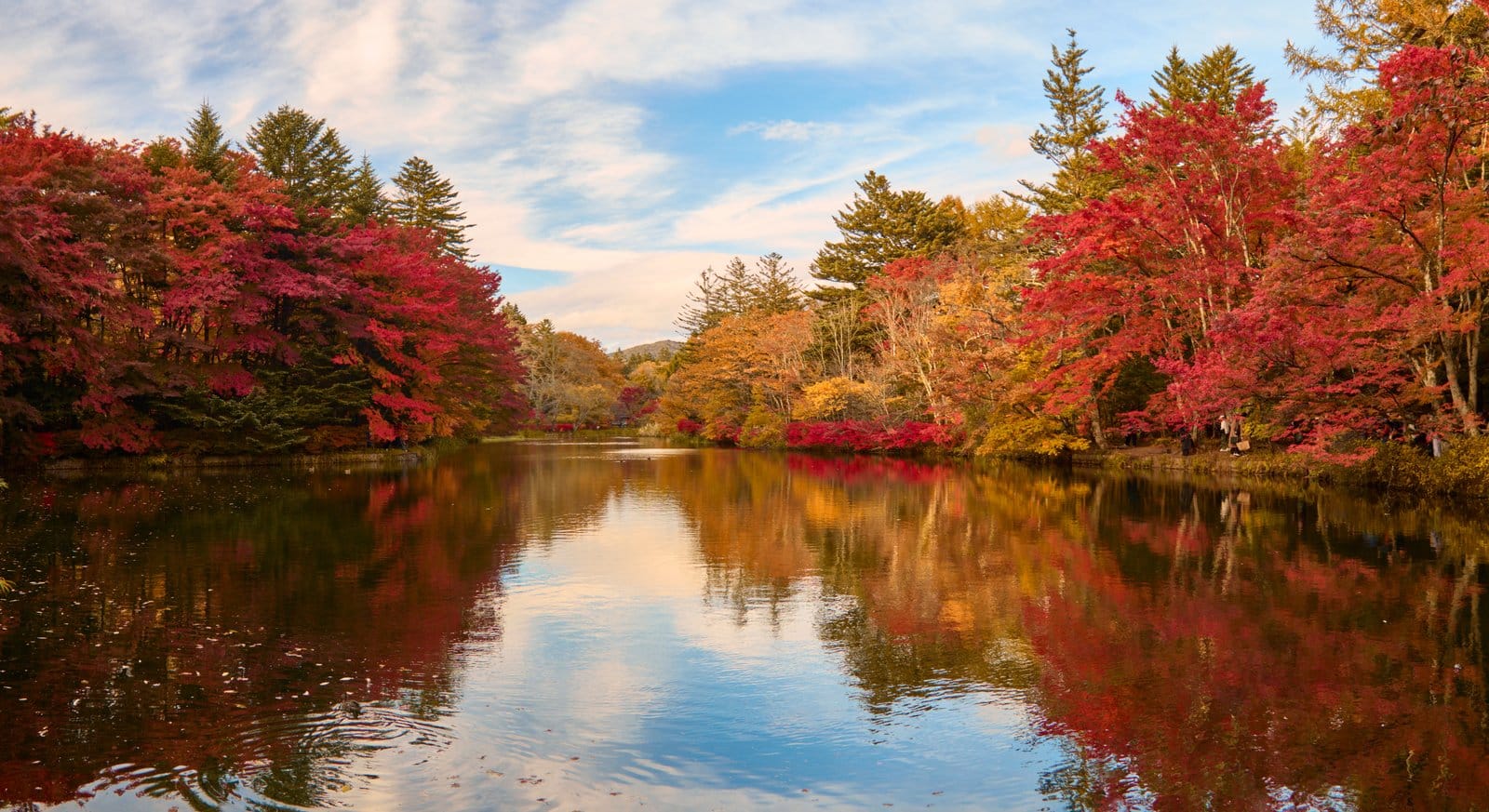
If you have ever visited Karuizawa in autumn as a “day trip from Tokyo,” you may have felt the same way I did the first time: it is undeniably beautiful—the vivid red leaves around Kumoba Pond, the scent of freshly baked pastries along Kyu-Karuizawa—but somehow, something feels missing. It is like finishing an appetizer only to be told it is time to leave. Karuizawa was never really meant to be a standalone destination. It is a gateway to the entire highland region around Mount Asama, where autumn lasts longer and feels more intense than anywhere you can reach within one hour by Shinkansen from Tokyo.
The best part is that Karuizawa Station lets you branch out in four completely different directions. Head north to Kusatsu Onsen, the steaming hot-spring town reached by a bus route that passes through some of the region’s finest autumn forests; stop midway at Onioshidashi, a sea of volcanic rock beneath Mount Asama; travel east to Yokokawa and the historic railway route over Usui Pass; or continue west by Shinkansen to Nagano and the more-than-1,000-year-old Zenkoji Temple.
In this article, I’ll suggest practical ways to combine these routes into a well-paced 2–3-day autumn trip—what to visit first, where to spend each night, and which stops are truly worth the effort. This is not just a list of destinations, but the actual order I followed and found smooth, with less hauling luggage back and forth.
Why Karuizawa makes the ideal autumn “base”
Karuizawa sits at an elevation of around 1,000 meters, so its leaves change color a full month earlier than Tokyo’s—usually peaking from late October to mid-November, depending on the year. More importantly for planning, it is one of the few transport hubs in the region with a Shinkansen connection (the Hokuriku line, just over 1 hour from Tokyo), mountain buses to Kusatsu, and buses and hiking routes descending toward Yokokawa in Gunma.
That means you can arrive in Karuizawa in the morning, leave your luggage at the station or hotel, spend the whole day exploring, and then head in another direction the next day without returning to Tokyo. During foliage season, not having to go back to Tokyo is a huge advantage: weekend trains and buses are crowded, and every unnecessary backtrack costs half a day of sightseeing.
Another detail that people often overlook is Karuizawa’s wide range of accommodation, from affordable guesthouses near the station to forest resorts. That makes it easy to arrange your first night here. For the second night, I’m going to convince you to stay in Kusatsu—the reason comes below.
Four nearby routes worth combining with Karuizawa
Kusatsu Onsen — the most rewarding mountain bus ride of foliage season
Kusakaru Kotsu operates a direct bus from Karuizawa Station to Kusatsu Onsen, taking around an hour and a half. It may sound like an ordinary bus ride, but in autumn, the route is an attraction in its own right. The bus climbs gradually through Naka-Karuizawa and Kita-Karuizawa, following the slopes of Mount Asama with red and gold broadleaf forests interspersed among the evergreens. Try to sit on the left side of the bus on the way up for mountain views. You cannot always choose your seat, but it is worth boarding early.
Kusatsu needs little introduction for onsen lovers. Its naturally gushing hot-spring water is among the most abundant in Japan, and it is so hot and acidic that locals developed the yumomi ritual—stirring the water with large wooden boards while singing and moving in rhythm—to cool it without diluting it. The center of town is Yubatake, or “hot-water field,” steaming in the middle of the streets. At night, it is illuminated in warm yellow light, and the steam mingles with the cool autumn air. Just standing there makes the journey worthwhile.
My favorite autumn spot in Kusatsu is Sainokawara, the rocky park west of town, where hot water flows in streams between boulders surrounded by red leaves. At the far end of the park is a huge rotenburo (open-air bath). Soaking in the hot water while looking up at the momiji canopy with mountain wind brushing your face is the kind of experience no photograph can fully convey.
Onioshidashi — a volcanic rock field beneath Mount Asama
Located directly along the Karuizawa–Kusatsu bus route, with its own stop, Onioshidashi is the remnant of Mount Asama’s 1783 eruption—one of the largest volcanic disasters in Japanese history. The lava from that eruption hardened into a vast field of jagged black rock. People long ago looked at the landscape and named it “Onioshidashi,” roughly meaning “where the demon pushed out the rocks.”
The autumn contrast here is spectacular: black rocks, red and golden shrubs growing between the cracks, and Mount Asama rising behind them, still regularly sending out plumes of smoke. In the middle of the park is a small Kannon shrine built to commemorate the victims of the eruption. From there, every direction opens onto rock and sky. The walking paths are well maintained, and a relaxed circuit takes about an hour.
My advice: do not treat Onioshidashi as a separate destination. Combine it with the Karuizawa → Kusatsu journey. Get off the bus, leave your luggage at the counter if possible (or travel light from the start), explore for 1–1,5 hours, and then take the next bus onward to Kusatsu. Buses are not particularly frequent during peak season, so take a photo of the timetable at the stop as soon as you get off.
Yokokawa–Usui Pass: a heritage route for railway fans and hikers
This is the most off-the-beaten-path of the four routes, but for me, it is also the most rewarding. In the past, the Shinetsu railway line over Usui Pass connected Yokokawa in Gunma with Karuizawa. It was notoriously steep and once required an Abt rack railway system to climb. When the Nagano Shinkansen opened in 1997, the railway section over the pass was closed, leaving behind an “open-air museum” that remains today.
The highlight is Megane-bashi, a four-arch red-brick bridge built during the Meiji era and spanning a valley. In autumn, red leaves frame its base beautifully. The old railway line has now become a walking trail known as Apt no Michi. You can walk through old brick tunnels, encountering a new photo spot every few hundred meters without crowds. At the foot of the pass, next to Yokokawa Station, the Usui Railway Heritage Park displays old locomotives. Children and train enthusiasts can easily lose track of time here.
And do not miss one of Japan’s most famous station specialties: Oginoya’s Toge no Kamameshi. This mixed rice dish is cooked in a traditional clay pot, a meal born in the days when train passengers had to wait at Yokokawa for an additional locomotive to be attached before climbing the pass. Eat the hot rice in the crisp autumn air, then take the pot home as a souvenir.
Getting there: JR buses run over the pass between Karuizawa and Yokokawa (there are not many services, so check the timetable in advance). Strong hikers can walk the old trail over Usui Pass from the Karuizawa side down to Yokokawa. It takes half a day and is wonderful during foliage season, but start early because mountain skies darken quickly. From Yokokawa, take a local JR train to Takasaki, then catch the Shinkansen to Tokyo. That makes this route a perfect final-day option on your way home.
Nagano and Zenkoji Temple — extending the journey west
If you have an extra day, or simply want to end the trip on a quiet, contemplative note, continue west by Shinkansen to Nagano—from Karuizawa, it takes only about half an hour. Zenkoji is one of Japan’s most important and oldest temples. It houses an image believed to be the first Buddhist statue brought to Japan and, notably, is not affiliated exclusively with any particular Buddhist school. Everyone is welcome.
The most memorable experience at Zenkoji is the o-kaidan meguri: descending into a pitch-black passage beneath the main hall and feeling your way along the wall in search of the “key to paradise,” attached directly below the place where the Buddha image is enshrined. It sounds simple, but spending several minutes in absolute darkness feels remarkably strange—as if your mind has been reset after several days of travel. If you stay overnight in Nagano, you can also wake early for the o-asaji morning service, when the head priest walks past rows of kneeling worshippers and touches a rosary to each person’s head.
Nakamise Street, the approach to the temple, is especially pleasant in autumn. Its shops sell oyaki (Nagano’s specialty baked buns filled with vegetables), soba, and ice cream. You can stroll and snack beneath rows of brilliant golden ginkgo trees.
Suggested 2-day itinerary: Karuizawa + Kusatsu
This is the most classic and balanced combination if you only have a weekend.
Day 1 — A full taste of autumn in Karuizawa. Take an early Shinkansen from Tokyo and arrive in Karuizawa around mid-morning. Leave your luggage and rent a bicycle if the weather is good. Spend the morning at Kumoba Pond, where the still water reflects the red leaves like a mirror. Arrive early, before the crowds and before the wind picks up. For lunch, eat around Kyu-Karuizawa Ginza or head to Harunire Terrace in Naka-Karuizawa, a row of wooden buildings beside a stream where sitting outdoors in autumn feels wonderfully “chill.” In the afternoon, choose one of two options: Shiraito Falls in the northern forest, where water drops in thin, threadlike curtains framed by golden leaves, or a Usui Pass viewpoint overlooking the surrounding mountains. Return to the station area for dinner and spend the night in Karuizawa—choose somewhere near the station or Kyu-Karuizawa for convenience.
Day 2 — Onioshidashi + Kusatsu, then straight back to Tokyo. In the morning, take a Kusakaru Kotsu bus from Karuizawa Station, get off at Onioshidashi, explore for a little over an hour, then board the next bus to Kusatsu. Arrive around noon, have soba or pick up grilled food around Yubatake, then spend the afternoon walking to Sainokawara to see the autumn leaves and soak in the rotenburo. In the late afternoon, take an express bus or a bus to Naganohara-Kusatsuguchi Station and continue by train (there are also direct buses to Tokyo, so check and reserve in advance during peak season).
But honestly, this 2-day plan undersells Kusatsu. Onsen are meant to be enjoyed in the evening and early morning, after the day-trippers have gone and the only sound in town is running water. If you can, extend the trip to 3 days.
Suggested 3-day itinerary: the full version I recommend
Day 1 — Karuizawa. Follow Day 1 above: Kumoba in the morning, Harunire Terrace at lunchtime, and Shiraito Falls or the Usui Pass viewpoint in the afternoon. Spend night 1 in Karuizawa.
Day 2 — Onioshidashi, then Kusatsu and a ryokan stay. Take the bus in the morning and stop at Onioshidashi along the way as described above. Arrive in Kusatsu in the early afternoon, check into your ryokan, and slow down completely: catch the yumomi performance at Netsunoyu if the timing works, stroll through Sainokawara as the afternoon sun slants across the leaves, put on a yukata and head to Yubatake to see the evening lights, enjoy a kaiseki dinner at the ryokan, and soak in the onsen before bed. Spend night 2 in Kusatsu—this is the highlight of the entire trip, and it is worth investing in a good ryokan with a private bath or a beautiful open-air bath.
Day 3 — choose one of two endings:
- Ending A, for railway fans and hikers: Soak in the onsen one last time in the morning, take the bus back to Karuizawa, then continue down to Yokokawa (by bus over the pass, or on foot along the old trail if you start early enough and the weather is good). Spend the afternoon wandering around Megane-bashi and the old tunnels, eat kamameshi at Oginoya, then take a local train to Takasaki and transfer to the Shinkansen to Tokyo. This route flows naturally toward Tokyo, so you never have to backtrack.
- Ending B, for temple and food lovers: Return from Kusatsu to Karuizawa, leave your luggage, and take the Shinkansen to Nagano. Have soba on Nakamise Street at lunchtime, visit Zenkoji in the afternoon, try the o-kaidan meguri, and buy oyaki to eat along the way. From Nagano, you can take the Shinkansen straight to Tokyo, so there is no need to return to Karuizawa for your luggage if you are carrying it with you.
If you have even more time, you can spend night 3 in Nagano and attend the morning service at Zenkoji. But for most people working in Japan, 3 days and 2 nights is the perfect balance.
Transport, tickets, and a few money-related tips
- Tokyo–Karuizawa Shinkansen: the Hokuriku line runs frequently and takes just over 1 hour. Reserve seats in advance on autumn foliage weekends, especially for morning departures and evening return trips.
- Karuizawa–Onioshidashi–Kusatsu bus: operated by Kusakaru Kotsu. Buy your ticket on board or at the counter; the total journey takes around an hour and a half, not including the time you spend sightseeing along the way. There are not many services each day, so photograph the timetable and plan a “backup bus” in advance.
- Passes: if your itinerary includes Nagano and several JR journeys around the region, check whether the JR East Nagano–Niigata Area Pass or an equivalent pass would save you money. Depending on the specific itinerary, a pass may be cheaper—or individual tickets may be better—so check the official JR East website before you travel.
- Cash: many small shops and restaurants in Kusatsu and Yokokawa still accept cash only, so carry some with you to be safe.
Hard-earned advice for autumn in this region
Dress warmer than you think you need to. Karuizawa and Kusatsu are both in the mountains. In November, early mornings and late evenings can drop close to 0 degrees even when the daytime is sunny and mild. Bring a thick jacket, a scarf, and especially warm socks—you will inevitably be doing a lot of walking.
Avoid weekends if you can. Peak foliage coincides with Japan’s domestic travel season. On Saturdays and Sundays, you may have to queue for the Kusatsu bus, and Kumoba Pond can be crowded from 9 a.m. Traveling Thursday–Saturday or Sunday–Tuesday is much more comfortable, and ryokan rates are often lower too.
Book your Kusatsu ryokan early. Attractive rooms during koyo season commonly sell out a month in advance. If your preferred price range is fully booked, one option is to stay both nights in Karuizawa and make a day trip to Kusatsu. You can still use the public baths, but you will miss the nighttime atmosphere around Yubatake.
Handle your luggage strategically. Karuizawa Station has lockers and a luggage-storage counter, and many hotels will hold bags both before check-in and after check-out. For a 3-day trip, a backpack is easiest. If you must bring a suitcase, consider forwarding it to your hotel in Tokyo or directly to the airport.
Check the foliage forecasts. Peak color varies between locations: the higher areas around Asama and Kusatsu change earlier, while central Karuizawa and Yokokawa are slightly later. Before finalizing your tickets, check Japan’s koyo forecast sites to choose the best week. The timing usually falls somewhere between late October and mid-November.
Frequently asked questions
Can I travel this route independently if I do not speak Japanese? Yes. The Shinkansen and Karuizawa Station have comprehensive English signage, and the Kusakaru Kotsu buses have stops that are easy to identify by their romaji names. The main things to prepare are the bus timetable (take a screenshot) and the name of the Onioshidashi stop so you can press the bell at the right time. Larger ryokan in Kusatsu are accustomed to welcoming international guests.
Is it okay to do the route in reverse—Kusatsu first, then Karuizawa? Yes, especially if you are arriving from another direction or want to spend your final night near a Shinkansen station for an easier departure. The only minor drawback is that reaching Kusatsu from the Tokyo side without going through Karuizawa is more roundabout, which is why most people find Karuizawa → Kusatsu the more natural direction.
Do I need to rent a car? No. The entire itinerary in this article is possible by train and bus. A car is convenient if you want to visit smaller spots around Kita-Karuizawa or control your schedule at Onioshidashi, but mountain roads can be congested and parking lots crowded on autumn foliage weekends, so consider it carefully.
What should I cut if I am traveling with young children? Skip the Usui Pass hiking option, but keep Onioshidashi—the park paths are easy to walk, and children tend to love the “strange” rock formations—and the Railway Heritage Park in Yokokawa. Train-loving children may consider it the best stop of the trip. In Kusatsu, be aware that the onsen water is quite hot and acidic, and choose a bath with a milder-water area for children.
How long does autumn last here? It varies by year, but in general, much of the highland foliage has fallen after mid-November, and the weather turns distinctly cold and dry in early winter. If you miss peak foliage, do not be disappointed: late November is quieter, the clear skies offer excellent views of Mount Asama, and the colder Kusatsu weather makes soaking in the onsen even more enjoyable.
More from this region — Chubu (Nagano, Kanazawa)
View all →
Karuizawa’s Week-by-Week Fall Foliage Calendar
16 min · tips
Karuizawa in Autumn Foliage: Avoid the Crowds, Spend Wisely
14 min · tips
Karuizawa in Autumn Foliage: A Complete Guide to Nagano’s Highland Fall
14 min · tips
Autumn Leaves Onsen in Karuizawa: Soaking in a Forest Bath at Tombo-no-yu
17 min · tips