
Karuizawa in Autumn Foliage: Avoid the Crowds, Spend Wisely
Tips on choosing the right dates, visiting Kumoba early in the morning, finding quiet spots like Sengataki, plus sample budgets for 1-day and 2-day, 1-night trips with clear ways to save.
Aug 12, 2026·✍️ olablog·⏱ 14 min read
Tips on choosing the right dates, visiting Kumoba early in the morning, finding quiet spots like Sengataki, plus sample budgets for 1-day and 2-day, 1-night trips with clear ways to save.
Tap a region to browse articles
If you’ve ever visited Kumoba-ike in Karuizawa on a Saturday morning in late October, you probably know the feeling: by 9 a.m., the narrow path around the lake is already packed, with everyone holding up their phones and waiting for a moment when no stranger’s silhouette appears in the frame. I stood there watching the line inch forward, wondering how a place known as a peaceful resort could become as crowded as Shinjuku Station during rush hour.
The answer is simple: Karuizawa is only about an hour from Tokyo by Shinkansen, and the autumn foliage here peaks from late October to early November—right around Japan’s Culture Day on 3/11. Tokyo residents can easily make the trip in a day, so every fine weekend sees this small town struggle to accommodate tens of thousands of visitors.
The good news is that Karuizawa can still be as peaceful as its reputation suggests if you know how to choose the right date, time, and places to visit. In this guide, I’ve brought together all my crowd-avoidance tips along with realistic budget tables for 1-day and 2-day, 1-night trips, so you can enjoy the foliage at your leisure without watching your wallet "bleed" during peak season.
Why Karuizawa Gets So Insanely Crowded in Autumn—and When It’s Busiest
The location problem: too close to Tokyo
Karuizawa is in Nagano Prefecture, but in practice it’s Tokyo’s "backyard." The Hokuriku Shinkansen takes only about 60–70 minutes from Tokyo Station to Karuizawa Station—faster than traveling from central Tokyo to Kamakura on a day with train delays. That means anyone in the metropolitan area who wants a "weekend change of scenery" can get up at 7 a.m. and arrive in Karuizawa before 10 a.m. The result: weekend visitor numbers during the autumn foliage season can be many times higher than on weekdays.
The 3/11 holiday—a combination to avoid at all costs
3 November every year is Culture Day (Bunka no Hi), a national holiday in Japan. The unfortunate part is that it falls right at the peak of Karuizawa’s autumn foliage season. When 3/11 falls on a Friday or Monday, Japanese travelers get a 3-day weekend—and Karuizawa practically "breaks down": the Shinkansen runs out of unreserved seats, hotels raise their prices by one and a half to two times, and even pedestrians have to queue along Kyu-Karuizawa Ginza. Even when 3/11 falls midweek, many people still take an extra day off to extend the holiday.
My advice: if your schedule is flexible, avoid the entire period from 1 to 4 November, as well as every Saturday and Sunday in the second half of October. The ideal days are Tuesday through Thursday, especially right after a long holiday—by then, everyone has just returned from their trips, and the foliage-viewing spots are noticeably quieter.
The weather also "funnels" visitors together
Japanese travelers check the forecast very carefully. A sunny Saturday after a string of rainy days will be many times busier, as everyone who postponed their plans the previous week piles into the same day. By contrast, a lightly overcast weekday with no rain is a hidden gem: autumn foliage photographed in diffused light can look even more vibrant than in harsh sunshine, and there will be far fewer people around.
The Best Time Windows at Each Hotspot
The general rule in Karuizawa during autumn is that day-trippers from Tokyo arrive at around 10 a.m. and leave around 16–17 to catch their trains home. That means your two ideal time windows are before 9:30 a.m. and after 15:30. Here’s how that applies to each specific spot:
Kumoba-ike
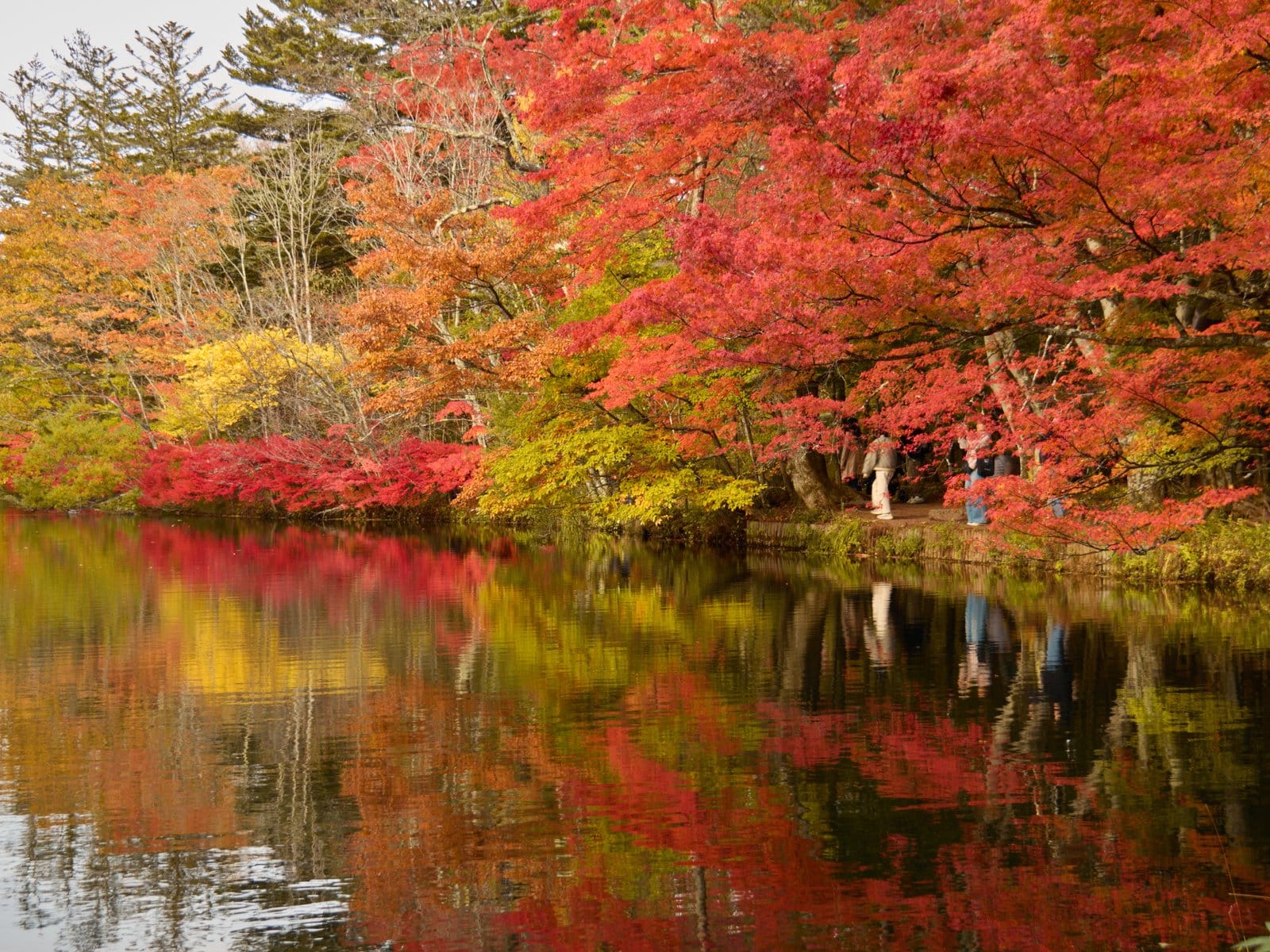
This is Karuizawa’s number-one foliage-viewing spot—and also its busiest. The calm lake reflects rows of red and golden trees, but it only looks its best when there is... no wind and no 500 people squeezing together. Arrive before 8 a.m.: the morning mist still lingers over the water, the slanting light filters through the foliage, and you’ll practically have the entire lake to yourself. Early morning is also when the surface is least rippled, making for much better reflections than at midday. If you can’t get up early, come back after 16:00—the rich golden afternoon light is well worth it too.
Shiraito Falls
This delicate, curtain-like waterfall is about 20–30 minutes from the center by bus and is a regular stop for tour groups. Tour buses usually drop off visitors between around 10:00 and 15:00. For a quieter visit, take the earliest bus of the day from Karuizawa Station (check the local bus company’s autumn timetable, as schedules change seasonally). Arrive before 9:30, and you’ll hear the sound of the water instead of tour-guide announcements.
Kyu-Karuizawa Ginza and Harunire Terrace
These two shopping and dining areas are busiest from 11:30 to 14:00, when all the day-trippers get hungry at the same time. My tip: eat at an off-peak hour, either before 11:00 or after 14:00. Harunire Terrace, beside the stream in the Hoshino area, is wonderfully relaxing early in the morning—many cafés open from 8–9, so you can have breakfast here and then walk along the stream toward the church area before the tour groups arrive.
Stone Church (Ishi no Kyokai) and Kogen Church
These two buildings are set in the forest of the Hoshino area and look their best when there are few people around. Keep in mind that the churches still hold actual weddings, especially on autumn weekends, and may temporarily close to general visitors without advance notice. That’s another reason to go on a weekday, preferably in the morning.
Kumoba after dark and late-afternoon cycling
After 16:00, when the crowds start heading back to the station, do the opposite: rent a bicycle and cruise through the tree-lined roads of the old villa district (Kyu-Karuizawa). The late-day sunlight filtering through the maple forest is the most beautiful moment of the day, and at that time the roads are almost entirely yours.
Less Crowded Alternatives That Are Still Easy on the Eyes
If you have to visit on a weekend or during a holiday, the best strategy is to leave the famous spots to the crowds and choose Plan B:
Sengataki Falls
In the same direction as Shiraito Falls but far less well-known, Sengataki Falls requires a 20–30-minute walk through the forest from the parking area—the walk itself "filters out" most visitors who aren’t keen on exercising. The trail follows a stream, and in autumn, fallen leaves turn the path golden. It has a kind of wild beauty that Shiraito doesn’t offer.
Kose Forest Road (Kose Rindo)
This trail runs from the Kyu-Karuizawa area up toward the mountains, with broadleaf forests changing color on both sides. Locals walk and jog here more often than tourists. There’s nothing particularly spectacular to "check in" at, but if you want the genuine feeling of walking through an autumn forest, this is the number-one choice—and it’s completely free.
Usui Pass and the Observatory
This spot offers panoramic views toward Mount Myogi. It’s busier around sunset, but still far more manageable than Kumoba. Taking a taxi or driving up is convenient; if you’re in good shape, you can hike up from Kyu-Karuizawa on a gentle trail, which takes about an hour.
One More Station: Komoro and Kaikoen Garden
From Karuizawa Station, the local Shinano Railway takes only about 25 minutes toward Komoro. Kaikoen Garden, built on the grounds of Komoro Castle, has brilliant red maple forests, yet attracts only a fraction of Karuizawa’s visitors. Admission is inexpensive (a few hundred yen, so check the official website), and you’ll experience a more "authentic" Nagano town with less tourism.
Naka-Karuizawa and Oiwake
Stay overnight in Naka-Karuizawa instead of near the main station: room rates are gentler, evenings are quiet, and in the morning you’ll be close to the Hoshino area, ready to "ambush" Harunire Terrace before everyone else. The Oiwake area is a little farther out and has cafés and secondhand bookshops tucked into the forest—the true Karuizawa of several decades ago.
Sample Budgets: 1 Day and 2 Days, 1 Night
A note before we begin: the figures below are estimates for one adult in autumn 2026, intended to give you a sense of the budget range. Train fares, room rates, and admission fees vary by date—always check the official websites before booking.
1-Day Option from Tokyo (Day Trip)
| Item | Details | Estimate |
|---|---|---|
| Train | Round-trip Tokyo–Karuizawa Shinkansen, unreserved seat | approximately 11,000–12,500 yen |
| Local transportation | Full-day bicycle rental or several bus rides | approximately 1,000–2,500 yen |
| Lunch | Restaurant in the Ginza area or Harunire Terrace | approximately 1,500–2,500 yen |
| Coffee and snacks | Bread, soft cream, coffee | approximately 800–1,500 yen |
| Admission fees | Most foliage-viewing spots are free; 1 museum if you like | approximately 0–1,500 yen |
| Total | approximately 15,000–20,000 yen |
One thing is immediately clear: the Shinkansen alone accounts for more than half the budget. That’s where you can make the biggest cuts, as I’ll explain below.
2-Day, 1-Night Option
| Item | Details | Estimate |
|---|---|---|
| Train | Round-trip Shinkansen | approximately 11,000–12,500 yen |
| Accommodation | Mid-range hotel/guesthouse, 1 weekday night | approximately 8,000–15,000 yen/person |
| Local transportation | Bicycle for 2 days + several bus rides | approximately 2,000–4,000 yen |
| Food and drinks | 2 lunches, 1 dinner, 1 breakfast, coffee | approximately 6,000–9,000 yen |
| Admission fees | 1–2 paid attractions | approximately 500–2,500 yen |
| Total | approximately 28,000–43,000 yen |
One important note: the room rates above are for weekdays. On a Saturday night or the night before an autumn-foliage holiday, the same room can cost one and a half to two times more. In other words, simply switching from Saturday night to Sunday night or a weekday can save you tens of thousands of yen—equivalent to the entire cost of two days of meals.
Truly Effective Ways to Cut Your Budget
1. Book train tickets early or switch to a highway bus
If you have an Ekinet account with JR East, advance-purchase Shinkansen tickets are often considerably cheaper than buying them at the ticket counter. Discounted tickets are limited, so book as early as possible. If your budget is really tight, highway buses from Tokyo/Ikebukuro to Karuizawa cost only about 2,000–3,000 yen one way—up to three-quarters cheaper than the Shinkansen—but take around 3 hours. For a 2-day, 1-night trip, taking the bus outbound (departing early) and the Shinkansen back is a pretty good balance between cost and time.
2. Sleep outside the peak: Sunday night, or stay in Komoro/Ueda
Besides avoiding Saturday nights, here’s another trick: towns along the Shinano Railway line, such as Komoro, or Ueda on the Shinkansen line, have noticeably cheaper business hotel rates than Karuizawa during peak season. Take the train back for 20–30 minutes the next morning and you’ll be there—saving money while still arriving before the crowds.
3. Eat Karuizawa-style without paying Karuizawa prices
Karuizawa is famous for bread, and the long-established bakeries here really are excellent. A picnic-style breakfast or lunch with bread from a bakery and a bottle of coffee, eaten in a park or beside a stream, is both inexpensive (under 1,000 yen) and more in keeping with the resort "mood" than squeezing into a restaurant during peak hours. It makes more sense to save your money for one proper dinner than to pay for two expensive lunches.
4. Prioritize free attractions—they’re often the most beautiful
In Karuizawa, nearly everything worth seeing in autumn is free: Kumoba-ike, Shiraito Falls (you only pay for the bus), Kose Forest Road, the old town, and the forest churches. Museums and paid gardens are extras—go only if you’re genuinely interested, not out of obligation.
5. Use a bicycle instead of taxis and individual bus rides
Central Karuizawa is fairly flat, and the main attractions are 2–4 km apart. Renting a bicycle for the whole day (approximately 1,000–2,000 yen depending on the type; electric-assist bikes cost more) is almost always cheaper than adding up multiple bus and taxi rides. It also gives you control over your schedule—essential when you want to "ambush" the hotspots early in the morning. Shiraito Falls is the one exception: it’s far away and uphill, so take the bus and save your energy.
6. Outlet shopping: beware of a "leaking wallet" at Prince Shopping Plaza
The outlet mall next to the station can make your budget disappear very quickly. If the purpose of your trip is autumn foliage, my advice is to leave the outlet for the end of the day, when you’re tired and your train is about to depart—you’ll naturally buy much less. If shopping is the real goal, though... that’s a topic for another blog post.
Sample One-Day "Avoid the Crowds" Itinerary During Peak Season
To make it easier to picture how everything fits together:
- 6:30 — Board an early Shinkansen from Tokyo (or stay overnight in Naka-Karuizawa/Komoro the day before).
- 7:45 — Arrive at Karuizawa Station, rent a bicycle, and ride straight to Kumoba-ike.
- 8:00–9:15 — Kumoba at its quietest, with morning mist and a glassy lake.
- 9:30 — Take the bus to Shiraito Falls, arriving before the tour buses.
- 11:00 — Return and have an early lunch at Harunire Terrace before the crowds arrive.
- 12:30–15:30 — The busiest hours: escape to Kose Forest Road or take the train to Komoro to visit Kaikoen Garden.
- 15:30–17:00 — Return and cycle through the old villa district in the afternoon sun, stopping by Kyu-Karuizawa Ginza as the street begins to quiet down.
- 17:30 — Board the train home, avoiding both the crowds and the feeling that your "vacation" was actually an endurance test.
Frequently Asked Questions
When is Karuizawa’s autumn foliage at its best?
The peak color usually arrives from the second half of October to early November, with higher mountain areas changing color first and the town center following later. The timing can vary by a full week from year to year depending on the weather, so check koyo forecasts on Japanese weather websites as your trip approaches.
Should I cancel my trip if I’m going on 3/11?
There’s no need to cancel, but change your strategy: reserve a Shinkansen seat in advance (don’t gamble on an unreserved seat), arrive very early, visit the famous spots before 9:30, and spend the late morning and early afternoon at alternatives such as Sengataki, Kose, or Komoro.
Is Karuizawa cold in autumn, and what should I wear?
It’s noticeably colder than Tokyo because it sits at an elevation of about 1,000 m. In the early morning in late October, temperatures can drop close to 0 degrees, then warm up at midday. Dress in layers: thermal underwear, a sweater, a windproof outer layer, and don’t forget thin gloves if you plan to cycle at 8 a.m.
What if I can’t get up early—is there another way to avoid the crowds?
Yes: go on a weekday, or explore in the late afternoon from after 15:30 until dark. Most day-trippers will have left, and if you stay overnight, Karuizawa is absolutely peaceful in the evening. Sunset at Usui Pass is the reward for late risers.
Do I need to rent a car in Karuizawa?
During the autumn foliage season, I’d recommend against it unless you’re traveling in a large group or combining Karuizawa with distant attractions such as Onioshidashi. On peak weekends, the roads around the center and the parking lots are gridlocked, and cycling can often be faster than driving. Train + bus + bicycle is all you need.
What’s the minimum budget for a 2-day, 1-night trip?
If you use all the tips—take a highway bus outbound, stay on a weekday in Naka-Karuizawa or Komoro, and mix bakery and konbini meals with one restaurant meal—you can keep the total to around 20,000–25,000 yen per person. That’s enough for the autumn foliage, plenty of beautiful photos, and most importantly, the leisurely feeling people come to Karuizawa to find.
More from this region — Chubu (Nagano, Kanazawa)
View all →
Karuizawa in Autumn Foliage: A Complete Guide to Nagano’s Highland Fall
14 min · tips
Autumn Leaves Onsen in Karuizawa: Soaking in a Forest Bath at Tombo-no-yu
17 min · tips
Kimono in Gifu: Where to Wear It, Best Photo Spots and How to Plan the Day
7 min · culture
Kimono in Nagano: Where to Wear It, Best Photo Spots and How to Plan the Day
7 min · culture