
Two Days and One Night in Nagano in Autumn: The Alps Loop or the Northern Loop
Hour-by-hour timings for two autumn routes — Matsumoto and Kamikochi, or Zenkoji, Obuse and the snow monkeys. Where to sleep and why not the obvious town, rough costs, what to book first, and the honest downside of each.
Aug 14, 2026·✍️ olablog·⏱ 15 min read
Hour-by-hour timings for two autumn routes — Matsumoto and Kamikochi, or Zenkoji, Obuse and the snow monkeys. Where to sleep and why not the obvious town, rough costs, what to book first, and the honest downside of each.
Tap a region to browse articles
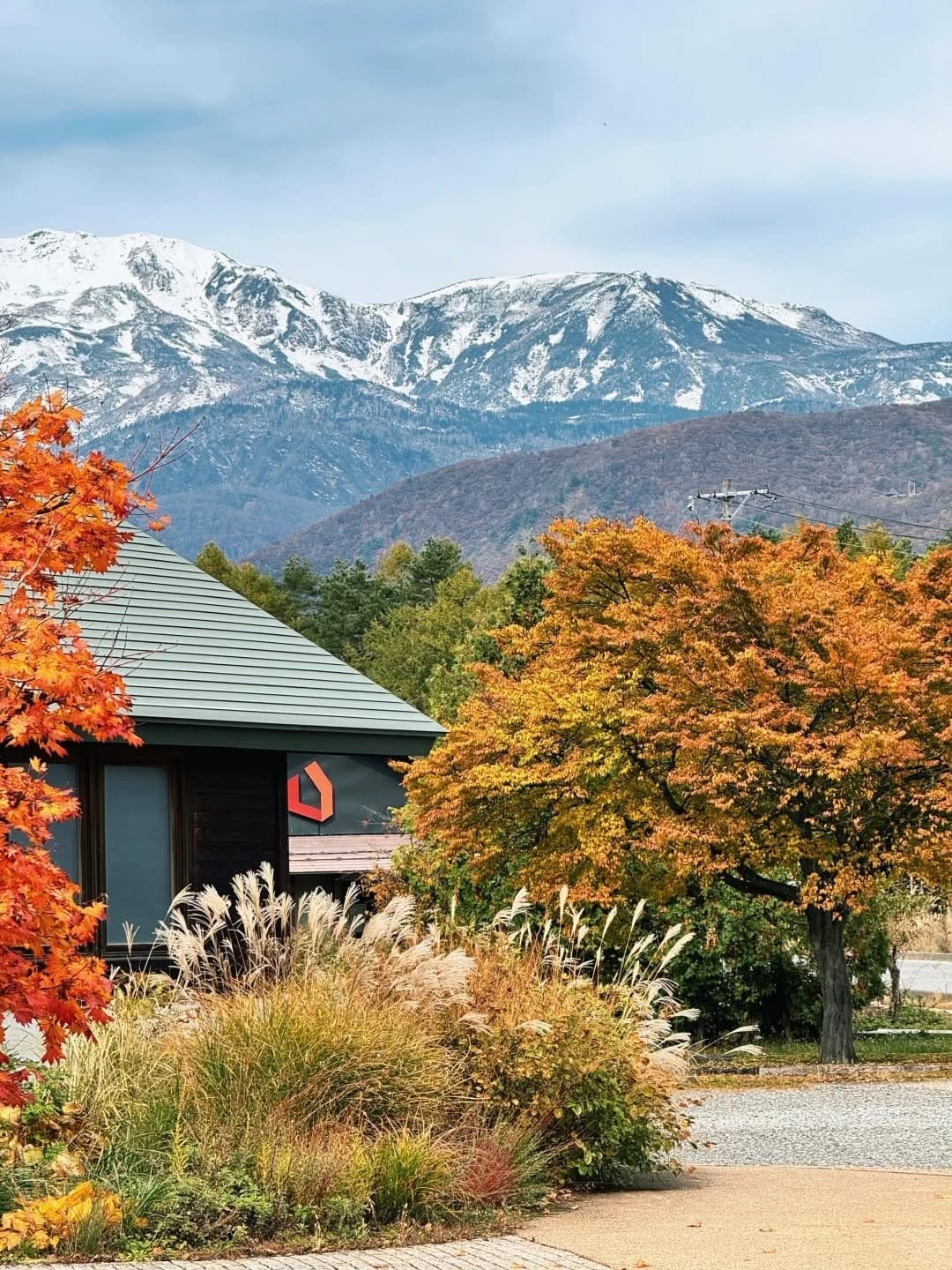
You have seen the photographs: a pond flat as poured glass holding a ridge with the season's first snow on it, mist lifting off a river, larch forest gone gold. Then you go, and come home with grey crowded frames and a mountain lost in cloud, and decide the weather was against you.
Most of the time the weather was fine. You arrived about three hours late.
That is the argument of this article: the second day of a Nagano trip is not a bonus, it is the only mechanism that puts you at 1,500 metres at eight in the morning instead of eleven. The gap between those two clock readings is the gap between the photos you saw and the photos you get. Not the camera, not luck, not whether the foliage is good. The clock.
There is a one-day version for people who only have one day, and it works. But two days and one night is the length this prefecture deserves — not because you see twice as many places, but because you buy a morning.
What the second day actually buys
Nagano's two best autumn destinations funnel visitors into a narrow window. Kamikochi bans private cars, so everyone arrives by bus from outlying car parks: the first wave lands around 8am, it peaks at midday, it drains before late afternoon. Jigokudani monkey park keeps office hours and sits a thirty-minute forest walk from the nearest bus stop, so a day-tripper out of Tokyo cannot be there before noon.
Sleep in the region and you own both ends of the day. A mirror-flat pond is a product of still dawn air; by midday the wind breaks the surface and the same view hands you a different picture. There is a less romantic argument too: two mornings is two rolls of the weather dice, and the morning after a wet afternoon is often the best of the trip. The general autumn guide to Nagano covers how colour moves down the mountain.
Route A — The Alps loop: Matsumoto and Kamikochi
Day one is towns and culture: no alarm, no fitness required. Day two is the mountain, and everything on day one exists to serve it.
Day 1, 08:00–17:30 — Tokyo, Matsumoto, and into the mountains
The Azusa limited express runs direct from Shinjuku in two and a half to three hours; the highway bus takes about three and a half and costs roughly half, but must be reserved and sells out on autumn weekends. Leaving Shinjuku around eight puts you in Matsumoto before eleven. Lock the suitcase away on arrival — today is walking, tomorrow is a mountain bus.
Matsumoto Castle is fifteen minutes from the station, one of Japan's few surviving original wooden keeps, black against its moat with the Northern Alps behind on a clear day. Admission around 700 yen, six floors of very steep stairs, easy-off shoes mandatory. Then walk Nakamachi, the white-walled storehouse street, and Nawate along the canal, and eat there: from late October look for 新そば, shin-soba, milled from the new buckwheat harvest.
Mid-afternoon, take the local line half an hour to Shin-Shimashima, where the mountain buses start. This transfer is where the trip is won or lost.
Night 1 — Hirayu Onsen, not Matsumoto
Matsumoto is the obvious answer: hotels, fair prices, real restaurants. The problem is the next morning. Reaching Kamikochi from there means the first local train, a bus change and about two hours — if it all connects you step off alongside the day-trippers, and if one link slips you lose the morning. You pay for a hotel and still get the day-tripper's trip.
Hirayu Onsen, over the pass on the Gifu side, is the one to book: a real hot-spring town with a big bus terminal, lodgings across the price range, and a ride into Kamikochi of only twenty-five to thirty minutes on buses that start well before sunrise. Norikura Kogen and the pensions around Sawando are the Nagano-side alternatives — Sawando cheaper, Norikura prettier but needing a connection, so check the timetable before booking the room rather than after. Budget roughly 12,000–18,000 yen per person for a small inn with two meals, and take the dinner plan, because these towns have no late food. To compare sleeping inside the valley, the Kamikochi accommodation breakdown goes lodge by lodge.
Day 2, 05:30–12:00 — The first bus in, and the riverside walk
This is the part you paid for. Many inns will do an early breakfast or a rice-ball packet if you ask the night before; they are used to hikers. Dress warmer than you think — a late-October dawn at 1,500 metres can be near freezing while midday is still t-shirt weather.
Two things must be checked on the official site, since either can wreck the plan: Kamikochi closes seasonally, with most facilities running roughly mid-April to mid-November and exact dates varying, and private cars are banned outright, so a rental has to be left at an outlying car park.
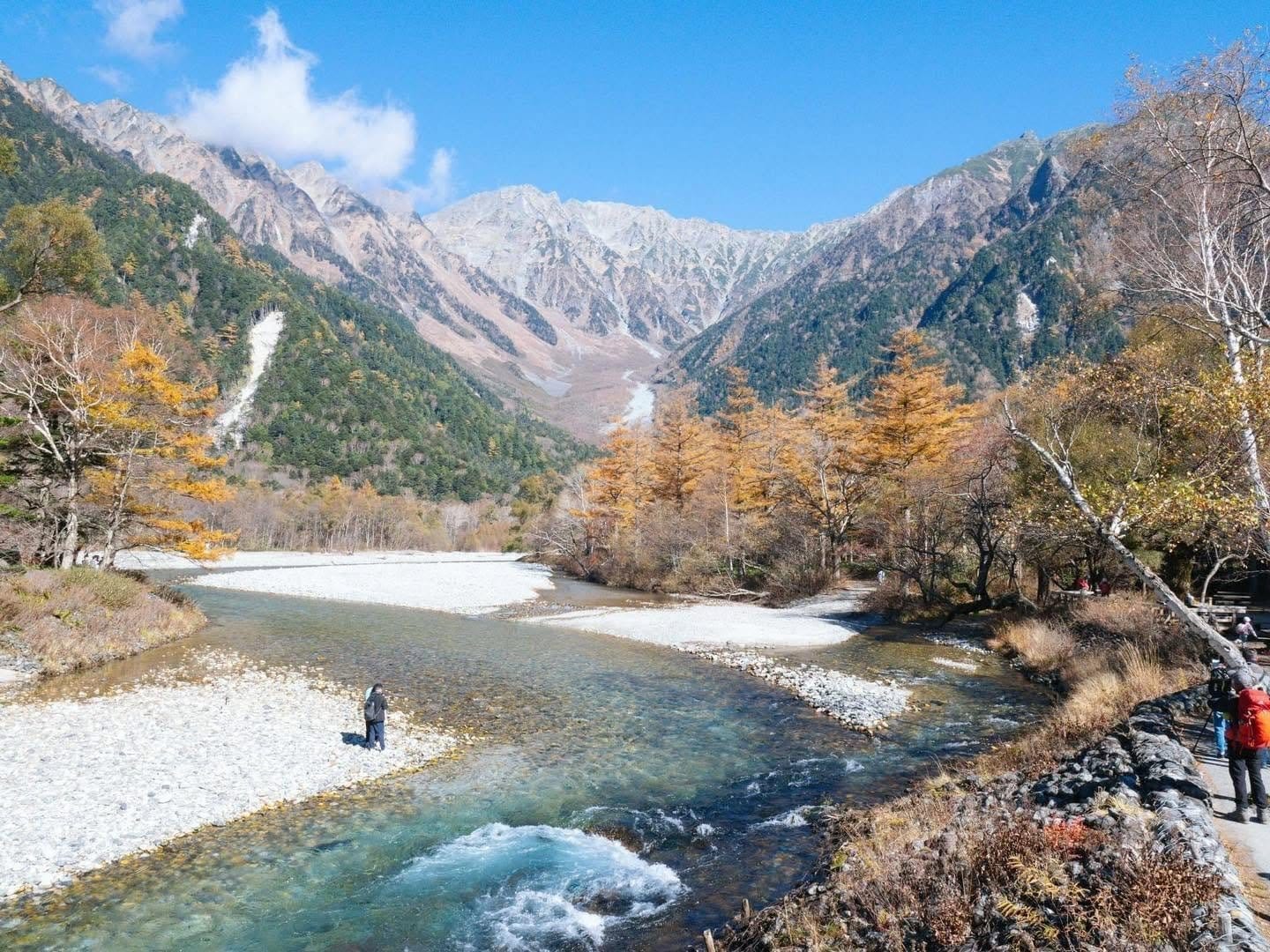
From the terminal it is a few minutes to Kappa Bridge, and at this hour the valley is more or less yours. Walk upstream toward Myojin, an hour each way on the flat, gold larch on both banks and the Azusa clear enough to read the riverbed through; Myojin Pond sits inside Hotaka Okumiya shrine, charges a few hundred yen, and is still enough to reflect almost perfectly. If mist is your priority, go downstream to Taisho Pond instead. Pick one — trying both makes you rush, and rushing kills this morning. Leave before midday while the bus queue is short, lunch late in Matsumoto, and be back in Tokyo by early evening.
Costs, the Hakuba extension, and the honest downside
Estimates for budgeting, not quoted fares: Azusa return around 13,000–15,000 yen (highway bus 7,000–9,000), Matsumoto to Hirayu around 3,000–4,000 each way, the Kamikochi bus about 2,000 return, the room 12,000–20,000 with meals, food 4,000–6,000. Call it 40,000–55,000 yen per person from Tokyo.
With an extra night, do not stay longer in the valley — it has already given you its best hour. Take the Ōito line from Matsumoto up to Hakuba instead and ride the Happo-one gondola at first light: the same principle applied twice, laid out in the Hakuba two-day itinerary.
The downside is real. This route has the most connections in the article, each on its own sparse timetable; the weather can erase the payoff, and the morning you got up at five for may be a white-out; and the season is short, since from late November Kamikochi is likely closed and this route does not exist at all.
Route B — North Nagano: Zenkoji, Obuse and the snow monkeys
Less mountain, more culture and hot water, far less season-dependent, much easier to move around. If you are with parents or small children, or would rather not set a 5am alarm, this is your route.
Day 1, 08:00–16:00 — Nagano city, Zenkoji, Obuse
The Hokuriku Shinkansen reaches Nagano in eighty minutes to just under two hours with no changes, so you arrive before ten without an early start.
Zenkoji is fifteen minutes from the station: over 1,300 years old, belonging to no single sect, one of Japan's great pilgrimage sites. Do not skip the kaidan meguri, the pitch-dark passage under the main hall where you feel along the wall for a metal key — it sounds gimmicky, it is the most memorable thing here, and it is dark enough that you cannot see your own hand. Eat on the Nakamise approach street, lined with soba and miso shops.
Then Nagano Dentetsu half an hour to Obuse, known for chestnuts and for Hokusai, who spent his last years here; the Hokusai-kan holds the festival-float ceiling panels he painted. Kuri-kanoko and kuri-okowa are in season, and the old confectioners often sell out by early afternoon.
Night 1 — Shibu Onsen, not Nagano city
Stay on the line to the terminus at Yudanaka. Once again the obvious choice is wrong: Nagano city has cheap hotels beside the shinkansen, and it also puts you ninety minutes from the monkey park in the morning, arriving with the first coaches.
Shibu Onsen is the pick — one of the best-preserved onsen townscapes in the country, narrow stone lanes, tall wooden inns, the clatter of geta all evening. Its distinguishing feature is a set of nine public bathhouses; guests at the village inns get a key opening all nine, and working through them in a yukata is the evening's entertainment rather than a chore. The bus stop for the monkeys is fifteen minutes away. Yudanaka Onsen, beside the station, is easier with luggage and slightly cheaper, but the streets have none of the atmosphere. Expect roughly 15,000–30,000 yen per person with two meals — the biggest line in this budget and the one most worth paying.
Day 2, 07:30–15:30 — Monkeys early, then one thing, not two
Early bus to Kanbayashi Onsen, then a flat but unpaved forest trail of thirty to thirty-five minutes, damp and slick on an autumn morning, so grippy soles rather than smooth city shoes. Opening hours are fixed and shift by season; be at the gate as it opens and you get roughly forty minutes before the crowd.
Here is where honesty is owed. The famous image of a macaque chest-deep in a steaming pool with snow on its head is a winter photograph. In autumn it is not cold enough for the monkeys to bathe nearly as often. They are still there, still wild, still worth the walk — but if you came for that specific frame, this is not your season. In exchange the surrounding forest is far better than in winter, and nobody is queuing.
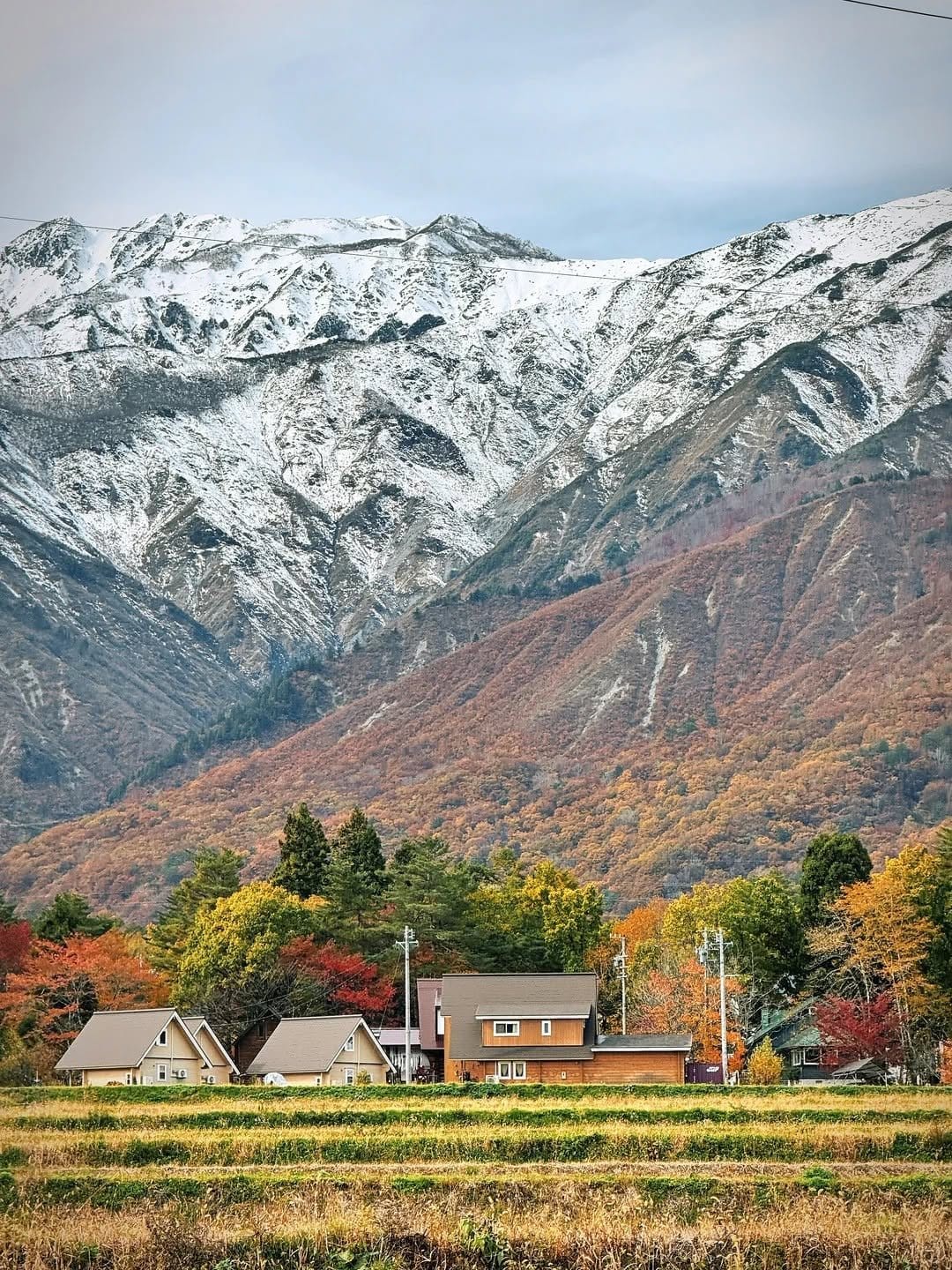
Then choose one. Shiga Kogen sits directly above the monkey valley, forty to seventy minutes further by bus: a plateau at roughly 1,500–2,000 metres scattered with ponds among birch and conifer, and being high, its colour arrives two to three weeks earlier than the valleys. Togakushi means backtracking to Nagano city and a bus about an hour up, for the avenue of ancient cedars leading to Okusha shrine and soba that Japanese connoisseurs rank at the very top — but around two and a half hours of travel, which makes day two tight. Short version: early autumn, Shiga Kogen; late autumn, when the high ground is bare, Togakushi. Then a bento at Nagano station and under two hours home.
Costs and the honest downside
Shinkansen return around 16,000–18,000 yen, regional trains and buses around 4,000–6,000 total, park entry around 800 yen, the Shibu room 15,000–30,000 with meals, incidentals around 5,000. Roughly 40,000–60,000 yen per person, almost entirely dependent on the inn. Combination passes covering rail, bus and park entry exist — ask at the counter in Nagano station before buying singles, since they are not always cheaper but asking costs nothing.
The downside: nothing here matches Kamikochi for mountain scenery. Shiga Kogen is gentle and lovely, forest and ponds; it does not hand you a three-thousand-metre rock wall over a clear river, and if the Alps are what pulled you to Nagano this route will leave you short-changed. The monkeys do not look like the photographs. And Shibu is expensive, because the inns that kept the atmosphere are small.
What to book, and in what order
- Rooms, first and far ahead. Ryokan in Shibu and inns in Hirayu are typically full months out for weekends from mid-October into early November. This is the hard constraint on the trip: choose dates around available rooms, not rooms around your dates.
- Highway and express buses. Shinjuku services to Matsumoto and direct to Kamikochi need reservations and go quickly at peak. Local mountain buses usually cannot be reserved but run sparsely — screenshot the timetable.
- Train seats, once your times are fixed. Non-reserved cars exist, but standing two hours on a Sunday evening is a real outcome.
- Everything else — gondolas, museums, park entry — can be bought on the day.
The most valuable tip here: shift the trip to midweek. Tuesday to Thursday is easier to book, distinctly cheaper, and far emptier on the trails.
When a guided two-day coach makes more sense
I travel independently by default, so this is not a sales pitch. But the maths flips in three cases. When you want both Kamikochi and Hakuba in two days, because independently they are separated by a chain of connections long enough that most of day two goes to sitting on vehicles. When you are travelling solo, because Japanese inns price per person and often surcharge single occupancy, so an independent trip can approach the package price. And when the timetable is the thing you cannot face, which is a reasonable decision rather than a defeat. If one of those fits, the two-day Kamikochi–Hakuba autumn trip from Tokyo is the right shape to compare against; from the Nagoya side, a Kamikochi day hike removes the transfers without committing you to a night.
But check one thing before booking any two-day coach, and it goes to the heart of this article: ask what time the group leaves the hotel on the second morning. If the answer is nine o'clock, you are buying convenience rather than light, and you will be in the valley during exactly the window this article has spent its length telling you to avoid. Some operators handle this well and some do not; the question separates them, and there is nothing rude about asking it.
Packing, and a note on altitude
The commonest mistake is dressing for the forecast in Nagano city or Matsumoto. Both are low. Kamikochi is around 1,500 metres and Shiga Kogen 1,500–2,000, easily seven or eight degrees colder, with a far wider day-to-night swing.
- Three layers, non-negotiable: base layer, fleece or light down, windproof shell. At midday you shed two; at 6am you wear all three.
- Thin gloves and a wool hat, which sound excessive for October until you are holding a camera by a river at first light.
- Grippy shoes, because both trails are easy but both have wet boardwalk and slick earth in the morning.
- Cash, since small inns, family soba shops, local buses and most bathhouses still prefer it and foreign-card ATMs are thin up here.
- A power bank and offline maps, because cold drains batteries and signal disappears along the trails.
At these altitudes a healthy adult will not get altitude sickness in any medical sense, but you will get out of breath faster than at home, dehydrate without feeling thirsty, and burn in stronger sun despite the cold. Walk slower than feels necessary for the first half hour, drink on a schedule rather than on thirst, and wear sunscreen. And there are bears in these mountains — the main trails are busy enough to be low-risk, but if you branch onto a quiet route or set out before anyone else, carry a bell or walk with someone.
FAQ
Is two days really that much better than a day trip?
Yes, by more than the ratio of hours suggests. A day trip gives you five or six usable hours, all inside the busiest window with the worst light. Two days gives you roughly fourteen, including one early morning a day-tripper cannot buy at any price.
Route A or Route B for a first visit?
Route A if you came for mountains and can walk continuously for an hour. Route B if you are with parents or young children, dislike early starts, or want more onsen and culture. Route B is also the only option from late November, once Kamikochi closes for the season.
When in autumn should I go?
High ground turns first, around early to mid-October. Kamikochi and the Hakuba valley are usually best from the second half of October into early November, and towns like Obuse and Matsumoto come last. Peak shifts by a week or more between years, so check the official foliage reports about a week ahead.
Do I need a rental car?
For Route A it is close to useless: private cars are banned from Kamikochi, so you would drive to an outlying car park and take the bus anyway. For Route B a car helps with scattered sights around Togakushi, but trains and buses cover this itinerary comfortably.
Can I just sleep cheaply in Matsumoto or Nagano city?
You can, and you will genuinely save money. Be clear about the trade: it is precisely the early morning that is the entire reason to stay overnight. If the budget forces that choice, do the one-day version instead and save the difference.
What if the weather is bad?
Change the script rather than cancelling. Route A: skip the valley and give day two to Matsumoto, or soak at Hirayu all morning. Route B: Zenkoji, the Hokusai museum and Shibu's nine bathhouses are nearly weather-proof, and an onsen town in the rain is better, not worse. And keep hoping for the morning, because mist rising after a wet night is the best thing many people ever see up here.
More from this region — Chubu (Nagano, Kanazawa)
View all →
Nagano in Autumn: Beating the Crowds and Controlling the Cost
11 min · tips
Autumn in Nagano: the foliage here is an altitude ladder, not a date
11 min · tips
Nagano's Onsen in Autumn: Which Cluster to Choose, and How to Use Them
11 min · tips
Nagoya — Comprehensive Travel Guide to Japan's Fourth-Largest City
8 min · destinations