Enjoying Japan's Fireworks and Festivals in Summer Yukata
Why yukata is the summer outfit, how a yukata rental works in Tokyo and Kyoto, what it costs, how to wear it to a fireworks night or a festival, and the small habits — the fan, the short steps, the hem on the stairs — that make the evening comfortable.
May 4, 2026·✍️ olablog·⏱ 6 min read
Why yukata is the summer outfit, how a yukata rental works in Tokyo and Kyoto, what it costs, how to wear it to a fireworks night or a festival, and the small habits — the fan, the short steps, the hem on the stairs — that make the evening comfortable.
Japan's summer has a uniform. From the first fireworks of July to the last Bon dance of August, the evening crowds along the rivers and around the shrine stalls are full of cotton yukata — indigo and white, morning glories and goldfish, paper fans tucked into the obi at the back. For a visitor it is the easiest and cheapest way to step inside a Japanese season rather than watch it from the pavement, and it needs nothing more than a rental slot in the afternoon and a plan for the evening. This guide covers what a yukata is, how the rental works, what to do with it once you have it on, and the handful of habits that separate a comfortable festival night from an uncomfortable one.
What a yukata is, and why it is the summer garment
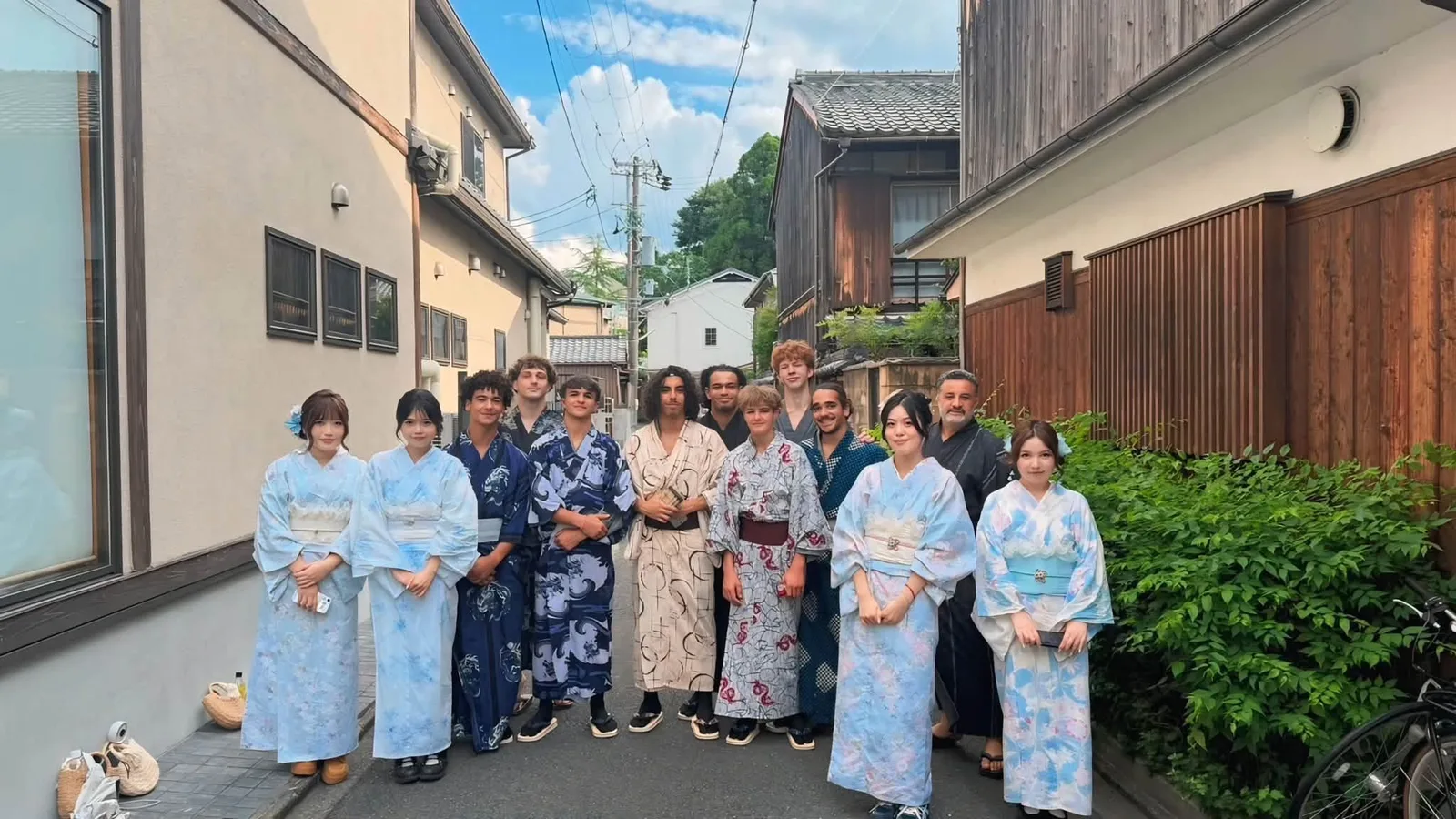
A yukata is a kimono reduced to its essentials: one layer of cotton, worn without the under-robe, closed with a soft, narrow obi, and finished with wooden geta on bare feet. The word comes from the bathrobe worn at hot springs, and the design keeps that logic — light, quick to put on, easy to move and sit in. In heat and humidity a lined silk kimono is a trial; a yukata is simply summer clothes. That is why, from June to September, it is the garment Japanese people choose for the evening events of the season and the one a rental shop will steer you towards.
The patterns are the season too: fireworks, goldfish, water, morning glories, hydrangeas, dragonflies on cool blues, whites and greens. Men's yukata are darker and plainer — indigo, charcoal, stripes and lattices.
How the rental works and what it costs
Yukata are the least expensive plans on the rack. At OlaChill — the same prices at Tokyo Asakusa and Kyoto Kiyomizu, tax and accessories included — a men's yukata is ¥4,000, a women's ¥4,500, and children's ¥3,000 (boy) and ¥4,000 (girl). The plan includes the obi, geta and a drawstring bag; the staff dress you in about twenty minutes, which is faster than a kimono because there are fewer layers. Hair styling is ¥1,500 extra and, on a hot evening, worth every yen: hair off the neck is cooler and shows the back of the collar, which is the yukata's most elegant line.
Both shops open at 09:00 and close at 18:00, and the outfit is normally returned before closing. For a fireworks night that is the wrong way round — the display starts after dark — so add a next-day return (¥1,100), which lets you keep the yukata until 10:00 the following morning, or a hotel return (¥1,100), where the outfit is collected from your hotel. Book on the Asakusa or Kiyomizu product page: plan, date and time, details, payment, with 10% off for paying online.
Where to wear it
- Fireworks (hanabi). Every large city has at least one summer display, and the great river festivals — the Sumida River in Tokyo at the end of July, the displays along the Kamo and Uji rivers around Kyoto in August — are the classic yukata evenings. Arrive two hours early with a mat to sit on; the embankments fill completely.
- Shrine and temple festivals (matsuri). Lanterns, food stalls, goldfish-scooping, drums, sometimes a procession or a dance. Kyoto's Gion Festival in July and the Bon dances of August are the biggest, but the small neighbourhood festivals are the ones where a yukata feels most natural.
- An evening walk. Asakusa after the stalls close, with the temple lit, or Gion as the lanterns come on, is reason enough. Yukata was made for exactly this — an unhurried walk on a warm night with something cold to drink at the end.
Wearing it well
- Left over right. The shop wraps it correctly; do not reverse it when adjusting yourself. The other way round is for the dead.
- Short steps, toes slightly in. Geta have no grip; small steps are balance, not just manners.
- Hold the hem on stairs. Lift the front panel a few centimetres with one hand going up and down steps so the cotton does not catch under a foot.
- Sit on the front of the seat, at a café or on the train, so the obi knot at the back stays neat.
- Keep the fan. A round uchiwa fan tucked into the back of the obi is the correct accessory and the most useful one you will carry all night.
- Eat with care. Festival food is sauce and skewers; hold it away from the sleeves and use the paper. Light marks are normal and cleaned after every rental; heavy stains can carry a fee.
- Do not take off the obi to cool down. Everything is tied to it. If the heat is too much, find shade and use the fan, or step into a shop.
A summer evening, planned
Dress in the late afternoon — a 16:00 slot at either shop leaves time for hair and a slow start. Walk the district while the light is still good and the crowd is at its thinnest: Asakusa's side streets and the river, or Kyoto's lanes below Kiyomizu and Yasaka Shrine. Eat early at a stall or a small restaurant, then take your place on the embankment or at the festival an hour before the main event. Afterwards, walk back through the emptying streets; the next-day return means nobody is watching the clock. Return the outfit in the morning on your way to the station.
For a comparison of yukata with the lined kimono of the other seasons, see kimono versus yukata; for what to wear in each season and where to photograph it, the best season for kimono.
What's included, price, where, how to book
- Included: yukata, obi, geta and drawstring bag; dressing by staff; free locker; umbrella loan. Tax included.
- Price: ¥4,000 (men) · ¥4,500 (women) · ¥3,000 (boy) · ¥4,000 (girl). Hair styling ¥1,500. Next-day return or hotel return ¥1,100 — essential for a fireworks night. Online payment 10% off.
- Where: OlaChill Tokyo Asakusa (Taito-ku, Kaminarimon 2-3-7, 4F) · OlaChill Kyoto Kiyomizu (Higashiyama-ku, Kiyomizu 4-190-3, B1F). Both 09:00–18:00.
- How to book: plan → date and time → details → payment on the product page; add next-day return at the options step. Free cancellation up to two days before.
Book a summer evening: OlaChill Tokyo Asakusa · OlaChill Kyoto Kiyomizu. Tick next-day return if the fireworks start after dark.
🎆 Make a trip of it — tours near the fireworks
Day tours departing from the nearest city — tour by day, fireworks by night.
 Day tour
 Day tour
 Day tour
 Day tour