
Chasing Kyoto’s Autumn Leaves: No Crowds, No Empty Wallet
Tips on choosing the 6–8 a.m. time slot and weekdays, three lesser-known temples, a three-tier budget guide, and booking deadlines for accommodation and flights for a November trip.
Aug 12, 2026·✍️ olablog·⏱ 17 min read
Tips on choosing the 6–8 a.m. time slot and weekdays, three lesser-known temples, a three-tier budget guide, and booking deadlines for accommodation and flights for a November trip.
Tap a region to browse articles
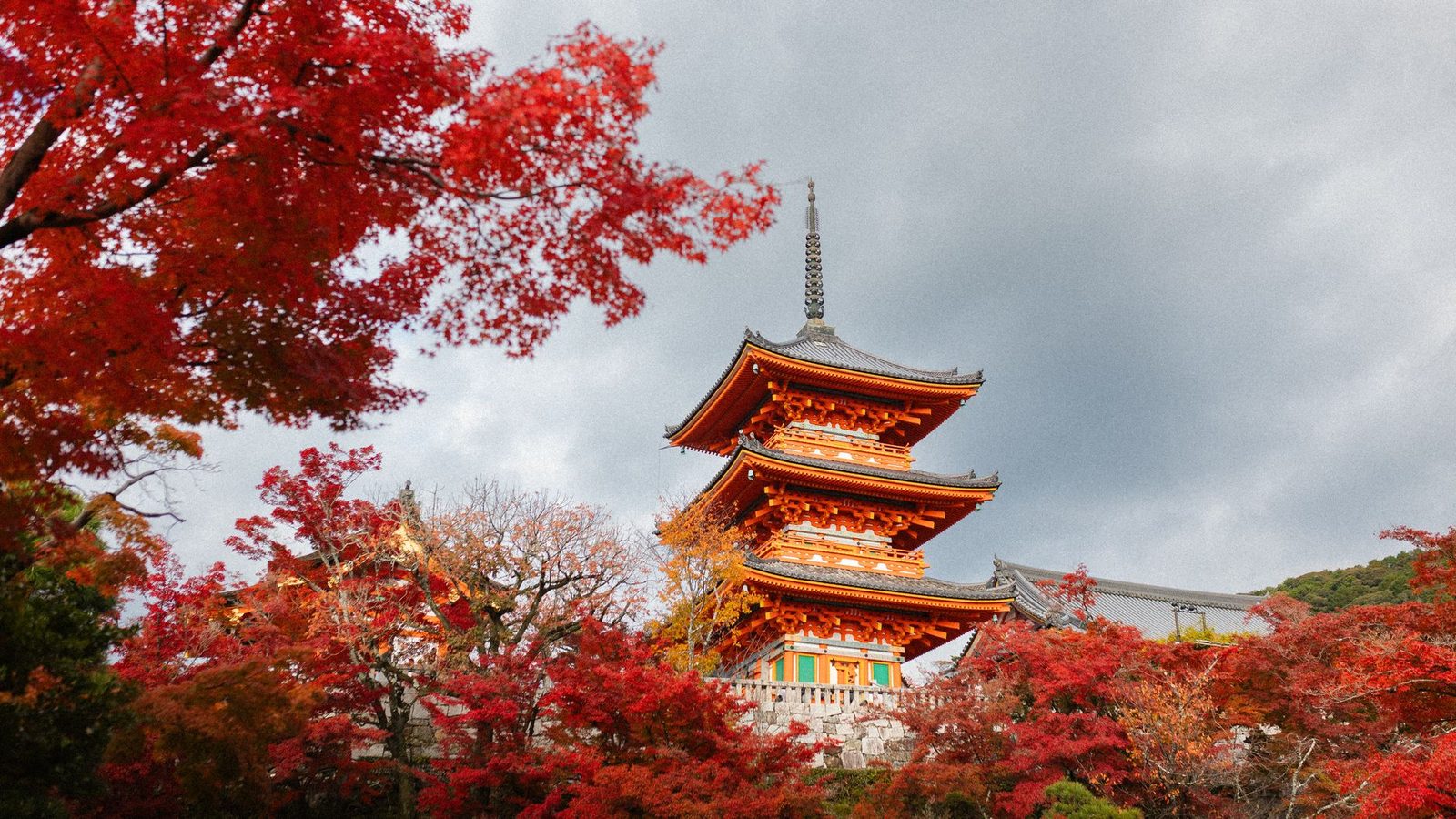
If you’ve ever stood at Kiyomizu-dera on an afternoon in late November, you’ll understand why people joke that Kyoto’s autumn foliage comes in two colors: the red of the maple leaves and the black of... people’s heads. The slope of Sannenzaka leading up to the temple gets so crowded that you don’t walk so much as drift along with the flow of visitors. Even stopping to take one decent photo is a challenge. At the same time, open a hotel-booking app and you’ll find that an ordinary business hotel costing a few thousand yen a night is suddenly charging double or triple — and still selling out.
That’s the downside of one of Japan’s most beautiful seasons. Kyoto in autumn deserves every word of praise: thousand-year-old temple roofs immersed in blazing red foliage, the Philosopher’s Path strewn with golden leaves, and slanting sunlight filtering through bamboo groves. But the whole world knows about that beauty, and for roughly three peak weeks, this small ancient capital strains under a massive influx of visitors. Without a strategy, a dream trip can easily turn into an exhausting ordeal amid a sea of people, followed by a bill that hurts for months afterward.
The good news is that I’ve visited Kyoto in autumn many times, including the busiest years, and I’ve still enjoyed mornings almost entirely alone in temple courtyards carpeted with red leaves. The secret isn’t luck, but three things: choosing the right time, the right day, and the right places. This article brings together the complete strategy, along with a three-tier budget guide and a booking timeline for accommodation and flights, so you won’t be unfairly “picked clean” by the peak season.
Understanding Kyoto’s peak season: when it’s crowded and when it’s expensive
Kyoto’s maple leaves usually begin changing color in early November, reaching their peak between mid-November and early December, depending on the weather each year. This is also the “storm center” for both visitor numbers and prices. During these three weeks, Kyoto welcomes international tourists, domestic Japanese travelers (Japanese people are extremely fond of viewing autumn leaves, a practice called momijigari — maple-leaf hunting), and school groups on autumn field trips all at once.
Here are a few rules worth knowing:
- The weekends in mid-November are the absolute peak. Saturdays, Sundays, and public holidays (Japan’s Labor Thanksgiving Day falls on 23/11) combine to create days when famous spots such as Arashiyama, Kiyomizu-dera, and Tofukuji are practically overwhelmed.
- Room prices fluctuate by day, not by season. The same hotel may charge half as much for a Tuesday night in mid-November as it does for the Saturday night of that same week. This is your biggest opportunity to save.
- Early December is a little-known “back door.” The leaves in many places are still beautiful — in fact, fallen leaves carpeting the ground can feel even more poetic than leaves on the trees — while the crowds have thinned considerably and room prices are beginning to cool off.
Now that you understand the rhythm, let’s get into the specific strategies.
Strategy number 1: the golden hours of 6–8 a.m.
It may sound painful, but this is the most valuable tip in the entire article: in Kyoto during autumn, one early-morning hour is worth three in the afternoon. Most tourists — especially tour groups — start their day at 9–10 a.m. That means that from sunrise until around 8:30 a.m., Kyoto’s most famous sights are practically yours.
Where to go early in the morning?
Not every temple opens early, so choose the right places for this time slot:
- Kiyomizu-dera: the temple opens at around 6 a.m. (you should check the official website again before you go). Standing on the famous wooden stage and looking down over the red-leafed valley at 6:30 a.m., while the mist is still hanging in the air and only a handful of people are around, is a completely different experience from squeezing shoulder to shoulder with visitors at 2 p.m. Walk down through Sannenzaka and Ninenzaka while the shops are still closed, and you’ll see this historic neighborhood looking as quiet and beautiful as a film set.
- Fushimi Inari: open day and night, and free of charge. Arrive at 6–7 a.m. and you can photograph thousands of red torii gates without a single person appearing in the frame — something that is almost impossible after 9 a.m.
- Arashiyama Bamboo Grove: the bamboo path is a public thoroughfare with no opening or closing hours. Early in the morning, the angled sunlight through the bamboo and the absolute stillness are why every photographer tells everyone else to arrive before 8 a.m. Afterward, you can have breakfast around the station before visiting the nearby temples as soon as they open.
- The Philosopher’s Path (Tetsugaku no michi): a public pedestrian path along a canal, freely accessible at all times. Go early, when maple leaves float on the water and you may encounter only the occasional local walking their dog.
A small tip: most temples in Kyoto open between 8:30 and 9 a.m. A sensible strategy is to spend 6–8 a.m. at the early-opening or open-air spots above, then arrive at the gate of a major temple you want to explore in depth at 8:30–9 a.m., entering with the first wave of visitors.
Go to bed early to wake up early — and an unexpected reward
Going to bed at 9–10 p.m. in Kyoto isn’t difficult, since the city doesn’t have a nightlife culture like Osaka. In return, you get two things: a golden morning like the one described above, and a body that feels much less exhausted after walking 15–20 thousand steps a day — a perfectly normal figure in Kyoto during autumn. If you want an evening experience, choose nights when temples illuminate their autumn leaves (light-up events): they’re still crowded, but seeing maple leaves glowing against a black sky is worth braving the crowds once. In recent years, some temples have sold timed-entry tickets or advance online tickets for light-up nights, so check ahead to avoid a long wait.
Strategy number 2: choose weekdays and avoid weekends at all costs
If your schedule allows, arrange all your days in Kyoto from Monday to Thursday. The difference is far from minor: visitor numbers at the same attraction may be half as high, or even lower, on weekdays than on weekends, because the domestic Japanese crowds taking weekend trips have largely disappeared.
Here’s how I usually arrange a week-long Kansai trip: arrive in Japan on the weekend, but spend Saturday and Sunday in Osaka or Nara, Uji, and Kobe — places that are either naturally busy year-round, so the difference is less noticeable, or much less popular with autumn-leaf hunters. Then launch your “full-scale Kyoto campaign” on Monday and stay through Thursday. You avoid both the visitor peak and the accommodation price peak — remember that a Saturday night in Kyoto during this season can cost one and a half to twice as much as a midweek night.
You should also check Japan’s public-holiday calendar for November in advance: a holiday falling on a Monday or Friday creates a three-day weekend, and those three days can be just as crowded as a regular weekend.
Strategy number 3: three quieter alternatives with foliage just as beautiful
This is the part I’m most passionate about. Kyoto has hundreds of temples, and the truth is that many of them have foliage just as beautiful as the “stars,” but are far quieter because they aren’t included in standard tour itineraries. These are three places I always recommend to friends.
Komyo-ji — a maple tunnel in Nagaokakyo
Komyo-ji is in Nagaokakyo City, southwest of Kyoto. It takes about 10–15 minutes by train from Kyoto Station, followed by a short bus or taxi ride. The temple is well known among Japanese autumn-leaf enthusiasts for momiji sando — a stone-paved path leading down to the temple gate, where two rows of mature maple trees meet overhead to form a literal red-orange tunnel. Late in the season, when fallen leaves cover the stone path, the scene becomes even more surreal.
Admission is normally free, but during the autumn foliage season there is an entrance fee (a few hundred to under one thousand yen; check the temple’s official website again). In return, most visitors are older Japanese people strolling at a relaxed pace, with none of the selfie-stick scrum. Since it’s a little far from central Kyoto, set aside a full morning or afternoon for Komyo-ji and combine it with a walk around peaceful Nagaokakyo.
Bishamon-do — a red carpet of fallen leaves on stone steps in Yamashina
Bishamon-do is in Kyoto’s Yamashina Ward, just one JR train stop from Kyoto Station (about 5 minutes), followed by a roughly 20-minute walk along a gently uphill residential road. That walk serves as a natural filter, keeping tour groups away.
Bishamon-do’s most photogenic feature is the stone staircase leading to the temple gate, covered in a vivid carpet of fallen red maple leaves late in the season — an image you may have seen on Japanese tourism posters without knowing where it was taken. The best time for this leaf carpet is usually late November to early December, slightly later than the peak for leaves still on the trees — another reason to visit in early December to avoid the crowds. The temple grounds also contain a garden and several old halls worth seeing, and admission to the main hall area is reasonably priced.
Shinnyo-do — a blazing-red temple in the heart of the city that few people turn toward
Shinnyo-do (whose full name is Shinsho Gokuraku-ji) sits on a small hill in eastern Kyoto, near the Okazaki area and the Philosopher’s Path. That makes it very easy to add to an existing itinerary, yet most visitors simply walk past. Best of all: the temple grounds are free to enter; you only pay a fee (not a high one) if you want to visit the garden and interior halls.
The free grounds alone are impressive: an elegant three-story pagoda rising amid a forest of red maples, leaf-strewn paths, and a rare sense of quiet — at many times, the only sound you’ll hear is monks sweeping leaves. Right next door, the Kurodani temple complex (Konkai Komyo-ji) is similarly beautiful and uncrowded, and the two make a perfect autumn afternoon. A good itinerary pairing is: the Philosopher’s Path early in the morning, Eikando or Nanzenji mid-morning (crowded but worthwhile), then retreat to Shinnyo-do in the afternoon to “recover” in peace and quiet.
Budget guide: three price levels for one day in Kyoto during peak season
The figures below are estimates for one person, one day, excluding airfare, based on typical peak-season prices — everything, especially accommodation, is considerably more expensive than usual during this period. Exchange rates and actual prices change constantly, so use this as a guideline and adjust it for yourself.
| Item | Budget | Mid-range | Comfortable |
|---|---|---|---|
| Accommodation (per night) | Hostel, dormitory-style lodging: around 3.500–6.000 yen | Business hotel, 3-star: around 12.000–20.000 yen | Ryokan, boutique hotel: from around 30.000 yen |
| Food | Konbini, noodle shops, affordable teishoku: around 2.000–3.000 yen | Two decent restaurant meals and one light meal: around 4.000–7.000 yen | Including a kaiseki meal or a reservation-only restaurant: from around 10.000 yen |
| Transportation in Kyoto | One-day bus/subway pass: around 1.000 yen, give or take | Combination of trains and buses, with the occasional short taxi ride: around 1.500–2.500 yen | Taxis as needed or a private car: from several thousand yen |
| Admission fees | 1–2 paid temples, with the rest free: around 1.000–1.500 yen | 3–4 temples plus one light-up evening: around 2.000–3.500 yen | More freely, plus a tea ceremony and kimono rental: 5.000 yen or more |
| Estimated daily total | Around 8.000–12.000 yen | Around 20.000–33.000 yen | Around 50.000 yen or more |
A few notes to make this table work in real life:
- Accommodation is by far the most volatile expense. The same room can cost twice as much when booked 1 month out as when booked 5 months in advance. Everything else — food, temple admission, and transportation — barely changes with the season, so the entire budget battle comes down to booking your room early.
- Budget tip: consider staying in Osaka or Otsu (on Lake Biwa, only about 10 minutes by train from Kyoto) — rooms in both places are noticeably cheaper than in Kyoto during the autumn foliage season, though you’ll spend a little extra time and money commuting each day.
- Mid-range is the sweet spot for most Vietnamese travelers visiting Japan independently: stay in a clean business hotel near a station, enjoy one good meal a day, and eat casually for the rest — you won’t miss out on the experience, and your wallet won’t suffer too much.
- Don’t forget the little expenses: coffee, grilled mochi along the way, souvenirs... in practice, these often add another 1.000–3.000 yen per day, an amount few people budget for in advance.
Accommodation and airfare booking timeline: count back from the autumn leaves
For Kyoto’s peak season, the golden rule is: book accommodation first, flights second, and the details later. Here’s the timeline I recommend, counting back from a trip in mid- or late November:
5–6 months ahead (around May–June): finalize dates and secure accommodation
- Decide roughly when to travel. If you have to choose, prioritize the second half of November extending into early December, on weekdays.
- Book a room in Kyoto immediately with free cancellation. This is the key: you lock in a good price without losing anything if your plans change. Well-located, reasonably priced Kyoto hotels for peak-season weeks often begin selling out in summer; well-known ryokan sell out even earlier.
- If you’re traveling with a large group or want to stay at a ryokan, this deadline is even more important.
3–5 months ahead (around June–August): hunt for flights
- For flights from Vietnam to Kansai (Osaka), the general rule of thumb is that the most reasonable prices often appear around 3–5 months before departure; once November approaches, prices tend to do nothing but rise. Set fare alerts on flight-search tools and book when you see an acceptable price — don’t wait for the “bottom.”
- Flying directly to Kansai is the most convenient option for Kyoto; if a flight to Tokyo is significantly cheaper, remember to add the cost and travel time of the Shinkansen to Kyoto before comparing.
1–2 months ahead (around September–October): review accommodation and book experiences
- Check the price of the room you held: sometimes a better option appears, in which case book the new one and cancel the old one (since you chose a free-cancellation rate).
- Book anything that requires advance reservations: special restaurants, experience classes, kimono rentals, and tickets for light-up evenings if the temple sells them online in advance.
- Consider buying train tickets or transportation passes in advance if your itinerary is already clear.
1–2 weeks ahead: track the foliage forecast
- Japanese koyo forecast websites update leaf conditions for individual locations almost daily during the season. Use them to fine-tune the order of your itinerary: visit places at peak color first, and save lower-elevation spots (which usually turn red later) for the end of the trip.
- Print out or save your early-morning plans: getting up at 5:30 a.m. is much easier when you already know exactly where you’re going and how you’ll get there the night before.
A few final tips from someone who’s been there
- Send your luggage ahead and travel light. Luggage-delivery services between hotels and station lockers can save you from dragging suitcases up crowded stone slopes.
- Don’t try to see everything. During this season, 3–4 places a day is enough. Kyoto is at its best when you have time to sit on a temple veranda, sip tea, and watch the leaves fall — not when you’re racing through a list of 10 attractions.
- Wear comfortable shoes and bring a warm enough jacket: early mornings in Kyoto in November can be quite cold, with some days reaching only a few degrees C, while sunny afternoons are warm — dressing in layers is the smartest approach.
- Cash is still useful: many small temples and roadside eateries accept cash only, especially at lesser-known spots such as the three alternative temples above.
Kyoto in autumn is not as “hopeless” as many online complaints make it sound. Simply get up two hours earlier than the crowds, shift your schedule away from the weekends, be willing to turn into lesser-known temples, and book your accommodation half a year in advance — and you can enjoy the autumn foliage season you imagined, with costs under control. I hope you have quiet November mornings filled only with the sound of falling leaves and your own footsteps on stone.
Frequently asked questions
Which week of autumn is the “best” time to visit Kyoto?
The autumn foliage peak usually falls between mid-November and early December, but it varies with the weather each year. If avoiding crowds and getting better prices are your priorities, late November extending into the first week of December, on weekdays, is the best compromise: foliage is still beautiful in many places (especially the carpets of fallen leaves), the crowds are thinning, and room prices are easier to manage. As your trip approaches, follow koyo forecast websites and fine-tune your plans.
What if I can’t get up at 6 a.m.?
You can still make it work, but less effectively. Plan B is to visit at the end of the day: many temples become noticeably quieter during the hour before closing, and the evening light is beautiful. Plan C is to focus your itinerary on less famous places such as Komyo-ji, Bishamon-do, and Shinnyo-do — these remain comfortable even around midday. But if you want Kiyomizu-dera or the bamboo grove without crowds, early morning is almost the only way.
Is Kyoto during peak season still worth visiting on a tight budget?
Yes, because accommodation is the only truly expensive part — and you can deal with it by booking 5–6 months ahead or staying in Osaka or Otsu and taking the train in. Food, transportation, and temple admission in Kyoto do not rise with the season; many of the most beautiful spots (Fushimi Inari, the Philosopher’s Path, the bamboo grove, and the grounds of Shinnyo-do) are completely free. A budget of around 8.000–12.000 yen per day is feasible even in mid-November.
Do I need to buy temple tickets in advance?
Most Kyoto temples sell tickets at the gate, so advance booking isn’t necessary. Notable exceptions include some autumn foliage illumination nights (light-up events) and a few special sites that may use timed-entry or advance online tickets during peak season — policies change from year to year, so about one month before your trip, check the official websites of any temples you plan to visit in the evening.
Which airport should I fly to from Vietnam for Kyoto?
The most convenient option is Kansai Airport (KIX) in Osaka: from there, trains run directly to Kyoto Station in about 75–80 minutes. If a ticket to Tokyo is significantly cheaper, you can fly to Tokyo and take the Shinkansen to Kyoto (a little over 2 hours), but remember to add the train fare when comparing — the “cheap ticket” often turns out not to be cheap. Airfares and flight schedules change constantly, so check directly with the airline before booking.
More from this region — Kyoto, Nara & Kansai
View all →
Kyoto in Autumn: A Complete Seasonal Guide for Trips from October to December
15 min · tips
Kyoto’s Autumn Foliage Onsen: Kurama, Arashiyama, and Ohara
17 min · tips
Kyoto's Temples and Shrines
22 min · destinations
Planning a Trip to Japan from A–Z: Choosing the Season, Region, and Experiences
17 min · tips