Exploring Kanazawa's Higashi Chaya District in a Kimono
Why Kanazawa's teahouse district is one of the best kimono streets outside Kyoto, how it differs from Gion and Asakusa, what to choose by season, how to walk the lattice-fronted lanes, and where the quiet corners are.
May 4, 2026·✍️ olablog·⏱ 5 min read
Why Kanazawa's teahouse district is one of the best kimono streets outside Kyoto, how it differs from Gion and Asakusa, what to choose by season, how to walk the lattice-fronted lanes, and where the quiet corners are.
Tap a region to browse articles
Kanazawa is the city people go to when they want Kyoto without Kyoto's crowds, and its Higashi Chaya district is the reason. Two streets of former teahouses — ochaya, the geisha houses of the Edo period — stand almost exactly as they were built, with the fine red-brown lattice fronts called kimusuko running unbroken along the lane. It is a short district, a few hundred metres from end to end, and it is one of the best places in Japan to walk in a kimono: flat, quiet, wooden from ground to eave, and far less busy than Gion. This article explains what makes it different, how to choose an outfit for the season, and how to move through the lanes so that the experience is as calm as the setting.
How Higashi Chaya differs from Gion and Asakusa
Gion is Kyoto's geisha district and it is alive — teahouses still operate, maiko still pass in the evening, and the streets are busy with people hoping to see them. Asakusa is a temple town, loud and festive. Higashi Chaya is neither: it is a preserved district, quiet by day, where several of the old teahouses are now museums or shops selling gold leaf, and the atmosphere is closer to a painting than to a street scene. For photographs that means clean backgrounds, even light bouncing off the lattices, and the freedom to stand in the middle of the lane for a moment without blocking anyone. For the walk it means no slopes and no stairs — the district is on the flat beside the Asano River, and the wooden bridge over the river is the natural way in.
Choosing by season
Kanazawa's climate is wetter than Kyoto's and its winters are real, which shapes the choice:
- Spring. Cherry blossom along the Asano River and in Kenroku-en garden in early to mid-April; a lined kimono in soft colours is the classic pairing with the dark lattices.
- Summer. Hot and humid; a cotton yukata is the sensible garment, and the district's evening lanterns and the riverside are the places to wear it.
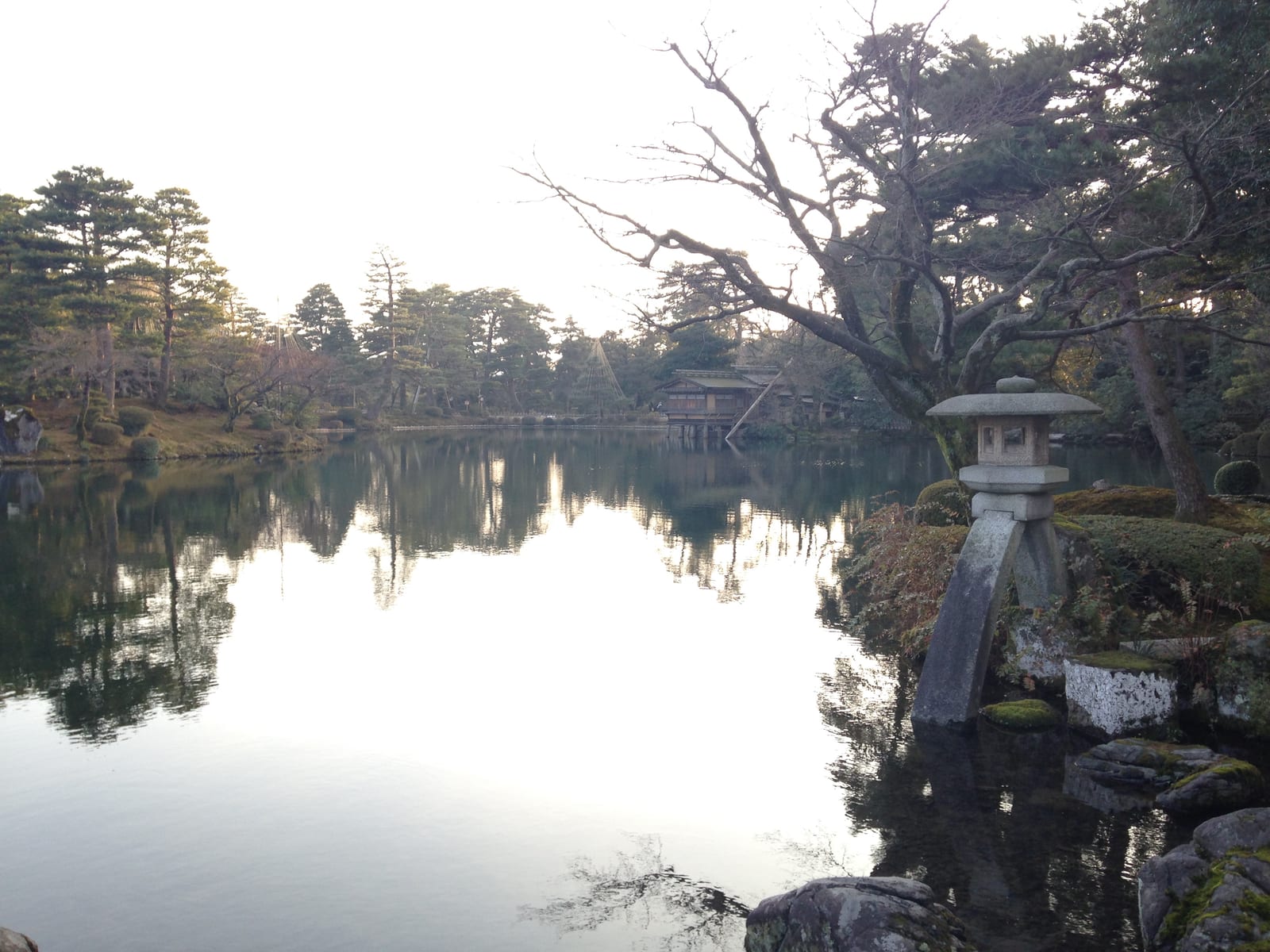
- Autumn. The maples in Kenroku-en turn in mid-to-late November, and the gardeners begin hanging the famous yukitsuri rope cones over the pines; deep reds and browns suit the season and the wood.
- Winter. Snow is likely from December, and Kenroku-en under snow with the yukitsuri in place is the city's signature view. Rental shops add a haori jacket and shawl; dark colours against white snow photograph beautifully, and the lanes are almost empty.
Whatever the season, Kanazawa is a city of rain. Ask the shop for an umbrella when you collect the outfit rather than when you need one.
Walking the lanes
The main street runs east from the river, with a small square partway along. Walk it slowly, from the square outwards, and give the side lanes as much time as the main one — they are narrower, quieter and lined with the same lattices, and the best portraits are taken there against a single wooden wall with nothing else in frame. In kimono, the etiquette is the practical kind: short steps with the toes turned slightly in, the hem lifted a few centimetres at the wooden threshold of any shop you enter, and shoes off inside the teahouses that are open to visitors. Stand to the side of the lane for photographs so that other people can pass; the district is small enough that a group standing in the middle is felt by everyone.
Two of the old teahouses can be visited — the interiors are red-walled, gold-leafed and dark, and were built for the evening; you will be asked to remove geta at the entrance. A cup of matcha and a gold-leaf sweet in one of the teahouse cafés is the traditional pause, and the low tables suit a kimono better than a chair does: kneel, sit back, and sweep the hem clear as you rise.
Beyond the district, Kenroku-en is a twenty-minute walk or a short bus ride and, in kimono, the garden's paths are gravel and gentle; the castle park next to it is open and free. The Nagamachi samurai quarter across the city has earthen walls and canals and is the other place in Kanazawa where the outfit looks entirely natural.
A note on renting in Kanazawa
Kanazawa has its own rental shops near the station and around the district, and the process is the same as anywhere in Japan — choose, be dressed by staff, walk, return before closing. If your trip also passes through Kyoto or Tokyo, the fuller range of plans at OlaChill Kyoto Kiyomizu and Tokyo Asakusa — fourteen plans from ¥3,000, tax and accessories included — is described in our Kyoto rental guide and our Asakusa guide; the etiquette and the way to walk in geta are identical in all three cities, and our kimono etiquette guide covers them in full.
Higashi Chaya rewards the same discipline as any kimono street: go early, walk slowly, look at the small things — the lattice shadows, the gold leaf in a shop window, the river at the end of the lane — and let the outfit set the pace.