
Hakuba Changes Color by the Week: A Leaf-Peeping Calendar from Summit to Valley
From late September, the leaves begin to turn at 1,900 meters before gradually drifting down toward the village: which weeks to take the gondola, which weeks to stay low, and how to check the forecast before you go.
Aug 12, 2026·✍️ olablog·⏱ 17 min read
From late September, the leaves begin to turn at 1,900 meters before gradually drifting down toward the village: which weeks to take the gondola, which weeks to stay low, and how to check the forecast before you go.
Tap a region to browse articles
There is a very particular kind of regret familiar to anyone chasing autumn leaves in the mountains: you book a room in August, aim for the best weekend in October, drive or take a four-hour train ride to get there—and then stand in the village looking up at a forest that is still brilliantly green. Or the opposite: you reach the highest gondola station and find only bare branches, the leaves having mostly fallen two weeks earlier. Both trips were during the “right season,” but at the wrong elevation.
Hakuba is where this kind of regret happens most often, because it is not a single leaf-viewing spot—it is a nearly 1,400-meter vertical column, stretching from the valley floor at around 700 meters up to gondola stations above 1,900 meters, with the nearly 3,000-meter Northern Alps as a backdrop. The leaves in Hakuba do not change color all at once. The colors move slowly and steadily from the top down, like a streak of color flowing down the mountain over six straight weeks. If you visit Hakuba in autumn without knowing what elevation that “streak of color” has reached that week, it is very easy to miss it.
This article is not about how beautiful Hakuba is in autumn—everyone already knows that. It is a week-by-week calendar: from late September to early November, where the colors are each week, when you should buy a gondola ticket to go high, when you should skip the gondola and walk around the village and lakes, plus how to check the foliage forecast before your trip so you do not have to guess.
Why Hakuba Changes Color by Elevation Rather Than by Date
The elevation rule: every 100 meters means a few days
Leaves change color when nighttime temperatures stay low enough for long enough—the benchmark often cited by Japan’s koyo watchers is when the daily minimum temperature falls to around below 8 degrees C, at which point the color change becomes noticeable. Once temperatures drop to around 5 degrees, the colors develop quickly and become more intense.
Temperature decreases with elevation. For every 100 meters you climb, the air temperature drops by roughly half a degree to slightly more than half a degree. That means the summit area around Tsugaike at about 1,900 meters is around 6–7 degrees colder than Hakuba village below 700 meters. Autumn arrives there around three to four weeks earlier than in the village below.
This is the number you need to remember. It is not “Hakuba is beautiful in mid-October.” It is: in mid-October, the best colors are usually around 1,000–1,500 meters, while above 1,900 meters the peak has already passed and below 700 meters it has not arrived yet.
The “three layers of color”—something only high mountain areas can offer
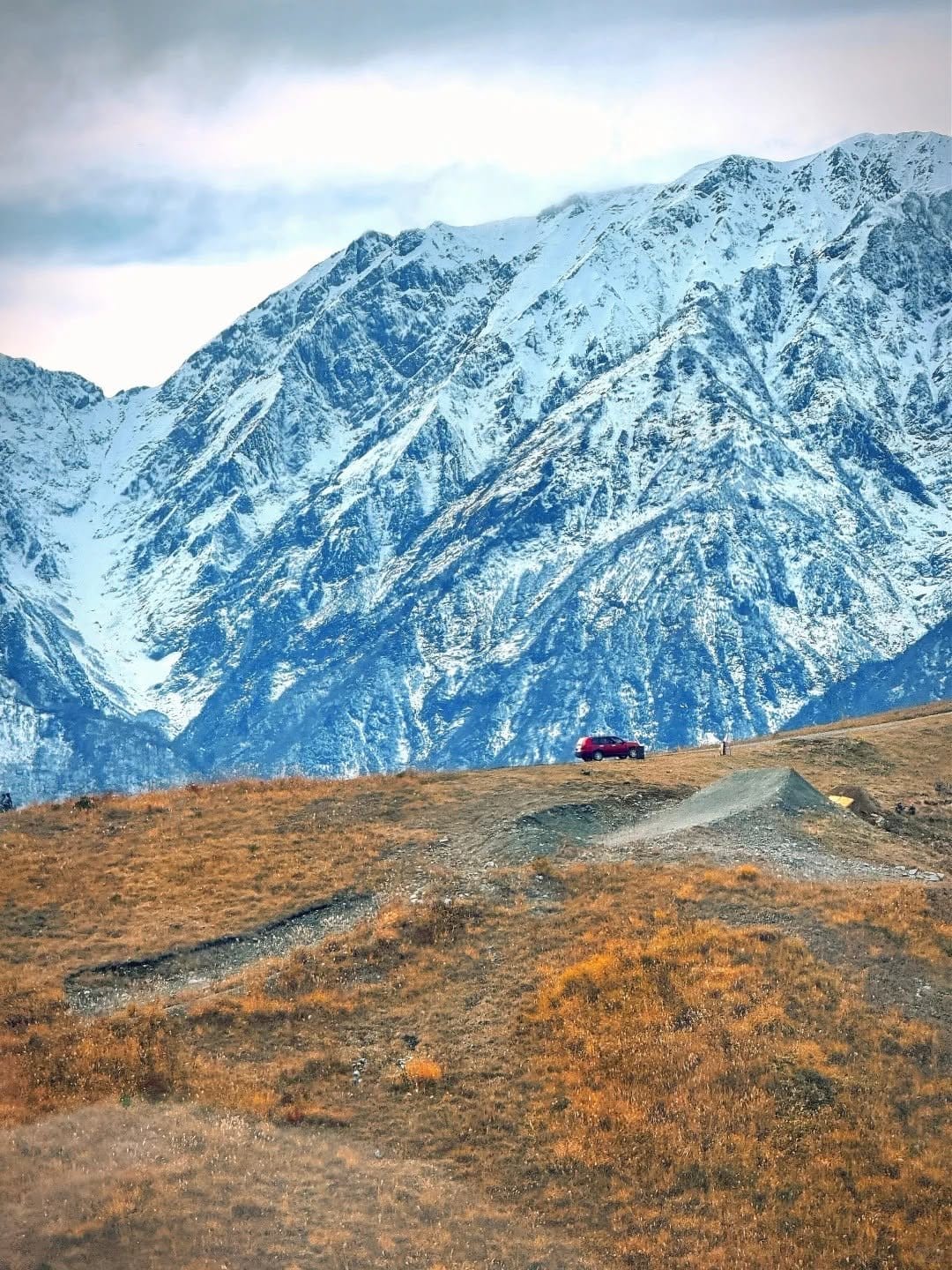
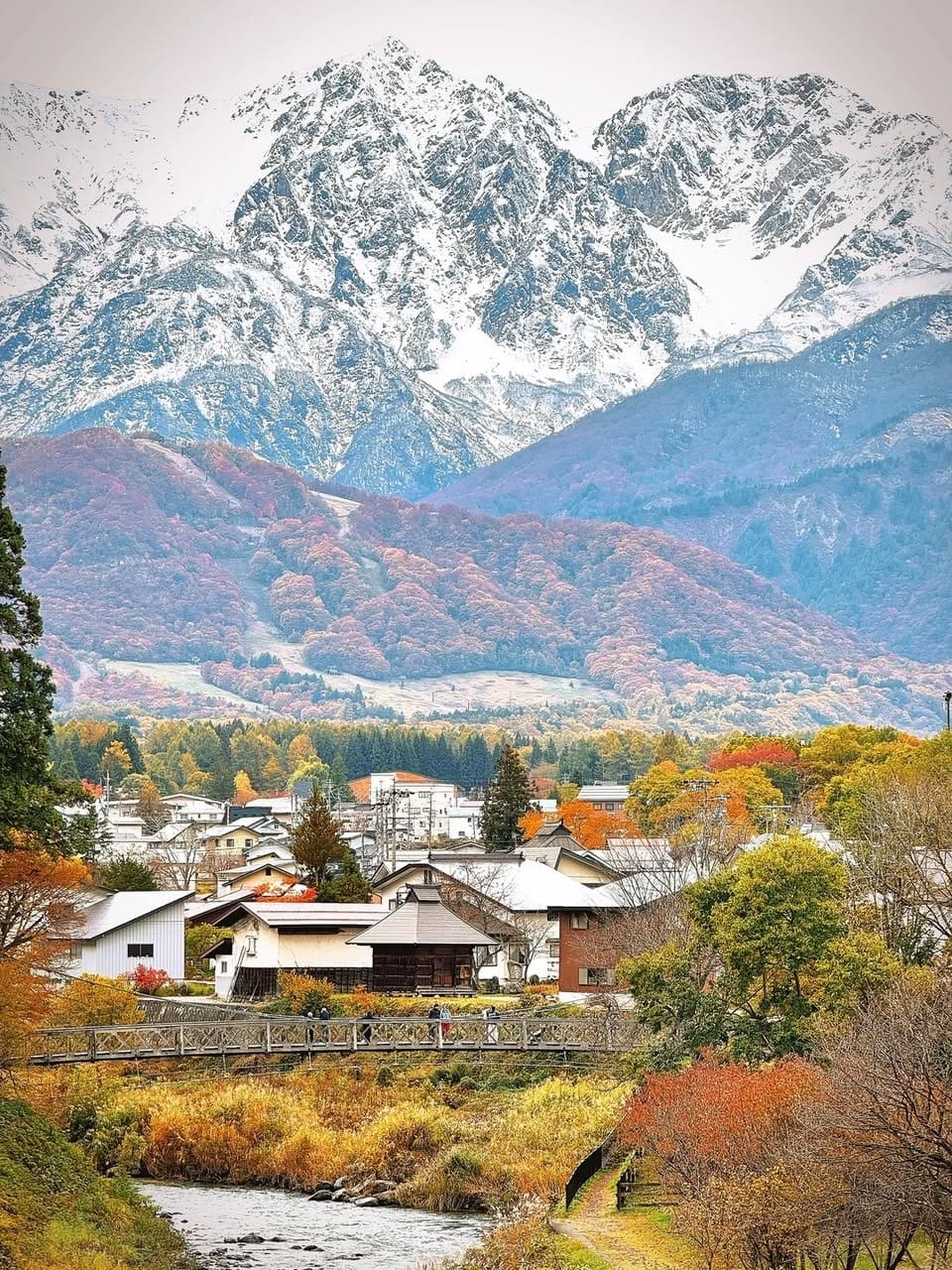
In Japanese, this phenomenon is called 三段紅葉 (sandan kōyō), roughly meaning “three-layer autumn foliage.” In a single frame, you can see three seasons stacked together:
- Top layer—white: the mountain peaks are covered in the first snow of the season.
- Middle layer—red, orange, and yellow: the mountain slopes are at peak foliage.
- Bottom layer—green: the valley forest has not yet had time to change color.
The important point that few people mention is that the three layers of color do not appear every time. They only show up when three conditions coincide—the peaks have received their first snowfall, the slopes are at their peak, and the valley is still green—and that window usually lasts a few days to around two weeks, often around mid-October. The first snowfall on the Northern Alps usually arrives sometime in October, but the timing can vary by a full week from year to year. So if your goal is to photograph sandan kōyō, go immediately after a cold front moves in—that is when fresh snow has just covered the peaks while the lower slopes have not yet shed their leaves.
Hakuba’s Weekly Koyo Timeline
The dates below are a rough guide based on many years of experience in the area. Each year shifts by about one week depending on the weather, so use this as a framework and adjust it with a near-term foliage forecast—the final section explains how to check one.
Late September (around 20–30/9): above 2,000 meters gets things started
The colors begin in the highest areas most visitors can reach: around Happo-ike (Happo Pond) at elevations above 2,000 meters and along the alpine grass-covered slopes above the Happo-one lift stations. At this altitude, the first plants to change are not maple momiji but low alpine shrubs (nanakamado and alpine grasses), turning vivid red and golden brown. They create broad patches of color across rock and grass rather than a canopy of forest.
The defining features of this week are very few visitors, noticeably cold air—early mornings at high elevations can be around 5 degrees or lower—and absolutely no color in the village yet. If you visit this week and stay only in the valley, it will feel like you came to see the tail end of summer.
Also note that some gondolas and chairlifts may be undergoing maintenance or operating only on weekends at the beginning of the season. Check the operating schedule on each area’s official website before setting out.
Early October (around 1–7/10): Tsugaike reaches its peak
This is the week when Tsugaike Nature Park, at around 1,900 meters, enters its most beautiful phase. The alpine marshes turn a warm golden brown, the shrubs around the boardwalks gradually turn red, and the views of the mountains beyond remain wide open because the low-cloud season of late autumn has not yet arrived.
The boardwalk at Tsugaike is flat and several kilometers long, and can be comfortably walked in sneakers—making this the easiest week for families with young children or older travelers who still want to see vivid fall color.
At 1,400–1,600 meters—the Alps Daira area of Goryu and the middle slopes—the colors are only beginning. The village below is still green.
8–15/10: the golden window for three-layer color
If I could visit Hakuba only once in my life during autumn, this is the week I would choose. Here is why:
- The 1,800–2,000-meter zone still has color, although it is just past its peak.
- The 1,200–1,600-meter zone is at its best—this is the true forest layer, with dense canopies glowing red and orange.
- The high peaks in the background have a high chance of receiving their first snowfall.
- The valley is still green or only just beginning to turn yellow, meaning the third layer is still there.
This is also the busiest week. Weekends during this period are the peak of the peak: long gondola lines, parking lots full from early morning, and village accommodations almost completely booked. If you can adjust your schedule, go Tuesday through Thursday—the difference in crowds is enormous, while the foliage looks no different.
16–22/10: color spills down to the middle slopes
The streak of color moves down to around 1,000–1,400 meters. This is when areas such as Iwatake—whose summit is close to 1,300 meters and has a café area overlooking the valley—and the middle elevations of Goryu are at their best. Broadleaf forests at this elevation are much denser and more colorful than the sparse upper mountain slopes, so photographs come out looking far more vibrant.
Above 1,900 meters, the foliage is usually already 落葉 (rakuyō—fallen leaves). It is still beautiful up high because of the snow and views, but do not go expecting autumn leaves.
In the village, the trees around Wadanomori, the small roads, and the edges of the rice fields are beginning to turn yellow. This is the most balanced week: the mid-mountain gondolas are beautiful, but there is also plenty to see on foot at lower elevations.
23–31/10: it is the village and lakes’ turn
Now the lowest layer gets its moment. Lake Aoki, Lake Nakatsuna, and Lake Kizaki—the group of three lakes south of the valley, at elevations just above 800 meters—reach the stage when the lakeside forests turn red and orange and reflect across the water. Ōide Park, with its suspension bridge and traditional-style rooftops overlooking the snowy mountains, also offers Hakuba’s classic autumn composition: a wooden bridge, golden leaves, and white peaks.
The weather becomes less predictable this week: more low clouds, frequent thick morning fog in the valley—which is beautiful for photographs but hides the mountains—and colder nights at lower elevations. On the other hand, this is the week with the best combination of lower costs and fewer crowds. The peak season has passed, while the lowland scenery is at its best.
In the high mountains, some gondola routes begin closing for the seasonal transition in preparation for ski season. Do not assume that a gondola will be operating just because you have arrived—check beforehand.
Early November (around 1–10/11): the season winds down
There is still some color in the valley during the first few days of the month, especially around temples, houses, and along the roads—but this is already the final stage, and one strong gust can strip the trees bare. Higher up, autumn is completely over and the landscape has shifted into early winter.
If you visit this week, adjust your expectations: you are not really chasing leaves anymore, but enjoying the changing season—white mountains, brown forests, quiet villages, hot onsen, and more affordable room rates. It can still be a wonderful trip; it is simply different from what you may have imagined.
Quick Reference: When to Go High and When to Stay in the Village
| Time period | Elevation at its best | What to do | Three layers of color? |
|---|---|---|---|
| 20–30/9 | Above 2,000 m (around Happo-ike) | Take the Happo-one gondola, hike the Happo-ike route | Not yet (the peaks usually have no snow yet) |
| 1–7/10 | Around 1,900 m (Tsugaike) | Gondola + lift up to Tsugaike, walk the boardwalk | Rare |
| 8–15/10 | 1,200–2,000 m (several layers at once) | Go high in the morning and avoid weekends | Highest chance—this is the golden window |
| 16–22/10 | 1,000–1,400 m (Iwatake, middle Goryu) | Take a mid-mountain gondola and combine it with a lowland walk | Possible, if the lower layer is still green |
| 23–31/10 | 700–1,000 m (village, three-lake area) | Skip the gondola; walk or cycle around Lake Aoki and Ōide | Almost never |
| 1–10/11 | Below 800 m, final stage | See the village, enjoy onsen, photograph the changing season | No |
Here is the simplest way to use the table: find your travel dates, locate the corresponding row, and only book a gondola ticket if that row lists an elevation above 1,000 meters. If you visit at the end of October and still buy a ticket to Tsugaike, you are paying to see bare branches while the best scenery that day is right at your feet.
How to Check the Foliage Forecast Before Your Trip
Three sources to check, in order of priority
1. The official website of each gondola area. Tsugaike, Happo-one, Iwatake, and Goryu all have their own websites, which usually post foliage conditions with photos taken that week, along with gondola operating schedules. These are the most accurate sources because the staff are right there at that elevation. Just as importantly, these pages tell you which days the gondolas are operating—information no foliage forecast can provide.
2. Nationwide koyo reports. Japan’s major weather websites—such as tenki.jp from the Japan Weather Association and Weathernews—have foliage forecasts and status reports by destination, updated throughout the season. Their advantage is that they offer forecasts several weeks ahead, which is useful when finalizing your plans. The drawback is that observation points are usually assigned to one fixed elevation, so for a place as vertically expansive as Hakuba, the reported status represents one layer, not the entire valley.
3. Real-time photos on social media and webcams. This is a favorite trick among mountain travelers: search for the place name in Japanese—白馬, 栂池, 八方—on social media and filter for photos from the last few days. A visitor’s photo from yesterday is more reliable than any forecast. Many ski areas also have live mountain cameras operating year-round, and looking at the color of the slopes through the webcam will immediately tell you what stage the season is in.
Read foliage reports using four Japanese words
Japanese koyo reports almost always use the same set of terms. Remember these four and you will be able to read any website, even when machine translation produces awkward English:
- 色づき始め (irozuki-hajime) — beginning to change color. About another week before peak.
- 見頃 (mikoro) — at its best. This is the word you want to see.
- 見頃過ぎ (mikoro-sugi) — past peak. There is still color, but it is duller and thinner.
- 落葉 (rakuyō) — leaves have fallen. No need to go up.
A useful rule of thumb: when a website reports "色づき始め" for a high-elevation area in late September, you can infer that a layer 300–400 meters lower will have its turn about one week later. Keep working your way down and you can build your own calendar for that year instead of rigidly following a table from an old article.
Follow cold spells, not calendar dates
What speeds up the leaves is not the date, but a run of cold nights combined with sunny days. The best way to time your trip is therefore to check the 10-day weather forecast for Nagano:
- If a cold front moves in and the minimum temperature in the village drops to around 8–10 degrees → the middle elevations should show clear color 5–10 days later.
- If the forecast calls for the first snowfall of the season in the high mountains → the following week is the best opportunity for three-layer color, provided the skies are clear.
- If heavy rain and strong winds are forecast for the week you plan to visit → expect the leaves in the area currently at its best to fall earlier than expected.
Conversely, an unusually warm, cloudy autumn can make the foliage both late and pale. In years like that, the leaves turn brown instead of vivid red, and there is no solution except to accept it.
Plan with “two windows”
This is how I recommend arranging an autumn trip to Hakuba, especially if you are traveling from Tokyo or Osaka and have to book a month in advance:
- Book your accommodation first and choose a week between 8–20/10—this period has the highest chance of working in both early and late years, because some elevation will always be looking good.
- Do not finalize your activities too early. Leave the question of “which gondola to take” open until 3–5 days before your trip.
- Three days before departure, check the three sources above, identify the elevation currently at mikoro, and then choose between a high gondola, a mid-mountain gondola, or a lowland walk.
- Leave one backup day open. Mountain weather can change within hours; morning fog that completely hides the mountains may clear after an hour. A backup day gives you a second chance.
When choosing accommodation, prioritize the central village area—around Happo or Wadanomori—because it is convenient in every direction from there. The northern gondolas and the southern lakes are both within a 15–30-minute drive.
Common Mistakes When Timing Your Visit
- Treating last year’s calendar as gospel. The foliage season can shift by a full week from one year to the next. This article’s table is a framework, not a promise.
- Checking only one source. A nationwide report may say “at its best,” but at what elevation? Always cross-check it with the gondola area’s official website.
- Forgetting to check the gondola operating schedule. Late October and early November are when routes gradually stop operating for the switch to winter service. The leaves may still be beautiful, but there is nothing you can do if the gondola is closed.
- Spending the entire day focused on just one elevation. The smart approach is to go high in the morning and low in the afternoon—you can pass through two or three stages of autumn in a single day.
- Dressing for the village temperature. A 6–7-degree difference between the village and the summit is normal, not counting the wind. Dress in three layers, bring a windbreaker, and avoid thick cotton clothing that absorbs sweat easily.
- Visiting on a mid-October weekend without booking anything in advance. This is Hakuba’s busiest week of the year for autumn travel, even after ski season.
Frequently Asked Questions
If I can only visit for one weekend, which week should I choose?
The second or third weekend of October. That is the period when multiple elevations are most likely to be at their best, so even if that year’s season is a week earlier or later than usual, you will still have something to see—the only difference is where you will need to go to find it.
Is late September a waste of time?
Not at all, but you have to do it the right way: that week, you need to go high, which means buying a gondola ticket to Happo or Tsugaike. If you only wander around the village, there really will not be much to see. In return, you get fewer visitors and skies that are often clearer than later in the season.
Am I guaranteed to see three layers of color?
No one can guarantee it, because it depends on the first snowfall on the peaks—something that can arrive as much as ten days early or late. To improve your odds, go between 8–20/10, choose a clear day immediately after a cold spell, and head up early in the morning before clouds roll in and cover the peaks.
Can I see beautiful foliage in Hakuba without taking a gondola?
Yes, but you need to visit at the right time: from around the end of October onward, when the colors have descended to the village and the southern lake area. At that point, walking or cycling around Lake Aoki and stopping by Ōide Park is more than enough, and you will not spend a single yen on a gondola ticket.
How much do gondola tickets cost, and what are the operating hours?
Each area has different prices and schedules, which also change depending on the day of the week and the weather, so check the official websites for Tsugaike, Happo-one, Iwatake, or Goryu shortly before your visit. In general, round-trip tickets for the major gondola routes cost several thousand yen, and the last downhill ride is usually earlier than you expect—check the timetable as soon as you reach the upper station.
How cold is Hakuba in autumn?
At the beginning of the season, daytime temperatures in the valley can still be fairly comfortable, but early mornings and high elevations are distinctly cold. When the wind picks up, temperatures can drop to around 5 degrees or lower. By the end of October, evenings in the village are cold as well. The rule remains the same: wear several thin layers rather than one very thick layer.
Do I need to rent a car for an autumn trip to Hakuba?
If you are focusing on just one gondola area, the village buses and the train to Hakuba Station are sufficient. But if you want the flexibility to change elevations according to the forecast—go up the mountain in the morning and drive down to the three-lake area in the afternoon—a rental car is much more convenient. The lakes are some distance from the village center, and public transportation is not especially frequent.
What is it like in late November?
By then, the foliage season in Hakuba is essentially over, both high and low. You can still visit, but go expecting early-winter scenery and onsen, not autumn colors.
More from this region — Chubu (Nagano, Kanazawa)
View all →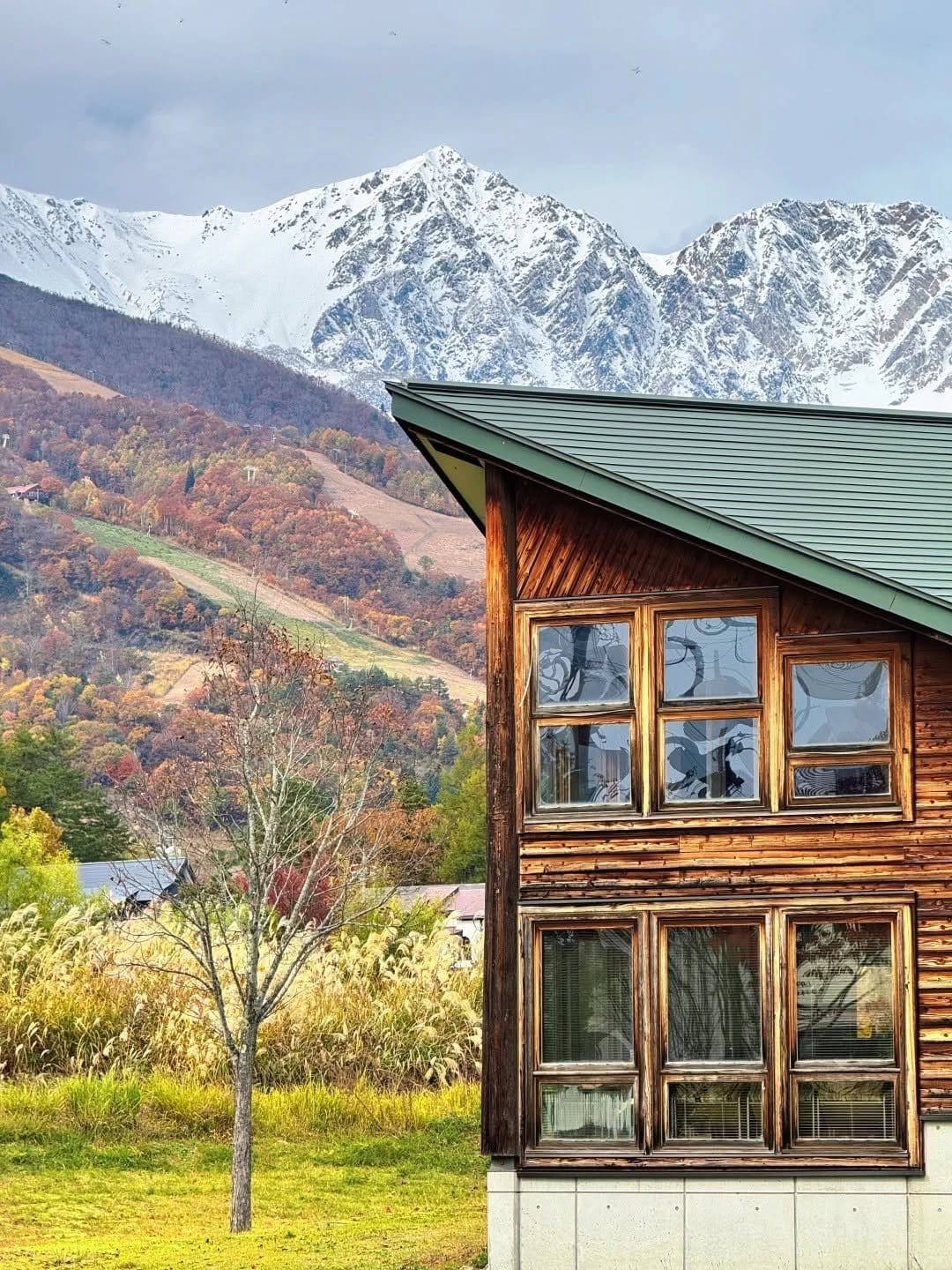
What to Eat in Hakuba in Autumn — Fresh Soba, Wild Mushrooms, Shinshu Apples
20 min · tips
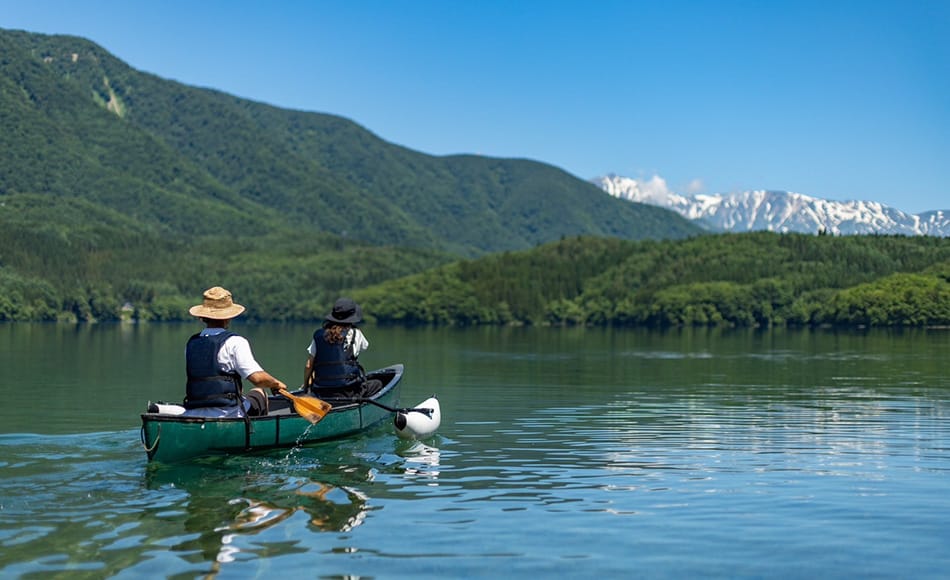
Autumn in Hakuba — Hiking & Canoeing Through the Foliage
2 min · tips
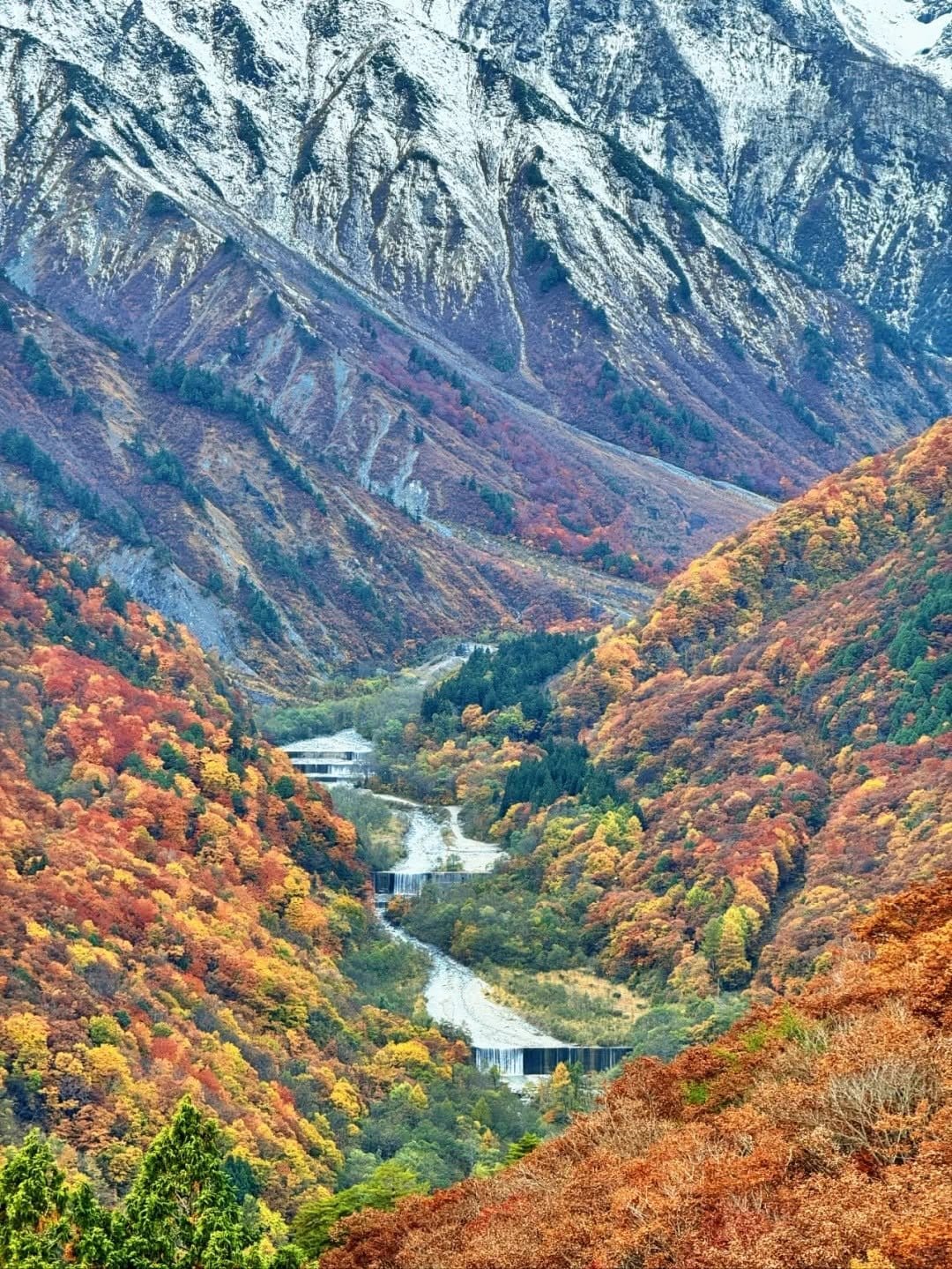
Pairing Autumn Hakuba with Kamikochi, Matsumoto, Togakushi, and the Alpine Route in 3–5 Days
18 min · tips
Alkaline Onsen in Hakuba: Four Baths for an Autumn Afternoon After Hiking
17 min · tips