
Hakuba in Autumn: Gentle Walks for Three-Generation Families
Tsugaike's boardwalks, Happo's three ropeway sections, and a stroll around Lake Aoki: how to choose a route based on the least mobile member of your group, plus rest stops, toilets, and tips for traveling with a stroller.
Aug 12, 2026·✍️ olablog·⏱ 18 min read
Tsugaike's boardwalks, Happo's three ropeway sections, and a stroll around Lake Aoki: how to choose a route based on the least mobile member of your group, plus rest stops, toilets, and tips for traveling with a stroller.
Tap a region to browse articles
Anyone who has ever taken the whole family out to see the autumn leaves will recognize the scene: the group stops in the middle of the trail, Mom sits down on a rock and rubs her knee, the child wants to be carried, and you stand in the middle with your phone open to the map, mentally calculating how much longer it will take to reach the “best view” praised by every article. The scenery is still beautiful. But the trip has already gone wrong the moment someone has to grit their teeth and keep going.
Hakuba has a reputation as a destination “for mountain climbers.” Open almost any guide and you will find rocky trails, high-top hiking shoes, trekking poles, and three-hour round trips. What very few articles point out is that most of Hakuba’s best autumn scenery is where the ropeways drop you off, not where you have to climb to reach it. This valley was built to serve tens of thousands of skiers every winter, so its infrastructure for getting people up into the mountains is among the best in Japan—and in autumn, the system still runs. The difference is that instead of depositing people on snowy slopes, it sets you down amid a sea of red and golden leaves at nearly 2,000 meters.
This guide is written specifically for “three-generation” groups: grandparents who can walk but cannot handle slopes, children who can walk but not very far, and you—the person responsible for everything. The three routes below are all gentle walks that do not require serious trekking. More importantly, each has clear turnaround points where you can stop without feeling that you have missed out.
Why Hakuba Works Well for Grandparents and Young Children
The biggest advantage is that you “buy” altitude with ropeways rather than your legs. Hakuba Valley sits at around 700 meters, while the upper ropeway stations take you to 1,800–1,900 meters in just 20–40 minutes of sitting still. For older travelers, this can make all the difference: elsewhere, you have to trade a few hundred meters of elevation gain for the same mix of snowy mountains and autumn leaves; here, you trade it for the price of a ticket.
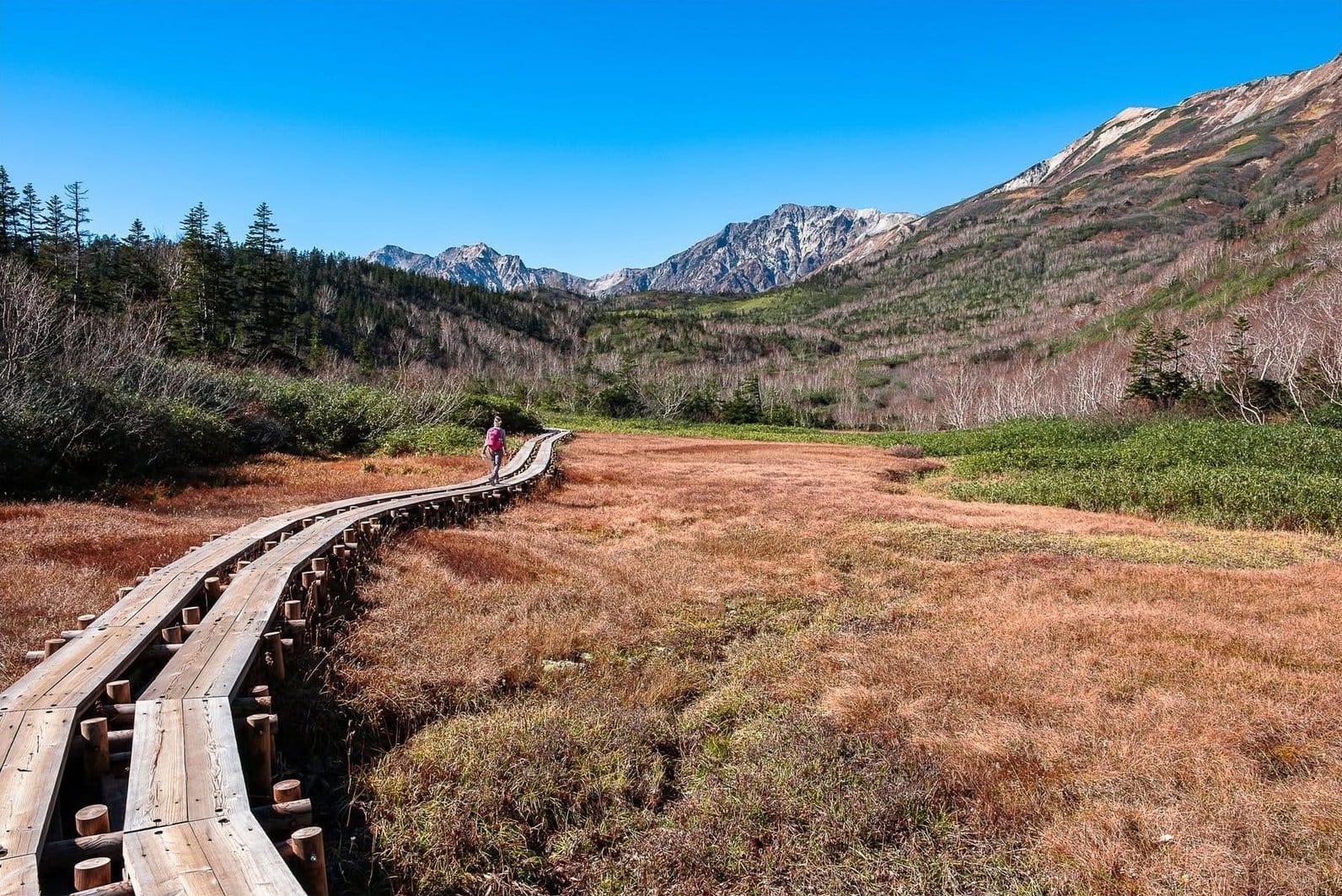
The second advantage is how surprisingly gentle the terrain is at the top. The upper areas of Tsugaike and Happo both have patches of high-altitude marshland (shitsugen)—flat, damp ground covered with wooden boardwalks to protect the vegetation. You walk across golden marshland, turn around to see the snow-dusted Northern Alps, and your feet remain on level ground.
The third advantage, which few people mention, is that autumn here is much quieter than the leaf-viewing spots around Tokyo. You are less likely to wait forty minutes for a ropeway or be pushed along by a crowd. For grandparents and children, being able to “take your time” is often more valuable than the scenery itself.
That said, there are some real drawbacks: at 1,900 meters, temperatures can be eight to ten degrees lower than in the valley, the wind hits you directly, and most of the ropeways are open-air chairlifts. Older people can easily become painfully cold during ten minutes on a chairlift even when the sun is still shining at the foot of the mountain. We will come back to this in the packing section.
Assess Your Group’s Fitness First, Then Choose a Route
This is the step everyone skips and then pays for later. Before finalizing your plans, sit down and answer these four questions honestly.
How long can the least mobile person in the group walk continuously on flat ground? Not “how far can they walk,” but “how long can they go before they need to sit down?” Under twenty minutes, over forty minutes, or somewhere in between—the answer determines everything.
How are their knees and hip joints on downhill sections? Many older people manage uphill walking well but experience pain going down. Japanese mountain trails often have uneven stone steps, and the descent is usually the harder part.
Does anyone get dizzy, have blood-pressure issues, or feel unwell at altitude? Nearly 2,000 meters is not an inherently dangerous altitude, but anyone with a history of blood-pressure problems should walk very slowly for the first fifteen minutes after getting off the ropeway rather than setting off quickly.
Will the child walk independently or still need to be carried? If the child still needs to be carried, the person doing the carrying is the least mobile member of the group. Assess the group’s stamina based on that person, not the child.
A quick comparison of the three routes in this guide:
- Tsugaike boardwalk loop: The gentlest terrain, but the longest if you complete the entire loop. Best for groups with reasonably fit grandparents who know when to conserve their energy and turn back.
- Happo’s three ropeway sections: The least walking and the most spectacular scenery for every step you take. Best for groups that include someone particularly reluctant to walk—provided they are comfortable riding open-air chairlifts.
- Lake Aoki stroll: The flattest, warmest, and most flexible option. Ideal for a relaxing afternoon or as an alternative when the weather in the mountains is rainy and windy.
Route 1: The Tsugaike Nature Park Boardwalk Loop
If you can visit only one place, this is the one I recommend. Tsugaike Nature Park (Tsugaike Shizen-en) sits at around 1,900 meters and consists of a large high-altitude marshland, with wooden boardwalks covering the entire visitor route.
Getting There: A Gondola and a Ropeway
From Tsugaike Kogen in the valley, take the gondola—a covered cabin with seats that takes about twenty minutes—to the middle station, then transfer to a short ropeway to reach the park entrance. Because the gondola is an enclosed cabin, this section is especially comfortable for grandparents and young children: it is sheltered from the wind, you can sit down, and the ride itself offers excellent value as a high-altitude leaf-viewing experience.
A full round-trip ticket usually costs a few thousand yen per person, with discounts for children and occasional packages that include a meal or onsen. Prices and operating hours vary by season, so check the official Tsugaike website before your trip—especially the time of the last descent, since autumn days are short and the service ends earlier than you might expect.
How to Walk It at a Comfortable Pace
The complete boardwalk loop is about 5 km and takes around three to four hours with photo stops. With grandparents in the group, do not set out with the goal of completing the entire loop.
The smart approach is to walk out and turn back: enter from the park gate and follow the main route. The first section is flat and also the most scenic, with open marshland and broad views of the mountains. Walk for around twenty-five to thirty minutes, find a place to sit, have a snack, take photos, and then turn around. The entire outing will take about an hour, and you will have experienced nearly all of the best scenery. Anyone with energy left can continue, while anyone who is tired can rest at the station area—one advantage unique to Tsugaike, since the ropeway station has indoor seating.
There are cross paths along the loop that let you return early instead of completing the whole route. Take a photo of the map at the park entrance with your phone as soon as you arrive—cell service can be intermittent, and paper maps are easily blown away by the wind.
Strollers, Walking Sticks, and Toilets
To be blunt, so you do not carry unnecessary gear: strollers are almost impossible to use on the boardwalk loop. There are steps, narrow sections only wide enough for one person, and places where the boards are damp and slanted. Pushing a stroller there is exhausting and obstructs other visitors. For children under three, a back carrier or front carrier is the right choice—it keeps your hands free, is compact, and helps keep the child warm.
By contrast, walking sticks are well worth bringing for older adults. Not because of the slopes, but because the boards can be slippery with morning dew, and having a third point of support makes each step feel much more secure. A folding trekking pole or a standard walking stick will work; just make sure it has a rubber tip so it does not damage the boards.
Toilets are concentrated around the ropeway station and near the park entrance. Along the boardwalk loop, toilet facilities are very sparse or nonexistent for long stretches. The non-negotiable rule when traveling with grandparents and young children is: use the toilet at the station before entering the loop. Exact locations may change from year to year, so check the on-site map to be sure.
Route 2: Happo’s Three Ropeway Sections—Up by Chairlift, Not by Foot
Happo-one is home to Hakuba’s classic photograph: a small lake reflecting the snow-covered mountains. The problem is that Happo-ike is not actually an easy route—from the highest ropeway station, you still have to walk around sixty to ninety minutes each way along a genuinely rocky, steep, and uneven trail. For groups with grandparents and young children, I recommend treating the lake as an optional reward, not the main goal.
The section before that, however, is excellent for a gentle outing.
Three Sections Taking You Close to 1,800 Meters
From the base, take an enclosed gondola cabin to the first station, then transfer to two chairlift sections to reach the highest station, where there is a mountain lodge. The total riding time is around thirty to forty minutes, and the only walking required is getting from one station to the next—just a few dozen meters on flat ground each time.
This is the “almost no trekking” experience many people talk about. But there are two important things to keep in mind.
The chairlifts are open-air. There is no roof or glass, and your legs hang freely below you. At ten degrees with the wind blowing, ten minutes on a chairlift is enough to leave an older person shivering. Bring a windbreaker, scarf, and a thin blanket or large towel to cover your legs. With young children, ask the staff in advance about age restrictions and the rules for riding with an adult—each area operates differently.
The uppermost chairlift has its own, shorter operating schedule. In many years, this section runs only during certain hours or parts of the autumn season and stops early in bad weather. Check the official Happo-one website on the morning of your visit, rather than relying on last year’s timetable.
The Smart Stopping Point: The Middle Station
This is the tip I most want you to remember. At Happo’s middle station, there is a small patch of marshland with a short wooden boardwalk around the water. The loop takes only ten to fifteen minutes, the path is flat, and the views of the mountains behind it are already impressive. For a group with grandparents, this is an ideal stopping point: there is scenery, somewhere to sit, toilets in the station area, and no one has to push beyond their limits.
A popular way to split the group is for everyone to ride together to the middle station, while the grandparents and young children walk the boardwalk loop and rest. The stronger members can continue on the final chairlift section, enjoy the views at the upper station, or walk the first twenty minutes of the trail before turning back. Set a clear meeting time and do not rely on your phones—mountain reception is unreliable.
If You Still Want to Try for the Lake
Only consider it if the least mobile person in the group can walk continuously for over forty-five minutes and does not experience knee pain on descents. You will need shoes with good grip (high-top hiking shoes are ideal), a windbreaker, water, and an early start so you do not end up racing for the last ropeway. Fog can roll in very quickly, and visibility may disappear within ten minutes. If you reach the top and the weather is foggy, do not wait around hoping it will clear—turn back down. It is much safer.
Route 3: Lake Aoki—Flat, Warm, and Less Dependent on Mountain Weather
Lake Aoki (Aokiko) lies south of the valley in the Omachi area, about half an hour by car from central Hakuba. It is famous for its clear water; in autumn, the surrounding forest changes color and is reflected on the surface. The scenery is peaceful rather than as dramatic as the mountains, but it is far more relaxing.
Its main advantage for groups taking a gentle outing is that the lower elevation makes it much warmer than the mountains, and you are not dependent on whether the ropeways are operating. When the mountain forecast calls for rain and wind, this is an alternative that almost always works.
The route around the lake is about 5 km. But do not assume you need to complete the whole loop: part of the route shares the road with vehicles, and some sections have no separate pedestrian path. The most comfortable approach is to choose a lakeside section with parking and a rest area, walk out, and turn back—thirty to sixty minutes is enough to enjoy the scenery.
This is also the only one of the three routes where a stroller is genuinely practical, at least on paved sections and flat paths near the parking areas. Toilets are generally located at parking areas, campgrounds, and facilities around the lake. Some facilities reduce their hours or services in autumn, so check in advance or choose a starting point near a facility that is still open.
Timing and Weather
The autumn colors in Hakuba move from the higher elevations down to the valley week by week:
- Late September to mid-October: The 1,900–2,000-meter elevations are at their best. This is when you are most likely to see three layers of color—the first snow on the peaks, red leaves on the slopes, and green still covering the valley.
- Mid-October to early November: The colors spread down to the middle elevations and the area around Lake Aoki.
- Early to mid-November: The valley season winds down, the upper elevations turn cold, and the ropeway routes gradually begin to stop.
For groups with grandparents, I favor the first half of October over the end of October—not necessarily because of the leaves, but because the temperatures at altitude are still manageable. By late October, temperatures at 1,900 meters can approach 0 degrees in the morning.
One habit worth adopting: the night before, check the wind forecast, not just the rain forecast. Strong winds are the most common reason chairlifts stop operating, and they can derail your plans much faster than light rain.
Getting Around and Finding Accommodation with Grandparents and Young Children
From Tokyo, the most comfortable route for older travelers is the Shinkansen to Nagano followed by a highway bus to Hakuba—a smooth train ride, one transfer, and around three hours in total. A direct bus from Shinjuku is cheaper but involves several continuous hours on the road, which can be tiring for older people and young children who are not used to it. Operating times and frequency change by season, so book ahead and check the official timetable.
Within the valley, renting a car is worth the money for a larger group. The ropeway areas are fairly far apart, local buses do operate but are infrequent, and the plan of “returning to the hotel for a midday break and going out again in the afternoon” is only realistic with your own vehicle.
For accommodation, two criteria matter more than the view: an onsen—extremely effective for soothing grandparents’ knees after a day of walking—and Japanese-style rooms with futons or spacious family rooms, so you do not have to deal with many stairs. Many small lodges in Hakuba are two- or three-story buildings without elevators, so ask before booking.
What to Wear and Bring
The rule is to wear several thin layers rather than one heavy jacket, because the temperature difference between the valley and the mountaintops is significant. The minimum list for each person:
- A waterproof windbreaker for the outside, with a thin down jacket or fleece underneath
- Earmuffs or a hat that covers the ears and thin gloves—very important on the chairlifts
- Athletic shoes with good grip; absolutely no smooth soles
- Warm water in an insulated bottle, plus sugary snacks
- A lightweight rain jacket or poncho—umbrellas are nearly useless in the wind
For grandparents, add a walking stick, regular medication carried on their person rather than left in the suitcase, and a thin blanket for the chairlift sections. For young children, add a carrier to use instead of a stroller, a change of clothes, and a hat with a chin strap.
A Two-Day, One-Night Itinerary for a Three-Generation Group
Day 1: Leave Tokyo in the morning and arrive in Hakuba in the early afternoon. Check in and let the grandparents rest for a while. In the late afternoon, take a short walk along Lake Aoki or around the village, have an early dinner, and enjoy the onsen. Deliberately keep the first day easy—this is the secret to making sure nobody collapses on day two.
Day 2: Get up early and take one of the first gondolas to Tsugaike. The weather is clearer in the morning, the crowds are smaller, and you still have time to spare if you need to walk slowly. Spend about an hour on the first section of the boardwalk loop, then return to rest at the station and have lunch there or back down in the valley. Descend in the early afternoon, enjoy the onsen one more time, and head home.
If you have three days, add a visit to Happo, using the group-splitting plan at the middle station described above.
Common Mistakes
Setting goals based on photos online. That photograph of the lake reflecting the snowy mountains was taken after a real trail hike. Chasing it with grandparents in the group is simply setting a trap for yourself.
Forgetting the time of the last ropeway. This is the most dangerous mistake. Autumn gets dark quickly, and missing the last ride leaves you with no pleasant alternatives. Photograph the timetable as soon as you arrive, then set an alarm for forty-five minutes beforehand.
Dressing for the valley weather. Sunshine and eighteen degrees at the foot of the mountain does not mean conditions will be comfortable at the top. Bring enough warm clothing and take layers off as needed—do not do the opposite.
Carrying a stroller onto the boardwalk loop. As mentioned above, but worth repeating because so many people make this mistake.
Trying to fit all three areas into one day. The areas are far apart, and the price is not measured in time but in the energy of the least mobile member of the group. One area per day, slow walking, and plenty of sitting will make for a much more enjoyable trip.
Frequently Asked Questions
My grandparents are nearly 80 and need to rest after about twenty minutes of walking—can they still go? Yes, if you choose the right route. The best option is to take the gondola to Tsugaike, walk the first section of the boardwalk for around fifteen minutes, then turn back and rest in the station area. Alternatively, go to Happo’s middle station and take the short boardwalk loop there. Both options have indoor seating and nearby toilets.
Can we bring a stroller? Strollers are almost unusable on the Tsugaike boardwalk loop and the trails in the Happo area, so switch to a carrier. Around Lake Aoki and in the village, strollers work well on flat sections.
Are there toilets along the way? They are mainly concentrated at the ropeway stations, around the park entrance, and in parking areas around the lake. They are very sparse along the trails and in the middle of the boardwalk loops. Assume you need to use the toilet at the station before setting out.
Do we need specialized hiking shoes? For the Tsugaike boardwalk loop, the area around Lake Aoki, and the ropeway stations, athletic shoes with good grip are sufficient. Only if you plan to continue up to the mountain lake in the Happo area should you use high-top hiking shoes.
Is it accessible by wheelchair? Some areas around the ropeway stations and observation decks have flat surfaces, but the boardwalk loops and trails are not suitable for wheelchairs. If someone in your group uses a wheelchair, contact the ropeway area in advance to ask about each section and how to board and exit the gondola—the information varies by facility, so asking directly is the safest approach.
How long do the ropeways run in autumn? Usually until around late October or early November, depending on the area and the weather. They then take a break before reopening for ski season. Since the schedule varies from year to year, check each area’s official website before booking your train and bus tickets.
What should we do if it rains? Skip the mountains and choose Lake Aoki or a stroll through the village, then spend most of your time at an onsen and enjoying good food. At nearly 2,000 meters, rain combined with wind not only ruins the views but can also be dangerously cold for older travelers—it is not worth the risk.
More from this region — Chubu (Nagano, Kanazawa)
View all →
Hakuba Changes Color by the Week: A Leaf-Peeping Calendar from Summit to Valley
17 min · tips
What to Eat in Hakuba in Autumn — Fresh Soba, Wild Mushrooms, Shinshu Apples
20 min · tips
Autumn in Hakuba — Hiking & Canoeing Through the Foliage
2 min · tips
Pairing Autumn Hakuba with Kamikochi, Matsumoto, Togakushi, and the Alpine Route in 3–5 Days
18 min · tips