
Hakuba in Autumn: Choose the Right Dates for Fewer Crowds and Much Lower Prices
Why you should avoid the long September holiday and peak fall-color weekends, the benefits of traveling midweek, a 2-day, 1-night cost breakdown at three budget levels, and expenses you can cut without regret.
Aug 12, 2026·✍️ olablog·⏱ 18 min read
Why you should avoid the long September holiday and peak fall-color weekends, the benefits of traveling midweek, a 2-day, 1-night cost breakdown at three budget levels, and expenses you can cut without regret.
Tap a region to browse articles
There is a slightly counterintuitive thing about Hakuba that only people who have visited several times tend to notice: the price of the same room, with the same view of the Northern Alps, can differ by as much as double between a Saturday night in mid-October and a Wednesday night at the end of October. It is not a different room or a different level of service—the only difference is the date you click to book.
The reason is that Hakuba lives on two seasons: summer, for campers, hikers, and lake paddlers; and winter, when skiers from around the world arrive. Autumn, roughly from mid-September to mid-November, falls right in the gap between those two seasons. Lodges, pensions, and hotels in the valley still have to pay for electricity, staff, and bank loans, but their rooms sit empty. The result is lower prices—except for the handful of days each year when all of Japan is on holiday, or all of Kanto heads into the mountains to see the autumn leaves.
This article is not about where to go, which trails to hike, or where to take photos. It is about choosing your dates and choosing how to spend your money—the two things that determine whether your autumn trip to Hakuba is “quiet, surprisingly affordable, and easygoing” or “stuck in traffic from Nagano, waiting forty minutes for the gondola, and paying more for a room than during snow season.” At the end, you will find a 2-day, 1-night budget table at three levels, along with a list of expenses you can cut without regret.
Why autumn is Hakuba’s most valuable “price gap”
Imagine Hakuba’s annual room-price curve as an M. The first peak is summer, especially the Obon holiday in mid-August. The second peak—much higher—is ski season, from around the end of December through the end of February, when visitors from Australia, Taiwan, and Hong Kong book rooms more than half a year in advance. Between those two peaks are two troughs: spring (April–May) and autumn.
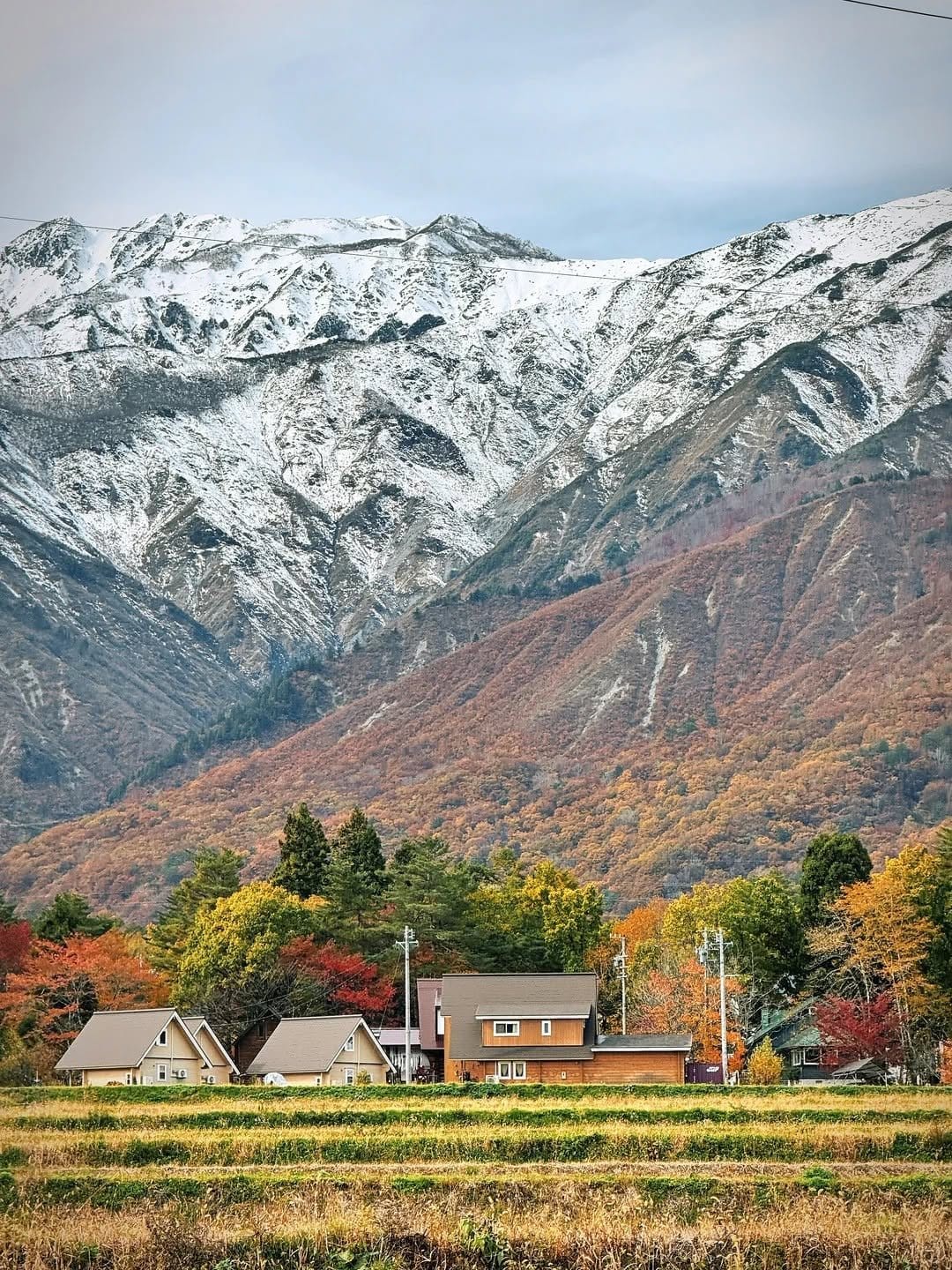
Autumn’s trough is more appealing than spring’s because the scenery is still at its best. This is when you can see the three-layer color phenomenon that Japanese mountaineers call sandan koyo: fresh snow on the mountaintops, blazing red and orange leaves halfway down the slopes, and green valleys below. At the same time, accommodation prices are near their annual low, gondolas do not have long lines, mountain roads are free of traffic, and restaurants in the villages still have tables without requiring reservations a week in advance.
But “low season” does not mean that every day is equally cheap. During the roughly two months of autumn, there are about five to seven days when prices jump almost to snow-season levels, and if you happen to travel on those dates, all the benefits of visiting in the off-season disappear. Identifying those days is the most important skill in this article.
Dates to avoid, and why
The long holiday in mid-September (Silver Week)
Japanese people call the September holiday period Silver Week—the younger cousin of Golden Week in May. It is formed by two public holidays: Respect for the Aged Day (the third Monday of September) and the Autumnal Equinox (usually around September 22–23). Normally, these two holidays fall separately, creating two individual three-day weekends—which are already crowded enough. But once every few years, they fall close enough together that the day between them also becomes a legal holiday, giving the country a continuous five-day break. Those are the years of “true Silver Week,” and Hakuba is one of the destinations that feels the full force of the surge.
Why does Hakuba get so busy during this particular period? The higher elevations—Tsugaike and the area around Happo Pond—are beginning to change color, while the Kanto plains are still hot and humid. Tokyo residents have five free days, a full tank of gas, and a cool destination with changing leaves just four hours away by car. The result is easy to predict: gondola parking lots fill up early in the morning, lines form for the lifts, and room prices in the villages can be two to three times higher than usual.
Here is the straightforward advice: if your schedule is flexible, treat the September holiday period as a no-go zone. Move your trip back or forward by just one week and you can save enough to upgrade your entire room category. Japanese public holidays shift from year to year, so before finalizing your tickets, check the official holiday calendar for the year of your trip to determine exactly when the holiday period falls.
Peak autumn-color weekends
The second trap is more subtle. Autumn foliage does not appear across Hakuba all at once—it “flows” downhill over a period of about six weeks. But there is a stretch, usually in the second half of October, when the colors reach the elevation served by the gondolas, meaning everyone can enjoy them without hiking. During that period, Saturday and Sunday become the most expensive and crowded days of the entire autumn.
Here is how to recognize it: Nagano Prefecture’s autumn-leaf forecasts and the official websites of Hakuba’s lift areas begin posting words such as “full” or “peak viewing.” As soon as you see those notices, room prices for the following weekend will jump within a few days, and the best-value rooms will disappear first.
The irony is that the best foliage and the best experience are not the same thing. On a peak weekend, you will queue for the gondola, squeeze past people on narrow trails, and find strangers in every photo. Shift your trip by three to four days and the colors will look almost identical—the leaves do not change much in one week—but the mountainside will feel almost entirely yours.
Three smaller traps that few people notice
Sports Day—the second Monday of October—creates a three-day weekend right in the middle of the foliage season. This is Hakuba’s second-busiest autumn period, after Silver Week.
Culture Day in early November also creates a three-day weekend, and because it often coincides with the valley’s golden peak, it still draws a sizable number of visitors even though the season is nearly over.
Weekends with regional sporting events. Hakuba regularly hosts trail races, cycling races, and outdoor events in autumn. A race attracting several thousand people is enough to “wipe out” the best-value rooms in the villages, even during the low season. Before booking, try checking Hakuba village’s event calendar for your planned dates—it takes five minutes and can save you from a major price shock.
The golden dates: from Monday afternoon to Friday morning
If this entire article had to be reduced to one sentence, it would be: stay on Tuesday, Wednesday, or Thursday night.
There are three very specific reasons. First, room prices at Japanese resorts are generally divided into “weekend nights” (Friday and Saturday nights, plus the night before a public holiday) and “regular nights.” The difference in Hakuba during the low season is significant, and the important thing is that you get no better service in exchange for paying it. It is the same room, the same breakfast, and the same hot spring.
Second, midweek travel is much more pleasant when it comes to transportation. Long-distance buses from Shinjuku to Hakuba have several fare tiers, and cheaper seats are still widely available on weekdays while weekend departures sell out early. The expressway is not congested on the way out of Tokyo. Parking spaces near the gondolas are still available. You can usually get on the gondola with almost no wait.
Third, and something few people consider: midweek is when you can “buy” solitude, which is Hakuba’s greatest value in autumn. On a Wednesday morning along a mountain trail, with the mist not yet lifted, you might encounter only two other people in an entire hour—that is an experience money cannot buy on a weekend, even if you are willing to pay three times as much.
If work does not allow you to take two full weekdays off, choose the effective compromise: take Monday off, travel from Sunday evening, and stay Sunday night. Sunday night is still priced as a regular night at most accommodations, while Monday morning on the mountain is nearly as quiet as midweek.
Booking accommodation: book early or wait until the last minute?
In Hakuba during autumn, the answer differs from winter.
During ski season, the rule is to book as early as possible; wait too long and everything will be gone. In autumn, rooms are generally not scarce, so the strategy changes: book early if you must travel on a weekend or holiday; take your time if you are traveling midweek. For a midweek night outside a holiday period, booking two to three weeks ahead is more than sufficient, and sometimes accommodations release discounted rooms at the last minute to fill vacancies.
Here are three Hakuba-specific points to know in advance:
Watch out for the “closed season.” Between autumn and ski season, many lodges, pensions, and small village restaurants close for maintenance and winter preparations—usually around early to mid-November. At the same time, the lift areas gradually stop operating for the green season. If you travel too late, you may arrive to find half the village shuttered. If you are planning a November trip, check the official website of your chosen lift area to find out when its final autumn operating day is.
In Hakuba, “hotel” is not the default. The area’s signature accommodations are pensions and lodges—small, family-run guesthouses originally built for skiers, with simple rooms, friendly owners, and often excellent home-cooked dinners. During the low season, they are usually the most affordable option and also offer the most local experience.
Check exactly which area your accommodation is in. Hakuba is a long valley, not a compact town. Happo is the busiest central area, with plenty of restaurants and public hot springs. Wadano is higher up and quieter, but getting food in the evening means walking downhill. The area around Hakuba Station is convenient for travelers arriving by train or bus. Places near Lake Aoki or Tsugaike are farther from the center and better suited to people with a car. In autumn, local buses do not run as frequently as the ski shuttles do in winter, so walking distance is a real consideration, not a minor detail.
Sample 2-day, 1-night budget
The figures below are rough estimates for one person, departing from Tokyo and traveling on a midweek night outside a holiday period. Train, bus, lift, and room prices vary by year, operator, and booking date, so use these figures as a planning framework rather than a final bill—before your trip, you should still check the official websites of the bus operator and lift area.
Budget option
| Item | Estimate (yen/person) |
|---|---|
| Round-trip long-distance bus from Shinjuku to Hakuba, booked early on a weekday | approximately 9.000 – 13.000 |
| 1 night: hostel bunk or shared room in a lodge | approximately 3.500 – 6.000 |
| Food for 2 days: supermarket meals, noodle shops, boxed meals | approximately 3.000 – 4.500 |
| 1 round-trip gondola ride | approximately 2.500 – 4.000 |
| 1 visit to a public hot spring | approximately 600 – 1.000 |
| Incidentals, water, snacks | approximately 1.500 |
| Total | approximately 20.000 – 30.000 |
To land at the lower end of this range: take an overnight bus or the earliest departure of the day, book more than a month ahead while the operator still offers its lowest fare tier, stay in a hostel, buy food at a supermarket in the village, and choose one lift area instead of visiting two or three.
Mid-range option
| Item | Estimate (yen/person) |
|---|---|
| Round-trip Shinkansen from Tokyo to Nagano + round-trip bus from Nagano to Hakuba | approximately 20.000 – 23.000 |
| 1 night: pension or small hotel, private room with breakfast | approximately 8.000 – 13.000 |
| Food for 2 days, including 1 proper dinner in the village | approximately 5.000 – 7.000 |
| Gondola: 1 main area, with the option of adding 1 secondary area | approximately 4.000 – 6.500 |
| Hot springs, local buses, coffee | approximately 2.000 – 3.000 |
| Total | approximately 39.000 – 52.000 |
This is the level most first-time visitors should aim for: fast transportation (the Shinkansen cuts the Tokyo–Nagano leg to around an hour and a half), a private room with breakfast, and enough comfort that you do not have to count every yen.
Comfortable option
| Item | Estimate (yen/person, based on 2 people sharing a room) |
|---|---|
| Round-trip Shinkansen + taxi or shuttle for the final leg | approximately 22.000 – 28.000 |
| 1 night: resort hotel or ryokan with an onsen, including dinner and breakfast | approximately 20.000 – 35.000 |
| 2 lunches, coffee, evening drinks | approximately 5.000 – 8.000 |
| 2 lift areas, with the option of adding an outdoor activity (lake paddling, electric-bike rental) | approximately 8.000 – 14.000 |
| Souvenirs, local specialties, incidentals | approximately 5.000 |
| Total | approximately 60.000 – 90.000 |
At this level, what you are really buying is not a beautiful room but time: no waiting for buses, no 25-minute walk down to the village in the dark, and dinner served at your accommodation after your onsen. On a short two-day trip, that is a worthwhile way to spend money on time.
Expenses you can easily cut without ruining the trip
Skip the Shinkansen and take a long-distance bus. This is the biggest, simplest, and least painful saving. Buses run directly from Shinjuku to Hakuba, in exchange for taking two or three times longer than the Shinkansen. If you do not have a JR Pass and are not in a hurry, this is where you can save the most during the entire trip. A small tip: the earlier you book, the lower the price, and weekdays always have cheaper fare tiers than weekends.
Visit fewer lift areas. Hakuba has many lift areas operating during the green season, and the feeling that “since I came all this way, I have to see them all” leads many people to spend twice as much on scenery that looks quite similar. Choose one area that suits your fitness level and the day’s weather, then spend the rest of your time walking around a lake or wandering through the village—cheaper and less rushed.
Skip a restaurant dinner if your accommodation serves dinner. At a pension, a “one night with two meals” package is often cheaper than the total cost of eating out, and you will not have to walk through the cold night looking for a restaurant that is still open.
Skip breakfast if it is charged separately at a high price. This is the reverse of the point above. If breakfast is an expensive add-on, buy bread and coffee at a convenience store the night before and eat outside while looking at the mountains—it is not a bad option at all.
Skip equipment rental. Bring trekking poles, a windbreaker, and a small backpack from home instead of renting them. Do not skimp on footwear, though: wearing unsuitable shoes on rocky trails is the fastest way to ruin the entire day.
Skip scattered souvenir purchases. Buy everything at once at a rest stop or local supermarket instead of purchasing items individually at each tourist spot; the prices are usually noticeably more reasonable.
Expenses you should not cut
On the other hand, there are three areas where cutting costs will backfire.
Do not skimp on warm clothing. At an elevation of two thousand meters in October, cold winds can ruin your mood within twenty minutes and send you back down early—effectively wasting your gondola ticket. A thermal layer and a windproof jacket are the cheapest investment you can make to protect all your other travel expenses.
Do not skip weather insurance in the form of a “backup day.” If your schedule allows, choose two consecutive days on which both have a reasonable chance of being suitable for going into the mountains, rather than placing all your hopes on a single morning. Autumn fog can roll in very quickly.
Do not skip checking operating schedules before you go. Green-season gondolas may stop running because of strong winds or end their season earlier than expected. Five minutes checking the official website can save you from a wasted trip costing tens of thousands of yen.
A budget-friendly 2-day, 1-night midweek itinerary
Day 1. Leave Tokyo early in the morning by bus or an early Shinkansen. Arrive in the valley around early afternoon, leave your luggage at your accommodation, and spend the afternoon on free activities: walk along a lake, wander through the village, or photograph harvested rice fields with the mountains in the background. In the late afternoon, soak in a public hot spring, eat dinner early, and go to bed early—the valley gets dark very quickly in autumn, and restaurants close earlier than you might expect.
Day 2. This is the day to “spend” money: get up early and take the first lift of the day. The first morning departure on a midweek day is the most valuable moment you can buy at the lowest price—mist still hangs in the air, sunlight comes in at an angle, and there is almost nobody up there yet. Spend the entire morning in the mountains, come down for a late lunch in the village, take another quick bath if you have time, and then catch an afternoon departure home.
The logic behind this plan is: concentrate all ticketed activities on the morning of Day 2, and make Day 1 almost free. It fits the rhythm of mountain weather—mornings are usually clearer than afternoons—while keeping costs low.
Frequently asked questions
How much cheaper is Hakuba in autumn than in winter?
There is no fixed figure, but the difference is very clear: a midweek night at a lodge or pension in autumn is often only a significant fraction of the price of that same room during peak ski season, before adding the cost of lift tickets and equipment rental in winter. In addition, many accommodations require a minimum stay of several nights in winter, while in autumn they will accept even a one-night booking.
Should I rent a car, or are buses enough?
If there are two of you and you are only targeting one lift area and the central district, buses and walking are sufficient, and renting a car will not make up for the cost. If there are three or more people, or you want to connect Hakuba with Lake Aoki, Tsugaike, and scattered destinations around the valley, splitting the rental cost usually works out cheaper per person and saves a great deal of time—because buses in the village run much less frequently during the green season than in winter. Check the autumn bus schedule before deciding.
Is there any way to reduce costs if I travel on a weekend?
There are three ways. One, stay Sunday night instead of Saturday night—the price difference is often huge, while you can still spend all of Monday in the mountains if you can take one day off. Two, stay farther from the center or in a neighboring town and travel into Hakuba in the morning. Three, choose a weekend outside the foliage peak—about one week earlier or later than the “full” week—and prices will be much softer while the scenery remains beautiful.
Are restaurants open during the week?
Most are, but there are fewer options than during peak season and they close earlier. Some restaurants take fixed days off during the low season. The safest approach is to identify two or three dinner options in advance, or choose accommodation that serves dinner, and always have a supermarket plan as a backup.
Is Hakuba still worth visiting in November?
Early November is still beautiful around the valley and is when prices reach their lowest point of the season. But from mid-November onward, more lifts stop operating for the green season, many accommodations and restaurants close for the seasonal transition, and the weather becomes more unpredictable. If you travel during this period, accept that the trip will be more about relaxing, enjoying the onsen, and walking at lower elevations than going into the mountains, and check the final operating dates on the official website before booking anything.
How can I time the foliage so I catch the colors while avoiding the crowds?
Follow Nagano Prefecture’s autumn-leaf reports and announcements from Hakuba’s lift areas, and wait until they report that the colors are approaching their best—then book for a midweek day immediately after the peak weekend. The leaves do not fall apart within a few days, but the crowds disappear as soon as Sunday ends. That is the point where “best colors” and “fewest people” overlap, and it is also when room prices have returned to regular weekday levels.
More from this region — Chubu (Nagano, Kanazawa)
View all →
Hakuba in Autumn: Gentle Walks for Three-Generation Families
18 min · tips
Hakuba Changes Color by the Week: A Leaf-Peeping Calendar from Summit to Valley
17 min · tips
What to Eat in Hakuba in Autumn — Fresh Soba, Wild Mushrooms, Shinshu Apples
20 min · tips
Autumn in Hakuba — Hiking & Canoeing Through the Foliage
2 min · tips