
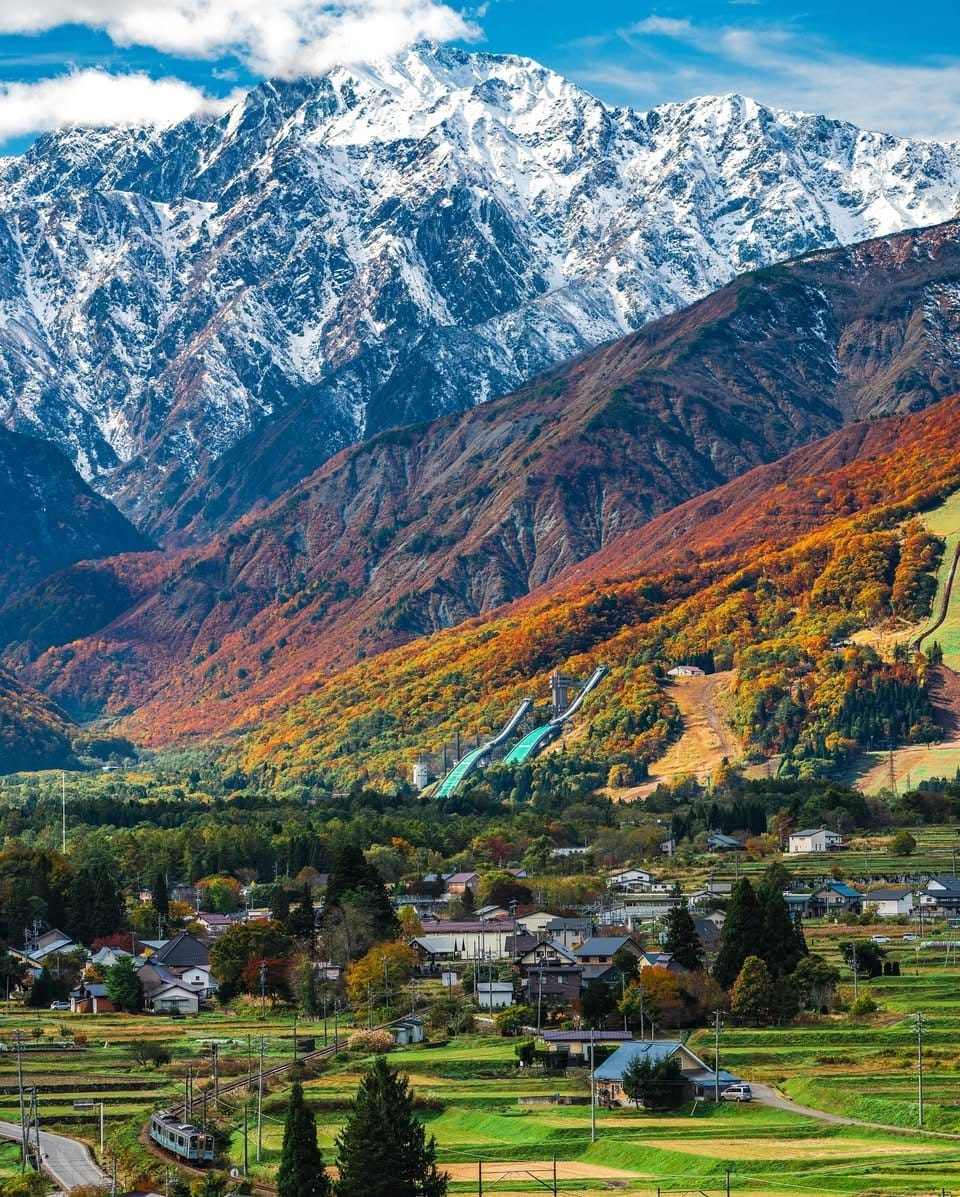
Hakuba in Autumn: Getting There, Lift Tickets, and the Final Operating Day
Take the Shinkansen to Nagano followed by an Alpico bus, the Ooito Line from Matsumoto, or a night bus from Shinjuku: which route to choose, how to buy gondola tickets, and how to time your visit before the mountain closes.
Aug 12, 2026·✍️ olablog·⏱ 19 min read
Take the Shinkansen to Nagano followed by an Alpico bus, the Ooito Line from Matsumoto, or a night bus from Shinjuku: which route to choose, how to buy gondola tickets, and how to time your visit before the mountain closes.
Tap a region to browse articles
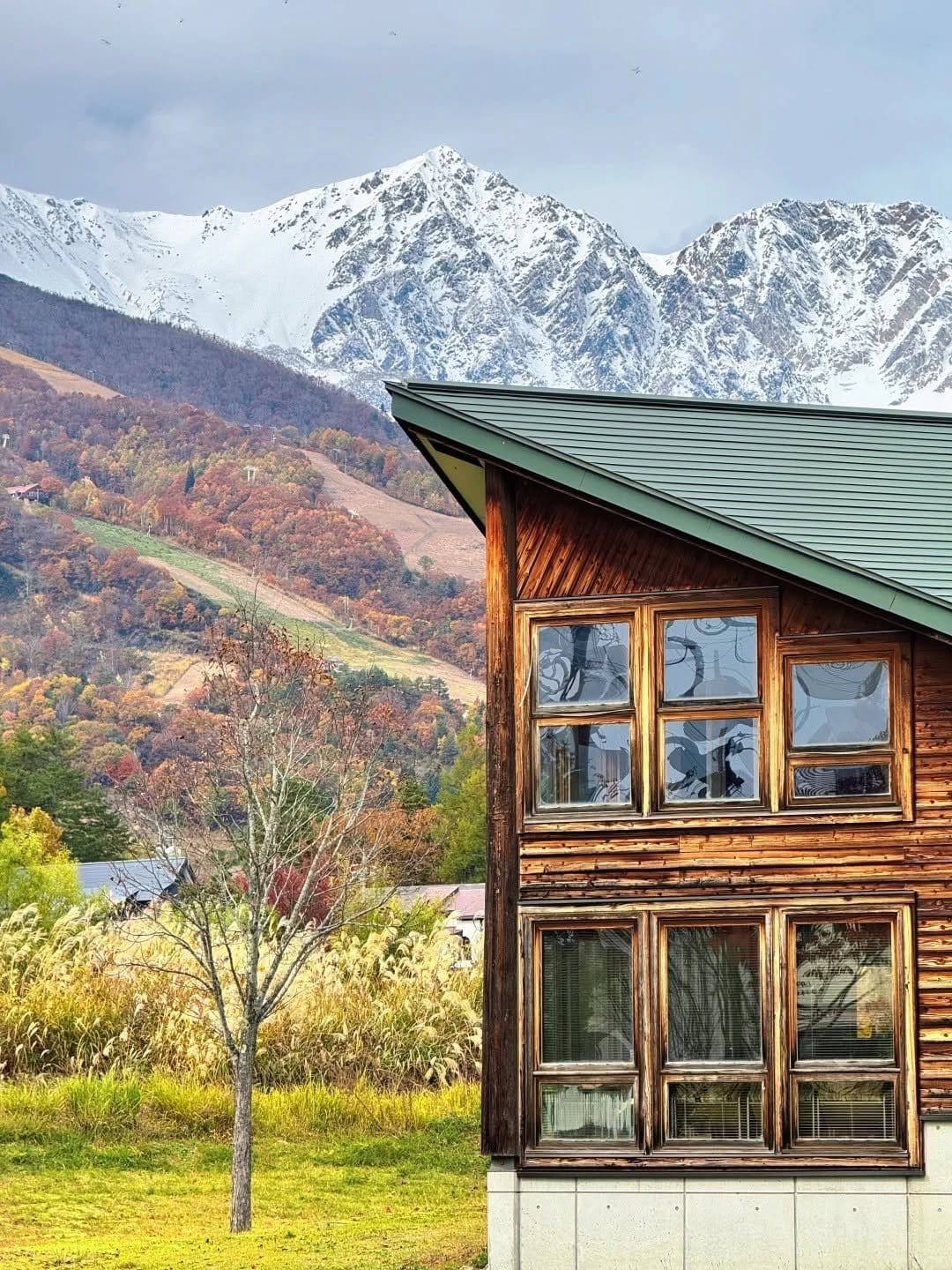
There is a very particular kind of disappointment that comes with autumn in the mountains: you fly over from Vietnam, or take the train up from Tokyo, and find yourself at the foot of Hakuba on a perfectly clear morning — the fall colors are still glowing across the slopes and the sunlight is beautiful — but the gondola cabin hangs motionless on its cable, the ticket counter is closed, and an A4 sheet taped to the window says the final operating day passed three days ago. It is not because of rain or a storm. The green season has simply ended, and the entire valley is shifting into preparation mode for winter.
That is Hakuba. It is not a year-round destination like Kyoto or Hakone, but a ski valley that "does overtime" in summer — autumn. In other words, from around late May to early November, the lifts open for hikers, sightseers, and cyclists; then they shut down completely for a few weeks of maintenance, net installation, and snow preparation. The gap between those two seasons is the trap that catches many independent Vietnamese travelers, especially anyone timing their trip around Tokyo's fall foliage calendar — where koyo peaks in late November, a full month and a half later than in Hakuba.
This article is not about hiking routes or photo spots. It focuses on the two things that determine whether your trip goes smoothly or falls apart: how to get to Hakuba in a way that fits both your budget and your schedule, and how to buy lift/gondola tickets without wasting money or missing the final ride. All the figures below are reference levels based on recent seasons — Hakuba publishes its ticket prices and operating schedules again each year, so you still need to check the official website for each resort before you go. Think of this article as a mental map, not a price list.
First: Where is Hakuba, and how many entry points are there?
Hakuba (白馬村, Hakuba-mura) is a small village in Nagano Prefecture, tucked against the foot of the Northern Alps. From a transportation standpoint, remember these three names, because they are not in the same place:
- Hakuba Station (JR Hakuba) — the station for the Ooito Line, located in the center of the village.
- Happo Bus Terminal — the main stop for buses from Nagano and Tokyo, about a few minutes' walk to more than ten minutes from Hakuba Station, depending on the direction.
- The bases of the lift areas — Happo-one, Iwatake, Tsugaike, Goryu... scattered around the valley, anywhere from a few minutes to more than thirty minutes by car from the village center.
That alone should explain why "getting to Hakuba" and "getting to the gondola base" are two different problems. Once you book your hotel, ask directly whether they offer a shuttle (送迎) to the bus terminal/station — most Hakuba accommodations do, and in autumn there is almost always space because visitor numbers are far lower than in winter.
From Tokyo, there are three practical routes. I will cover them from fastest to cheapest.
Route 1: Hokuriku Shinkansen to Nagano, then an Alpico bus
This is the most popular route, and the one I recommend to most first-time visitors.
Shinkansen leg: Tokyo → Nagano
The Hokuriku Shinkansen runs from Tokyo Station (as well as Ueno and Omiya) to Nagano. The fastest service is Kagayaki, taking about 1 hour 20–1 hour 40 minutes; Hakutaka is slightly slower because it stops at more stations. A one-way ticket in a reserved regular seat costs around 8,000–8,700 yen, depending on the season and seat type.
A few points worth noting:
- Kagayaki has reserved seats only and no non-reserved cars. If you are used to simply arriving at the station and boarding a jiyuseki car, you need to reserve a seat on Kagayaki. Hakutaka does have non-reserved cars.
- On fall-foliage weekends, the Tokyo–Nagano section can be quite busy because it overlaps with the pilgrimage season at Zenkoji Temple. Reserve your seat a day or two in advance to be safe, especially for early-morning trains.
- If you have a nationwide JR Pass, this leg is covered (except Kagayaki with some special fare categories — ask at the midori no madoguchi counter). If you live in Japan and are only traveling around this area, also check JR East regional passes (the type covering Nagano – Niigata) or the Hokuriku Arch Pass if your itinerary continues to Kanazawa/Osaka. For Japan residents, these regional passes can sometimes be considerably cheaper than buying individual tickets if you are taking at least two long-distance legs.
Bus leg: Nagano → Hakuba
After exiting the ticket gates at Nagano Station, head toward the Zenkoji-guchi (善光寺口) — the side with the large plaza and bus terminal. The Hakuba bus is operated by Alpico Kotsu (the Nagano – Hakuba – Otari route), taking about 1 hour to 1 hour 15 minutes to reach Happo Bus Terminal, with a one-way fare of around 2,000 yen. Buses run throughout the day. They are less frequent in autumn than in winter, but still adequate, usually with several departures each part of the day.
Practical tips for this leg:
- The boarding stop number (nori-ba) may change depending on the season and construction work around the station plaza. Do not memorize a number from an old article online — check the electronic board or ask the Alpico counter at the terminal. Staff are on hand and can manage basic English.
- You can buy a ticket at the counter before boarding, which is more convenient than paying on the bus. Have cash ready — not every service accepts IC cards or credit cards, and in the mountains you should not count on being able to tap your card.
- This bus is not covered by the JR Pass. It is an unavoidable extra cost, even if you have a pass.
- The bus continues toward Tsugaike/Otari after passing through Hakuba. If your hotel is in the Tsugaike area, stay on board rather than getting off at Happo and taking another bus.
- If you are traveling in a group of 3–4 and arrive during a busy period, consider a taxi from Nagano Station. It is much more expensive and rarely worthwhile, but it can save you if you miss the final bus.
The total Tokyo → Hakuba journey on this route takes around 3 hours door to door, at a cost of around 10,000–11,000 yen one way. Fast, dependable, and low-risk.
Route 2: The Ooito Line from Matsumoto — slow, affordable, and scenic
If you are not in a hurry, or already have an itinerary through Matsumoto (Matsumoto Castle, Kamikochi, Norikura), this is the most scenic route.
Getting to Matsumoto first
The Azusa limited express runs directly from Shinjuku to Matsumoto, taking about 2 hours 40 minutes and costing around 6,500–7,000 yen. From Nagoya, take the Shinano. One interesting detail: depending on the season, some Azusa services run all the way to Hakuba/Minami-Otari without requiring a transfer — the schedule changes with each timetable revision, so it is well worth checking the JR East website before you go. If you catch a direct service, the journey becomes much easier.
Ooito Line leg: Matsumoto → Hakuba
The Ooito Line (大糸線) is a local railway that follows the valley alongside rivers and lakes. It takes around 1 hour 30 minutes to 2 hours to reach Hakuba Station and costs around 1,200 yen. These are typically two-car trains with longitudinal or paired seating. They run slowly and have large windows — in autumn, the section around Lake Kizaki and Lake Aoki feels like sitting inside a film.
But the main drawback is worth stating plainly: services are infrequent. There can be gaps of more than an hour during the day, and some trains only go as far as an intermediate station, requiring you to wait for a connection. Missing a train here is not like missing one in Tokyo — you can lose an entire half-day. The golden rule is: lock in the train times first, then plan the rest of your schedule, not the other way around.
As for passes: the Ooito Line is a JR line and is covered by the nationwide JR Pass; the section north of Minami-Otari belongs to JR West, while the section south of it belongs to JR East. This only matters if you are using a regional pass, but check the coverage carefully before buying one.
Route 3: Highway and night buses from Tokyo — the cheapest option
Highway buses run directly from Busta Shinjuku to Hakuba, taking around 4.5 – 5.5 hours depending on traffic. Fares vary widely by date and seat class — around 5,000 – 8,000 yen one way is a common range, with weekdays significantly cheaper than weekends.
As for night buses: this is where many people get confused. Tokyo–Hakuba night buses run frequently during the snow season (roughly December through March), when the valley is at peak demand. In autumn, there are far fewer night services, and during some periods there are almost none, while sale dates can also be unpredictable. So do not assume that "you can just go to Shinjuku and find a night bus to Hakuba" — check the operator's website or an aggregated bus-ticket site in advance. If there is no night service, switch to the earliest daytime bus.
Buses suit travelers on a tight budget, or solo travelers who would rather avoid calculating multiple train and station changes. They are less suitable for people prone to motion sickness, anyone with a rigid schedule (buses can be delayed by mountain roads and weekend traffic), or travelers who want to head straight up the mountain on their first morning — night buses usually drop you off in the early hours, before the cafés and ticket counters have opened.
Quick comparison of the three routes
| Route | Travel time | One-way cost (reference) | Best for |
|---|---|---|---|
| Shinkansen + Alpico bus | ~3 hours | ~10,000–11,000 ¥ | Most travelers, short trips, JR Pass holders |
| Azusa + Ooito Line | ~4.5–5 hours | ~7,500–8,500 ¥ | Combining Matsumoto with Hakuba, scenic travelers |
| Highway bus from Shinjuku | ~4.5–5.5 hours | ~5,000–8,000 ¥ | Tight budgets, direct travel |
A small trick frequent travelers often use: take one route there and another route back. Go up by Shinkansen to save time on the first day, then return via the Ooito Line and Matsumoto, visit Matsumoto Castle, and take the Azusa back to Shinjuku. You get two different kinds of scenery on the same trip, with almost no change in the overall cost.
Getting around the valley
This is the part people often overlook. Hakuba stretches out across a wide area, and the lift areas are quite far apart.
- Local buses connect the main areas (Happo, Iwatake, Goryu, Tsugaike) during the high season, but autumn service is less frequent than winter service. Check the timetable as soon as you arrive and take a screenshot.
- Hotels and pensions often run morning shuttles for guests to the gondola bases — ask before booking. This can save you thousands of yen per day.
- Renting a car is the most flexible option for groups of 3 or more with an international driver's license or a Japanese license. Roads are generally dry in autumn, so winter tires are not yet necessary — but toward the end of the season, reconsider if snow is forecast at higher elevations.
- Taxis are not plentiful in Hakuba; ask your hotel to call one.
Gondola and ropeway tickets in autumn: three peaks worth visiting
Hakuba's green season (summer – autumn) usually opens around late May or June and closes around late October – early November, depending on the area. These are the three best-value options in autumn:
Happo-one — the classic mountain-view gateway
From the base, take the Adam gondola, followed by two chairlift sections to reach an elevation of just over 1,800 meters — the starting point for the trail to Happo Pond. A recent round-trip ticket for the full route (gondola + two lifts) costs around 3,000–3,600 yen; a gondola-only ticket is considerably cheaper.
Important: the gondola and lifts operate on different schedules, and the final descent of the upper lift is usually earlier than the gondola's final descent. Many people hike up to Happo Pond, get carried away taking photos, then return too late and miss the lift, leaving them to walk a long section downhill as darkness falls. Ask the staff when you buy your ticket: "What time is the final ride down?" Then set an alarm for 60 minutes earlier.
Tsugaike — the earliest closing area
At Tsugaike, take a gondola followed by a ropeway up to an alpine marshland at around 1,900 meters. A full-route round-trip ticket costs around 3,500–4,300 yen — the most expensive of the three — but this is also where you get the most beautiful "three layers of color" and the easiest boardwalk trail.
The key point: Tsugaike is usually the first area to close for the season, because of its higher elevation and earlier snowfall. In some years, the mountaintop nature park stops admitting visitors from around late October, while Happo-one and Iwatake continue operating for another week or two. If your trip falls from late October onward, verify Tsugaike first, then schedule the remaining days.
Iwatake — the easiest option, ideal for families and non-hikers
The Noa gondola takes you to the summit of Iwatake, where a viewing deck projects from the mountainside with a direct view of the Northern Alps, along with a café/bakery. A round-trip ticket costs around 2,000–2,600 yen. There is no hiking required: step off the gondola, enjoy the viewpoint, have a coffee, take some photos, and ride back down.
This is the perfect fallback for a day with poor weather (it is still manageable in light rain), families with young children, older travelers, or an afternoon after an exhausting morning hike at Happo.
Which combo tickets are worth buying, and which are not?
Hakuba offers several types of bundled tickets, and the right choice depends on how long you are staying:
Bus + lift bundles sold at Nagano Station. Depending on the season, the Alpico counter at Nagano Station sells sets combining a round-trip Nagano – Hakuba bus ticket with a gondola ticket for one area. If your plan is "a day trip from Nagano, visit one peak, then return," this usually saves a few hundred to more than a thousand yen and means you do not have to queue at two ticket counters. Worth buying.
Multi-mountain passes in Hakuba Valley. The areas in the valley belong to the same alliance, so seasonal passes are sometimes available for use at several peaks, occasionally with restaurant discounts included. The break-even point is generally from the second peak onward: if you are staying two nights and visiting two or three different areas, buy one; if you are visiting one peak on a single day, individual tickets are cheaper. The name and price of this pass change from season to season, so do not search for an old name on blogs. Go to the official Hakuba Valley website or ask at the first ticket counter you reach.
Multi-day passes for one area. Only worthwhile if you are basing yourself in one area for several days of hiking — uncommon for short autumn trips.
Discount vouchers. Many hotels, pensions, and guesthouses in Hakuba provide lift-ticket discount vouchers for staying guests. This is the easiest saving that everyone forgets: just ask the front desk when you check in. Some bus companies also include coupons with their tickets.
The general rule: do not buy a combo ticket before checking the weather. Mountain weather can change very quickly in autumn. Buy a three-peak bundle and then get two days of fog, and the ticket cost becomes a tuition fee.
The final operating day — the biggest trap
This is why this article exists. To be perfectly clear:
- The green season ends earlier than you think. At higher elevations, the fall colors are beautiful from around late September to mid-October; in the valley, they last until early November. But the lifts generally stop operating sometime between late October and early November, with different closing dates for each area. This means the valley foliage may still be beautiful after the lifts have closed.
- The gap between seasons is a real shutdown. From the end of the green season until the snow season begins (usually after enough snow accumulates, around December), most lifts, some restaurants, and equipment-rental shops in Hakuba close. The village becomes very quiet. Visiting during this window is not wrong, but you need to know what to expect.
- The closing date can be moved forward. Storms, strong winds, and early snowfall can all cause the final operating day to be brought forward from the published schedule. The closer you get to the end of the season, the higher the risk.
- Operating hours also shrink as the season progresses. As autumn advances, the days get shorter, the first service starts later, and the final service ends earlier than it does in August. Do not reuse operating hours you found in an article about summer.
The safest way to check is to follow this order:
- 2–3 weeks before your trip: visit the official websites for Happo-one, Tsugaike, and Iwatake and look for the green-season operating calendar (営業期間 / グリーンシーズン) to find the expected final operating day.
- 1 week before: check the latest foliage report to see how far the colors have progressed up the mountain, then choose the area that matches.
- The night before and the morning of your visit: check the day's operating notice (運行状況) again — mountain lifts may stop because of strong winds even when the weather in the village remains beautiful.
Sample 2-day, 1-night itinerary without a car
Day 1. Leave Tokyo on an early-morning Shinkansen, reach Nagano around mid-morning, and take the Alpico bus to Hakuba before noon. Leave your luggage at the hotel (or in a locker near Happo Bus Terminal), grab a quick lunch, then head to Iwatake in the afternoon — an easy introduction to the area, with sunset views from the observation deck. Return to the village in the evening for soba and an onsen soak.
Day 2. Get up early and take the first gondola of the day at Happo-one (the clearest time of day, before the clouds build), hike to Happo Pond, and return before the upper lift's final service. Have a late lunch, take the bus back to Nagano, visit Zenkoji Temple if you still have time, and take an evening Shinkansen back to Tokyo.
If you have a third day, add Tsugaike in the middle — and remember to prioritize Tsugaike early in the trip because it closes for the season first.
Common mistakes
- Timing the fall colors according to Tokyo's calendar. Hakuba peaks about a month and a half earlier. Visiting in late November almost certainly means missing them.
- Leaving the bus leg out of your budget because "you already have a JR Pass." The Alpico bus is not covered by the pass.
- Booking a hotel in "Hakuba" without checking the map. Some places are more than a dozen kilometers from the bus terminal and gondola bases.
- Wearing canvas shoes to Happo. The trail to the pond is a genuine rocky mountain path. Sneakers are sufficient for Iwatake and Tsugaike.
- Dressing for the temperature in the village. It is noticeably colder at higher elevations, with strong winds; always bring a windproof layer.
- Not having a backup plan in case the lifts stop because of wind. Prepare valley alternatives: Lake Aoki, onsen, mountain-view cafés.
Frequently asked questions
When is autumn at its best in Hakuba? The higher areas (Tsugaike and the area around Happo Pond) are usually at their best from around late September to mid-October; the colors spread down into the valley from around late October to early November. The timing shifts by a few days each year depending on the weather, so check the foliage report before finalizing your tickets.
Is Hakuba worth visiting if I have a JR Pass? Yes, but the pass only helps with the Shinkansen and Ooito Line legs. The Nagano – Hakuba bus must still be purchased separately, at around 2,000 yen each way. If you live in Japan and are only visiting this region, compare JR East's regional passes with the nationwide pass before buying one.
Do night buses from Tokyo to Hakuba operate in autumn? There are far fewer than in the snow season, and during some periods there are almost no services. Check the operator's ticketing website in advance; if there is no night service, take a daytime highway bus from Busta Shinjuku or switch to the Shinkansen.
Can I buy gondola tickets online in advance? Some areas sell electronic tickets depending on the season, but autumn tickets rarely sell out, so buying at the counter is perfectly fine — and often more flexible because you can decide based on the day's weather. Check the official website; if advance tickets are available, buying one can save you some time in line.
Which peak should I visit if I only have one day? If you can walk and the weather is good: Happo-one. If you are traveling with young children, older people, or uncertain weather: Iwatake. If you arrive in early October and want the best alpine-marsh scenery: Tsugaike.
What is there to do once the lifts have closed? There is still plenty to do: the road around Lake Aoki, Lake Kizaki, mountain-view cafés, village onsen, and Olympic museums/historic sites. You simply will not be able to reach the higher elevations — so if your main goal is mountain scenery, avoid the transition period.
Can I make a day trip from Tokyo? Technically yes, but it is very rushed: with around 3 hours each way, plus the time needed to ride the lifts, you will have only a few hours on the mountain and will need to catch the final bus back to Nagano with very little margin. Staying one night is much easier and is also the only way to catch the first gondola in the morning — the clearest time of day.
More from this region — Chubu (Nagano, Kanazawa)
View all →
Hakuba in Autumn: Choose the Right Dates for Fewer Crowds and Much Lower Prices
18 min · tips
Hakuba in Autumn: Gentle Walks for Three-Generation Families
18 min · tips
Hakuba Changes Color by the Week: A Leaf-Peeping Calendar from Summit to Valley
17 min · tips
What to Eat in Hakuba in Autumn — Fresh Soba, Wild Mushrooms, Shinshu Apples
20 min · tips