
Kamikochi–Hakuba 2-Day Autumn Tour: Should You Take a Tour or Go Independently?
A 2-day, 1-night Kamikochi–Hakuba group tour from Tokyo in autumn, ¥15,000 per guest: an honest comparison of going independently versus taking a tour, the best fall foliage season, and the 15/11 closing date.
Aug 12, 2026·✍️ olablog·⏱ 11 min read
A 2-day, 1-night Kamikochi–Hakuba group tour from Tokyo in autumn, ¥15,000 per guest: an honest comparison of going independently versus taking a tour, the best fall foliage season, and the 15/11 closing date.
Tap a region to browse articles
Every autumn, the question OlaChill gets most often isn’t “Is Kamikochi beautiful?”—anyone who has seen the photos already knows it is. The real question is: should you take a tour or go independently? This article is here to help you answer that for yourself, even if your final answer is, “Actually, I’ll go on my own.” We do sell a 2-day, 1-night Kamikochi–Hakuba autumn tour for ¥15,000 per guest, departing from Tokyo from 1/9/2026—but most of this article is about transportation, fall foliage, and the genuine inconveniences involved, not a sales pitch.
Why combining Kamikochi and Hakuba makes sense
Many people look at the itinerary and ask: why not spend both days enjoying Kamikochi? The answer lies in the geography and in the fact that these two destinations offer completely different kinds of scenery—even though they are both in Nagano Prefecture.
Kamikochi: a 1,500m-high valley glowing with golden karamatsu
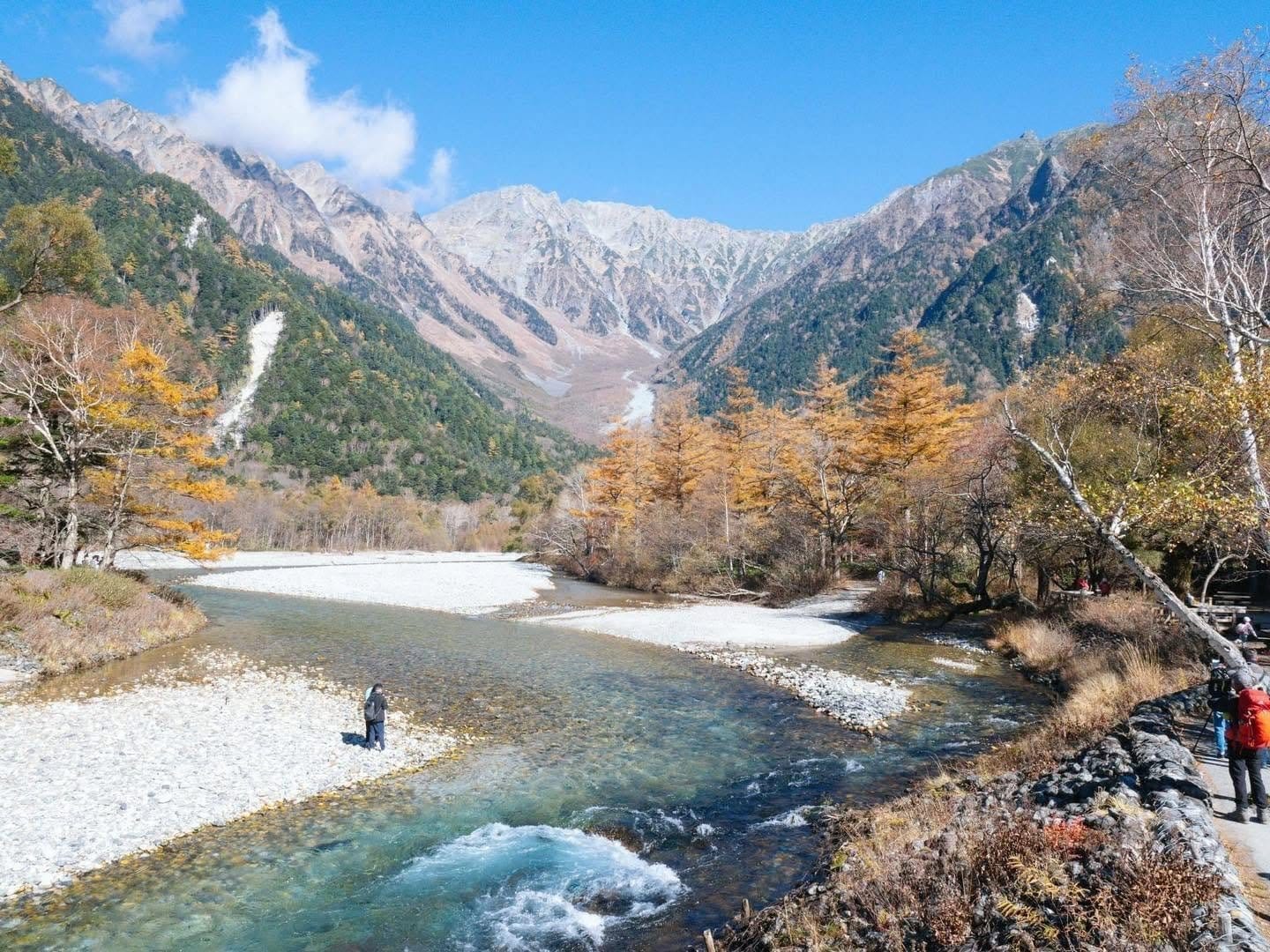
Kamikochi is a valley at an elevation of around 1,500m, within Chubu-Sangaku National Park. The Azusa River runs through it in a distinctive jade green, with the sheer cliffs of the Hotaka Range rising above. The best thing about Kamikochi is its almost entirely flat riverside walking trails—there’s no mountain climbing involved, no trekking experience is necessary, and older travelers and families with children can manage them comfortably.
In terms of color, Kamikochi isn’t the kind of place with brilliant red momiji leaves that you see in Kyoto. The dominant tree here is karamatsu (deciduous larch)—a conifer that turns yellow before shedding its needles in autumn. The mountainsides become coppery gold, reflected in the waters of Taisho Pond. It’s a cool, open, slightly wild kind of beauty—very different from the warm, vivid reds many people picture when they hear the words “Japanese autumn.”
Hakuba: “three-layered autumn foliage” beneath the Northern Alps
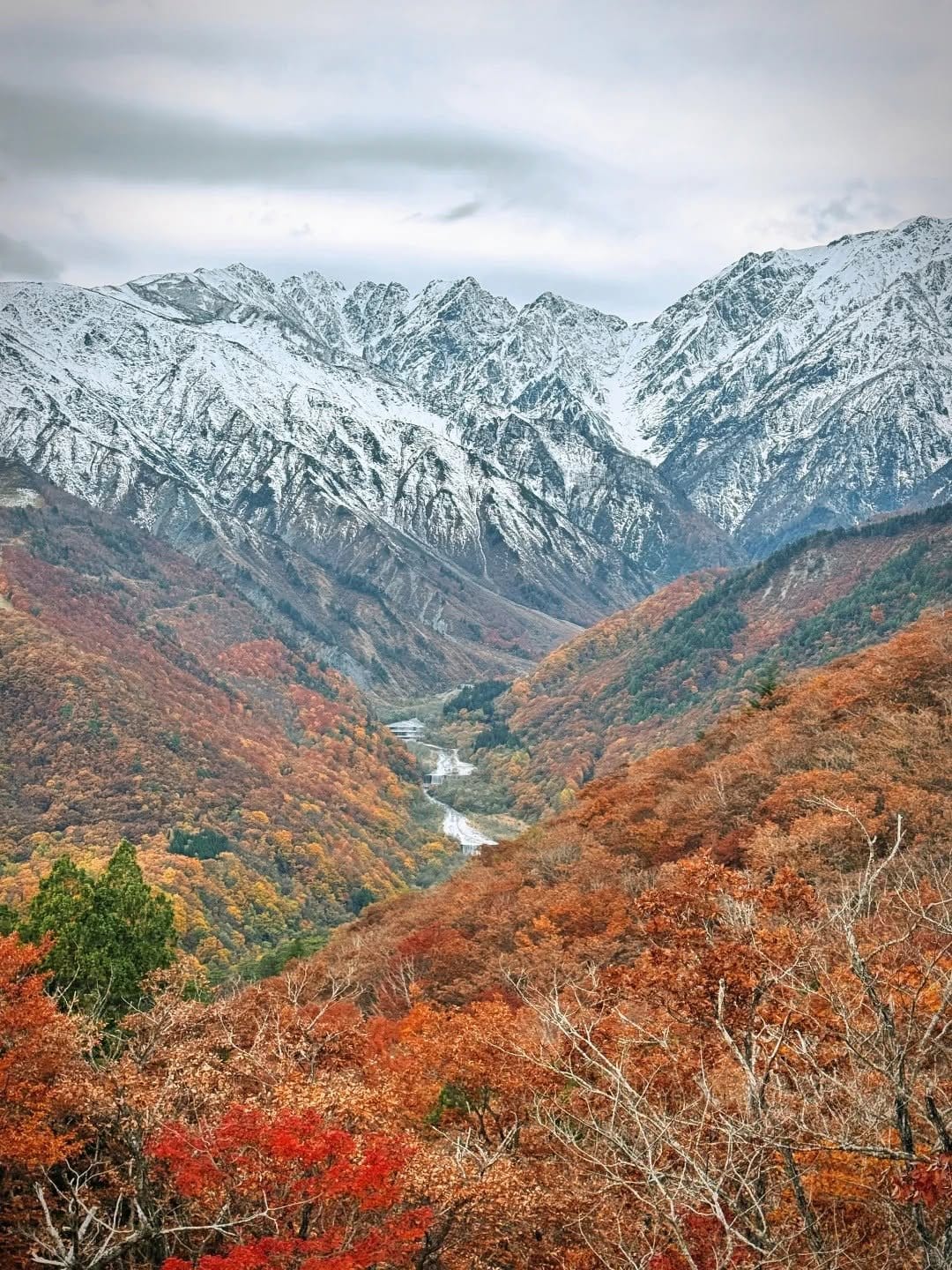
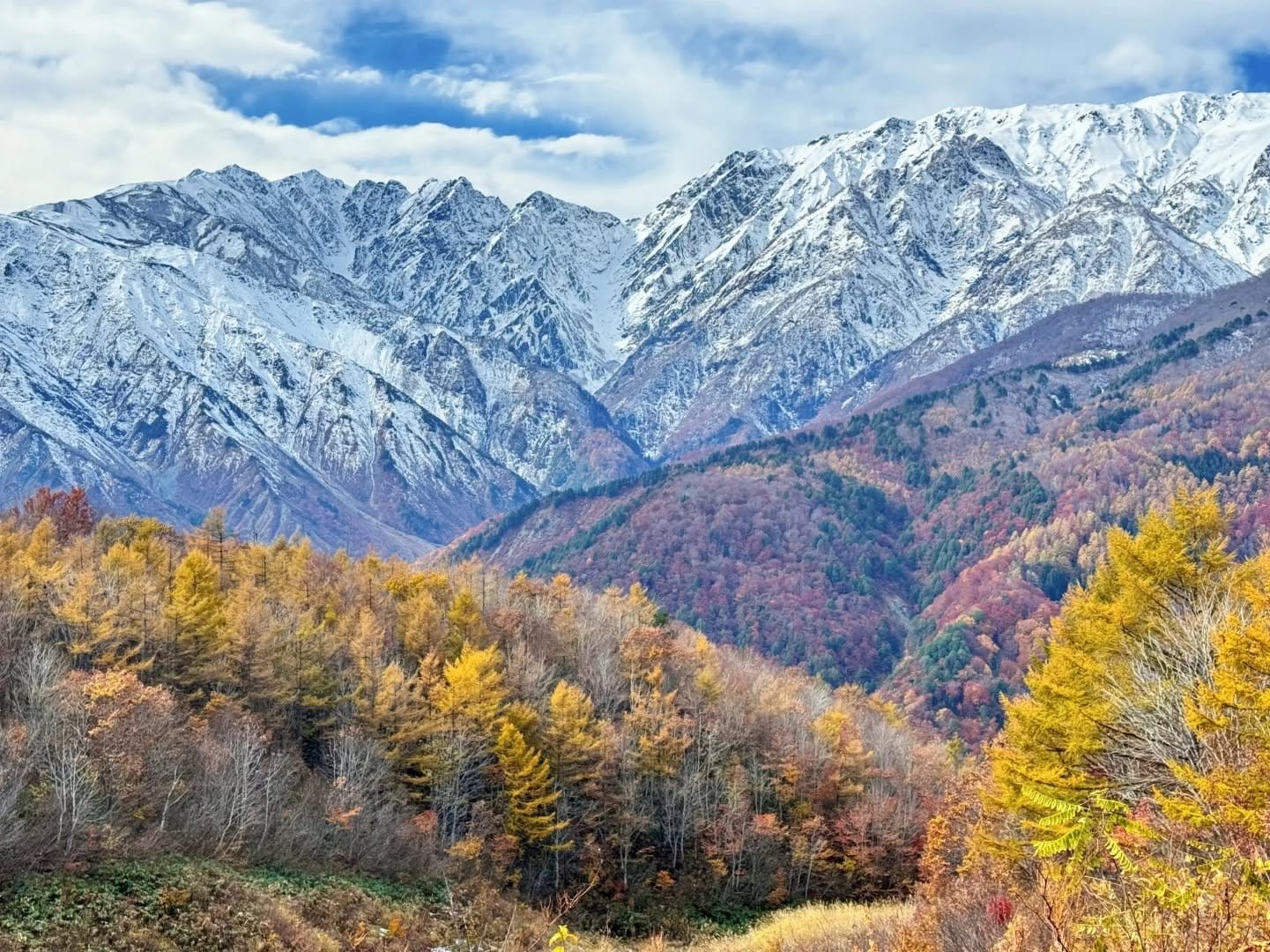
Hakuba is a village at the foot of the Northern Alps, best known for its ski season. But in late October, Hakuba offers a scene that very few places in Japan can match: three-layered autumn foliage.
- Top layer: mountain peaks dusted with the first snow of the season.
- Middle layer: mountainsides covered in yellow and red leaves.
- Bottom layer: valleys and villages that are still green, with the fields yet to change color.
Three bands of color stacked within a single frame. That’s why Japanese photographers head to Hakuba during the final two weeks of October—and why combining these two destinations in one trip is worthwhile: you get both the scenery looking up from inside the valley (Kamikochi) and the scenery looking across at the entire mountain range (Hakuba), rather than seeing the same type of view twice.
Traveling independently from Tokyo: where the real difficulty lies
This is the part we want to discuss frankly, because going independently is entirely possible—it’s just important to understand what you’re trading off.
For the Tokyo-to-Kamikochi leg, independent travelers generally take one of two routes:
- Take the Shinkansen to Nagano, then change transportation toward Matsumoto before catching a bus.
- Or take a train to Matsumoto, then catch a bus from there up into the mountains.
The key point many people don’t discover until they start planning: private vehicles are prohibited around Kamikochi year-round. It isn’t a seasonal restriction or a time-based restriction—it’s a complete ban. To enter, everyone has to leave their vehicle at a transfer parking lot in Sawando (on the Matsumoto side) or Hirayu (on the Takayama side), then take a shuttle bus or taxi into the valley. So even if you rent a car and drive from Tokyo, you still have to get out and wait for a connecting vehicle for the final stretch.
The Kamikochi-to-Hakuba leg is even more complicated. Although both destinations are in Nagano Prefecture, they lie on opposite sides of the prefecture, and there is no convenient direct connection. Traveling independently often takes most of the afternoon just to get from one place to the other and make the connections—and mountain buses run on fixed schedules, so missing one bus can cost you half a day.
Put it all together, and a 2-day independent trip can easily turn into one where you spend half of each day on transportation, leaving little time actually immersed in the scenery. Cost-wise, the round-trip train fare from Tokyo plus the mountain-bus segments often comes to as much as or more than the tour price, even before adding one night at a Hakuba hotel during peak foliage season.
In return, traveling independently gives you something a tour can’t: freedom. You can sit beside the Azusa River for two hours if you like, walk farther toward Myojin or Tokusawa, or stay an extra night in Hakuba. For people who love long-distance walking and don’t mind checking mountain-bus timetables, going independently is the right choice.
What you gain—and give up—by taking a tour
Let’s start with the benefits, then go into the drawbacks in more detail—because the drawbacks are what will help you decide.
Benefits:
- A round-trip seat from Tokyo Station, with no need to monitor train times or drag your luggage through three transfers.
- The shuttle into Kamikochi is arranged in advance—you won’t have to queue to buy a ticket at the transfer parking lot during the busiest season.
- One night at a Hakuba hotel is booked for you, right when rooms in Hakuba are hardest to secure all year.
- An English-speaking tour leader accompanies the group, and OlaChill provides support in Vietnamese via LINE/Zalo throughout the trip—so you can manage even if you don’t speak Japanese.
- Minimum 1 guest, so solo travelers can book too; payment is made on site.
Drawbacks:
- This is a group tour. You’ll be traveling with strangers from different countries, and the whole group has to follow a shared schedule. It’s not ideal if you want complete privacy.
- You don’t control the timetable. See a beautiful stretch of river and want to stay another 40 minutes? You can’t. The vehicle leaves on schedule, and the morning meeting time at Tokyo Station is early.
- The order of stops may change depending on the weather and mountain traffic. We deliberately don’t promise an hour-by-hour itinerary, because if we did and then encountered a traffic jam or heavy rain, it would be an empty promise.
- You can’t choose the hotel. This is a standard Hakuba hotel for one night, not a luxurious onsen ryokan.
- There is no long trekking. You’ll walk approximately 4–6 km per day on flat paths. If you want to climb the peaks of the Hotaka Range, this tour won’t meet your needs.
- The foliage color cannot be guaranteed. The timing of the color change depends on the weather each year and can vary by an entire week. No one—even locals—would dare promise that a specific day will be the most beautiful.
- Meals and the Happo gondola are not included. The gondola is optional and costs approximately 1.700–3.000 yen, payable on site if you want to go higher.
When to go and the essential date to remember
If you remember only one thing from this entire article, please remember this: Kamikochi closes for winter on 15/11. After that date, access to the valley stops, accommodation facilities close, and you won’t be able to enter again until the following spring. All autumn plans must end before this date.
Other key periods:
- Golden karamatsu foliage in Kamikochi: usually in late October. This is when the valley is at its most beautiful—and its busiest.
- “Three-layered autumn foliage” in Hakuba: usually during the final two weeks of October, when the peaks have just received their first snow but the foothills have not yet lost their color.
- September and early October: not much foliage has changed color yet, but there are fewer visitors and the mountains are clearer—an unfairly underrated time to visit.
- Early November: the high-elevation foliage has passed its peak, but the lower areas can still be beautiful, while the snow on the peaks is deeper.
To be frank: if you’re betting on the exact week with the best foliage, accept that it’s a weather gamble. A safer approach is to choose dates that fit your schedule, then treat beautiful foliage as an added bonus.
What the trip looks like (by leg, not by hour)
Day 1—Tokyo to the valley. Meet at Tokyo Station on the Marunouchi side in the morning, then travel directly toward Nagano before taking the shuttle into Kamikochi. The afternoon is spent at Taisho Pond, where dead tree trunks stand in the water with Mount Yake reflected behind them, followed by a walk along the Azusa River to Kappa Bridge, Kamikochi’s iconic viewpoint. In the late afternoon, leave the valley and travel to Hakuba for check-in.
Day 2—morning in the mountains, then back. In the morning, head up to the Happo highlands above Hakuba village, where you can enjoy open views across the Northern Alps. Those who want to go higher can purchase a gondola ticket on site. The vehicle then returns to Tokyo, arriving at the station in the evening.
The price of ¥15,000 per guest includes round-trip transportation from Tokyo Station, the shuttle into Kamikochi, one night at a Hakuba hotel, and an English-speaking tour leader. Meals, the Happo gondola ticket, and personal expenses are not included.
What to bring
This is one of the most overlooked parts—and also one of the things that causes people the most trouble in the mountains.
- Clothing you can layer. Kamikochi is at 1,500m, and Hakuba is higher still. In the early mornings of October–November, temperatures can drop to around or below 0°C while Tokyo is still 20°C. Bring thermal underwear, a light down jacket or fleece, and a windproof outer layer—you’ll be taking layers off and putting them back on throughout the day.
- Walking shoes or sneakers with good traction. The paths are flat, but some sections are damp, with exposed roots and dew. Thin canvas shoes or sandals will be very uncomfortable.
- A raincoat or waterproof jacket. Mountain weather changes quickly, and an umbrella is practically useless in strong winds.
- Thin gloves and a wool hat. They take up little space but make a big difference during mornings in Happo.
- Water, snacks, cash, and a portable charger. Facilities are limited in the mountains, not every place accepts cards, and cold weather drains your phone battery faster than usual.
Who this tour is—and isn’t—for
A good fit for:
- Travelers based in Tokyo or visiting Tokyo who have only one free weekend and want to see real mountains rather than mountains viewed from a distance.
- First-time visitors who aren’t used to checking Japanese mountain-bus timetables or who don’t speak Japanese.
- Families with older adults or children who can walk a few kilometers on flat paths.
- Solo travelers who want an arranged itinerary and don’t want to drive at night.
- Landscape photography enthusiasts who accept that foliage color is ultimately up to the weather.
Not a good fit for:
- Travelers who want long treks, summit climbs, or to camp in the mountains.
- People who need complete freedom with their schedule and can’t stand waiting for the group.
- Anyone expecting vivid red leaves like those in promotional photos on any day during the season.
- Travelers looking for a high-end onsen ryokan and kaiseki meals—this trip focuses on scenery and getting around, not relaxation.
- People with severe motion sickness: this trip involves many hours in a vehicle and winding mountain roads.
Conclusion: choose what suits you, not simply what is cheapest
If you have several days, enjoy organizing things yourself, and want to explore deeper into the valley at your own pace—going independently is the better choice, and we genuinely mean that. But if you only have two days and want to see both golden karamatsu forests and Hakuba’s three-layered scenery without having to solve the puzzle of connecting mountain buses, this group tour was designed precisely for that situation.
The tour runs from 1/9/2026, costs ¥15,000 per guest, requires a minimum of 1 guest, and accepts payment on site—and please remember the 15/11 deadline, because Kamikochi closes after that until the following season.
See departure dates and book here: 2-Day, 1-Night Kamikochi–Hakuba Autumn Tour
More from this region — Chubu (Nagano, Kanazawa)
View all →
Venus Line, Nagano – Japan's Most Breathtaking Highland Drive
5 min · tips
Tateyama Alpine Route Group Logistics: Drop-Off, Luggage and Snow Wall Planning
8 min · tips

Landing at Centrair on Match Day: A First-Day Plan With a Private Car
7 min · tips
Hosting VIP Guests at Aichi-Nagoya 2026: Alphard and Luxury Car Transfers
7 min · tips