

Chasing Tateyama’s Autumn Foliage Wave from Murodo Down to Lake Kurobe
Along the Alpine Route, autumn colors begin at 2.450m and gradually descend over six weeks; this guide explains how to check forecasts and choose the right week to head into the mountains.
Aug 12, 2026·✍️ olablog·⏱ 16 min read
Along the Alpine Route, autumn colors begin at 2.450m and gradually descend over six weeks; this guide explains how to check forecasts and choose the right week to head into the mountains.
Tap a region to browse articles
There’s a situation I come across quite often in Vietnamese community groups in Japan every autumn: someone eagerly plans a trip along the Tateyama–Kurobe Alpine Route in late October “to catch the autumn leaves,” only to reach Murodo and… stare in confusion. The shrubs have already lost their leaves, the mountain slopes have turned gray, and on some days snow has even covered the trails. Meanwhile, on that very same day, someone else standing below Kurobe Dam is taking photos of the brightest autumn forest of the year. Both travelers went during the “right season”; the only difference was their elevation.
That’s what makes Tateyama special — and also makes it a trap. The Alpine Route stretches from around 1.400m up to 2.450m, which means autumn doesn’t arrive just once along this route. It arrives four times, each wave separated by one to two weeks, gradually sliding from the peaks down toward the foothills. Once you understand the rhythm of that wave, you can avoid arriving after the leaves have fallen and choose your travel week deliberately, positioning yourself at the most beautiful elevation — or aim for the rare moment when the mountaintops are covered in snow while the mid-slopes are still blazing red.
In this article, I’ll break down Tateyama’s autumn-color schedule by elevation and by week, along with ways to check the latest forecasts close to your travel date, so you can plan your trip around whichever scenery matters most to you.
Why Tateyama’s autumn leaves follow elevation rather than the calendar
The principle is simple: leaves change color when nighttime temperatures drop and the day–night temperature range becomes sufficiently large. The higher the mountain, the earlier it gets cold, so autumn always begins at the summit and gradually spreads downward. In many other parts of Japan, the elevation difference isn’t large enough for you to feel this clearly. Tateyama is different: in a single ride involving a cable car, highland bus, and ropeway, you gain more than 1.000m in elevation — the equivalent of fast-forwarding or rewinding autumn by several weeks.
For visitors, the practical takeaway is that the right question isn’t “Which month should I visit Tateyama for autumn leaves?” but “Which elevation zone of Tateyama will be at its best that week?” Taking the route in the final week of September and taking it in the final week of October are almost completely different experiences in terms of scenery. There’s no “wrong” week — only expectations placed at the wrong elevation.
Another thing worth knowing is that the vegetation changes at each level. Up high at Murodo, above the tree line, “autumn leaves” actually means low shrubs and alpine grasses — what the Japanese call kusamomiji, or “grass autumn colors” — turning entire mountainsides wine-red, orange, and bronze-yellow. Farther down, broadleaf forests (maple, rowan, oak, and beech) become more abundant, creating a more traditionally “woodland” palette with denser canopies. So the best elevation also depends on the kind of scenery you enjoy.
The autumn-color schedule across four elevations: remember these four periods
A note first: the periods below reflect a pattern observed over many years, but they can shift by about one week depending on the weather (a prolonged warm year means later colors, while an early cold spell means earlier colors). Use this schedule to narrow down your travel week, then finalize your dates using updated forecasts — I’ll explain how to check them later.
Murodo (2.450m) — mid to late September
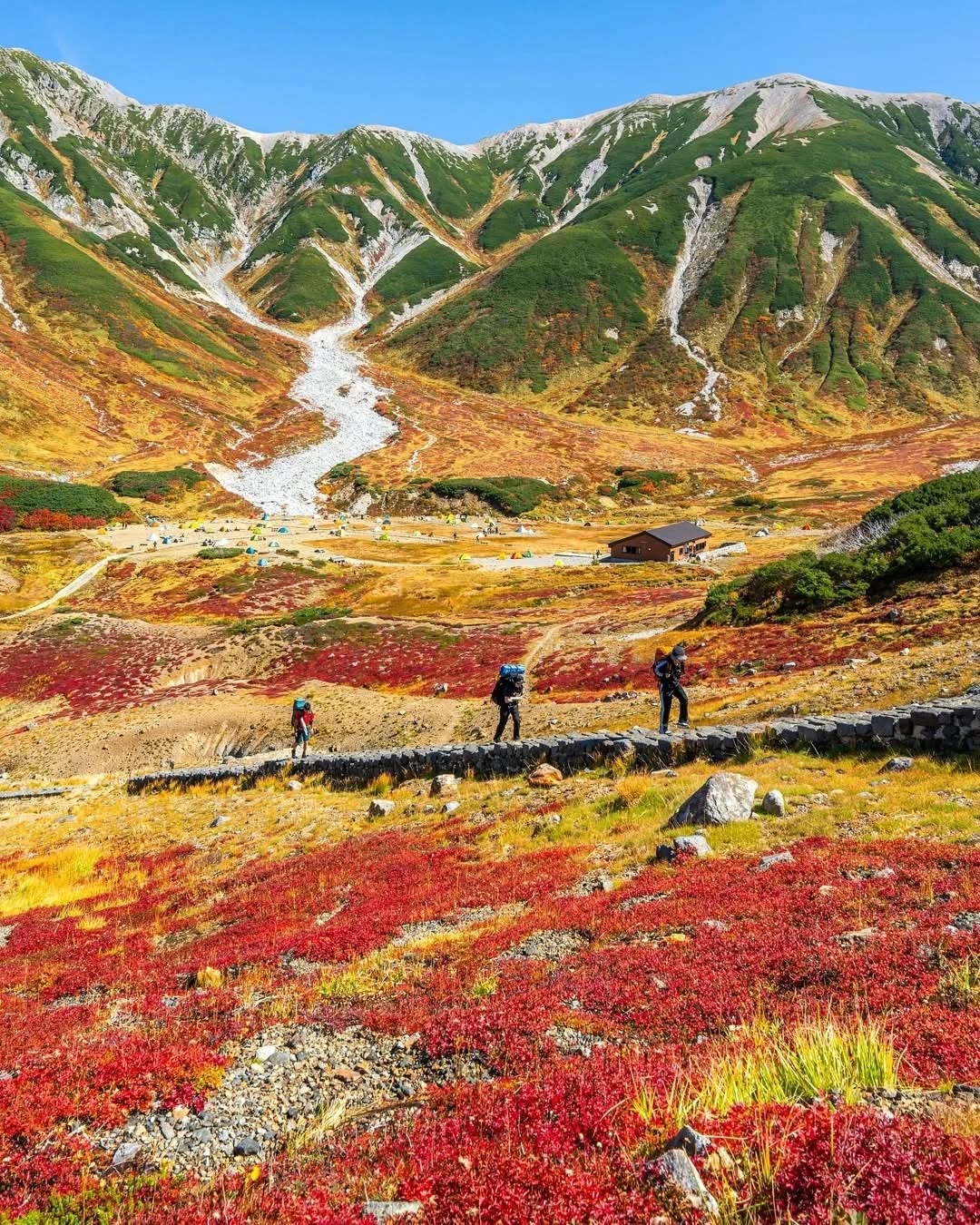
This is where autumn arrives first along the entire route, usually around mid-September, with the best colors generally appearing in late September. The scenery here is not a Kyoto-style red maple forest. Instead, an immense volcanic plateau gradually changes color: wine-red shrubs, golden-brown grasses, and patches of lingering evergreen, all backed by the imposing Tateyama mountain range. On calm days, Mikurigaike Pond reflects both the mountains and the autumn sky — for me, it’s one of the most worthwhile views anywhere along the route.
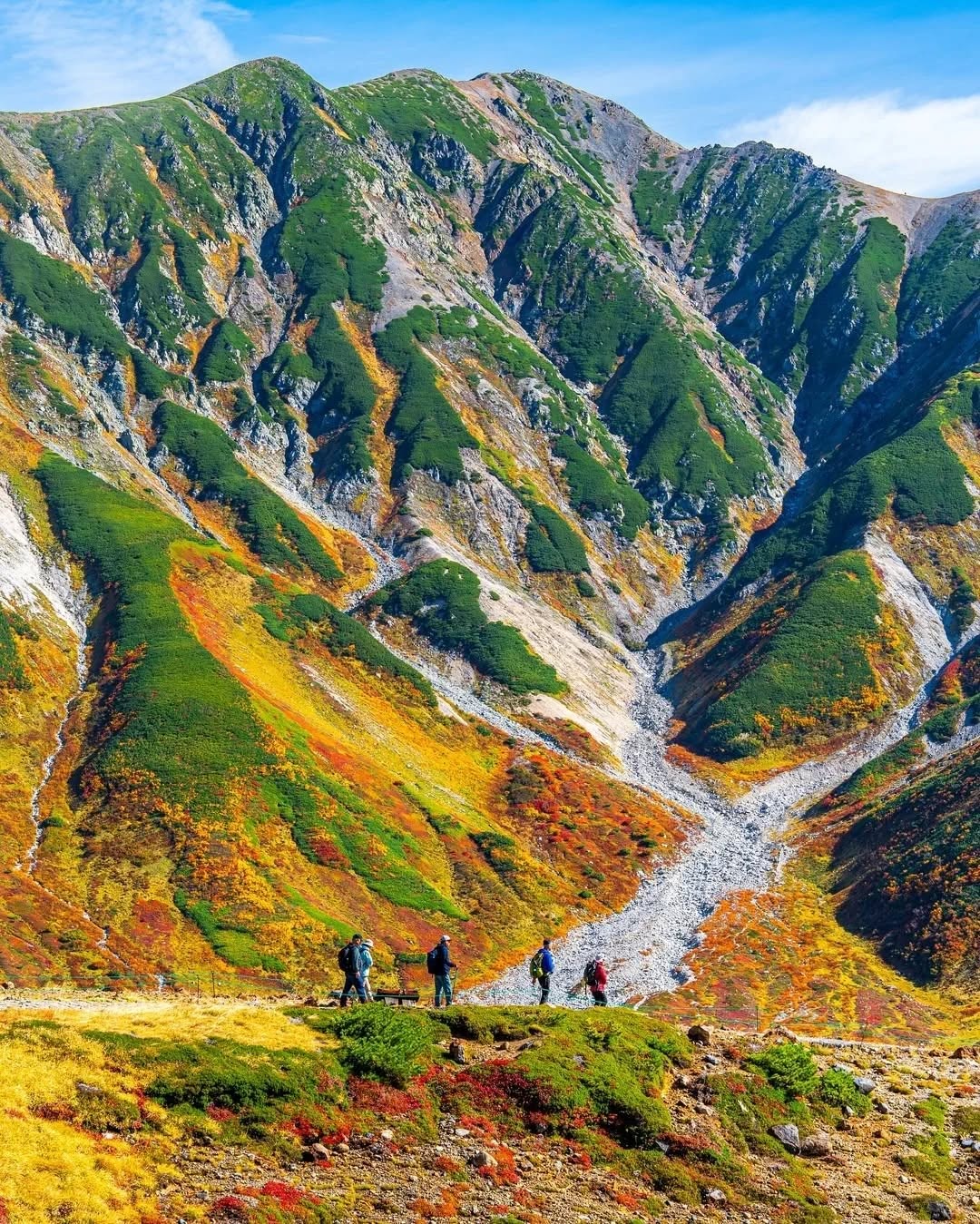
One fascinating feature of this period is the “sanmyaku sandan” effect, which Japanese visitors particularly love. If you happen to catch an early first snowfall in late September or early October, you can see three color layers at once: snowy white peaks, red foliage on the middle slopes, and green foothills. You won’t get this every year, but when the timing works, it’s the kind of photo you’ll keep as your phone wallpaper for a very long time.
Remember that late September at this elevation is already genuinely cold, especially in the wind. By mid-October, Murodo is essentially past its autumn-foliage season, and snow can arrive at any time.
Midagahara (around 1.930m) — early October
One level lower, the Midagahara marshland plateau is usually at its best from the first week through mid-October. This mountain wetland is recognized under the Ramsar Convention, with wooden boardwalks winding through marsh grasses that have turned a glowing gold, interspersed with small ponds known as “gaki no ta” that reflect the autumn sky. The dominant colors here are the bronze and orange of marsh grasses and shrubs, very different from the vivid red of maple forests — a more subdued, open, and peaceful kind of beauty.
Midagahara’s biggest advantage is that it is noticeably less crowded than Murodo, since most visitors simply pass through on the bus. If you get off at the stop and take the roughly one-hour boardwalk loop, you can almost have the entire plateau to yourself early in the morning. A small tip: when buying a highland bus ticket, getting off at Midagahara and boarding a later bus in the same direction is generally accepted, but the rules can change by season, so ask at the ticket counter to be sure.
Kurobedaira (around 1.830m) — mid-October
Kurobedaira is the transfer station between the ropeway and the cable car on the Kurobe side, and its best week usually falls around mid-October. This is when the route’s main attraction takes center stage: the Tateyama Ropeway connecting Daikanbo and Kurobedaira is a cableway with no support towers between the stations along more than one kilometer of cable. As the cabin glides across the valley, an entire Tateyama mountainside covered in red, orange, and yellow spreads out below you, with no poles or structures cutting across the view. Japanese visitors often describe it as “a ropeway traveling through a painting,” and mid-October is when that painting is at its richest.
From my experience, try to stand on the side of the cabin facing down into the valley (ask the staff which direction offers the best view — they are very happy to point it out). If possible, take a morning departure, when the angled light gives the foliage much more depth than it has at midday. The observation deck at Daikanbo Station also looks down over emerald-green Lake Kurobe surrounded by autumn forest — standing there, you’ll understand why people are willing to change between four or five different types of transport just to complete this route.
Lake Kurobe and Kurobe Dam (around 1.470m) — late October to early November
The lowest level, and the final stage of the autumn-color wave, is usually at its best from late October into the first week of November. Around Lake Kurobe, deciduous forests change color later than anywhere else, embracing the emerald surface of the lake — the color contrast here is probably the strongest along the entire route. You can walk across the top of the dam, climb to the observation deck for a panoramic view, or, if sightseeing boats are still operating that season, admire the autumn forest from the water (the boats usually stop running earlier toward the end of the season, so check in advance).
One note about Kurobe Dam’s famous water discharge: the viewing discharge operation generally lasts only until around mid-October. So if you want both the rainbow created by the spray and red leaves around the dam, the overlap is quite short, roughly from early to mid-October — when the foliage around the lake is only just beginning to change rather than at its peak. If you want the deepest colors around the lake, you will usually have to give up the water discharge. The schedule changes from year to year, so remember to check the dam’s official website before finalizing your plans.
Also keep in mind that the Alpine Route usually remains open only until the end of November, and the upper sections may temporarily stop operating during snowstorms. The later you travel, the more closely you need to monitor operating updates.
How to “chase the wave”: three itinerary strategies
Strategy 1: Take a one-day trip and focus on the elevation at its peak
The simplest approach is to identify which elevation will be at its best during your travel week, then devote most of your time to that area. In late September, prioritize spending longer at Murodo and walk around Mikurigaike. In early October, get off at Midagahara and explore the boardwalks. In mid-October, spend your time on the ropeway section and at Daikanbo. In late October, make Lake Kurobe and Kurobe Dam the focus, passing through the upper levels more quickly (and bringing warm clothes, because it will already be very cold up there).
Strategy 2: Travel the entire route in one day during the “golden week” from early to mid-October
If you can choose only one week to see the widest range of colors along the route, I would choose sometime from the first to the middle of October. By then, Murodo will be past its peak but still retain traces of color (and might even have early snow), Midagahara will be beautiful, Kurobedaira will be turning intensely colorful, and early autumn will have reached the area around Lake Kurobe. Traveling all the way from Toyama (Tateyama Station) to Ogizawa on the Nagano side — or in the opposite direction — in a single day lets you watch autumn “fast-forward” right in front of your eyes: the lower you descend, the fresher the colors become, like replaying three weeks of weather in slow motion.
When traveling the entire route during peak season, remember to leave early — the first departure of the day is always easier — because by around 9–10 a.m., groups of visitors begin to pile in and waiting times for the ropeway and cable car can become lengthy. For large luggage, use the baggage-forwarding service from one end of the route to the other (such a service is available; check the official website for fees and drop-off/pickup hours) so you can travel light.
Strategy 3: Chase the wave in multiple trips throughout the season
If you live in Japan and can travel on weekends, this is the most luxurious approach: go twice. Make one trip in late September just for peak kusamomiji at Murodo, then another in late October focused solely on Lake Kurobe from the Ogizawa side (from Nagano, it’s a fairly short trip to the dam, so you don’t need to travel the entire route). Each trip costs less than a full-route ticket, and on both occasions you’ll be standing in the place that is currently at its best rather than compromising. For people living in the Kansai or Kanto regions, each trip can easily be done in two days and one night.
How to check updated autumn-color forecasts and choose your dates
The weekly patterns above help you narrow down the period, but finalizing your dates requires real-time information. Here are a few sources I often use:
- The official Tateyama–Kurobe Alpine Route website: In autumn, it usually updates foliage conditions for individual spots (such as “beginning to change / at its best / past peak”) along with the latest photos. This is the most reliable source because the updates come from staff on site. The website also has live webcams at places such as Murodo — checking the webcam in the morning immediately tells you whether the summit is clear or foggy that day.
- Japanese koyo forecast aggregators such as the autumn-leaves sections of tenki.jp, Walkerplus, and Weathernews: enter the name of a location (for example, “室堂”, “弥陀ヶ原”, or “黒部ダム”) to find peak-date forecasts and current conditions reported by users and site managers. These sites are in Japanese, but browser translation works well enough. Most importantly, look for these status terms: 色づき始め (beginning to change color), 見頃 (at its best — the keyword you want), and 落葉 (leaves have fallen).
- Social media by hashtag and location: searching Instagram or X for recently posted photos of the area from the past 2–3 days is the fastest way to verify conditions with your own eyes. Photos from visitors who were there yesterday are more honest than any forecast.
- Mountain weather forecasts: beautiful leaves are no use if everything is hidden in fog. Two or three days before your trip, check a dedicated mountain forecast (Japanese mountaineering forecast sites have a section for the Tateyama range) rather than Toyama City’s forecast — the weather above 2.400m is completely different from that on the plains.
My usual checking rhythm is: 2–3 weeks in advance, look at the seasonal forecast to narrow down the week; 1 week ahead, check the actual conditions at each location and choose your main “elevation”; 1–2 days before, check the weather and webcams to decide whether to go or postpone. Tateyama’s autumn scenery can change quickly. One strong windstorm or heavy rain can bring an elevation’s display to an end in just a few days, so don’t trust any blog post — including this one — for an exact date. Trust the latest updates instead.
Hard-earned tips for autumn along the route
Dress as if you’re experiencing two seasons in one day. Around Tateyama or Ogizawa Stations, temperatures may be 15–20 degrees, while Murodo may be only a few degrees with strong winds. The rule is to wear layers: a thin thermal base layer, fleece, windproof jacket, and, from mid-October onward, a wool hat and gloves. Your shoes should at least be sturdy sneakers with good traction; toward the end of the season, trails at Murodo may be icy in the morning.
Tickets and transportation: tickets for the route are sold by section or for the entire route. During the peak autumn-leaf season, reserve through the official website if possible, especially for morning time slots. If you’re driving, remember that private cars cannot travel across the entire route — you’ll need to park at one end and either use a paid vehicle-transfer service to move your car to the other end (advance reservations required) or return by the same road.
Stay overnight in the mountains if you can. Around Murodo and Midagahara, several mountain lodges and hotels operate seasonally. Spending one night there gives you something day-trippers never get: sunsets and sunrises turning the empty plateau gold, along with starry skies at an elevation of 2.000m. Rooms during the autumn-leaf season sell out very early, and you usually need to reserve several months ahead.
Don’t plan your schedule too tightly. Leave room to push your trip back by one day if the weather is bad. In the high mountains, one clear day and one foggy day are two completely different worlds, and a full-route ticket is far too expensive to gamble on fog.
Frequently asked questions
Which week is the “safest” for visiting Tateyama during the autumn-leaf season if I can go only once? Sometime from the first to the middle of October. At this point, almost every elevation has something colorful to offer: Midagahara and Kurobedaira are looking beautiful, Murodo still retains some color and may have early snow, and early autumn has begun around Lake Kurobe. This is when the chance of coming away empty-handed is lowest for the entire season.
Is there anything to see at Murodo in late October? The foliage is essentially finished, but you may instead encounter the first snow covering the plateau — snow on Murodo beneath a clear autumn sky is also spectacular. Just establish in advance that your autumn-leaf goal at that time should be Kurobedaira and below, and bring enough warm clothing.
Should I travel from the Toyama side or the Nagano side? If you travel the entire route, the scenery is the same; only the order changes. The general rule is to start from whichever side is closer to where you’re staying so you can catch an early departure. In late October specifically, if your main goal is Lake Kurobe and Kurobe Dam, entering from Ogizawa (Nagano) is much faster and cheaper than traveling the entire route from Toyama.
Can I make a day trip from Tokyo or Osaka? It’s possible, but quite demanding, especially during peak season when you may have to wait at transfer stations. Ideally, stay one night in Toyama, Nagano (Omachi/Shinano-Omachi), or in the mountains, then take the earliest departure the next morning — you’ll avoid some crowds and get better light.
How can I tell whether the leaves are early or late this year? Start following Japanese koyo forecast sites around the beginning of September. They will assess whether that year’s season is early or late compared with average conditions, based on summer and early-autumn temperatures. Then follow the actual conditions at each location through the route’s official website and recent social-media photos. The general rule is that a prolonged hot summer usually delays the leaves by about one week, with lower elevations more noticeably affected.
Does the route operate throughout the autumn season? The route usually operates from around mid-April through the end of November, but upper sections may temporarily stop operating locally during bad weather or heavy snow, and some services (boats on Lake Kurobe and the dam’s water discharge) end earlier. Before your trip, always check operating notices on the official Alpine Route website — it takes one minute and can save you from an entire wasted journey.
More from this region — Chubu (Nagano, Kanazawa)
View all →
A Day Across Tateyama in Autumn Colors, Hour by Hour
16 min · tips
Staying Overnight on the Alpine Tateyama Route: a 2-Day, 1-Night Autumn Itinerary
17 min · tips

Tateyama in Autumn: Strategies for Avoiding Crowds and the Real Budget
16 min · tips
Three-Tier Autumn Colors Along the Tateyama Alpine Route
16 min · tips