
Three-Tier Autumn Colors Along the Tateyama Alpine Route
From late September to early November, the Alpine Route showcases white snow, golden-red forests, and deep-green mountain scenery all at once—with tips for timing your visit from Murodo to the Kurobe Dam.
Aug 12, 2026·✍️ olablog·⏱ 16 min read
From late September to early November, the Alpine Route showcases white snow, golden-red forests, and deep-green mountain scenery all at once—with tips for timing your visit from Murodo to the Kurobe Dam.
Tap a region to browse articles
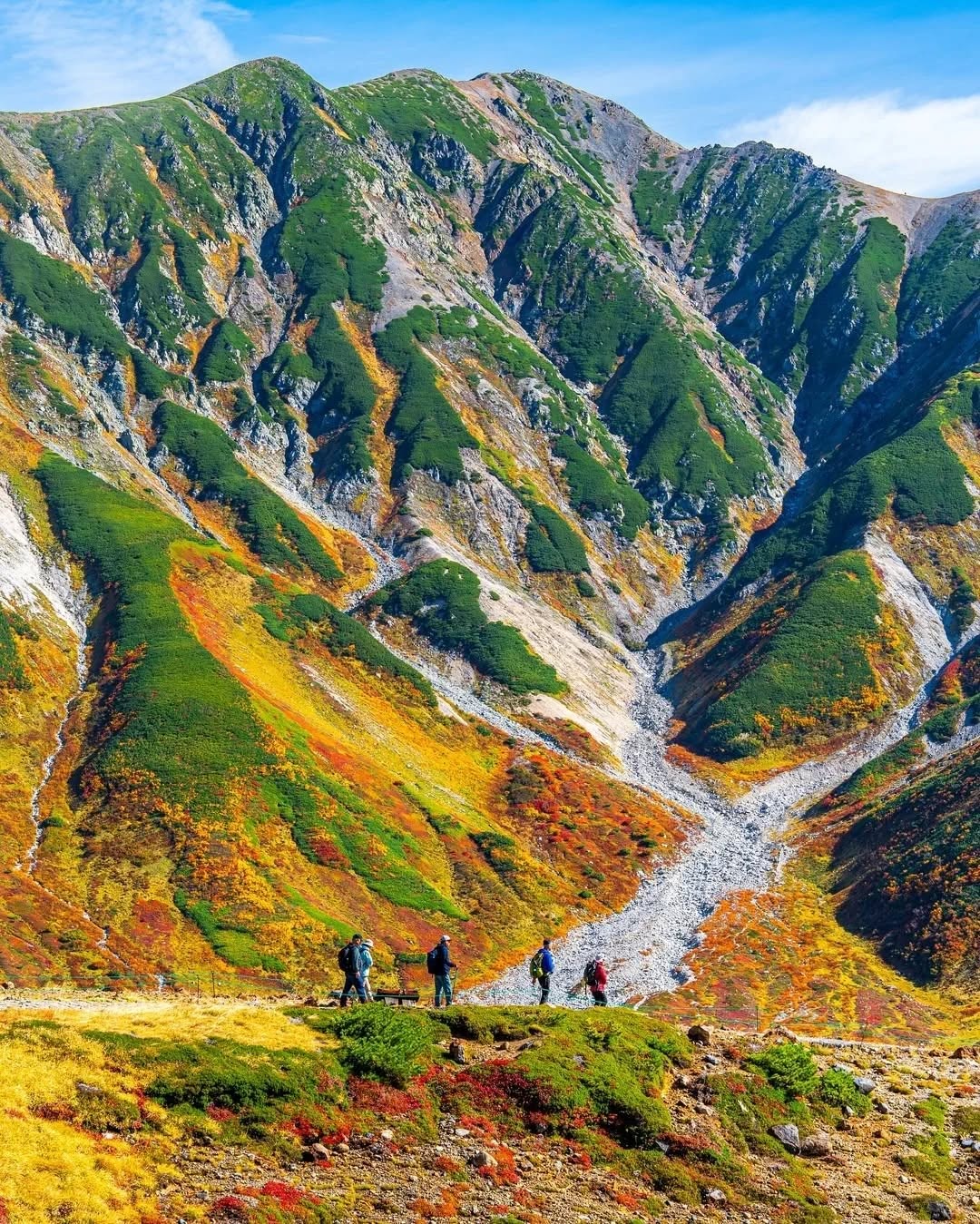
There is a moment in Tateyama that anyone who has experienced it will find hard to forget: you are standing on the Daikanbo observation deck, cold wind stinging your face, with a scene before you that would normally take three separate trips to experience—a blanket of white snow on the mountain peaks, a vivid band of blazing red and gold foliage across the middle slopes, and deep-green conifer forests below, seemingly unaware that autumn has arrived. Three seasons, three layers of color, all at once in a single frame. The Japanese call this phenomenon "sandan koyo"—three-tiered autumn colors—and there are only a handful of places in Japan high and steep enough for nature to arrange itself in layers like this.
When people mention the Tateyama–Kurobe Alpine Route, most think only of the nearly twenty-meter-high Yuki no Otani snow walls in spring. That is understandable: the snow walls are incredibly famous and incredibly photogenic. But people who visit Tateyama repeatedly tend to whisper something else: if the snow walls are the number-one peak season, autumn—from around late September to early November—is the second peak season, and it may be just as spectacular. The snow walls give you one wall. Autumn gives you an entire mountain range changing color with elevation, a new appearance every week and a different character at every stop.
In this article, I’ll take you through the Alpine Route’s full autumn transformation: what sandan koyo is and why Tateyama is the perfect stage for it, how the wave of changing colors rolls down from the peaks to the foothills, and what each section of the route—Murodo, Midagahara, Kurobedaira, and Kurobe Dam—has in store. If you are wondering when to visit Tateyama outside snow-wall season, by the time you finish reading, you may find yourself booking a ticket for October.
Sandan koyo — when one mountain holds all three seasons
"Sandan koyo" (三段紅葉) literally translates as "three-tiered autumn foliage." The conditions required for this phenomenon sound simple but are actually quite demanding: you need a mountain high enough for its summit to have received the first snow of the season, while the middle slopes are at peak foliage and the foothills are still green—all three bands must line up within the same short window, usually lasting only one to two weeks.
Tateyama has all the necessary ingredients. The range lies within Japan’s Northern Alps, with its main peaks standing around 3,000 meters high, while the Alpine Route climbs from the foothills in Toyama to Murodo at an elevation of 2.450 meters—a difference of nearly 2.000 meters in just a journey of a few hours. A major elevation difference means a major temperature difference, and autumn does not arrive here all at once: it reaches the summits first, then gradually "rolls" downward, descending a few hundred meters each week.
That rolling transition creates sandan koyo. Around early to mid-October, when the first snow has usually reached the peaks of Tateyama and Tsurugi, the middle slopes around Midagahara and the valley near Kurobedaira are at their most brilliant, with deep-red nanakamado (Japanese rowan), along with orange-gold maples and oaks. Below, the conifer and oak forests are still green. From a good vantage point—Daikanbo is the classic choice—you can see all three layers stacked together, as if someone painted the mountain in three coats of color.
The best part is that you do not need the kind of luck required to catch a rare "once-a-year, only-for-a-few-days" scene. If you time your visit for early to mid-October and keep an eye on local Toyama reports or the Alpine Route’s official website for news of the first snow (hatsukansetsu), your chances of seeing sandan koyo are quite good. Of course, nature does not sign contracts—some years the snow arrives late, while in others typhoons bring down the leaves early—but compared with chasing other fleeting moments around Japan, Tateyama’s sandan koyo is relatively forgiving.
Why autumn is the second peak season after the snow walls
Many people assume that Tateyama is worth visiting only once, during snow-wall season. In reality, the crowds and atmosphere on the route in October may make you reconsider: it is the second-busiest season of the year, and on weekends in mid-October, both the highland buses and the ropeway can involve long queues. There are several very practical reasons for this.
First, Tateyama’s autumn foliage arrives earlier than almost anywhere else in Japan. While Kyoto has to wait until late November, the leaves around Murodo have already begun changing color by mid-to-late September. For people living in Japan, this is where the koyo season begins—anyone eager to see the first autumn colors often chooses Tateyama or Nikko, and Tateyama wins when it comes to the grandeur of its high-mountain landscape.
Second, autumn is the only season when you can see sandan koyo. Spring has the snow walls, but the surrounding scenery is almost uniformly white. Summer is lush and green but lacks contrast. Only autumn gives you the mountain range’s fullest palette, along with the crystal-clear air that characterizes the season—visibility is often far better in autumn than in summer, and on clear days you can make out every fold of the mountains from Murodo.
Third—and this is something few people notice—autumn is the "deadline" for the entire route. The Alpine Route typically closes completely from early December to mid-April (you should check the exact schedule for each year on the official website). In early November, when the autumn colors have rolled down to Kurobe Dam, snow is also beginning to pile up on Murodo. Visiting at this time gives you the feeling of racing winter: you can admire the first snow on the peaks in the morning and still make it down to Kurobe Lake in the afternoon to see golden forests reflected in emerald water.
And then there is one very down-to-earth reason: Kurobe Dam’s spectacular water discharge—the famous rainbow-producing plume—usually continues from late June until around mid-October. That means that if you visit in the first half of October, you can combine autumn foliage and the water release in a single trip. After mid-October, the discharge usually stops, so anyone prioritizing this sight should check the dam’s official schedule.
The autumn scenery at each section of the route
The Alpine Route is not a single destination but a chain of destinations linked by all kinds of transport: mountain-climbing cable cars, highland buses, electric buses through tunnels, aerial ropeways, and more mountain cable cars. Each stop sits at a different elevation, so autumn arrives at each one differently—both in timing and in character.
Murodo (2.450m) — autumn arrives first, briefly and intensely
Murodo is the highest point on the route and the first place autumn reaches, usually from mid-to-late September through early October. But do not picture Kyoto-style forests of red maple leaves—large trees cannot survive at this elevation, and Murodo’s "koyo" belongs to the alpine vegetation: patches of chinguruma turning wine-red, mountain grasses shifting to orange-gold, and dwarf nanakamado glowing like embers among the rocks. The Japanese even have a specific term for this kind of display: "kusa-momiji," or autumn colors in the grasses.
The classic scene is Mikurigaike Pond, whose still surface reflects the peaks of Tateyama. If you arrive at the end of September during a clear spell, the summits may already be dusted with the first snow while the area around the pond is still glowing with autumn colors—a miniature version of sandan koyo right at your feet. Walking around the pond takes about an hour, and the paved path is easy to manage, but remember that the weather changes very quickly here: a sunny morning can turn into dense fog by noon, and from late September temperatures can easily fall to around 0 degrees. Thermal layers, a waterproof windbreaker, and closed-toe shoes are essential, even if it is still hot in Toyama below.
A note from someone who has learned the hard way: in October, Murodo can get snow at any time. For sightseers, that is a gift—fresh snow on golden grasslands is almost absurdly beautiful—but if you plan to climb Mount Oyama, you need proper equipment and real experience. Do not take a chance in sneakers.
Midagahara (1.930m) — golden grasslands and a marshland above the clouds
When you get off the highland bus at Midagahara, you enter a completely different world: a vast marshland plateau recognized as a Ramsar wetland, where thousands of small ponds called "gaki no ta" (fields of hungry ghosts, according to Buddhist legend) are scattered across the grasslands. Autumn here—usually peaking from late September to mid-October—is the season of kusa-momiji in the truest sense: the entire plateau turns bronze-gold, dotted with red nanakamado shrubs, while the ponds gleam like pieces of sky-reflecting glass.
Midagahara has wooden boardwalks that cross the marshland, with a short loop taking around forty minutes to an hour and a longer loop for those with more time. This is the section where I recommend not simply staying on the bus as it passes through—many people experience the Alpine Route by "running from stop to stop" and skip Midagahara, even though it may be the quietest and most meditative place on the entire route in autumn. The highland buses allow you to get off here along the way (confirm the procedure when purchasing your ticket), and an hour spent walking through golden grasslands in the mountain mist is time well spent.
Near Midagahara, there is also a distant viewpoint for Shomyo Falls—the waterfall considered the highest in Japan. In autumn, the white ribbon of water cascading between cliffs mottled with red and gold makes a frame well worth leaving extra time in your bus schedule for.
Kurobedaira and the Tateyama Ropeway — the "main stage" of sandan koyo
If I had to choose one section to represent Tateyama in autumn, I would pick the Tateyama Ropeway ride connecting Daikanbo and Kurobedaira, which usually peaks in mid-October. This is a "single-span" ropeway with no support towers between the stations—often described as a "moving panoramic park"—and during the seven-minute ride, you float past a huge mountainside covered in red and gold foliage, streaked with green conifers, while emerald Kurobe Lake gradually appears below in the valley.
The observation deck at Daikanbo (2.316m) is the classic place to see sandan koyo. Looking down toward the Kurobe Valley, the three layers of color are clearest in early to mid-October, when the peaks around the valley have already turned white with snow. At the lower end of the ropeway, Kurobedaira (1.828m) has a terrace looking back up at the mountainside—the upward view creates a different kind of overwhelming impression. There is also a small alpine garden where you can wander while waiting for your ride.
Practical advice: this is the biggest bottleneck on the entire route during peak foliage season because the ropeway has limited capacity on each departure. On weekends in mid-October, the wait at Daikanbo or Kurobedaira can reach a full hour. Visit on a weekday if possible, set out early, and do not plan your itinerary too tightly—the Alpine Route in autumn is not for people in a hurry.
Kurobe Dam (around 1.470m) — a golden finale beside an emerald lake
Kurobe Dam is the lowest of the main scenic "stops," so autumn arrives here last, usually from mid-to-late October through early November. Japan’s tallest arch dam (around 186 meters) stands dramatically in the gorge, and when the forests around Kurobe Lake turn golden-orange against the lake’s characteristic emerald water, you understand why people travel all the way here simply to walk across a dam.
Climb up to the observation deck above the dam (there are quite a few stairs, but it is worth it). From there, you can see the dam, the lake, and the mountain range beyond. In early November, the surrounding peaks are usually already white with snow, giving you one more chance to see sandan koyo at the end of your journey, even when Murodo may already be fully into winter. If you visit in the first half of October and the dam is still releasing water, you may see a rainbow stretching across the plume from the lower observation bridge on sunny days—one of the most photogenic views on the route. Autumn also brings sightseeing cruises on Kurobe Lake (usually operating only until around early November, so check in advance). Sitting in the middle of the lake with golden mountains surrounding you is a distinctly different experience from the rest of the route.
Timing your visit: the wave of autumn colors by elevation
If the entire article could be reduced to one rule, it would be this: Tateyama’s autumn colors begin at the peaks in mid-to-late September and roll down toward the foothills until early November, with each elevation typically lagging by around one to two weeks.
- Late September – early October: Murodo is at its best, with brilliant kusa-momiji and a chance of seeing the first snow on the peaks.
- Early – mid-October: the golden window for sandan koyo. Midagahara turns bronze-gold, the Daikanbo–Kurobedaira ropeway section reaches its peak, and the summits usually have snow. If you can visit only once, aim for this period.
- Mid–late October: the best colors move down to Kurobedaira and begin spreading around Kurobe Lake; Murodo may already have a light covering of snow.
- Late October – early November: the area around Kurobe Dam and the lower elevations toward Ogizawa and Nagano are at their best; higher up, the scenery has already shifted into early winter.
Of course, this is only a general guide—each year can easily run a full week early or late, so before setting out, check the latest foliage updates (koyo joho) on the Alpine Route’s official website or Japan’s autumn foliage forecast sites.
Practical tips for an autumn trip
As for the route, you can travel across the entire route from Toyama to Nagano (Tateyama Station to Ogizawa/Shinano-Omachi) or make a round trip from one side. Crossing the route is the most complete option, but you need to think about your luggage—same-day suitcase forwarding is available from one end to the other (reserve it and check the conditions in advance), because dragging a suitcase through that many cable cars and buses is a nightmare. A full-route ticket for adults is fairly expensive, at around ten thousand yen give or take depending on the section and the year—check the exact figure on the official website, and consider purchasing tickets online in advance during peak season to avoid the queues.
For clothing, the temperature difference between the foothills and Murodo can reach more than ten degrees. The rule is to dress in layers: thermal wear, a fleece, a waterproof windbreaker, a wool hat, and thin gloves from October onward are all useful. Sneakers with good traction are sufficient for the main walking paths, but be careful on the stone paths around Mikurigaike if it has just snowed.
As for timing, one full day is enough to travel across the route and stop at all the main stations, provided you set out early—the first departure of the day is always the smart choice during foliage season. If you want to take things slowly, staying one night at a hotel on Murodo or an inn in Midagahara gives you what day-trippers miss: sunset, an early-morning sea of clouds, and a star-filled sky at an elevation of 2.000 meters. However, these places have limited rooms and fill up very early in autumn, so book as far in advance as possible.
Finally, leave room for a Plan B. High-mountain weather in autumn can bring rain or a wall of fog that lasts all day. My experience is this: do not place all your hopes on a single viewpoint, because the route is long and the weather can vary dramatically from one section to the next—there are days when Murodo is completely fogged in, only for the sky to open up spectacularly by the time you reach the Kurobedaira ropeway. Keep going; somewhere along the mountain, the view will open up.
Frequently asked questions
When is it easiest to see sandan koyo?
Early to mid-October is the best "window": the middle slopes are at peak foliage, while the summits usually have received the first snow. Before your trip, follow reports on the first snow in the Toyama area and foliage updates on the route’s official website for more precise timing, as the dates can vary by about one week from year to year.
Where is the best place to see sandan koyo?
The Daikanbo observation deck overlooking the Kurobe Valley is the classic viewpoint, together with the seven-minute ride down to Kurobedaira on the Tateyama Ropeway. In addition, you may see the three layers of color around Mikurigaike Pond in Murodo in late September, or from the Kurobe Dam observation deck in early November.
Is Tateyama cold in autumn, and what should I wear?
From late September, temperatures in Murodo can fall to around 0 degrees, and snow is entirely possible in October. Dress in layers: thermal wear, a fleece, and a waterproof windbreaker. From October, bring a wool hat and gloves as well. The difference from the foothills can exceed ten degrees, so do not assume conditions will be mild just because the weather in Toyama looks warm.
Can I complete the entire route in one day?
Yes, if you take an early departure and accept spending around an hour or less at each stop. On autumn-foliage weekends, you will usually have to queue for the ropeway, so weekdays are much more relaxed. If you want to see the sunset, a sea of clouds, or the stars, you will need to stay overnight in the mountains, and autumn rooms sell out very early.
Can I still see the Kurobe Dam water discharge in autumn?
Usually, if you visit in the first half of October—the dam’s tourist water discharge generally runs from late June until around mid-October. After that, the discharge stops, but the golden forests around the lake in late October – early November are every bit as worthwhile. Check the official website for the exact discharge schedule each year.
How long does the Alpine Route remain open in autumn?
The route usually operates until the end of November before closing completely for winter, but from mid-November onward, the scenery at higher elevations has already shifted firmly into winter, and some services—such as Kurobe Lake cruises and certain inns—end earlier. For the fullest autumn experience, go before mid-November and check that year’s operating schedule on the official website before booking.
More from this region — Chubu (Nagano, Kanazawa)
View all →
Soak in Japan’s Highest Onsen Amid Tateyama’s Autumn Leaves
17 min · tips
Kamikochi–Hakuba 2-Day Autumn Tour: Should You Take a Tour or Go Independently?
11 min · tips
Venus Line, Nagano – Japan's Most Breathtaking Highland Drive
5 min · tips
Tateyama Alpine Route Group Logistics: Drop-Off, Luggage and Snow Wall Planning
8 min · tips