A Station-by-Station Photo Map for Tateyama’s Autumn Foliage
From Mikurigaike’s mirror-like surface reflecting snow-capped peaks to rainbows beneath Kurobe Dam: the best autumn foliage photo spots at every station, with golden hours, sun direction, and the lenses to bring.
Aug 12, 2026·✍️ olablog·⏱ 16 min read
From Mikurigaike’s mirror-like surface reflecting snow-capped peaks to rainbows beneath Kurobe Dam: the best autumn foliage photo spots at every station, with golden hours, sun direction, and the lenses to bring.
Tap a region to browse articles
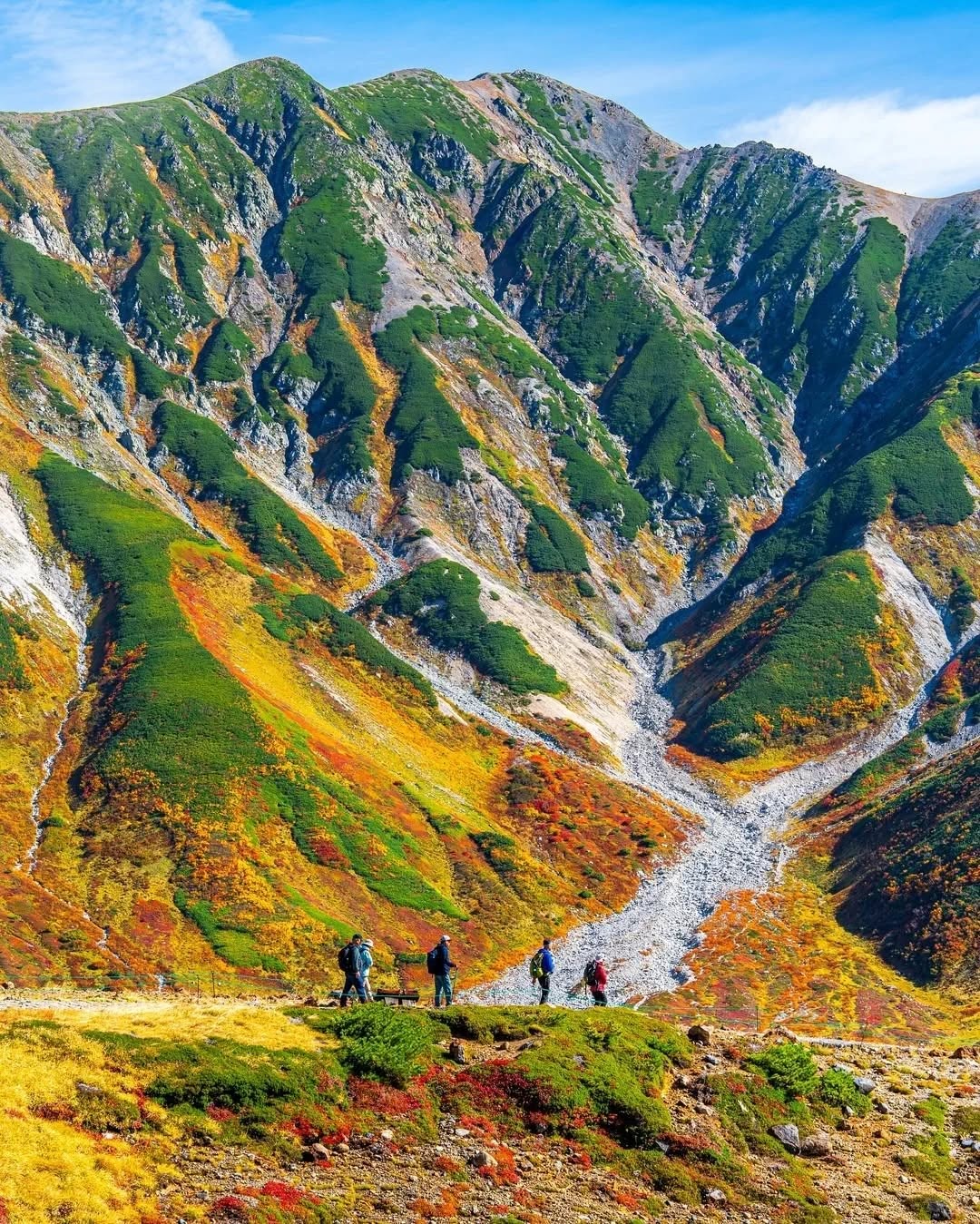
There’s a moment photographers in Japan whisper about every year toward the end of September: standing more than 2,400 meters above sea level on the Murodo Plateau, you can capture all three seasons in a single frame—the mountain peaks covered in their first blanket of white snow, the slopes blazing red and orange with autumn foliage, and the deep blue sky left over from summer. The Japanese call this phenomenon “sanshoku”—three layers of color—and in all of Japan, there are almost no other places where you have quite the same chance to capture it in full as on the Tateyama–Kurobe Alpine Route.
I traveled this route in mid-October, carrying two lenses and a tripod that I barely ended up using, and squeezing through six different forms of transport, from cable cars and electric buses to the ropeway. What I learned wasn’t that “the Alpine Route is beautiful”—everyone already knows that—but that the light, the direction of the sun, and the best shooting angles change completely at every stop. Arrive at the wrong time and you might find yourself standing in front of Mikurigaike with the wind breaking up the entire reflection, or looking down over Kurobedaira Valley while backlight plunges the sea of red leaves into darkness.
This is the photo-hunting map I wish I’d had before my first trip: what to photograph at each station, where to stand, what time to aim for, which way the sun will shine, and what lenses to pack. Save it now and pull it out when the autumn foliage arrives.
Why autumn here is worth carrying your camera up the mountain
The Alpine Route runs from Toyama, on the Sea of Japan side, to Nagano, via Ogizawa, crossing a high mountain range with peaks around 3,000 meters. What makes it fascinating for photographers is the constant change in elevation. The autumn colors don’t appear all at once; they “flow” downhill for more than a month. High-altitude Murodo usually reaches peak color first, around the end of September; mid-level areas such as Kurobedaira and Midagahara are at their best from early to mid-October; while the lower areas around Kurobe Dam and Ogizawa glow later, sometimes lasting until the end of October. That means no matter which week you visit during this period, at least one section of the route will be at peak color—the only question is which one.
The autumn foliage here also looks nothing like the momiji in city parks. In the high mountains, the dominant colors come from deep-red nanakamado, chichippbenibana grasses, and low shrubs turning yellow and orange, spreading across the slopes in broad patches as if someone had poured paint over them. Photography here is about wide landscapes, blocks of color, and light—not close-ups of individual leaves.
One more thing: high-mountain weather changes incredibly quickly. The morning may be clear, clouds can pile into the valleys by noon, and those same clouds may sometimes give you a sea-of-clouds shot even more beautiful than a blue sky. The right mindset for this route is to plan carefully, but stay ready to photograph whatever the sky decides to give you.
A station-by-station map of the best photo spots
Murodo — Mikurigaike’s mirror and the three layers of color
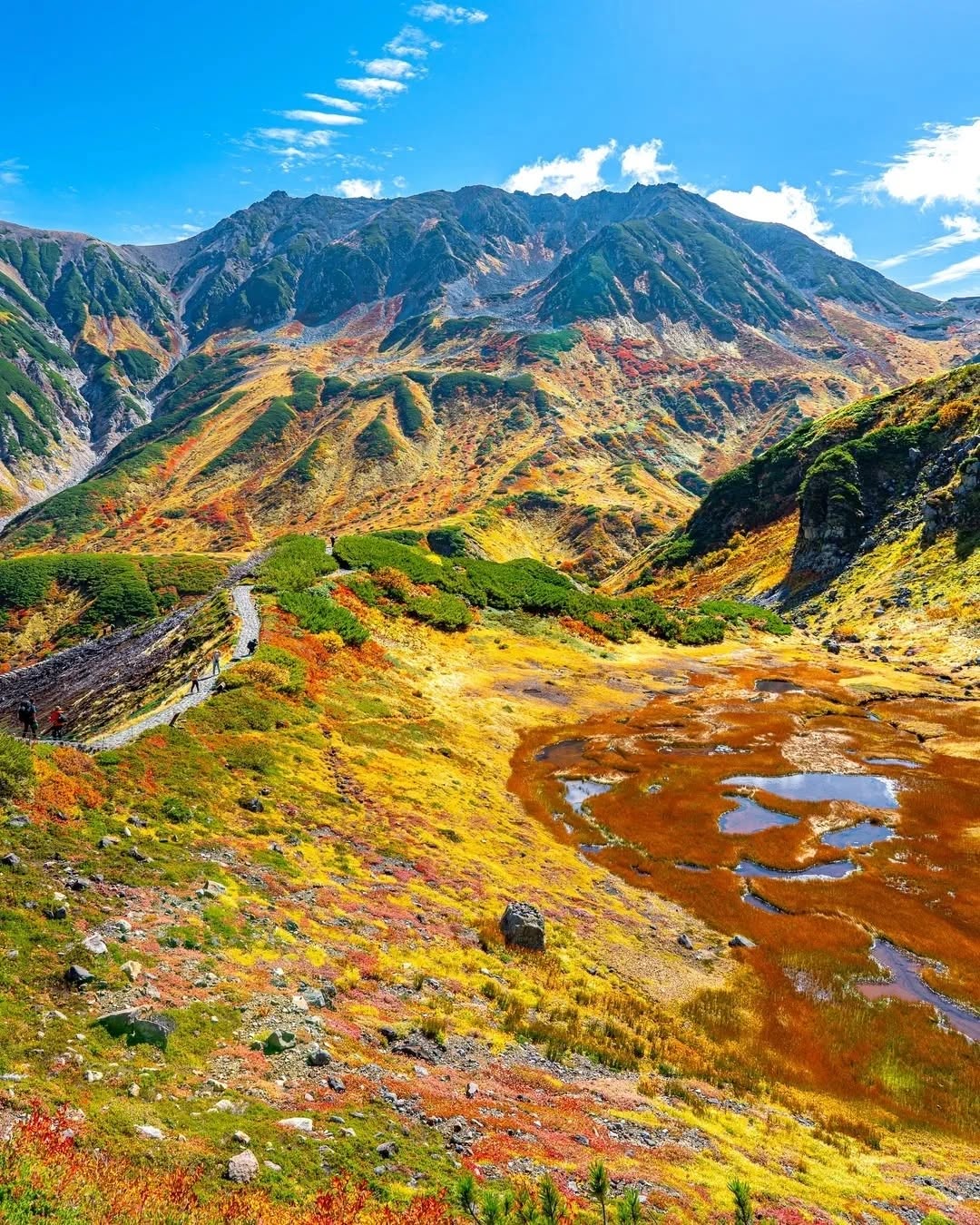
Murodo is the highest station on the route and the main stage for autumn. From the station, a 10–15-minute walk along a paved path brings you to Mikurigaike, a small volcanic lake famous throughout Japan for its reflections. On a windless day, the surface is as smooth as a mirror, embracing the entire Tateyama range: white snowy peaks, red-covered slopes, and blue sky—all doubled in the water.
The classic shooting angle is from the path along the lake’s western and southwestern sides, looking toward the main range to the east. Because the mountains lie to the east, the light here has two distinct “personalities”:
- Early morning: the lake is at its calmest (the wind usually gradually picks up from mid-morning onward), but you’ll be shooting into the sun. The mountains become dark silhouettes edged with light, and the sky can burn beautifully with color when clouds are present. This is the hour for silhouettes and high-contrast reflections. If you can stay overnight at a lodge on Murodo, this is the biggest reward, because the first bus from the foothills usually arrives after the sun is already high.
- Late afternoon: sunlight from the west shines directly onto the mountains, making the snow and autumn foliage glow with vivid color—the most flattering light for photos. The trade-off is that afternoon winds are more likely to ripple the lake. My advice: be patient and wait. Mountain winds often die down for a few minutes at a time, and the lake will briefly hold its breath long enough for you to capture a few shots.
Around Mikurigaike, you’ll also find a path circling the lake and smaller nearby lakes such as Midorigaike, which are far less crowded. Note that the Jigokudani area (Hell Valley) releases volcanic gases, and the path through it may occasionally close depending on gas conditions. Follow the signs, and don’t take risks just for a photo.
For Murodo, bring a wide-angle lens (the equivalent of 16–35mm full-frame) to capture the full reflection and sky, plus a mid-range telephoto to “crop” sections of red foliage on the slopes into abstract images. A CPL filter is extremely useful here, but remember the basic rule: turning the CPL too far can erase the reflection on the lake entirely. For mirror-water shots, you sometimes have to reduce the CPL effect to preserve the reflection.
Daikanbo — the balcony overlooking Kurobedaira
If Murodo is the stage, Daikanbo is the best seat in the audience. Perched on a cliff at around 2,300 meters, the observation deck on top of the station offers sweeping views over the entire Kurobedaira Valley and the emerald-green Kurobe Lake in the distance, with the Ushirotateyama range behind it. In autumn, the basin below you becomes a giant carpet mottled with red, orange, and yellow, broken up by streaks of evergreen trees. It’s breathtaking in person and even more satisfying in a photograph.
As for the light: Daikanbo’s main view faces east, so in the morning you’ll be looking toward the sun. That makes for easy backlighting, but if a sea of clouds rises through the valley, the morning backlight can make the clouds glow with a distinctly cinematic quality. For rich, even foliage colors, the best window is from late morning to early afternoon, once the sun has climbed higher and begun shining down into the valley.
Here’s a tip many visitors miss: from Daikanbo, time your shot to include the ropeway cabin crawling across the valley. A tiny cabin suspended in the middle of an immense sea of red leaves makes one of the route’s best visual stories about the scale of people versus nature. This is where a 70–200mm telephoto lens shines: it compresses the space, pressing the cabin and mountain slopes together into layers of color.
The station itself is small, and during peak foliage season you may have to queue for the ropeway. Use that waiting time to take photos instead of just standing around tapping your phone.
Tateyama Ropeway — the cable-car window, a “moving photo spot”
The ropeway connecting Daikanbo and Kurobedaira stretches for about 1.7km and has a rare feature: there are no support towers anywhere along the route, so the cabin hangs from a single cable span. Japanese visitors often describe it as a “moving picture frame,” and in autumn the picture inside that frame is an entire red-covered mountainside drifting slowly beneath your feet for about 7 minutes.
A few tips to make sure you don’t waste those 7 golden minutes:
- Choose your position in the cabin: when traveling downhill (Daikanbo → Kurobedaira), stand at the back and look up behind you to see the cliff face and Daikanbo Station clinging to the rock—a very “wow” angle. Stand at the front and you’ll be looking toward Kurobe Lake. During peak season, the cabin can be as crowded as a commuter train at rush hour, so board early or be willing to wait for the next departure to get a spot by the window.
- Settings: the cabin vibrates and moves, so keep your shutter speed fast—at least around 1/500s—and leave ISO on auto. Don’t press the lens against the window, because vibrations transfer directly to the camera. Keep it a few centimeters away from the glass.
- Reduce window reflections: wear dark clothing, bring the lens close to the window (without touching it), or use your hand or a cloth to block the gap around it. Photos taken through glass may lose a little sharpness, but in return you get a viewpoint found nowhere else.
- If you’re bringing only one lens into the cabin, choose a standard zoom (24–70mm or equivalent)—wide enough for the full landscape and long enough to crop into patches of color.
When you arrive at Kurobedaira, don’t rush straight onward. The station terrace offers a view back along the cable route you’ve just traveled, making it easy to frame a cabin suspended against the red-covered mountains. There’s also an alpine botanical garden nearby that you can explore in a few dozen minutes.
Kurobe Dam — rainbows in the released water
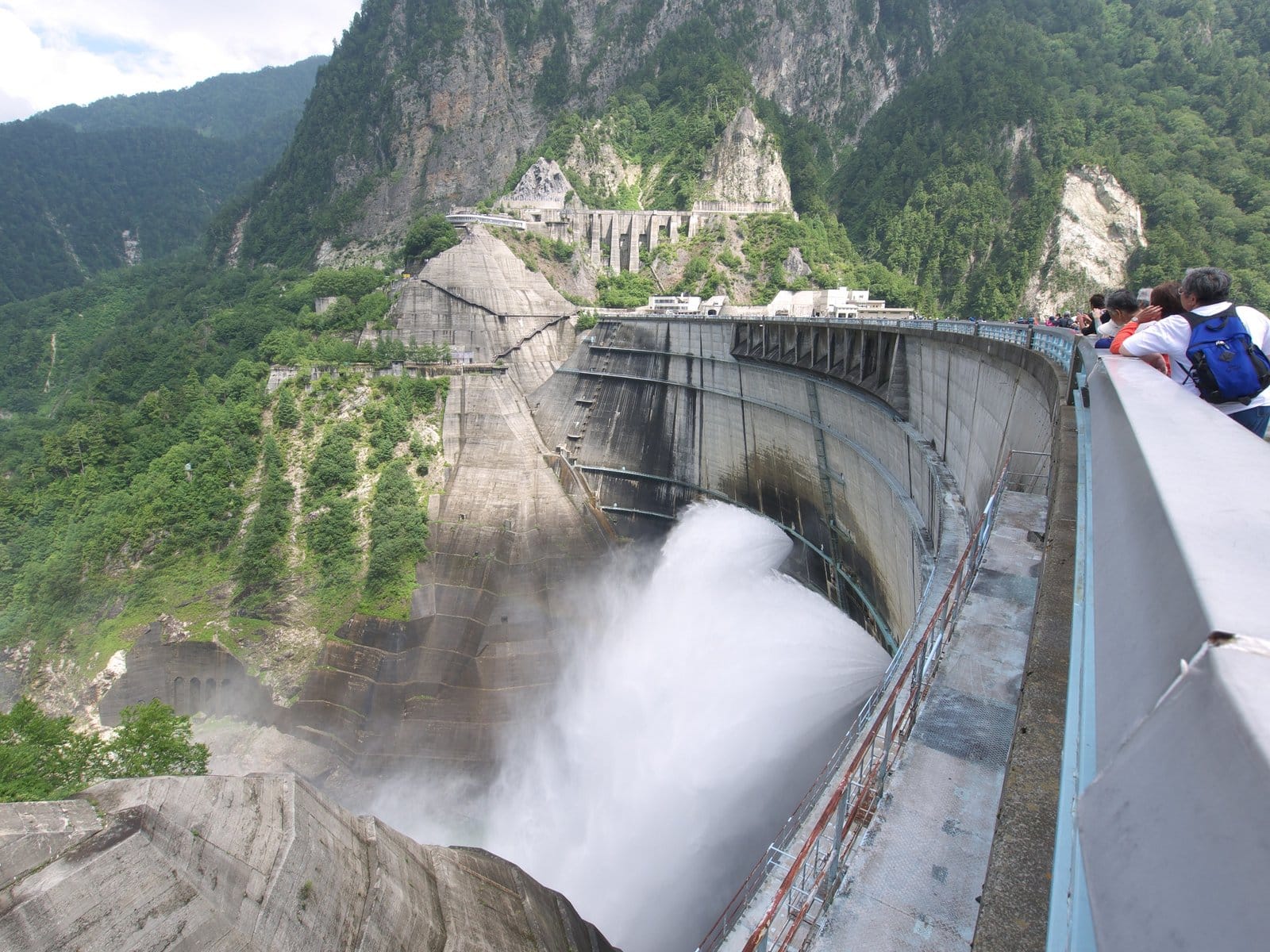
Kurobe Dam is Japan’s tallest arch dam, and the autumn highlight here is the sightseeing water discharge: dozens of tons of water per second erupt into a huge curtain of spray below the dam. When sunlight hits the spray at just the right angle, one—or sometimes two—rainbows appear across the valley. The discharge usually runs only from around the end of June to around the middle of October each year, meaning it overlaps only with the first half of the foliage season. If you visit toward the end of October, it may already be over, so check the discharge schedule on the dam’s official website before finalizing your date.
The physics of rainbow hunting is simple: the sun needs to be behind you, shining onto the water spray in front of you. Given the terrain, the easiest time to see a rainbow is usually from morning until close to noon, when the sun is strong. Two locations are especially worth climbing to:
- The upper observation deck (reached via a fairly long staircase from the Kurobeko Station/tunnel side—more than 200 steps, so take it slowly in the thin air): this gives you a sweeping view of the entire curved dam, the water discharge, and Kurobe Lake behind it, with autumn foliage framing the surrounding mountains. This is the “cover photo” angle.
- The walkway along the top of the dam and the lower area near its base: closer to the spray, with larger, clearer rainbows filling the frame and the refreshing sensation of mist hitting your face. Protect your camera—the spray here is enough to get your equipment wet.
At the dam, a wide-angle lens is essential if you want to include both the dam and the rainbow. A CPL is once again a double-edged sword, just as it is at the lake: turn it the wrong way and the rainbow may fade; turn it correctly and it can become more vivid. Rotate it while watching through the viewfinder.
Extra stops if you still have time
Midagahara is a mid-level marshland plateau with wooden walkways crossing a carpet of golden-orange grass. The early-morning mist here is mesmerizing, and it’s much quieter than Murodo. If you’re traveling from the Toyama side, Shomyo Falls near Tateyama is one of Japan’s highest waterfalls. The falls plunging between red-covered cliffs from late October to early November are worth setting aside a separate afternoon for.
A summary of golden hours and sun direction
- Mikurigaike (Murodo): early morning brings a calm lake and artistic backlit images; late afternoon brings vivid mountain colors, but you’ll need to wait for the wind to drop. The mountains are east of the lake.
- Daikanbo: late morning through early afternoon gives the valley its richest colors; early morning is beautiful only when there’s a sea of clouds. The view faces east.
- Ropeway: you can shoot at any time, but early morning and quieter periods make it easier to choose a good standing position in the cabin.
- Kurobe Dam: go from morning until close to noon, when the sun is out, to hunt for rainbows. Remember to keep the sun behind you.
If you combine everything into a one-day itinerary, starting from the Ogizawa side (Nagano), you’ll reach Kurobe Dam in the morning—perfect timing for rainbows—then continue upward to Kurobedaira and Daikanbo around midday, when the valley is richly lit, and finish at Murodo in the afternoon, when the mountains are glowing with color. For an afternoon of photography, this direction is almost designed for you. If you travel in the opposite direction from Toyama, consider spending one night on Murodo so you can catch the lake in the early morning.
What to pack in your camera bag
- Two lenses are enough: a wide-angle lens (16–35mm) for the lake, dam, and wide landscapes, plus a telephoto (70–200mm) for Daikanbo, the ropeway cabins, and patches of color on the mountain slopes. If you’re bringing only one, choose a versatile 24–105mm zoom or equivalent. You’ll be constantly moving and changing modes of transport on this route, so traveling light is a major advantage.
- CPL filter: the most worthwhile filter to bring, helping deepen the blue of the sky and intensify foliage colors. Just remember to use a light touch at the lake and with rainbows.
- Tripod: honestly, unless you’re staying overnight in the mountains to photograph sunrise or stars, your tripod will mostly remain in your bag. There’s more than enough daylight for handheld shooting, and setting up a tripod in crowded peak-season areas is both obstructive and likely to earn you a warning.
- Spare batteries: temperatures on Murodo can hover around 0 degrees in autumn, draining batteries quickly. Keep spare batteries warm in an inner jacket pocket.
- Moisture protection: bring a lens cloth and a rain cover for your camera—useful both for spray at the dam and sudden mountain rain.
- Clothing: the temperature difference between the foothills and Murodo can exceed 10 degrees. Dress in layers, bring thin gloves that still let you operate the camera, and wear shoes with good grip, as the stone paths around the lake may develop a thin layer of ice in the morning.
One important side note: autumn foliage season is the busiest time of year on the route. Book tickets for each section and accommodation on Murodo in advance through the official website. For large luggage, use a forwarding service to send it from one end of the route to the other—you really don’t want to haul a suitcase through six different forms of transport.
Frequently asked questions
When is the ideal time to photograph autumn foliage on this route?
The period from the end of September to the middle of October is the best “sweet spot” if you want both the three layers of color on Murodo and rainbows at Kurobe Dam, since the water discharge usually ends around the middle of October. By the end of October, the best colors have shifted down to the lower elevations around Kurobe Lake. The timing can vary by as much as a week from year to year depending on the weather, so check the route’s official autumn foliage updates before you go.
Can I photograph all the main spots on a day trip?
Yes, if you start early from one end of the route and don’t turn back. But “having time to pass through” is different from “having time to photograph”: you’ll have only around one to two hours at each station. If you’re serious about photography, stay overnight at Murodo or Midagahara for sunrise and sunset—two periods that day-trippers almost never get to experience.
I don’t have a dedicated camera. Can I still get good photos with a phone?
Absolutely. For wide scenes such as Mikurigaike or the full view of the dam, modern phones handle high contrast extremely well and can even be more convenient than a dedicated camera. Where phones fall short is in telephoto views from Daikanbo, such as a tiny cabin suspended in a sea of leaves, because digital zoom becomes grainy. One small tip: clean your phone’s lens before shooting through the cabin window, and turn off the flash.
Is Mikurigaike always beautifully reflective?
No. You need clear skies and calm winds, with the highest chances in the early morning. Toward the end of the season, the lake may also begin to partially freeze in years when cold weather arrives early. Go in with the mindset that “it’s wonderful if it works out, and if it doesn’t, I’ll photograph another angle”—the slopes around the lake are beautiful enough on their own.
Is the rainbow at Kurobe Dam guaranteed?
No. Three things have to happen at once: the water discharge must be operating, the sun must be shining, and you must be standing on the correct side with the sun behind you. The good news is that when the sun is out during the discharge period, your chances are fairly high from morning until close to noon. Check the official discharge schedule in advance, and give yourself at least an hour at the dam to wait for the sun.
Do I need permission, or are there any rules I should know about when photographing here?
Personal photography is fine, but there are a few unwritten rules: don’t set up a tripod where it blocks the narrow paths around the lake, don’t step off the wooden walkways in the marshland (the high-altitude ecosystem is extremely fragile), don’t fly a drone without first checking the local regulations, and follow the volcanic-gas warnings around Jigokudani. Leave the mountains unspoiled so we can come back again next autumn.