

Tateyama in Autumn: Choosing Your Route, Tickets, and Tips for Traveling Hands-Free
Compare entering from Toyama or Nagano, one-way through-route tickets versus round trips, the JR Area Pass, tips for booking the ropeway in advance, and luggage forwarding so you can enjoy the autumn leaves all day without a care.
Aug 12, 2026·✍️ olablog·⏱ 19 min read
Compare entering from Toyama or Nagano, one-way through-route tickets versus round trips, the JR Area Pass, tips for booking the ropeway in advance, and luggage forwarding so you can enjoy the autumn leaves all day without a care.
Tap a region to browse articles
If you have ever heard someone describe the “Roof of Japan route”—where you ride a ropeway suspended above a sea of golden and crimson leaves, then find yourself shivering at an elevation of 2,450m just a few dozen minutes later, gazing at snow-capped mountains—then you have heard of the Tateyama–Kurobe Alpine Route. Autumn here is unlike any other fall foliage destination: because the route climbs from the foot of the mountain all the way to the Murodo highlands, you can pass through three “layers” of autumn in a single day, from leaves just beginning to turn yellow at lower elevations, to blazing-red slopes midway up, and golden-brown grasslands higher above.
But that uniqueness is also what makes Tateyama during autumn foliage season one of the most logistically challenging destinations. The route connects Toyama and Nagano prefectures via six different modes of transport, there are dozens of ticket types, ropeway queues can last an hour during peak season, and if you are hauling a suitcase, you are practically... out of luck. I have traveled this route several times, entering from both the Toyama and Nagano sides, and every time I see people standing bewildered at Tateyama Station because they do not know which ticket to buy or which direction to take.
This guide will untangle the entire “how to get there and what tickets to buy” question for your autumn-leaf trip: whether to enter from Toyama or Nagano, whether to buy a one-way through-route ticket or a round trip, when the JR Alpine–Takayama–Matsumoto Area Pass is worth the money, how to reserve ropeway times in advance through the WEB ticket system, and how to use through-route luggage forwarding so you can truly travel hands-free.
Understand the route first: six sections, five types of transport
The Tateyama–Kurobe Alpine Route runs from Tateyama Station on the Toyama side to Ogizawa on the Nagano side, or in reverse. No private vehicles are allowed to drive all the way through—you have to change transportation repeatedly, and that is part of what makes the route so enjoyable. Traveling from Toyama, the order is:
- Tateyama → Bijodaira cable car: A short journey of about 7 minutes, climbing through primeval forest. This is the biggest bottleneck during peak season—I will cover it in detail in the WEB ticket section.
- Bijodaira → Murodo highland bus: About 50 minutes, passing through Midagahara Plateau—one of the most beautiful autumn foliage sections on the entire route. Sit on the right-hand side when traveling uphill for the best views of the valley.
- Murodo → Daikanbo electric bus through the tunnel: About 10 minutes through the heart of Mount Tateyama. This section used to be operated by the famous trolley bus, but it was replaced by an electric bus from the 2025 season.
- Daikanbo → Kurobedaira Tateyama Ropeway: About 7 minutes. This ropeway has no support towers between the stations, so the entire mountainside unfolds beneath your feet. During autumn foliage season, it is the route’s “golden frame.”
- Kurobedaira → Kurobeko underground cable car: About 5 minutes, running entirely through a tunnel to protect the scenery.
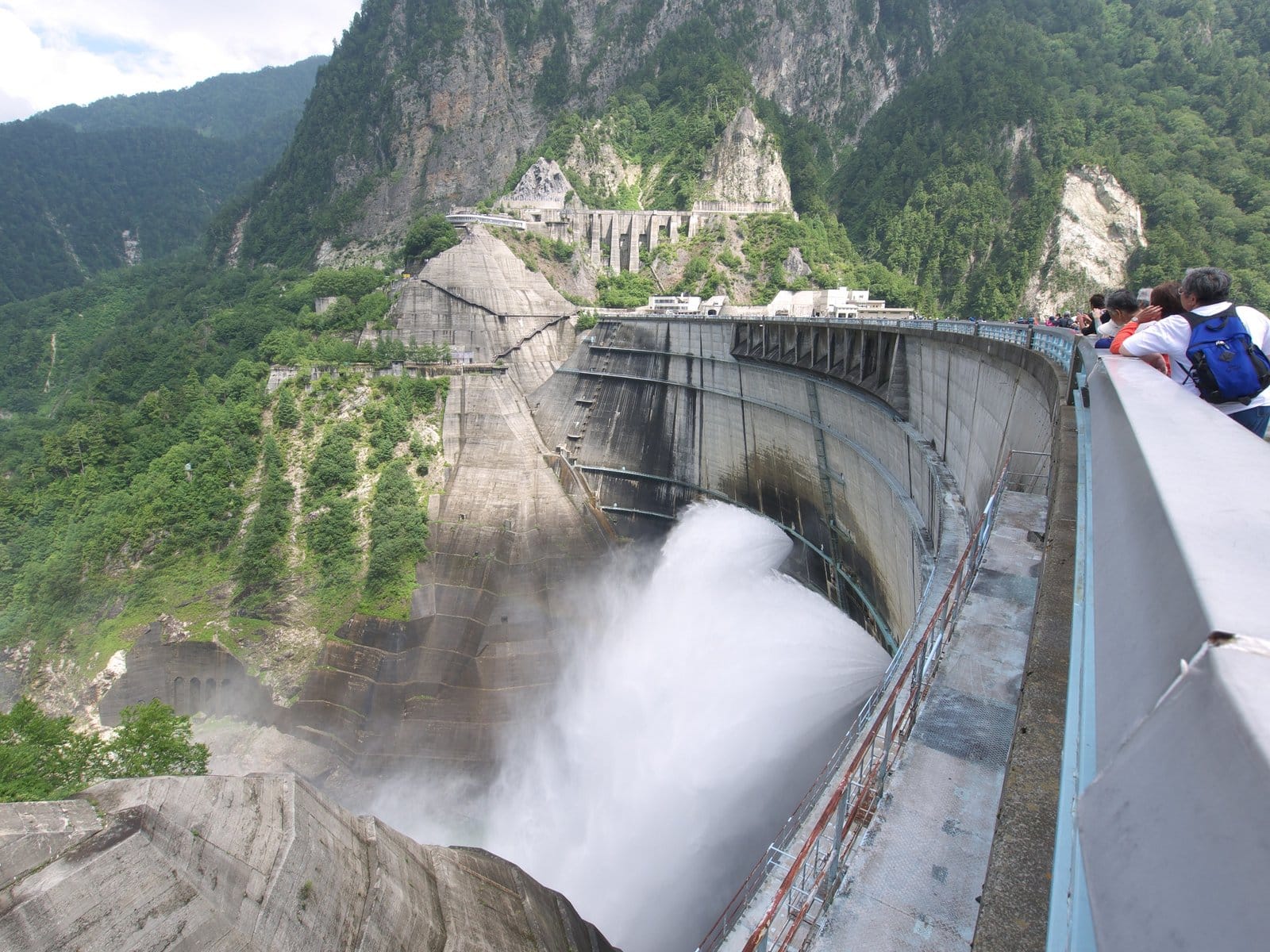
- Walk across Kurobe Dam, then take the electric bus to Ogizawa: Walk for about 15 minutes across Kurobe Dam—the tallest arch dam in Japan—then take an electric bus for about 16 minutes to Ogizawa, the gateway on the Nagano side.
From Ogizawa, a local bus takes about 40 minutes down to Shinano-Omachi Station on the JR Oito Line, from where you can continue to Matsumoto, Nagano, or Tokyo.
It may sound like a lot, but the total time actually spent riding the various forms of transport is only about 2 and a half hours. The real issue is the waiting, queuing, and... not wanting to tear yourself away from each stop. During autumn foliage season, set aside a full day for crossing the route—do not try to squeeze in too many other destinations.
Autumn at Tateyama “moves” from the top down
The most important thing to remember when planning your trip is that the leaves change color according to elevation, and the color gradually moves downward over time.
- Late September – early October: Murodo (around 2,450m) is at its most beautiful. At this elevation, grasses and shrubs are the main attractions, turning yellow and orange in what is known as “kusamomiji”—a carpet of withered-gold grass surrounding Mikurigaike Pond that looks very different from the red maple leaves people usually picture.
- Around early to mid-October: Midagahara Plateau and the areas around Daikanbo and Kurobedaira are at their most vibrant. This is when the Ropeway section is so beautiful that people are willing to queue for an hour just to ride it for 7 minutes.
- Mid to late October: The colors descend to Kurobe Lake and Kurobe Dam, reflecting across the emerald-green water.
- Late October – early November: The lower areas around Bijodaira and the foot of the mountain reach their peak, while Murodo may already have its first snow. If you are lucky, you may see “sandan-koyo”—three layers of color: white snow on the summit, red leaves midway down, and still-green forest at lower elevations.
These dates are estimates based on recent years. The timing can shift by a week or two depending on the weather, so check the foliage updates on the Alpine Route’s official website before finalizing your tickets. One more thing: Kurobe Dam’s spectacular water discharge usually continues only until around mid-October, so if you want to see both the discharge and the autumn leaves, the first week of October is ideal. Also note that the entire route usually remains open only until around late November before closing for the winter season.
Entering from Toyama or Nagano?
This is the question I am asked most often. The short answer is that both directions work, and the better choice depends on your starting point and overall itinerary.
Toyama side: Hokuriku Shinkansen → Dentetsu Tateyama
From Tokyo, take the Hokuriku Shinkansen to Toyama Station, a journey of a little over 2 hours. From Osaka or Kyoto, take the Thunderbird and connect to the Hokuriku Shinkansen via the Tsuruga–Kanazawa route. In Toyama, transfer to Dentetsu-Toyama Station—the station for the private Toyama Chiho Railway company, commonly shortened to Dentetsu—which is right next to JR Toyama Station and only a few minutes away on foot. The Dentetsu train takes about 1 hour to reach Tateyama Station, passing through the pleasant countryside of Toyama.
Advantages of this direction:
- It is convenient from Tokyo, Kanazawa, and Osaka, and Toyama is a large enough city for an overnight stay, with plenty of reasonably priced hotels.
- You experience the most scenic section (Midagahara → Murodo) in the morning, when the mountain air is usually clearer—clouds often gather around Murodo in the afternoon.
- Tateyama Station has the most complete ticketing and luggage-storage facilities on the route.
The downside: precisely because it is convenient, this is also the busier direction during peak season, especially for the morning queue for the Tateyama → Bijodaira cable car.
Nagano side: Ogizawa via Shinano-Omachi
From Tokyo, you can take the Hokuriku Shinkansen to Nagano and then a direct bus to Ogizawa (about 1 hour 45 minutes), or take the limited express Azusa from Shinjuku to Matsumoto, transfer to the JR Oito Line to Shinano-Omachi, and then take a bus up to Ogizawa. If you are staying around Matsumoto or Hakuba, or have just finished visiting Kamikochi, this is almost certainly the more natural route.
Advantages:
- It fits smoothly into an itinerary covering Matsumoto, Kamikochi, and Hakuba, all of which are also beautiful in autumn.
- Your first ride from Ogizawa is an electric bus straight to Kurobe Dam, meaning you begin with spectacular dam scenery right away.
- During peak season, visitor numbers entering from this side are usually a little more manageable than on the Toyama side, although it is by no means empty.
The downside: the Omachi area has fewer accommodation options than Toyama, and if you leave Tokyo in the morning, you will reach Ogizawa later than you would if you stayed overnight in Toyama and set out early.
So which direction should you choose?
Based on my experience, if this is your first time and you are coming from Tokyo or Kansai, stay overnight in Toyama, take the earliest possible Dentetsu train the next morning, cross the route to Nagano, and stay in Omachi Onsen or Matsumoto. Traveling Toyama → Nagano gives you beautiful morning light at Murodo and ends the day at Kurobe Dam in the afternoon sun. Conversely, if your itinerary is centered around Nagano or Matsumoto, simply enter from Ogizawa—there is no need to overthink it. The scenery is the same; only the order changes.
One-way through-route ticket or round trip?
The simple rule is: if you are crossing the route, buy a one-way ticket; if you are going to the summit and returning, a round-trip ticket to Murodo is enough.
One-way through-route ticket (Tateyama → Ogizawa or vice versa) bundles all the transport sections along the route into a single ticket. It is not cheap—roughly in the low tens of thousands of yen per person for one way, depending on annual price adjustments, so check the exact amount on the official website—but in return, you do not have to queue to buy separate tickets at each station, which is extremely valuable during autumn foliage season. This is the most sensible option if you are entering at one end and exiting at the other, and have already arranged your luggage (see below).
Round-trip tickets are suitable when you do not want or cannot change your accommodation area. For example, if you are based in Toyama and simply want to visit Murodo for the day to see Mikurigaike and the golden grasslands before returning to Toyama, a Tateyama ⇄ Murodo round-trip ticket is enough. It is considerably cheaper than a through-route ticket, and you do not have to worry about your suitcase. Similarly, on the Nagano side, many people buy a round trip from Ogizawa ⇄ Kurobe Dam (or as far as Kurobedaira) to see the dam and enjoy the foliage around the lake.
One point that often causes confusion: a round-trip ticket does not require you to travel all the way across the route and then turn around—in reality, almost nobody does that because it is expensive and takes an entire day just to ride the transport. Here, “round trip” means traveling to an intermediate point on the route and returning.
If you are wavering between the two options, simply ask yourself: “Am I willing to change hotels to the other side of the mountain?” If yes, travel through and buy a one-way ticket. If no, buy a round trip to Murodo and accept that you will skip the other half of the route—or save it for another trip, perhaps in the snow season.
JR Alpine–Takayama–Matsumoto Area Pass: who is it worth it for?
This is a 5-day consecutive pass from JR Central, and its special feature is that, in addition to JR routes along the Nagoya – Gero – Takayama – Toyama and Shinano-Omachi – Matsumoto – Nagoya corridors, it also covers all transport on the Alpine Route from Dentetsu-Toyama to Shinano-Omachi—including the cable cars, highland buses, ropeway, and everything else. For travelers following a loop such as Nagoya → Takayama → Toyama → across the Alpine Route → Matsumoto → Nagoya (or the reverse), it is practically the default choice: the pass costs around 20,000 yen (check the current price on the JR Central website), while the Alpine through-route ticket alone, combined with separate train fares, can easily exceed that amount.
A few things to know before buying:
- The pass is only available to visitors entering Japan on foreign passports under temporary visitor status. In other words, if you live in Japan on a work visa, student visa, or another status, unfortunately you are not eligible—this is something many people in my community still misunderstand. Family members visiting for a short time can use it.
- The pass is designed around the Nagoya loop, so it usually does not pay off if you start and finish in Tokyo—the Tokyo–Toyama Shinkansen and Shinjuku–Matsumoto Azusa sections are outside the pass coverage.
- On the Alpine Route, the pass generally allows travel through in one direction only; you cannot turn around and retrace the route, so plan your direction carefully.
- During autumn foliage season, having the pass does not mean you can skip the queues—you still need to obtain a timed ticket for the cable car. See the section below.
If you are only visiting Tateyama and are not stopping in Takayama or Matsumoto, do not buy this pass just because you have “heard it is a bargain”—a regular through-route ticket is usually enough and simpler.
Reserve in advance through the WEB ticket system: the key to surviving peak season
During autumn foliage season, the biggest bottleneck on the entire route is the Tateyama → Bijodaira cable car (and, in the opposite direction, the sections around Kurobedaira). Each cable car can carry only a limited number of passengers, so on weekends in early October, visitors arriving at Tateyama Station at 8–9 a.m. may not be able to board until noon—I have personally seen display boards showing waits of more than 2 hours.
The solution is to buy tickets through the Alpine Route’s official WEB ticket system (search for “Tateyama Kurobe WEB ticket” or visit the official alpen-route website). This allows you to:
- Buy a through-route or round-trip ticket online in advance and pay by card.
- Choose your cable car boarding time at Tateyama Station in advance—this is the real benefit. With a time slot secured, you arrive at the station, exchange or scan your ticket, and join the queue for your reserved time instead of taking a number and waiting in the general queue with the crowds buying tickets on site.
- Tickets usually go on sale well in advance (depending on the season, from several weeks to several months beforehand), and early-morning slots on fine October weekends sell out very quickly.
My practical advice:
- Decide on your travel date as early as possible, prioritizing weekdays (Tuesday through Thursday are the easiest).
- Visit the WEB ticket website as soon as sales open for your chosen date, and select the earliest cable car time possible—the first departure is not only less crowded but also gives you more time to take things leisurely at Murodo.
- Take a screenshot of your ticket code and save the confirmation email, since mobile reception in the mountains can be unreliable.
- If you cannot reserve online, arrive at Tateyama Station very early—before on-site ticket sales begin—and accept that your day’s schedule will need to remain flexible depending on the number you receive.
Note that the ticketing system, sales opening dates, and whether advance reservations are required may change from season to season. Before your trip, check the latest announcements on the official website—the route is updated fairly regularly.
Forward your luggage through the route and travel hands-free
This is a service I wish I had known about before my first trip. Along the Alpine Route, you have to carry your luggage through six transfers, numerous stairways, and packed cable car cabins during peak season—dragging a 25kg suitcase through all of that is genuinely exhausting, and at certain times large suitcases may not even be allowed onboard.
The solution is same-day through-route luggage forwarding. The basic process is:
- Leave your suitcase at the luggage counter at the starting end of the route—for example, at Dentetsu-Toyama Station or Tateyama Station when traveling from the Toyama side—before the morning cutoff time (usually early in the morning; the exact time varies by season, so check in advance).
- Your luggage is transported by road around the lower mountain route to the other side.
- That evening, collect your suitcase at the receiving point on the opposite end—Ogizawa, or at certain affiliated hotels in the Omachi/Shinano-Omachi area, depending on the option you choose when checking it in.
The fee is charged per item, at around several thousand yen per suitcase. Compared with having your hands free all day in the mountains, I consider it worth every yen. All you need is a small backpack containing warm clothing, water, snacks, and a portable battery for the entire day.
A few small points to remember:
- The reverse direction (Nagano → Toyama) is also available, with similar rules.
- The luggage counters can also be busy on crowded days, so arrive a little before the cutoff time to be safe.
- Carry fragile or high-value items with you.
- The list of drop-off and pickup locations, along with the exact seasonal fees, is posted on the Alpine Route’s official website. Check it a few days beforehand.
Suggested one-day autumn foliage itinerary (Toyama → Nagano)
- Night before: Stay in Toyama. Have cold-water Toyama Bay sushi for the full local experience.
- Early morning: Leave your suitcase at the luggage counter, take an early Dentetsu train from Dentetsu-Toyama Station, and at Tateyama Station transfer to the cable car for the time slot reserved through the WEB ticket system.
- Mid-morning: Pass through Bijodaira and take the highland bus across Midagahara—keep your eyes glued to the window here and do not fall asleep.
- Noon: Arrive at Murodo, walk around Mikurigaike Pond (about 1 hour), and have lunch. If the sky is clear, these will be the most beautiful hours of your day.
- Early afternoon: Take the electric bus to Daikanbo, then the Ropeway down to Kurobedaira. Be sure to take in the panoramic view from Daikanbo’s observation deck before joining the queue.
- Mid-afternoon: Take the underground cable car down to Kurobe Lake and walk across the dam. If the water-discharge season is still underway, stop to watch the rainbow in the column of water.
- Late afternoon: Take the electric bus to Ogizawa, then the bus down to Shinano-Omachi, collect your suitcase, and go to your hotel in Omachi Onsen or continue on to Matsumoto.
This is a relaxed full-day schedule with no need to rush. If you want an even more immersive experience, you can spend a night on the route itself—there is accommodation around Murodo—to catch the sunrise over a sea of clouds. However, these places sell out very early during autumn foliage season.
Hard-earned lessons for peak season
- The temperature difference is real: Toyama below may be 20 degrees, while Murodo is only a few degrees with strong winds. Bring thermal underwear, a windbreaker, and a knit hat, and dress in layers.
- Check the mountain weather forecast, not the city forecast: Murodo can be buried in thick white clouds even when Toyama below is enjoying clear sunshine. If your schedule allows, leave one spare day.
- Avoid weekends and public holidays in early to mid-October if possible. The difference between Wednesday and Saturday on this route is night and day.
- Cash is still useful at some small mountain stands, although the main facilities increasingly accept cards and electronic payments.
- Book accommodation at both ends of the route early: Toyama and the Omachi/Matsumoto area fill up quickly during autumn foliage season, especially if you need a hotel affiliated with the luggage-receiving service.
- Do not try to add Kurobe Gorge on the same day: Kurobe Gorge, reached by the torokko train from Unazuki, is another wonderful autumn foliage destination in Toyama, but it lies on an entirely different branch. Set aside a separate day if you want to visit both.
Frequently asked questions
Do I need to reserve tickets in advance for Tateyama during autumn foliage season?
It is highly recommended. For weekends in early to mid-October, I consider booking through the WEB ticket system practically essential if you do not want to spend several hours queuing at Tateyama Station. Weekdays are less stressful, but booking ahead still lets you control your entire schedule for the day.
Should I enter from the Toyama side or the Nagano side?
The scenery is the same in both directions; only the order changes. For first-time visitors from Tokyo or Kansai, stay overnight in Toyama and travel early from Toyama → Nagano for the best morning light at Murodo. If your itinerary is connected to Matsumoto, Hakuba, or Kamikochi, entering from Ogizawa makes more sense.
Can people living in Japan use the JR Alpine–Takayama–Matsumoto Area Pass?
No. This pass is sold only to foreign visitors entering Japan under temporary visitor status. If you hold a work or student visa, calculate the cost using regular through-route tickets instead. Relatives visiting for a short stay can buy the pass, and it is often an excellent deal for the Nagoya – Takayama – Alpine – Matsumoto loop.
Can I take a large suitcase across the route?
In theory, there are size restrictions, and in practice it is extremely inconvenient. During peak season, large luggage may be refused on some forms of transport. Use the same-day luggage-forwarding service: drop it off in the morning at one end of the route and collect it at the other end in the afternoon, for a fee of around several thousand yen per item.
When is Tateyama’s autumn foliage at its best?
It depends on the elevation: Murodo is beautiful around late September – early October; Midagahara and Kurobedaira around early to mid-October; and Kurobe Lake and the lower areas around mid to late October. The first week of October is usually the best overall balance, and you may still catch the Kurobe Dam water discharge. Remember to check the official foliage report before finalizing your date.
Is a day trip from Tokyo possible?
It is possible but tiring: you have to take an early-morning Shinkansen and will have almost no time to linger anywhere. Staying overnight in Toyama—or in Omachi if entering from the Nagano side—the night before crossing the route is far more comfortable and worth every yen spent on the room.
Can young children and older adults manage the route?
Yes. The entire route consists of connected public transportation, not trekking. Just keep in mind that the elevation at Murodo may leave some people feeling tired, temperatures are low, and there are some stairways when changing vehicles. Take it slowly, dress warmly, and choose a quieter weekday.
More from this region — Chubu (Nagano, Kanazawa)
View all →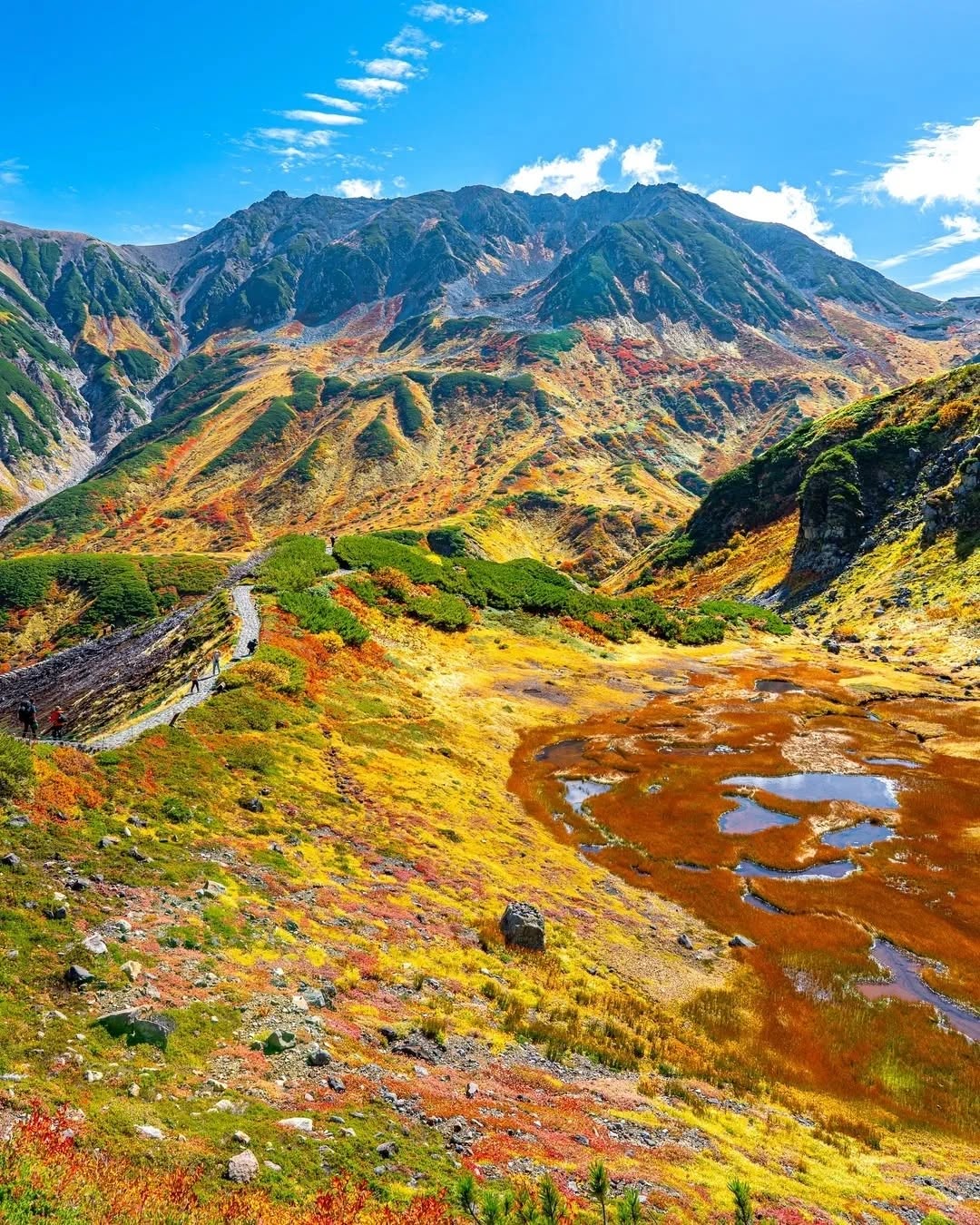
A Station-by-Station Photo Map for Tateyama’s Autumn Foliage
16 min · tips
Tateyama and a 4–5-Day Autumn Arc Around the Japanese Alps
15 min · tips
Tateyama Kurobe Alpine Route – Walking Through 65-Foot Walls of Snow
5 min · tips

Chasing Tateyama’s Autumn Foliage Wave from Murodo Down to Lake Kurobe
16 min · tips