
Kimono in Okayama: Where to Wear It, Best Photo Spots and How to Plan the Day
Kimono in Okayama: Kurashiki's white-walled canal quarter, Korakuen Garden and the black castle, plus seasons, access and a step-by-step plan for the day.
Sep 14, 2026·✍️ olablog·⏱ 8 min read
Kimono in Okayama: Kurashiki's white-walled canal quarter, Korakuen Garden and the black castle, plus seasons, access and a step-by-step plan for the day.
Tap a region to browse articles
Okayama sits on the Shinkansen line between Osaka and Hiroshima, and most people see it through a train window. That is a mistake if you like wearing kimono, because twenty minutes from the station is Kurashiki (倉敷), a canal town of white plaster warehouses and willow trees that was built, quite literally, for people in traditional dress to walk through. Add one of Japan's three great landscape gardens and a jet-black castle, and you have a full kimono day that never feels crowded the way Kyoto does.
The short version
Kurashiki's Bikan Historical Quarter (倉敷美観地区) is the reason to come. Okayama Korakuen (岡山後楽園) and Okayama Castle (岡山城) are the reason to stay a second day. Everything else, from the Kibitsu Shrine corridor to the mountain castle at Bitchu-Matsuyama, is for people who want a kimono photo nobody else has.
Kurashiki: the kimono town of western Japan
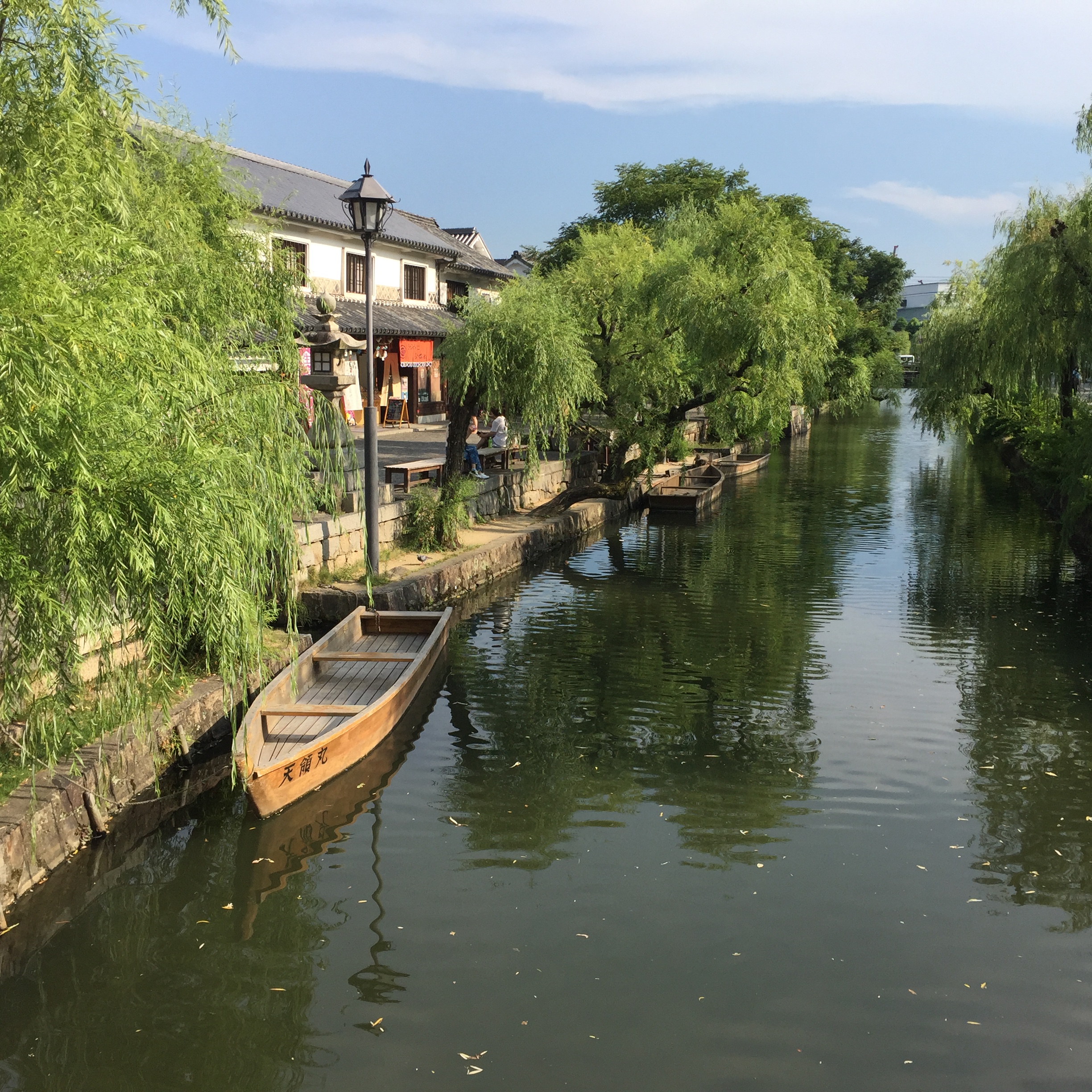
The Bikan quarter is a preserved merchant district from the Edo period, when Kurashiki was a shogunate-controlled rice port. The canal, the stone bridges, the black-tiled kura storehouses with white namako plaster walls: all of it survives and is used, not roped off. Rental kimono are a normal sight here, and the town has a lot of small businesses that want you to walk slowly past their windows.
The best photo is from the canal boat. The rowed boats take about twenty minutes and pass under the willows and the Nakabashi stone bridge. Board early; the boat sells out by late morning on weekends. On the bank, the Ohara Museum of Art (大原美術館) with its Greek-temple facade gives an unexpected Western backdrop to a very Japanese outfit, and the Ivy Square red-brick mill next door does the same in a different colour.
One street back, Honmachi and Higashimachi are quieter, with older shopfronts and fewer people. Denim from Kojima, the district that pioneered Japanese jeans, turns up in shops here too; a denim kimono is a real thing in this town and a surprisingly good choice for a modern look.
Okayama city: garden and castle
Korakuen was completed in 1700 as a lord's garden and is one of the "three great gardens" of Japan, with Kenrokuen and Kairakuen. It is spacious: wide lawns, a stream, a tea plantation, a small hill you can climb for the classic view with the castle keep rising over the trees. The light is best in the morning, and the garden opens at 7:30 in summer. Autumn evening illuminations run for a few weeks in November, when a kimono under lantern light looks extraordinary.
Okayama Castle, across the river on a short bridge, is nicknamed the Crow Castle for its black boards. The keep was rebuilt in concrete after the war and renovated recently, so the inside is a modern museum, but the exterior with a gold-tipped roof is the photo. Stand on the Korakuen side of the Asahi River for the full reflection.
Best kimono photo spots in Okayama
| Spot | Best time | Access | Crowd level |
|---|---|---|---|
| Kurashiki canal and Nakabashi bridge | Early morning or after 16:00 | 15 min walk from JR Kurashiki Station | Moderate; busy at midday on weekends |
| Kurashiki canal boat | First boats of the day | Ticket booth by the canal | Sells out |
| Ohara Museum facade | Mid-morning light | On the canal | Moderate |
| Korakuen Garden (岡山後楽園) | Morning, or November evening lights | Tram to Shiroshita, 10 min walk | Low to moderate |
| Okayama Castle (岡山城) from the riverbank | Late afternoon | Next to Korakuen | Low |
| Kibitsu Shrine (吉備津神社), 400 m roofed corridor | Any time; peonies in spring | JR Kibi Line to Kibitsu, 10 min walk | Low |
| Bitchu-Matsuyama Castle (備中松山城) | Autumn mornings for the sea of clouds | Bus and shuttle from JR Bitchu-Takahashi | Low, but a steep walk |
| Bizen pottery village, Imbe (伊部) | Weekday afternoons | JR Ako Line to Imbe | Very low |
Kibitsu Shrine's long descending corridor is the most underrated kimono shot in the prefecture: a tunnel of timber and light with almost no one in it on a weekday. Bitchu-Matsuyama is the highest original castle keep in Japan, but the final climb is a mountain path, so leave the kimono for the town below or change into it afterwards.
Seasons
- Spring: cherry blossom on the Asahi River bank next to Korakuen, usually early April. Kurashiki's willows go bright green.
- Summer: Okayama calls itself the "land of sunshine" and it lives up to it, which means heat. Wear yukata, do Kurashiki after 16:00, and eat white peach, the local fruit, in everything.
- Autumn: the season for kimono. Korakuen's illumination in November and the sea of clouds at Bitchu-Matsuyama from late September to early December.
- Winter: mild and dry compared with the Sea of Japan side. A lined kimono with a haori is enough.
Plan your kimono day in Okayama
- Arrive at Okayama by Shinkansen. Coin lockers at the station take suitcases; you want to walk light.
- Take the JR Sanyo Line to Kurashiki, 17 minutes. Walk to the Bikan quarter via the covered arcade, about 15 minutes, or a five-minute taxi.
- Boat first, then walk. Buy the canal boat ticket before anything else, then use the waiting time for the Ohara Museum or coffee in a converted storehouse.
- Lunch in the quarter. Kurashiki has plenty of small restaurants with tatami seating; local fish from the Seto Inland Sea and mamakari (a sardine-like fish, pickled) are the specialities.
- Back to Okayama by 15:00. Tram from the station to Shiroshita, walk into Korakuen, cross to the castle for the late light.
- Evening. Okayama's Omotecho arcade for dinner, or, in November, return to Korakuen for the lantern illumination.
If you have a second day, do Kibitsu Shrine in the morning and Bizen pottery in the afternoon; both are quiet and both sit on small JR lines that run every 30 to 60 minutes.
Where OlaChill fits in
We are honest about geography: OlaChill's shops are in Kyoto Kiyomizu and Tokyo Asakusa, and neither is in Okayama.
The useful trick is that Okayama is only about an hour from Kyoto on the Shinkansen. Rent at Kiyomizu in the morning, add the next-day return option (¥1,100), and you can do a Kyoto afternoon, sleep in Okayama, and walk Kurashiki in the same kimono the next morning before returning it in Kyoto. Our 14 plans start with a full set and dressing included, and booking online takes 10 percent off. Hair styling (¥1,500) and make-up (¥5,000) are add-ons at the counter.
If you are travelling as a group along the Sanyo coast, a private car with driver between Kyoto, Okayama and Hiroshima means the kimono stays neat and the luggage stays with you. Pricing is by route and hours; ask for a quote.
FAQ
Is Kurashiki really worth it compared with Kyoto's Higashiyama? For photos, yes, and for stress levels, absolutely. You get water reflections, white walls and willows, and a fraction of the crowd. It is smaller, so half a day is enough for the quarter itself.
How do I get from Kurashiki Station to the Bikan quarter in a kimono? It is a flat 15-minute walk along a covered shopping arcade, with no stairs. A taxi from the station rank is under ten minutes if the weather is bad.
Can I take a kimono onto the canal boat? Yes. The boats are low and stable and you board from a stone step. Keep the hem clear of the water when you step in and sit on the side you want photographed from the bank.
When is the Korakuen illumination? Usually a few weeks in mid to late November, in the evening after normal closing. Dates are announced by the garden each autumn; check them a few weeks ahead.
Is Okayama a day trip from Kyoto or Osaka? Yes. Shinkansen from Kyoto is about an hour, from Shin-Osaka about 45 minutes. Kurashiki plus Korakuen is a long but doable single day.
Ready to walk the canal?
Start the kimono in Kyoto at OlaChill Kiyomizu, add next-day return, and carry it west to Kurashiki. For the ground-level details, read our guides to Kurashiki's Bikan quarter and Korakuen and Okayama Castle, then book your kimono online.
More from this region — Chugoku & Shikoku
View all →
Kimono in Shimane: Where to Wear It, Best Photo Spots and How to Plan the Day
9 min · culture
Kimono in Tokushima: Where to Wear It, Best Photo Spots and How to Plan the Day
8 min · culture
Kimono in Tottori: Where to Wear It, Best Photo Spots and How to Plan the Day
7 min · culture
Kurashiki Bikan Quarter: Canals, Kura Houses and Japanese Denim
8 min · destinations