
The Fuji Five Lakes in Autumn: Two Days and One Night, and How to Choose Where to Stay
Sleep by the lake so you can catch the summit while the sky is still purple, spend the second day circling three quieter western lakes, and learn how to divide room costs by accommodation tier.
Aug 12, 2026·✍️ olablog·⏱ 19 min read
Sleep by the lake so you can catch the summit while the sky is still purple, spend the second day circling three quieter western lakes, and learn how to divide room costs by accommodation tier.
Tap a region to browse articles
There is something almost everyone visiting Mount Fuji on a day trip experiences: you take an early bus from Shinjuku, arrive at Lake Kawaguchi around noon, get off, look up—and see clouds. Not thick storm clouds, just a lazy strip of white stretching right across the part of the mountain you most want to see. You walk around, drink coffee, and wait. By three in the afternoon, the clouds are still there. At four-thirty, you have to head back to the bus terminal, and the mountain is still hiding. When you get back to Tokyo, you check your phone and see that someone has just posted a crystal-clear photo of Mount Fuji taken at six that morning.
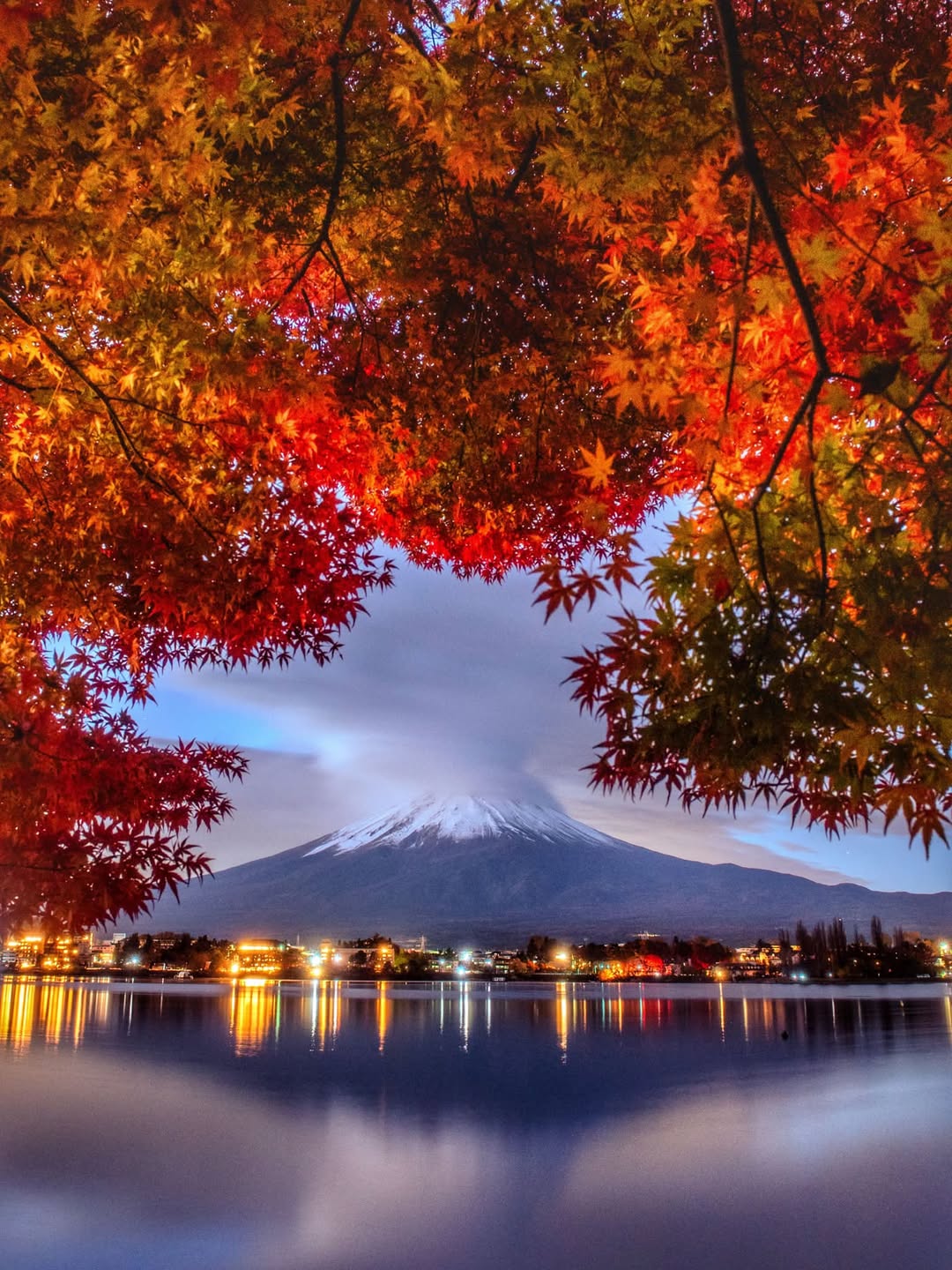
That is why this article is about two days and one night rather than a day trip. In autumn, the air around the Fuji Five Lakes is colder and drier, so the odds of seeing the mountain clearly are much higher than in summer—but those odds are concentrated almost entirely between the time the sky is still purple and around eight or nine in the morning. Once the sun is up, moisture rises from the lakes and forests, and clouds begin gathering around the summit. Day-trippers are almost never there during that golden window. If you stay overnight, all you have to do is open the curtains.
This is a specific itinerary: spend day one in the east (Kawaguchi or Yamanaka) for autumn foliage and a decent place to sleep, stay somewhere where you can open the door and see the mountain, get up early the next morning to catch the best moment, then spend day two circling the three western lakes—Sai, Shoji, and Motosu—where there are fewer people and the scenery feels much wilder. It also includes the part I think many people need most: how to divide the cost of the room fairly, because on this trip the biggest expense is not the train fare but that one night of accommodation.
Why autumn is the best time to stay overnight
Autumn in the Fuji Five Lakes brings two things together. The first is the changing foliage: red maple leaves, golden ginkgo trees, and, on the northern shore of Lake Kawaguchi, rows of kochia turning from green to burgundy. The second is visibility. Autumn air contains less moisture and the northwest monsoon begins to arrive, so on clear days the mountain appears so sharply defined that it almost looks unreal.
Peak foliage around the lakes usually falls somewhere between the second half of October and the middle of November, but the timing varies considerably with elevation and from year to year. Lake Yamanaka sits at a higher elevation, so its foliage season generally arrives about one week earlier than at Kawaguchi. Autumn-leaf events in Kawaguchiko are usually held from early to mid-November and often include evening illuminations, but you should check the town’s official website or the local tourism association before settling on your dates—the price and crowds can be completely different if you book during a peak weekend.
One more thing that few people account for: autumn is seriously cold before dawn. If you plan to be at the lakeshore at five-thirty in the morning waiting for the first light to reach the summit, pack as though you were spending winter in Tokyo. The lakes are significantly higher than sea level, the wind blows straight across the water, and you will be standing still for quite a while.
Which lake to stay at: Kawaguchi or Yamanaka
This decision shapes the entire trip, so it is worth discussing in detail.
Lake Kawaguchi: convenient, crowded, and full of options
Kawaguchi has the best tourist infrastructure of the five lakes. Kawaguchiko Station is the terminus of the Fujikyuko Line and the arrival point for most highway buses from Tokyo, so you are right in the middle of everything as soon as you get off. Around the lake, there is a wide range of prices: guesthouses for solo travelers, mid-range hotels, and upscale ryokan with onsen and direct mountain views. Buses circle the lake regularly, so you can manage without a car.
The trade-off is that Kawaguchi is crowded. On autumn-leaf weekends, the northern shore can suffer from traffic jams, and the popular photo spots may have tripods lined up in queues. If you prefer peace and quiet, that is a genuine disadvantage.
Lake Yamanaka: spacious, elevated, and quieter
Yamanaka is the largest lake by area and the highest of the five lakes. The atmosphere here is completely different: the lakeshore feels open, there are long stretches of walking paths without shops, and because the lake is so broad, the water is often calm in sheltered coves—ideal conditions for reflections of “Fuji upside down.”
Yamanaka is also often mentioned as a good place to see the sun set or rise directly over the summit, usually sometime from mid-autumn into winter depending on where you are standing. The exact time varies by viewpoint, so if that is the scene you are aiming for, check the schedule on the official Yamanakako Village website rather than relying on a generic article.
The downsides: there are fewer accommodation options than in Kawaguchi, public transportation is less frequent, and early mornings are noticeably colder.
How to choose simply
If this is your first time in the area, you are using public transportation, and you want to continue on day two to the three western lakes—stay in Kawaguchi. Logistically, it is much simpler, since buses to Sai, Shoji, and Motosu all depart from Kawaguchiko Station.
If you are driving, traveling as a couple, and value peace and beautiful photos more than convenience—choose Yamanaka, then drive through Kawaguchi to the western side on day two. It adds about thirty to forty minutes of driving, but you get a much more pleasant evening and morning.
Day 1: Head to the lake and chase the afternoon light
When to leave Tokyo
The highway bus from Shinjuku to Kawaguchiko Station takes about two hours when traffic is light, and can take considerably longer on peak-season weekends. It is usually the cheapest and simplest option because you do not need to change trains. By rail, take the JR Chuo Line to Otsuki Station, then transfer to the Fujikyuko Line—it is slightly slower but less vulnerable to traffic, and the Fujikyuko section, which runs along the town with the mountain gradually appearing outside the right-hand window, is a particularly enjoyable experience.
You do not need to take the earliest departure. A bus leaving around mid-morning is reasonable: arrive in the early afternoon, leave your luggage at your accommodation or in a station locker, and then get started.
Afternoon: the northern shore of Lake Kawaguchi
Spend the afternoon on the northern shore. This is the side with a direct view across the lake to the mountain, and it is also where the best autumn scenery is concentrated. Oishi Park on the northern shore has seasonal flowerbeds and shrubs, and looking across the lake from there gives you the area’s most classic composition. Walk east along the lakeshore and you will come to an area lined with dense maple trees that are often illuminated during the autumn foliage season.
If you want a view from above, the cable car to the observation deck on Mount Tenjo near central Kawaguchiko gives you the lake and mountain in a single frame. Check the official website for the final operating time and ticket price, since autumn days are shorter and the schedule is often adjusted seasonally.
One small tip about the light: about one hour before sunset, the face of the mountain looking toward the lake begins to turn pink. That is the moment to stand still rather than keep moving. Do not try to squeeze another attraction into this time slot.
Evening: Return to your accommodation early
This is something I want to emphasize: return to your accommodation early. This is not a trip for bar-hopping. The area around the lakes gets dark very quickly, and restaurants close earlier than you might expect, especially outside the station area. Returning early means you have time for an onsen, a proper dinner, and, most importantly, enough sleep to get up at five in the morning without feeling miserable.
If your accommodation offers a kaiseki-style dinner, serving times are usually fixed and fairly early. Ask about them when you check in.
Night and morning: the most valuable part of the trip
How to book a “Fuji view” room without being disappointed
The phrase “Mount Fuji-facing room” on booking websites is one of the easiest things to misunderstand. Check a few things before you click Book:
- Ask whether you can see the mountain from inside the room, or only from a shared area such as the lobby, an outdoor onsen, or the rooftop terrace. The price difference can be substantial, and many properties deliberately use vague wording.
- Look for photos taken from the room window, not generic landscape photos of the surrounding area.
- The floor and window orientation matter more than the room category. A standard room on a high floor facing the right direction is often much better than a large room on a low floor with trees blocking the view.
- If the ryokan has an outdoor onsen overlooking the mountain, ask when the men’s and women’s bathing areas are switched. Many places change them late at night, and if you want to bathe at dawn with a good view, you need to know in advance.
- Book early. Autumn-leaf weekends in this region are among the fastest periods of the year to sell out.
What time should you get up?
The simple rule: be outside about forty minutes before sunrise. In autumn here, sunrise is around six in the morning, shifting slightly depending on the month, so check the sunrise time for your specific date and count backward.
The period before the sun comes up is actually the most beautiful—the sky changes from deep blue to purple to orange, the lake lies flat as a mirror before the wind picks up, and the mountain appears as a sharply defined silhouette. Then, when the first rays touch the summit, the snowcap blushes pink for a few minutes before the light spills down the mountain. Those few minutes are the entire reason to pay for a night here.
Bring a thick jacket, gloves, and a thermos of hot water if you can. Also bring a small cloth to wipe your lens, because condensation forms quickly.
If the fog is thick that morning, do not leave immediately. Fog around the lakes often clears in layers, and there are mornings when the mountain does not appear until after seven, once the low mist pulls back. Staying for another hour and having coffee at your accommodation is often the right decision.
Day 2: The three western lakes
This is the part most day-trippers never reach, and also the part that makes the two-day itinerary worthwhile. The three lakes of Sai, Shoji, and Motosu lie next to one another to the west, separated by Aokigahara Forest. The scenery is much wilder, with far fewer shops and restaurants.
How to get around
With a car, it is simple: one main road connects all three lakes, and you can drive the whole route in a little over one hour without stops. In reality, you will be stopping constantly.
Without a car, use the sightseeing bus system departing from Kawaguchiko Station—one route circles the Saiko area, while a longer route continues to Shojiko and Motosuko. Services are much less frequent than the buses around Lake Kawaguchi, so take a photo of the timetable as soon as you arrive at the station and plan around a few key departures. Day passes for these routes are usually sold at the station counter; check the bus company’s official website for the specific pass and price, as they change seasonally.
Lake Sai
Lake Sai is quiet and narrow, tucked between wooded hills, so autumn here forms one continuous sweep of color rather than just a few isolated trees. The main place to visit is the reconstructed thatched-roof village on the northwestern shore—old-style houses rebuilt with thatched roofs, now home to small craft workshops. Looking back out from there, you can see the mountain rising in the distance if the sky is clear. On a weekday in autumn, the place is comfortably quiet.
There is also an elevated observation deck between Lake Sai and the forest, reached by a short but steep uphill walk. It opens onto a view over a sea of trees with the mountain in the distance. If your legs are still in good shape after getting up early, it is well worth the effort.
Lake Shoji
Shoji is the smallest of the five lakes, and also the one with what I find to be the strangest atmosphere—small, still, and almost entirely free of anything except a few old inns and the surface of the water. From the northern shore, photographers favor a famous composition: a low hill sits directly in front of the larger mountain, creating the impression of a smaller mountain nestled inside its mother mountain.
You do not need to stay long. But fifteen quiet minutes beside Lake Shoji on an empty autumn morning is something you will remember much longer than many more famous sights.
Lake Motosu
Motosu is the deepest lake, with water so dark blue it looks like ink. It is also the lake featured on the ¥1,000 banknote—take one out and compare it, and the composition is nearly identical. The exact viewpoint for the original image is on a pass above the lake, reached by hiking uphill for a while. The trail is not especially difficult, but you need proper shoes and should allow plenty of time for the round trip, especially in autumn when it gets dark early.
If you do not want to hike, the lakeshore still offers beautiful views, particularly along the southeastern shore where there is a campground. The deep blue water, golden trees, and distant white mountain form a complete composition without requiring you to go anywhere else.
The return journey
Work backward from the final bus. Late-afternoon light in the west is beautiful, but buses are infrequent, and you do not want to end up standing at an empty stop after dark. If you are using public transportation, return to Kawaguchiko Station before nightfall and take a highway bus back to Tokyo—the late-afternoon and evening departures usually give you several options.
Dividing the room budget by accommodation tier
This is a trip where one night’s accommodation can account for more than half of the total cost, so it is worth doing the math carefully. The figures below are rough estimates for one night and can vary widely depending on the day of the week and the peak season—an autumn foliage weekend may cost one-and-a-half to twice as much as a weekday. Check the actual price on the property’s website or booking platforms for your intended dates.
Budget tier
Guesthouses, hostels, dorm rooms, or budget hotels near Kawaguchiko Station. Usually a few thousand yen to around ¥10,000 per person per night, generally without meals.
This tier does not offer a mountain view from the room, and that is the main consideration. But if you stay near the lakeshore, it is still entirely possible to get up early and walk to the water for sunrise—you simply spend an extra fifteen minutes walking in the cold. For solo travelers or groups of young friends, this is the most sensible option: put the money you save toward meals and transportation on day two.
Mid-range tier
Lakeside hotels or medium-sized ryokan with twin or double rooms, usually including breakfast and sometimes dinner, plus a shared bath supplied with hot-spring water. A range of over ¥10,000 to more than ¥20,000 per person per night is common.
This is the best balance for most people. At this level, you can often choose a genuinely mountain-facing room, and there is usually a shared bathing area overlooking the lake. Tip: choose a place that serves breakfast early, because in autumn you will want to eat after returning from sunrise rather than skip the meal.
Mountain-view ryokan tier
Traditional ryokan with a multi-course kaiseki dinner, spacious tatami rooms, and the most expensive feature of all: a private open-air bath on the balcony facing directly toward the mountain. Prices start at around ¥20,000-something per person per night, while the top rooms at famous properties cost considerably more.
Is it worth it? If this is a special occasion—a milestone, a birthday, or your first time bringing your family from Vietnam to Japan—yes. You are not just buying a place to sleep; you are buying the chance to soak in hot water at five-thirty in the morning as the sky brightens and the mountain appears right in front of you, without having to share the moment with anyone. For a single night, the difference from the mid-range tier is often still less than the airfare for the entire trip.
A few principles for splitting the cost
- Put the money into one night. Since you are only staying one night, upgrade the room by one tier from what you would normally choose, and make up for it with a simple lunch. The difference in the experience is very noticeable.
- Weekdays are much cheaper. Visit on a Tuesday or Wednesday during the autumn foliage season and you may be able to stay in a higher tier for the same price as a weekend, with far fewer people around.
- Read the meal policy carefully. Ryokan prices are often calculated per person with two meals included. When comparing them with a hotel charging per room without meals, convert everything to the same basis before deciding which is actually cheaper.
- Rent an entire house for larger groups. For four or more people, a rental house around the lake may cost less per person than a hotel, while also giving you a kitchen and shared living space.
- Book early with a late cancellation date. Choose a room with free cancellation close to the travel date and reserve early. Autumn weather is unpredictable, and you will want to keep your options open.
Common mistakes
Trying to cram too many places into day one. You do not need to visit every museum around Lake Kawaguchi. This trip revolves around two moments—the afternoon light on day one and sunrise on day two—and everything else is secondary.
Failing to check the western bus timetable. This is the practical mistake most likely to ruin day two. Buses to Shoji and Motosu are infrequent, and missing one can mean a very long wait.
Not dressing warmly enough in the morning. Pre-dawn temperatures around the lakes are significantly lower than in Tokyo, and some mornings come close to freezing. If you stand still in the lakeside wind wearing light clothes, you will give up before the mountain appears.
Booking too close to the travel date. On autumn foliage weekends, places with good views and reasonable prices disappear months in advance.
Frequently asked questions
When is the best time to visit the Fuji Five Lakes in autumn? Generally, from late October to mid-November, though the timing varies with elevation and from year to year. Higher-elevation lakes such as Yamanaka usually change color earlier. Before finalizing your dates, check the foliage forecasts and announcements on the local authorities’ official websites.
Can I follow this itinerary without a car? Yes, if you stay in Kawaguchi. Day one can be done entirely by bus around the lake, and day two by sightseeing bus to the western lakes. The condition is that you stick closely to the timetable. If you stay in Yamanaka without a car, day two will involve considerably more backtracking.
What should I do if it is foggy when I wake up? Do not give up immediately. Fog around the lakes often clears in layers, and the mountain may appear later than expected. If it is still completely obscured by mid-morning, change plans: on a foggy day, the western forests and lakes are beautiful in a different way, and the thatched-roof village by Lake Sai does not depend on being able to see the mountain.
Do I have to stay at a ryokan? No. What determines the quality of the trip is whether you are by the lakeshore at sunrise, not where you sleep. A guesthouse ten minutes’ walk from the water can still give you that exact moment. A ryokan elevates the experience; it is not a requirement.
How should I adjust the itinerary for young children or older adults? Skip the climb up the pass overlooking Lake Motosu and the elevated observation deck near Lake Sai. Spend more time at the lakeshore and the thatched-roof village instead; both are relatively flat and easy to navigate. Choose accommodation with a mountain-view room so older travelers do not have to go outside during the coldest part of the day.
Should I stay for two nights? If your schedule allows, it is highly recommended. A second night gives you another chance with the morning weather, which is the biggest variable of the entire trip. A sensible split is to spend the first night in Kawaguchi or Yamanaka, then the second night on the western side near Shoji or Motosu so you can stand beside a quiet lake on your final morning.
How much does the entire trip cost? The room category is the main factor. Round-trip bus fares from Tokyo and local transportation are usually a small part of the cost compared with the accommodation. As a quick estimate, take the price of the one-night room you choose and add roughly the same amount for all transportation and food over two days. That will give you a close figure. Check the actual prices directly, since they can vary significantly by date.
More from this region — Mt. Fuji
View all →
Beating the Crowds and Budgeting Properly for Fall Foliage Beneath Mount Fuji
17 min · tips

Soak in an open-air onsen with views of Mount Fuji amid the autumn colors
18 min · tips
Oshino Hakkai: Mount Fuji's Spring-Fed Ponds and How to Visit
5 min · destinations
Fuji Panorama Line – The Ultimate Scenic Drive Around Mount Fuji
6 min · destinations