

Soak in an open-air onsen with views of Mount Fuji amid the autumn colors
Around Kawaguchiko and Yamanakako, several outdoor baths look straight toward the snow-capped peak: how to choose one, day-use admission prices, the best hours for clear mountain views, and tips for first-timers.
Aug 12, 2026·✍️ olablog·⏱ 18 min read
Around Kawaguchiko and Yamanakako, several outdoor baths look straight toward the snow-capped peak: how to choose one, day-use admission prices, the best hours for clear mountain views, and tips for first-timers.
Tap a region to browse articles
There is a moment that anyone who has visited an onsen around the foot of Mount Fuji in November remembers forever: you step into an outdoor bath while the air is still bitterly cold, steam billows around you, and then the mist drifts aside — revealing the entire snow-white mountain standing majestically behind a row of brilliant red momiji maples. No glass barrier, no fence, and no need to zoom in on your phone. Just you, shoulder-deep in hot water, and the mountain that all of Japan has printed on stamps, cake boxes, and banknotes.
Autumn is the best-value season for this experience because three things that rarely coincide come together: the air is dry and clear, making the peak much more likely to appear than in summer; the maples around the Fuji Five Lakes are at their most vivid; and outdoor temperatures fall low enough for a hot soak to feel genuinely blissful rather than torturous. In summer, ten minutes in the bath is enough to make you want to climb out; in November, you can sit for half an hour and still feel reluctant to leave.
This guide is for people already in Japan or planning a weekend trip: which baths truly have a view (rather than a “view if you stand on tiptoe in the left corner”), how much day-use bathing costs, when the mountain is most likely to appear, and the etiquette that leaves every first-time onsen visitor feeling a little awkward.
Why the area around Mount Fuji is one of the few places with “onsen facing the mountain”
It sounds obvious, but in reality, not every spot around the mountain offers a view of it. Mount Fuji is so enormous and so close that a low ridge, a line of pine trees, or a cluster of inns built in front of you can completely ruin the sightline. The area with the highest odds is the northern shore — around Lake Kawaguchi (Kawaguchiko) and Lake Yamanaka (Yamanakako), where the open expanse of water gives the mountain room to “step into” the view.
The key differences between the two lakes:
- Kawaguchiko is busier, with more luxury ryokan, easy access from the train station and bus terminal, and convenient public transportation. Its autumn foliage is famous for the “Momiji Corridor” along the northern shore.
- Yamanakako is quieter and slightly higher, so it gets cold earlier. The mountain views are often more dramatic because the lake is wider and there are fewer tall buildings. It is also home to several day-use baths with beautiful views and very reasonable prices.
- Narusawa – Saiko lies to the west. Fewer Vietnamese visitors know about it, but it has one bathhouse that is especially popular with locals.
Autumn foliage calendar: miss the timing by a week and you may miss the peak
Mount Fuji has an enormous range of elevations, so “autumn foliage season” here is not one fixed date but a wave of color that gradually moves down the mountain:
- Late September – early October: the area around Station 5 on the Fuji Subaru Line and the higher slopes change color first, but the leaves at this point are usually brownish yellow rather than brilliant.
- Mid to late October: the area around Lake Motosu, Lake Shoji, and the forests around Narusawa reaches its best.
- Early to mid-November: this is the peak around the shores of Lakes Kawaguchi and Yamanaka — also when the lakeside autumn foliage festivals take place, often with evening illuminations over a period of several weeks.
- Late November: leaves begin to fall around the lakes, but the snow on the summit is thicker and the air is crystal clear — if you prioritize mountain photos over foliage photos, this can actually be the best week.
The exact timing shifts each year depending on the weather, so before booking your tickets, check the foliage forecast and the official websites of the local festivals.
Day-use bathhouses: affordable, quick, and with real views
If you do not want to pay for a night at a ryokan, this is the most practical option. In Japan, this type of visit is called higaeri onsen (日帰り温泉) — an onsen visit without an overnight stay.
Benifuji-no-yu (紅富士の湯) — Yamanakako
This is the name most often mentioned when people talk about an “affordable onsen with views of Mount Fuji.” The name comes from the phenomenon known as beni-fuji, when the snow-covered slopes turn pink or red in the early morning or late afternoon light during the colder months.
Its main strengths are the large outdoor bathing area facing directly toward the mountain and the carefully trimmed trees that do not block the view. Indoors, there is a tatami-lined relaxation room where you can stretch out after bathing, a restaurant, and a shop selling local produce — a very Yamanashi-style combination of a “michi-no-eki with a bathhouse.”
Adult admission is generally under 1,000 yen, with considerably cheaper tickets for children. The facility closes on one fixed day each week, and its opening hours may change by season. Check the official website before you go, especially during holidays and the peak foliage season.
Ishiwari-no-yu (石割の湯) — Yamanakako, in the forest
Operated by the same local authority and located near the trail leading up to Ishiwari Shrine, this bathhouse is more about the forest atmosphere than a complete mountain panorama. Do not expect the postcard-style frame you get at Benifuji-no-yu. In return, it is quieter, the water is pleasant, and it is an excellent choice after a hike or a morning on the trails. Admission is also in line with the prices at other local public bathhouses.
Fuji Chobo-no-yu Yurari (富士眺望の湯 ゆらり) — Narusawa Village
The name translates directly as “hot spring with a view of Mount Fuji,” and it is not exaggerating. This is a large facility with more than a dozen types of baths: wooden baths, stone baths, herbal baths, cave baths, and, most importantly, an outdoor bathing area facing the mountain. It is high enough that, on a clear day, Mount Fuji seems to fill almost the entire view.
This is also one of the places with several private baths (kashikiri) for families or anyone uncomfortable bathing with others — especially useful if you are traveling with young children, someone unaccustomed to communal nudity, or a person with tattoos. Private rooms cost extra and should generally be reserved in advance.
Admission here is higher than at local bathhouses, usually around one or two thousand yen depending on the time slot and day of the week. Late evenings sometimes have discounted rates. Exact prices change from year to year, so check the official website for the current fee schedule.
Other options worth considering
- Large bathhouses in the Fujiyoshida area: not all of them offer mountain views from the baths, but their traditional wooden architecture and large scale still make for a worthwhile experience. They are a good choice on a foggy day when you still want a soak.
- The Saiko and Lake Motosu areas: several smaller facilities offer low prices and rustic surroundings, making them suitable for visitors traveling by rental car.
- Ryokan open to walk-in visitors: many inns around Kawaguchiko sell day-use bathing tickets during limited hours, usually from late morning to early afternoon, before overnight guests check in. It is a way to enjoy a luxury bath for a few hundred to more than one thousand yen. Availability and time slots change constantly, so call or check on the day.
Ryokan with rotenburo views of Mount Fuji: when is it worth the money?
Staying one night at a ryokan on the shores of Lake Kawaguchi or Lake Yamanaka is a completely different expense — but it buys you something a day-use ticket cannot: the morning. The mountain is most likely to appear clearly at dawn, and only overnight guests are there at that hour.
There are two common layouts:
1. A shared open-air bath on the top floor. Many lakeside ryokan place their baths on the highest floor to clear the tree line. This usually provides the widest view, and many properties switch the men’s and women’s bathing areas between the evening and morning so everyone gets a chance to use the bath with the best view.
2. A private bath on the room’s balcony. This is the “kyakushitsu rotenburo” room type — you can soak alone whenever you like, even if you wake up at three in the morning. It costs significantly more, but if you are uncomfortable with communal bathing, are traveling with your partner, or have tattoos, it is almost the only option that does not require explaining yourself to anyone.
A booking tip: do not trust the promotional photos; read the fine print carefully. Many rooms say “lake view” without saying “Mount Fuji view” — and those are completely different things. On Japanese booking sites, look for 富士山ビュー (Mount Fuji view) or 富士山側 (Mount Fuji side) in the room type name, and accept that these rooms are usually several thousand yen more per person than rooms in the same category.
Autumn foliage season is the region’s second-highest season of the year, after cherry blossom season and before New Year. Weekends in November are almost fully booked months in advance. If you want a mountain-facing room at a more reasonable price, aim for a weekday night, ideally Monday through Thursday.
Realistic costs: how much will you spend?
Use this as a rough framework for planning your budget, not as an exact price list:
- Day-use admission at a local bathhouse: usually under 1,000 yen to around 1,500 yen for adults.
- Admission to a large facility with multiple bath types: generally more expensive, sometimes approaching 2,000 yen on weekends or during popular time slots.
- Towel rental: small towels and bath towels are usually rented or purchased separately, at a few hundred yen each. Bringing your own towels is the easiest way to save money.
- Private bath (kashikiri): usually charged per 45–60-minute session, with a significant surcharge on top of the standard admission.
- Lockers: many facilities use a refundable 100-yen coin, so always keep a few coins handy.
- Ryokan with mountain-view baths: prices vary widely depending on the property, room category, and season; weekend nights during foliage season are considerably more expensive than weekdays.
Best hours: when will the mountain “show itself”?
This is the part many people overlook and later regret. Mount Fuji is famous for hiding behind clouds, and the chance of seeing it depends heavily on the time of day.
- From dawn until around 9 a.m.: the golden window. The air is coldest and most stable, and convection clouds have not yet formed. If you are staying at a ryokan, set an alarm and head to the bath as soon as the morning bathing area opens.
- Late morning to early afternoon: usually the worst time — clouds often build up around the slopes. This is also when many day visitors arrive, which is how people end up saying, “I spent the whole afternoon there and never saw the mountain.”
- About one hour before sunset: a second chance. The clouds may thin out, and if you are lucky, you will see the snowy peak turn pink and orange — the famous beni-fuji. Timing your soak for that moment is well worth it.
- After dark: you will no longer be able to see the mountain, but an outdoor bath beneath the autumn stars at an elevation close to 1,000 meters is still a wonderful experience. Many local bathhouses close fairly early in the evening, so check in advance.
A small tip: check a live webcam pointed toward the mountain before setting out. Many local organizations provide public webcams, and a quick glance can tell you whether it is worth changing your plans that day.
Getting around: train, bus, or rental car
- From Tokyo: the direct highway bus from Shinjuku Bus Terminal to Kawaguchiko is the simplest option, taking around two hours when traffic is light. The expressway often gets congested on autumn weekends, so allow extra time.
- By train: take the Chuo Line to Otsuki, then transfer to the Fujikyuko Line for Kawaguchiko. It is slower but more reliable than the bus on congested days, and the autumn valley views from the train are beautiful.
- Around the lakes: sightseeing buses circle Lake Kawaguchi and Lake Saiko, and a separate bus route operates around Yamanakako. Day passes are inexpensive and much more convenient than taking taxis.
- Driving: if you have a license valid in Japan, this is the best option — most bathhouses have free parking, and you can change locations easily when the weather turns bad. Note that the area can drop below 0 degrees at night in late November; if you rent a car, ask clearly whether it has winter tires.
Your first onsen visit: follow these steps and the nerves will disappear
For most first-timers, the biggest worry is not being naked but doing something wrong and attracting attention. In reality, there are very few rules, and they are easy to follow.
The standard procedure
- Take off your shoes at the entrance and put them in a shoe locker.
- Buy a ticket — many facilities use vending machines; choose the “入浴” button, meaning bathing.
- Enter the changing room with the correct curtain color: red is usually for women (女), and blue is usually for men (男). Many places switch the men’s and women’s sections each day, so do not rely on your memory from the previous visit.
- Remove everything — do not wear a swimsuit or underwear in the bathing area. Put everything in a locker and take only a small towel with you.
- Wash before entering the bath. There will be low stools, showers, shampoo, and body wash. Wash and rinse thoroughly. This is the most important step; an onsen is for soaking, not scrubbing.
- Pour warm water over yourself (kake-yu), then slowly step into the bath.
- Do not put the small towel in the water. Fold it neatly and place it on your head or beside the bath.
- Soak for 10–15 minutes, take a break, and soak again if you like. Do not force yourself to stay in too long.
- Wipe yourself down roughly with the small towel before returning to the changing room so you do not wet the floor.
Things to avoid
- Do not swim, splash, or speak loudly. Onsen are quiet places.
- Do not put your head underwater; if you have long hair, tie it up.
- Do not bring your phone into the bathing area. This is an absolute rule — taking photos in the bathing area is a serious matter.
- Do not visit an onsen after drinking alcohol, and avoid soaking when you are extremely hungry.
- Drink water before and after bathing. Hot water dehydrates you faster than you might expect, especially in cold weather when you do not notice yourself sweating.
- Autumn temperatures can vary dramatically — standing outside for long while still wet can easily make you ill. Dry yourself immediately after getting out of the bath.
What about tattoos?
Many facilities in Japan still refuse guests with tattoos, and the Fuji Five Lakes area is no exception. There are three ways to handle it:
- Cover the tattoo if it is small — tattoo-cover stickers are sold at drugstores and sometimes at reception desks.
- Choose a private bath (kashikiri) — the safest option, and many larger facilities have them.
- Book a ryokan room with a private bath — complete freedom, with no need to ask anyone.
If you are unsure, simply ask at reception: “Tattoo, OK?” Japanese staff are used to the question and will give you a clear answer.
Suggested itineraries
One day, no overnight stay: leave Tokyo early and arrive at Kawaguchiko around mid-morning. Walk along the lakeside foliage corridor and have hoto — Yamanashi’s local specialty of flat noodles stewed with pumpkin — for lunch. Head to Yamanakako or Narusawa in the early afternoon, then enjoy an onsen from around 15:00 to catch the late-day light. Return to Tokyo on an evening departure.
Two days, one night (much more worthwhile): arrive leisurely at the lake on the first afternoon, check into a mountain-facing ryokan, soak at sunset, enjoy a kaiseki dinner, and bathe again beneath the stars. The next morning, wake before dawn and soak when the mountain is most likely to be clear, have breakfast, then spend the rest of the morning exploring the lakeside foliage or taking the ropeway up to an observation deck. If you would like a ready-made itinerary that includes a ryokan stay and transportation, see the OlaChill Japan tour collection.
A few very common mistakes (and how to avoid them)
- Going on a Tuesday when the bathhouse is closed. Many local facilities have a fixed weekly closing day. Check in advance rather than finding out only after you arrive.
- Bringing only a card. Some smaller bathhouses still prefer cash, and the lockers require 100-yen coins.
- Bathing at midday. That is exactly when the mountain is most likely to be hiding.
- Not bringing a towel. Repeated towel rentals can add up to the price of an admission ticket.
- Dressing too lightly. The area is much colder than Tokyo at night in November. After bathing, your blood vessels are dilated, making you even more susceptible to the cold.
- Booking a “lake-view” room and assuming it means a mountain view. Read the room type carefully.
Soaking in hot water while the cool air brushes your face, red leaves trembling beside a wooden fence, and the white mountain standing motionless as it has for hundreds of years — this is the kind of experience no photograph can fully convey. If you can choose only one autumn trip this year, make it this one. For more ideas for other seasons, visit the OlaChill Japan travel blog.
Frequently asked questions
How much does day-use bathing here cost? Locally operated bathhouses usually charge under 1,000 to 1,500 yen for adults; larger facilities with multiple bath types may cost more, especially on weekends. Prices change by year and time slot, so check each facility’s official website before you go.
Can I get a refund if I do not see the mountain? No. No facility guarantees a view. To improve your chances, go early in the morning, choose a day after a cold front has passed, and check the webcam before setting out.
I am uncomfortable being naked in front of strangers. Is there another option? Yes. Choose an hourly private bath (kashikiri) at a larger facility, or book a ryokan room with a private open-air bath on the balcony. Both cost extra but solve the problem completely.
Can I visit if I have a tattoo? It depends on the facility. Many still prohibit tattoos. Small tattoos may be covered; the safest options are a private bath or a ryokan room with a private bath. Ask at reception before buying a ticket.
Can I bring young children? Yes, and children’s admission is usually much cheaper. Outdoor baths can be quite hot, so young children should not soak for long. Choosing a facility with a family bath will make things easier for everyone.
Which week in November should I visit? If you prioritize the lakeside autumn foliage, early to mid-November is usually the best time. If you prioritize photos of the snowy mountain and clear skies, late November is a better choice. The timing shifts each year, so monitor the foliage forecast before your trip.
Can I manage without knowing Japanese? Yes. Ticket machines usually have an English button or illustrations, the bathing process is the same everywhere, and staff are accustomed to foreign visitors. Remember three things and you will be fine: wash thoroughly before entering the bath, do not put your towel in the water, and do not bring your phone into the bathing area.
Can I reach the bathhouses by public transportation? Yes, but you need to plan around the bus schedule because services are infrequent, especially in the evening. If you plan to bathe at sunset and then head back, check the last bus before taking off your shoes.
More from this region — Mt. Fuji
View all →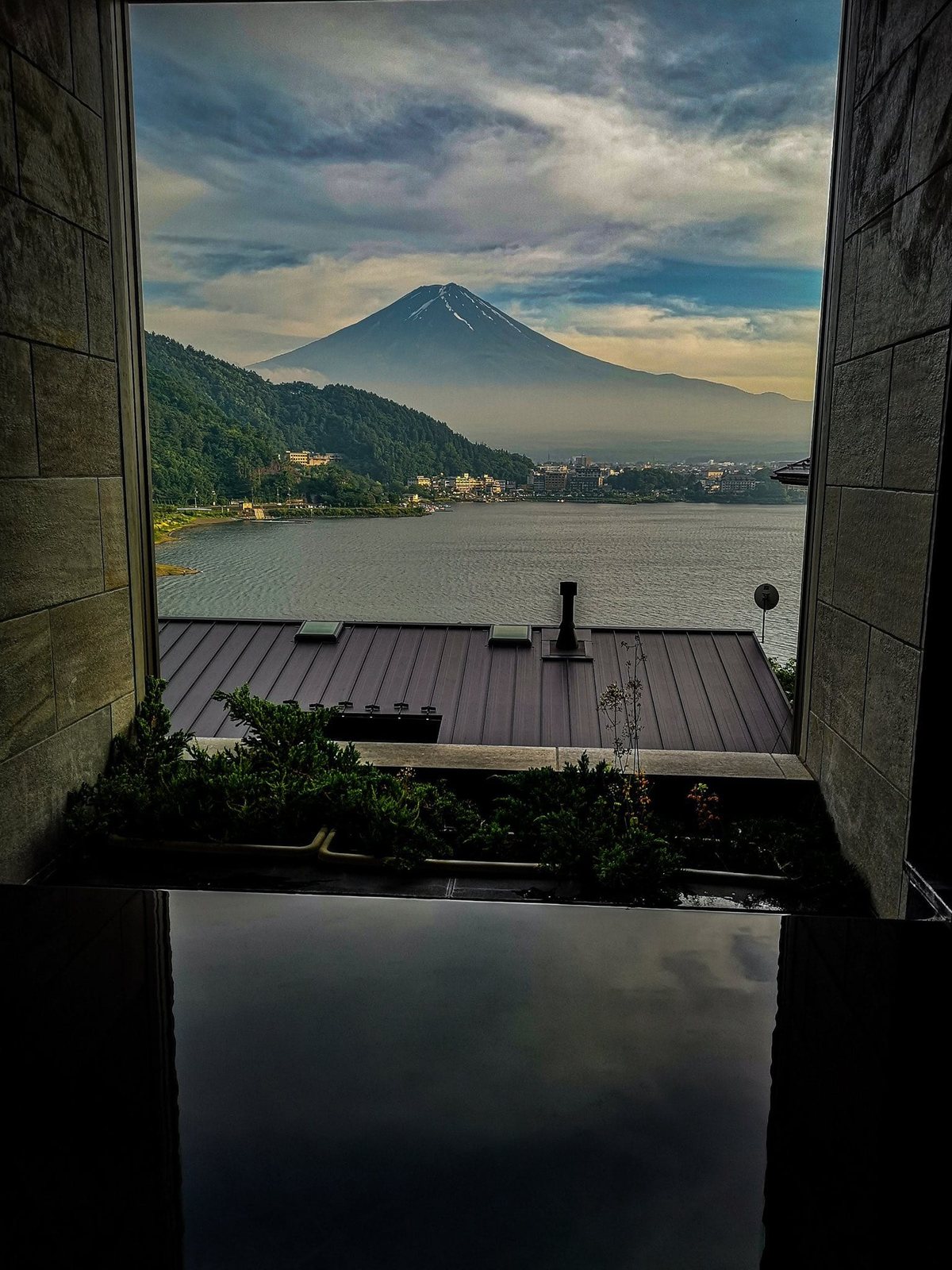
Oshino Hakkai: Mount Fuji's Spring-Fed Ponds and How to Visit
5 min · destinations
Fuji Panorama Line – The Ultimate Scenic Drive Around Mount Fuji
6 min · destinations
Lake Yamanakako Through the Seasons: Fuji Views and Access
5 min · destinations
Hakone in a Day — The Complete Round Course Loop from Tokyo
9 min · destinations