A Full-Bellied Autumn at the Foot of Mount Fuji: Pumpkin Hoto, Yoshida Udon, and Seasonal Fruit
The foothills turn cold earlier than Tokyo, and that is also when pumpkin noodle hot pots, firm chewy udon, kinako-covered mochi, and ripe grapes and persimmons taste their best. Includes reference prices.
Aug 12, 2026·✍️ olablog·⏱ 17 min read
The foothills turn cold earlier than Tokyo, and that is also when pumpkin noodle hot pots, firm chewy udon, kinako-covered mochi, and ripe grapes and persimmons taste their best. Includes reference prices.
Tap a region to browse articles
One late-October afternoon, you get off at Kawaguchiko Station at nearly four o’clock. The sun is still shining, but the wind blowing in from the lake carries the dry chill of the highlands—the kind of cold a light jacket brought from Tokyo can’t handle. You pull your collar up, walk for about five minutes, then duck into a restaurant with an indigo noren curtain. Fifteen minutes later, a black cast-iron pot is steaming in front of you, its miso broth thick and glossy, golden chunks of pumpkin split open, and broad noodles nestled among mushrooms and taro. You take a spoonful and immediately understand why people in this region have been eating it for hundreds of years.
Everyone knows about visiting Mount Fuji in autumn: the momiji tunnel ablaze with fall colors, the snow-dusted peak reflected in the lake, and the pampas grass fields of Oshino. But most Vietnamese visitors come for the day, take their photos, then board a bus back to Shinjuku, solving lunch with a combini meal or an anonymous bowl of ramen near the station. What a waste. This foothill region—or more precisely, Yamanashi Prefecture—has its own food culture, shaped by land that is poor for rice cultivation, long cold winters, and the need to create filling meals from wheat flour, pumpkin, vegetables, and dried fruit.
This article gathers what I’ve learned from several trips to Kawaguchiko and Fujiyoshida in October and November: what to eat, where to eat it, roughly how much it costs, and the small traps to watch for—such as the fact that the most famous udon restaurant closes at one in the afternoon. The prices listed here are reference prices based on what I observed. Restaurants can change them at any time, so you should still check each restaurant’s official website or Google Maps listing before you go.
Why autumn is the best season for eating at the foot of Mount Fuji
Yamanashi is an inland prefecture set in a basin surrounded by mountains. Rice paddies were once scarce, so people ate more wheat-based foods than rice—this is the root of both hoto and Yoshida udon. Well-drained volcanic soil and large day-night temperature swings are also ideal for fruit trees, which is why Yamanashi has long been Japan’s leading producer of grapes and peaches, as well as a famous region for dried persimmons.
Autumn brings all three factors together at exactly the right time. Kabocha pumpkin is sweetest after harvest and a period of “resting,” so a pot of hoto in October is noticeably sweeter than one in midsummer. At elevations of eight hundred to one thousand meters, nighttime temperatures drop into the single digits, making hot food feel perfectly appropriate rather than forced. Grapes are in peak season from around late August through the end of October, followed by persimmons from mid-October into November. In other words, the same period when you come to see the autumn leaves is also when local produce fills the markets.
One more thing that few people notice: autumn is the easiest season for eating your way around here. In summer, restaurants are packed with mountain climbers, while in winter many small establishments take extended breaks. From October to mid-November, the balance is just right—most restaurants are open, crowds are manageable, and you usually won’t face an hour-long wait, except on a few peak fall-color weekends.
Hoto: a pumpkin noodle hot pot that truly warms you up
What exactly is hoto?
Hoto (ほうとう) is a flat, wide noodle made from wheat flour kneaded without resting or adding salt. It is dropped directly into a pot of miso broth with pumpkin, taro, carrots, mushrooms, green onions, and sometimes pork or chicken. Because the noodles cook directly in the pot, their starch dissolves and thickens the broth into a hearty soup rather than the clear liquid used for ordinary noodles. Some of the pumpkin breaks down as well, turning the broth golden and giving it a natural sweetness.
People often call hoto “udon,” but locals will quickly correct you: hoto noodles are not rested, twisted, or boiled separately, so they have a softer, more floury texture. Local legend connects the dish to Takeda Shingen, the Sengoku-period warlord of Kai, who is said to have had his troops cook it because it was quick, filling, and warming. It is difficult to verify how much of that is true, but the logic of “one pot, quick to cook, and filling for hours” is obvious.
Where to eat around Kawaguchiko and Fujiyoshida
The two easiest hoto chains to find are Hoto Fudo and Kosaku. Hoto Fudo has several locations around Lake Kawaguchi, with the north-lake branch especially famous for its curved white dome, which resembles a cloud. Many people come just to photograph the building. The menu here is very focused, consisting almost entirely of hoto, so there is little to deliberate over. Kosaku has more of an old thatched-roof farmhouse feel, with larger pots and additional versions featuring pork, duck, and mushrooms.
Beyond those two names, hoto is also available at restaurants in lakeside hotels, at Saiko Iyashi-no-Sato Nenba, the thatched-roof village beside Lake Saiko, and at several michi-no-eki roadside stations such as Katsuyama and Narusawa. Quality is generally consistent because hoto is difficult to make badly; the main differences are the strength of the miso and the amount of pumpkin.
Reference price: A basic pot of hoto usually costs around 1,200–1,900 yen; versions with pork, mushrooms, or seafood run about 1,800–2,500 yen. The standard pot is quite large at many restaurants—two light eaters can easily share one and order a side dish. Prices vary by season and restaurant, so check the menu on the official website before you go.
A few tips for ordering hoto
First, hoto is cooked to order in the pot, so it takes longer than ordinary noodles. Waiting around fifteen to twenty-five minutes is normal. Don’t get impatient after you sit down.
Second, cast iron retains heat extremely well. Spoon the noodles and broth into a small bowl and eat gradually rather than drinking straight from the pot, or you are almost certain to burn your mouth.
Third, if the broth tastes mild, there is usually shichimi chili pepper or a jar of house-made chili paste on the table. Add it gradually, because the broth naturally becomes saltier as it reduces.
Fourth—and this is important for Vietnamese travelers with young children or vegetarian diets—most hoto is made with broth containing bonito flakes or bones, so ordering “no meat” does not necessarily make it vegetarian. If you follow a strict vegetarian diet, ask beforehand or choose a restaurant with a clearly plant-based menu.
Yoshida udon: the firmest noodles you’ve ever bitten into
So firm it became a trademark
If hoto is “soft and warming,” Yoshida udon (吉田のうどん) is its complete opposite. The udon in Fujiyoshida is thick, square-edged, and hard—genuinely hard, the kind you have to chew rather than slurp down. The historical reason is quite interesting: this was once a textile-producing area, and weavers worked in shifts, so lunch needed to be quick, filling, and substantial. The chewier the noodles, the longer they kept hunger away.
The broth is usually a blend of miso and soy sauce. Signature toppings include boiled cabbage and stewed horse meat—eating horse meat is perfectly ordinary here, but ask first if you avoid it. Every table has a jar of red seasoning called surida ne, a finely ground mixture of chili, oil, and sometimes sansho pepper. Add a small spoonful and the entire bowl changes character. That is what I remember most about this dish.
Where to eat—and the opening-hours trap
Fujiyoshida has several dozen udon shops, most of them family-run. Many operate out of private homes, with tiny signs that a first-time visitor could walk past three times without noticing. Names often mentioned include Sakurai Udon, Hana-ya, and the udon counter inside Michi-no-Eki Fujiyoshida. The city also publishes an udon-shop map, which you can ask for at the tourist information desk near Fujisan Station.
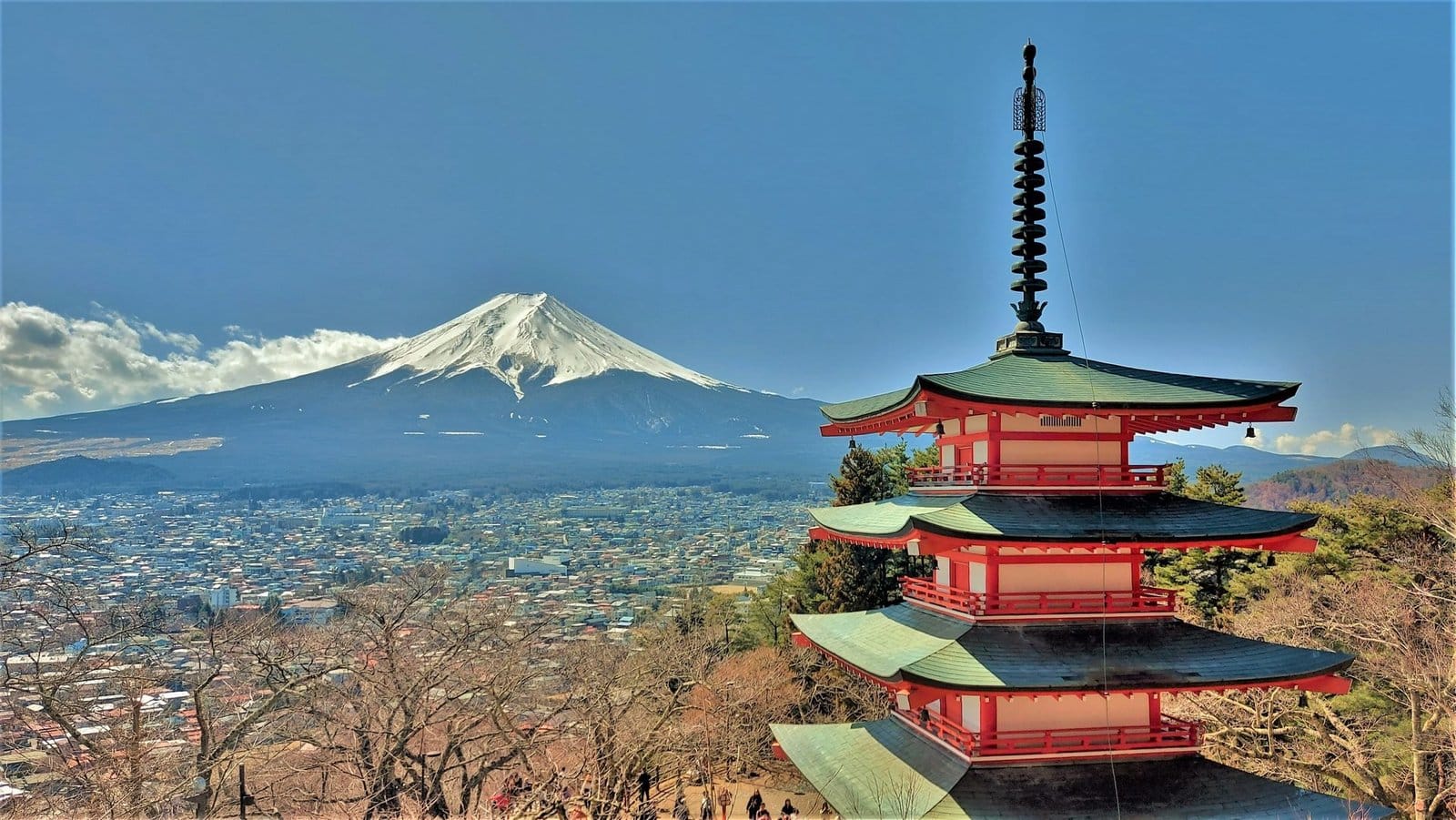
The biggest trap is this: many restaurants are open only for lunch and close when they run out of noodles, usually sometime between ten in the morning and one or two in the afternoon. Some also take irregular days off. That means if you plan to have lunch at three after photographing Chureito Pagoda, there is a good chance you will be standing in front of a closed door. A sensible plan is to eat udon around midday and save hoto for dinner, since hoto restaurants tend to stay open much later. Each restaurant’s hours vary by season, so check again before you go.
Reference price: This is the most charming part—basic udon usually costs only about 500–700 yen, while a bowl with a full range of toppings is around 700–1,000 yen. Many restaurants accept cash only and have no English menu; ordering may involve pointing at a paper sign taped to the wall. Bring plenty of small bills and a cheerful willingness to guess.
Shingen mochi and sweets worth taking home
Shingen mochi (信玄餅) is practically Yamanashi’s signature sweet: soft pieces of mochi covered in roasted soybean flour, or kinako, served with kuromitsu brown sugar syrup and wrapped in a small gathered plastic cloth. The “proper” way to eat it is to unfold the cloth as a plate, pour all the kuromitsu over the mochi, and mix everything together. It looks a little messy, but tastes much better than dipping the pieces one by one.
Two famous makers are Kikyoya and Kinseiken, each with its own recipe and devoted fans. People in Yamanashi debate which one is better much like Vietnamese people argue over northern versus southern pho. You can buy them at specialty-goods counters in Kawaguchiko Station and Fujisan Station, at michi-no-eki roadside stations, and at most souvenir shops around the lake. A small box with several pieces usually costs around 500–900 yen, while larger boxes run about 1,200–2,000 yen.
Keep in mind that fresh mochi has a fairly short shelf life, usually just a few days. If you plan to take it back to Vietnam, consider that carefully—cookies, candy, or Shingen mochi-flavored ice pops are better suited to a long journey.
Autumn also brings plenty of other seasonal sweets worth trying: chestnut (kuri) pastries from around September through November, grape- or tea-flavored soft serve, and pumpkin bread at a few small bakeries along the lake. In the Oshino Hakkai area, you can find kusamochi and baked sweets to eat on the spot, usually around 150–400 yen each. Buy one to hold in your hand and eat as you walk through the chilly air—that is exactly the right way to do it.
Yamanashi persimmons and grapes in season: where to buy them and how much they cost
A seasonal calendar for timing your visit
Yamanashi grapes are in season from around late August through the end of October, depending on the variety. The most sought-after variety these days is Shine Muscat—large green grapes that are crisp, seedless, and edible with the skin on, with a floral sweetness and aroma. Other varieties include large purple Kyoho, Pione, and Delaware. By November, grapes are nearly finished and persimmons take their place.
Persimmons (kaki) fall into two broad groups: sweet varieties eaten fresh, such as Fuyu-gaki, and astringent varieties that must be processed or dried. Yamanashi is famous for large persimmons used to make wind-dried persimmons. In November, you will see peeled persimmons hanging beneath the eaves of farmhouses, glowing orange across entire courtyards—one of the most beautiful autumn scenes around here, and one that a phone camera cannot really capture. Good dried persimmons are soft and chewy, intensely sweet, almost like jam. They are not cheap, but worth trying at least once.
Where to buy them fresh and cheap
There are three places to prioritize. The first is a michi-no-eki—a roadside station, almost always with a local-produce section where farmers consign their goods. Prices are good and the produce is fresh. Around the area, options include Michi-no-Eki Katsuyama beside Lake Kawaguchi, Michi-no-Eki Narusawa at the foot of the mountain, and Michi-no-Eki Fujiyoshida near the udon district. The second is JA farmers’ markets around Kofu, Fuefuki, and Katsunuma, where there is more variety and prices are often lower. The third is the roadside stalls that appear along national highways during peak season. These are usually the cheapest, but they almost always accept cash only and do not issue receipts.
Reference price: A medium bunch of Shine Muscat usually costs around 1,500–3,500 yen, depending on quality and where you are in the season. Premium gift boxes can cost much more. Fresh persimmons sold in bags of several fruits usually run around 300–700 yen. Gift-quality dried persimmons are sold by the box, generally from around 1,000 yen upward. Prices become more agreeable toward the end of the season, but the selection also becomes smaller.
Picking grapes and persimmons at a farm
The Katsunuma and Ichinomiya areas, in Koshu and Fuefuki cities and about an hour’s drive from Kawaguchiko, are the heart of wine-country grape farming. Many farms offer all-you-can-pick-and-eat sessions lasting thirty to sixty minutes. Reference prices are usually around 1,500–3,000 yen per person for ordinary grapes, with higher prices if Shine Muscat is included. Persimmon farms exist too, but are fewer and concentrated in November.
Note that many farms require advance reservations, and weekend sessions often fill up early. Opening dates depend entirely on the weather and the condition of the fruit, so do not trust an old schedule on a blog—even this one. Check the farm’s official website or the prefectural tourism website before setting out.
If you are heading toward Katsunuma, it is convenient to visit a few wineries as well. Yamanashi is the birthplace of Japanese wine; Koshu grapes, with their pinkish skins, produce light, crisp white wines that pair surprisingly well with Japanese food. Many wineries offer tastings of several samples for a small fee or free of charge. Of course, anyone driving must not taste at all—Japan’s drunk-driving laws are extremely strict, with no gray area whatsoever.
Other local specialties worth adding to your list
The foothills have excellent spring water flowing down from Mount Fuji, making them ideal for raising rainbow trout. Nijimasu appears at many restaurants around Lake Saiko and Oshino Hakkai, either grilled with salt or served as sashimi, usually costing around 800–1,800 yen depending on the preparation. Fujizakura pork is another local specialty, often served as tonkatsu or grilled. It is sweet, tender, and not overly heavy.
At Oshino Hakkai, the most worthwhile thing to try is also the simplest: the spring water. Fill a bottle in an area where it is permitted, take a sip, and you will understand why tofu and soba made with this water taste so good. Handmade soba at some restaurants around the area usually costs around 900–1,500 yen per serving.
Finally, there is craft beer. The region has several small breweries, including the well-known Fujizakura Heights line, often sold at lakeside restaurants and some establishments in Kawaguchiko. A glass costs around 600–900 yen. A cold beer after a steaming pot of hoto, with the lake darkening outside the window and the mountain silhouette fading into the evening sky—that is the kind of night you will remember longer than a check-in photo.
One-day and two-day food itineraries
One day, starting from Tokyo. Take an early-morning bus or train and arrive in Fujiyoshida around lunchtime. Eat Yoshida udon before one in the afternoon. In the afternoon, visit Chureito or circle Lake Kawaguchi, stop at a michi-no-eki to buy grapes or persimmons, and try a soft-serve cone. Have hoto in the late afternoon before heading to the bus terminal, then buy Shingen mochi at the station as a souvenir.
Two days. Follow the itinerary above on day one, but take it more slowly. Stay overnight in Kawaguchiko and have hoto with craft beer for dinner. On day two, drive toward Katsunuma to pick grapes or visit wineries, have lunch there, then return or continue straight to Tokyo on the Chuo Line. This arrangement works best with a rental car. By public transport, the connection between the two areas is infrequent, so check the schedules carefully and allow plenty of extra time for waiting.
A few practical notes for Vietnamese travelers
Cash is still king. Family-run udon restaurants, produce stalls, and small vendors often accept cash only. Withdraw enough at a combini before leaving Tokyo, since there are not many ATMs around the lake.
Language. The area around Kawaguchiko Station is used to foreign visitors, but deeper into Fujiyoshida, Japanese is essentially the only language. Save photos of the dishes on your phone to point at, or use a translation app’s camera mode; that will get you through almost anything.
Queues and peak hours. On fall-color weekends, large hoto restaurants may have waits of thirty to sixty minutes. Eating outside the usual hours—before eleven-thirty or after two—is the simplest way to save time.
Taking food home. Grapes and fresh persimmons bruise easily, so buy them near the end of your trip and wrap them carefully. As for taking fresh fruit back to Vietnam, do not even consider it—the quarantine regulations are very strict. Choose dried goods, sweets, or alcohol as gifts instead.
Weather. November evenings at this elevation can drop to around below five degrees. If you plan to walk from a restaurant back to your lakeside hotel, bring genuinely warm clothing, not just a fashionable jacket.
Frequently asked questions
How are hoto and Yoshida udon different? Hoto is a flat, wide noodle cooked directly in a miso pot with pumpkin and vegetables. The broth is thick and the noodles are soft. Yoshida udon has square, extremely firm noodles served in a separate broth, with cabbage and horse meat as signature toppings. One is for slurping to warm yourself up; the other is for chewing to fill you up.
Which meal is best for hoto? Dinner is a better choice because hoto restaurants stay open later and the air gets colder toward evening. Save lunch for udon, since most udon shops close early in the afternoon.
Is one pot of hoto enough for two people? Usually, yes, if you eat moderately, since standard portions are quite large and heavy on starch. However, some restaurants discourage sharing a portion, so ask the staff first as a matter of courtesy.
How long does the Yamanashi grape season last? For most varieties, it runs from around late August through the end of October, although a few farms continue into early November. The schedule depends on the weather each year, so check the farm’s official website before booking.
Can I eat all of these foods by train or bus? Yes, if you focus on the Kawaguchiko–Fujiyoshida corridor. Hoto, udon, Shingen mochi, and local produce are all within walking distance or a short bus ride. For grape picking in Katsunuma and visits to wineries, renting a car or taking a taxi is much more convenient.
What options are available for vegetarians? There are some, but you need to ask proactively, since hoto and udon broths often contain bonito flakes or bones. Some lakeside restaurants offer vegetable dishes and soba, while produce stalls are always a safe option for a light meal.
Are the prices in this article accurate? They are reference prices based on real-world observations, not official price lists. Restaurants change prices according to the season and ingredient costs, so check the restaurant’s official website or map listing before you go.