
Best Mount Fuji Viewpoints: Chureito Pagoda to Lake Motosu
Five classic Mount Fuji viewpoints around the Fuji Five Lakes: Chureito Pagoda, Honcho-dori, Kawaguchiko, Yamanaka and Motosu, with timing, access and tips.
May 4, 2026·✍️ olablog·⏱ 5 min read
Five classic Mount Fuji viewpoints around the Fuji Five Lakes: Chureito Pagoda, Honcho-dori, Kawaguchiko, Yamanaka and Motosu, with timing, access and tips.
Tap a region to browse articles
Mount Fuji looks surprisingly different depending on where you stand. From Tokyo it is a faint cone on the horizon on a clear winter morning; from the Fuji Five Lakes on its northern side, in Yamanashi Prefecture, it fills the sky. That is why most of the famous views are clustered here: a pagoda on a hillside, a shopping street pointing straight at the summit, and five lakes that each frame the mountain in their own way.
Getting to the Fuji Five Lakes
Kawaguchiko Station is the hub. Highway buses from Busta Shinjuku reach it in about two hours. By train, take the JR Chuo Line to Otsuki and change to the Fujikyu Line; a few Fuji Excursion limited express trains run straight through from Shinjuku with no change. From Kawaguchiko Station, sightseeing buses loop around the lakes. Shimoyoshida, the station for the pagoda, is a few stops before Kawaguchiko on the Fujikyu Line, so it is easy to visit on the way in or out. With a car you can reach all five viewpoints below in a day.
1. Chureito Pagoda at Arakurayama Sengen Park
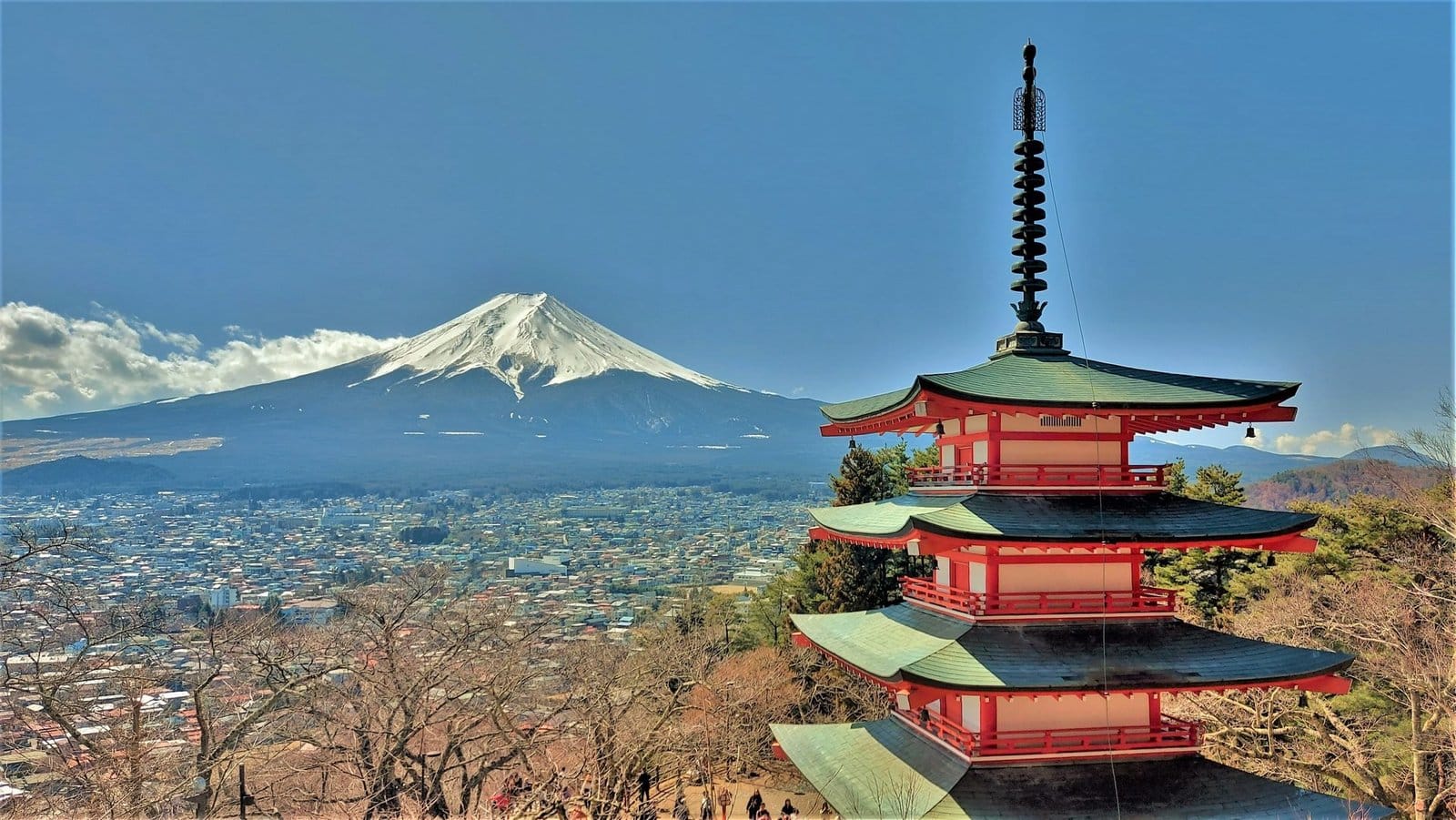
This is the view on countless posters: a red five-storey pagoda in the foreground, Mount Fuji behind it, and the rooftops of Fujiyoshida below. From Shimoyoshida Station it is about a 10-minute walk to the park entrance, then a climb of 398 steps (or a gentler sloping path) to the observation deck beside the pagoda. The pagoda is a memorial to the city's war dead, so keep your voice down and treat it as one. Cherry blossom season, usually early to mid-April, brings the biggest crowds of the year. Autumn leaves and the clear air of winter are just as rewarding and far calmer. Our full Chureito Pagoda guide covers the climb, the seasons and parking in detail.
2. Honcho-dori in Shimoyoshida
Not far from Shimoyoshida Station, Honcho-dori is an old shopping street that runs straight toward the mountain, so Fuji rises directly above the far end of the road. It is a real street with real traffic and people living on it. Photograph from the pavement, never stand in the road, and do not block doorways.
3. Lake Kawaguchi
The most developed of the five lakes has the widest choice of viewpoints:
- The north shore. Oishi Park looks across the water to the mountain, framed by seasonal flowers: lavender in early summer and kochia bushes that turn red in autumn. Along the same shore, the Momiji Corridor is a tunnel of maple trees that peaks in November, when the trees are lit up in the evenings.
- Ubuyagasaki. A small cape with a shrine, and one of the best places around the lake to catch the "upside-down Fuji" reflected on still water, usually early in the morning before the wind picks up.
- Kachi Kachi Ropeway. A short walk from Kawaguchiko Station, the ropeway climbs Mount Tenjo to a lookout with the lake below and Fuji straight ahead.
4. Lake Yamanaka
Lake Yamanaka, the largest of the five, sits on the mountain's eastern side and is famous for Diamond Fuji, when the setting sun sinks exactly onto the summit and flares like a jewel. At Yamanaka this happens from around mid-to-late October to the end of February. Because the sun sets further south as winter approaches, the right spot moves along the shore from day to day. The Panorama-dai lookout on the hillside southeast of the lake gives a sweeping view of lake and mountain together, and Nagaike Park on the north shore is a favourite for reflections on calm days. See our guide to Diamond Fuji at Lake Yamanaka for how to pick a spot for a given date.
5. Lake Motosu
Lake Motosu is the westernmost and deepest of the lakes, and much quieter than Kawaguchi. It is the view printed on the back of Japan's previous 1,000-yen note (and an older 5,000-yen note): Fuji rising behind the far shore with the lake in front. The classic angle is from the Nakanokura Pass, reached by a steep hiking path up from the lakeside road. On the way, stop at neighbouring Lake Shoji, where Fuji appears to cradle a smaller peak in front of it.
When to go
Visibility matters more than season. Mount Fuji hides behind cloud more often than first-time visitors expect, especially in the hazy, humid months of summer. From late autumn through winter the air is clearest, and the mountain wears its snow cap until early summer. At any time of year, your best chance is early in the morning: clouds tend to build around the summit from mid-morning, so a view that was perfect at 7 a.m. can be gone by noon.
Practical tips
- Check the webcams before you set out. Several live cameras around the lakes show whether the summit is clear. A cloudy forecast is a good reason to switch your day around.
- Dress for altitude. The lakes sit high enough that dawn is cold even in spring and autumn. Bring a warm layer and gloves for sunrise shoots.
- Respect private land and local rules. Many lakeside gaps are private property. Park only in marked car parks, and check drone rules before you fly.
- Start early in peak seasons. Cherry blossom weekends and autumn-leaf holidays mean long queues on the pagoda stairs and full car parks by mid-morning.
Plan your trip
For a day trip, leave Tokyo early, stop at Shimoyoshida for Chureito Pagoda and Honcho-dori while the air is still clear, then spend the afternoon on the north shore of Lake Kawaguchi or up the ropeway. If you stay overnight, you can shoot sunrise at a lakeside reflection spot, visit Motosu and Shoji in the morning, and finish at Lake Yamanaka for sunset.
More from this region — Mt. Fuji
View all →
Climbing Mount Fuji on the Yoshida Trail: A First-Timer's Guide
6 min · destinations
Lake Kawaguchiko Guide: Mount Fuji Views, Access and Seasons
5 min · destinations

A 2–3-Day Autumn Arc: Fuji Five Lakes, Hakone Pampas Grass, and Gotemba Outlet
17 min · tips

Momiji Matsuri Kawaguchiko – A Radiant Corridor of Light at Night
20 min · tips