10 Questions to Ask Before Accepting a Japan Charter Bus Quote
Use this practical checklist to compare vehicle sizes, confirm insurance, uncover extra fees, and book a licensed charter bus in Japan.
Aug 21, 2026·✍️ olablog·⏱ 9 min read
Use this practical checklist to compare vehicle sizes, confirm insurance, uncover extra fees, and book a licensed charter bus in Japan.
Planning a group trip in Japan often starts with a simple question: “How much is a private bus?”
The quote you receive may look straightforward, but the final cost and experience depend on details such as vehicle size, luggage space, tolls, driver hours, overnight arrangements, and documentation. Before accepting any offer, ask the following 10 questions.
A clear answer helps you compare providers fairly and avoid surprises during your trip.
First, confirm the vehicle and operator
1. What exact vehicle size will we receive?
“Private bus” can refer to very different vehicles. A compact 5-seat vehicle may suit an airport transfer, while a 45-seat coach is designed for a large group travelling between cities. Choosing the smallest suitable vehicle can reduce costs, but choosing one that is too small may leave passengers uncomfortable and luggage difficult to store.
Ask the operator to confirm:
- The seating capacity
- The vehicle type and approximate interior layout
- Whether all seats have seat belts
- The amount of luggage storage
- Whether the vehicle is suitable for narrow roads or mountain areas
- Whether the quoted vehicle can be substituted later
The practical difference between sizes is significant:
| Vehicle size | Best suited to | Main advantages | Points to check |
|---|---|---|---|
| 5 seats | Couples, families, or very small groups | Easy access, flexible for city trips | Limited luggage and no room for large groups |
| 7 seats | Small families or airport transfers | More passenger space than a standard car | Luggage capacity may be reduced when all seats are used |
| 10 seats | Small teams or extended families | Useful balance of capacity and flexibility | Confirm whether the vehicle is a minibus or van-style vehicle |
| 16 seats | Medium-sized groups | Comfortable for sightseeing and transfers | Check luggage storage and road restrictions |
| 29 seats | School groups, tour groups, and corporate teams | Good capacity without using a full-size coach | Some destinations may have limited parking |
| 45 seats | Large groups and major group itineraries | Efficient for long-distance travel | Requires suitable roads, parking, and passenger loading areas |
Also ask whether the quoted capacity includes the driver. In Japan, the driver is normally separate from the passenger seating capacity, but confirming this avoids misunderstandings.
2. Is the vehicle operated by a properly licensed charter company?
In Japan, passenger transport for hire must be handled by an appropriately licensed operator. Ask for the name of the operating company, not only the name of a booking contact or travel coordinator.
You can also ask:
- Is the vehicle operated under a commercial passenger transport licence?
- Is the driver employed or arranged through a licensed operator?
- Who is responsible if the vehicle breaks down?
- Will the operator provide a replacement vehicle if necessary?
This is particularly important when booking across multiple cities, where a local operating partner may be involved.
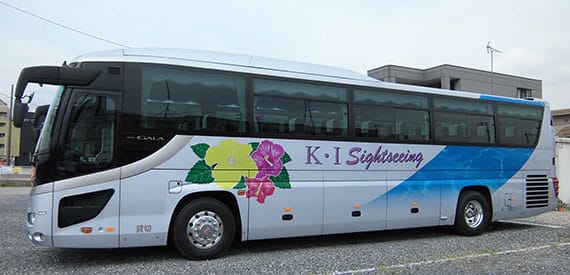
3. Does the vehicle have green plates?
Commercial passenger vehicles in Japan use green licence plates. This is one useful question to ask when checking whether a vehicle is authorised for paid passenger transport.
A green plate alone does not answer every question about service quality, so also confirm the operating company, insurance, vehicle condition, and driver arrangements. However, a provider should be comfortable explaining the vehicle’s licensing status.
Then, check protection and inclusions
4. What insurance is included?
Do not assume that your travel insurance and the operator’s insurance cover the same things. Ask what protection applies to passengers during the charter and whether the vehicle has the legally required insurance as well as additional commercial coverage.
Request confirmation of:
- Passenger accident coverage
- Third-party liability coverage
- Coverage for incidents while boarding or leaving the vehicle
- The process for reporting an accident
- Whether overseas passengers are covered in the same way as residents
You do not necessarily need a long insurance document before making an enquiry, but you should receive a clear explanation of what is included and who to contact in an emergency.
5. Which costs are included in the quote?
A low base rate may not include every expense connected with your route. Ask for an itemised quote and check whether it includes:
- Driver service
- Fuel
- Expressway tolls
- Parking fees
- Passenger loading and unloading fees
- Ferry charges, if relevant
- Driver accommodation and meals for overnight itineraries
- Hotel or airport access fees
- Taxes and payment-processing charges
- A bilingual coordinator or guide, if requested
Tolls and parking can vary by route, vehicle size, and destination. Popular areas such as central Tokyo, Kyoto, Osaka, and major sightseeing sites may have strict coach parking arrangements. Ask whether parking is estimated, included, or charged according to actual use.
6. Are there any hidden fees or conditions?
Ask directly: “What could cause the final amount to increase?”
Common examples include:
- Changing the pickup location
- Adding a stop
- Extending the charter
- Starting earlier than planned
- Returning later than planned
- Waiting during a meal or attraction visit
- Carrying oversized luggage
- Entering restricted roads
- Cancelling after the payment deadline
- Requesting a different vehicle size
A reliable quote should explain these conditions before you accept. If the answer is vague, ask for the assumptions to be written into the booking confirmation.
Clarify time, waiting, and changes
7. How is overtime calculated?
Charter buses are booked for a defined service period. That period may begin when the driver arrives, when passengers board, or when the vehicle leaves its base, depending on the operator’s terms.
Confirm:
- The included operating hours
- The official start and end time
- The grace period, if any
- The overtime rate or calculation method
- Whether overtime must be approved by the driver or dispatcher
- Whether delays caused by traffic count as additional time
Do not rely on an informal promise that the driver can “stay a little longer.” Japanese driving and working-hour rules must be respected, and the driver may have another assignment after yours.
8. Can the bus wait overnight?
An itinerary that ends in one city and resumes the next morning may require the vehicle and driver to stay overnight. This should be agreed before booking.
Ask:
- Is overnight waiting available for this vehicle?
- Will the driver remain with the vehicle?
- Who pays for the driver’s accommodation and meals?
- Is there a separate overnight charge?
- Can the bus be parked safely at the hotel?
- Is a different vehicle or driver used the next day?
For a 29-seat or 45-seat coach, hotel access and parking can be more difficult than for a 5-seat or 7-seat vehicle. Confirm that the accommodation has a suitable drop-off point and that a large vehicle can legally remain nearby.
9. What happens if our itinerary changes?
Group travel rarely runs perfectly. A flight may be delayed, a restaurant may take longer than expected, or a sightseeing stop may need to be removed.
Before accepting, ask about:
- Flight-delay handling
- Pickup-time changes
- Additional stops
- Route changes
- Passenger-number changes
- Vehicle-size changes
- Cancellation and refund conditions
Give the operator a realistic itinerary with estimated stop durations. A route that looks short on a map may take longer because of traffic, narrow roads, seasonal congestion, or limited coach parking.
10. Can you issue an invoice or receipt?
An invoice is important for company trips, school groups, tour organisers, and anyone who needs reimbursement. Ask whether the operator can issue a formal invoice or receipt and what information it will contain.
Confirm:
- The legal name of the operating company
- The service date and route
- The vehicle or charter description
- The tax treatment
- The payment deadline
- Accepted payment methods
- Whether the invoice is issued before or after payment
- Whether an English-language document is available
If your organisation requires a specific invoice format, explain that before confirming the reservation.
Compare the quote on more than price
The cheapest quote may not provide the best value if it excludes tolls, parking, insurance details, or sufficient luggage space. Compare each proposal using the same itinerary, passenger count, luggage assumptions, and service hours.
A useful final checklist is:
- Vehicle size and passenger capacity are confirmed
- Luggage space is suitable
- The operator is licensed
- The vehicle has green plates
- Insurance is explained
- Included and excluded costs are listed
- Overtime rules are clear
- Overnight waiting is confirmed, if needed
- Change and cancellation terms are written down
- An invoice or receipt is available
For a tailored itinerary, request a free Japan charter bus quote from OlaChill; the team replies within 24 hours.
FAQ
Is a 45-seat bus always more comfortable than a 29-seat bus?
Not necessarily. A 45-seat coach offers more capacity, but it may be harder to use on narrow roads or at small hotels. A 29-seat vehicle can be a better fit for a medium-sized group, especially on regional sightseeing routes.
Should we book a larger vehicle for our luggage?
Yes, if your group has large suitcases, ski equipment, golf bags, or other bulky items. Passenger capacity does not always equal luggage capacity. Ask for a luggage-space assessment before accepting the quote.
Are tolls and parking usually included?
It depends on the operator and itinerary. Ask whether they are included, estimated separately, or charged based on actual use. The exact quote comes from the booking form and should state these items clearly.
Can a charter bus collect us from an airport?
Often, yes, but airport pickup rules vary by terminal and vehicle size. Confirm the meeting point, waiting time, parking or access fees, and what happens if your flight is delayed.
Do we need to tip the driver in Japan?
Tipping is not generally expected in Japan. A polite thank-you is appropriate. If your group wishes to offer something extra, ask the booking contact about local etiquette and company policy rather than assuming it is required.