Charter with a Driver or Self-Drive Rental in Japan?
Compare charter buses and self-drive rentals in Japan, from international permits and road rules to parking, insurance, and total trip costs.
Aug 21, 2026·✍️ olablog·⏱ 9 min read
Compare charter buses and self-drive rentals in Japan, from international permits and road rules to parking, insurance, and total trip costs.
Charter with a Driver or Self-Drive Rental in Japan?
Choosing between a charter bus with a professional driver and a self-drive rental can change the entire shape of your Japan trip. The right option depends on more than the number of passengers. Your route, luggage, parking arrangements, driving experience, and comfort with Japanese road rules all matter.
For a couple or small family, renting a compact car may be practical. For a larger group travelling between airports, hotels, attractions, and restaurants, a private charter can be simpler and more comfortable. This guide compares both options across vehicle sizes from 5 to 45 seats.
The main difference: flexibility versus convenience
A self-drive rental gives you control. You can leave when you like, stop at small roadside attractions, and change your route without coordinating with a driver. It can work especially well in rural areas where public transport is limited and parking is available at your accommodation.
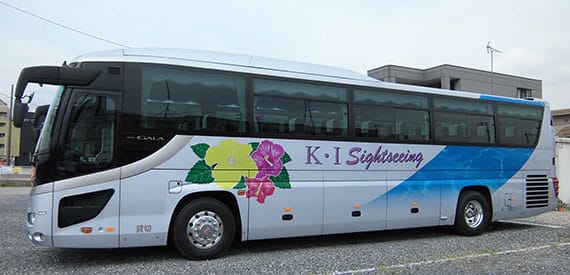
A charter bus gives your group a dedicated vehicle and a licensed Japanese operator who knows the local roads. Nobody in the group has to navigate, drive after a long flight, or worry about returning to a hotel after dinner. Your group can travel together rather than splitting between several cars.
The larger your group becomes, the more the practical advantages of a charter tend to increase. Several rental cars mean multiple drivers, separate navigation, different parking spaces, and the possibility of getting separated in traffic.
International driving permits and driving in Japan
Most visitors who want to drive in Japan need a valid passport, their home-country driving licence, and an International Driving Permit issued under the 1949 Geneva Convention. Japan does not generally accept every type of international permit, so check the issuing authority and format before departure.
Travellers from some countries and regions, including Belgium, France, Germany, Monaco, Switzerland, and Taiwan, follow a different process. They typically need an official Japanese translation of their licence instead of a Geneva-style permit. Requirements can change, so confirm the current rules with the Japanese embassy, consulate, or authorised issuing organisation before booking a car.
Important points include:
- The driver’s name must match across the passport, licence, and permit or translation.
- The permit must be valid on the day you drive in Japan.
- An electronic or unofficial version may not be accepted by a rental company.
- You must meet the rental company’s age and licence requirements.
- If several people may drive, each person needs the correct documents.
With a charter bus, international driving paperwork is not your responsibility. The operator supplies a properly licensed professional driver, which is particularly valuable for groups unfamiliar with Japanese traffic conditions.
What feels different about driving in Japan?
Japan drives on the left side of the road, with the steering wheel normally on the right. If you usually drive on the right, this can take time to adjust to. Turning across traffic, entering roundabouts, and positioning the vehicle at intersections may feel unfamiliar during the first day.
Other challenges include:
- Narrow residential streets and tight turns in older neighbourhoods
- Railway crossings and frequent traffic lights
- Mountain roads with steep slopes or limited visibility
- Snow and icy conditions in winter destinations
- Japanese-only signs outside major tourist areas
- Toll roads that may require an electronic toll card or payment at a booth
- Navigation systems that may locate places more accurately by telephone number or map code
A charter driver handles these details while you focus on the scenery and your group. This is especially helpful on long sightseeing days, when fatigue can make unfamiliar roads more stressful.
Parking can change the total cost
Parking is often underestimated when comparing self-drive with a charter. Popular districts in Tokyo, Kyoto, Osaka, Hakone, and major sightseeing areas may have limited parking or charge by the hour. Larger vehicles can face additional restrictions, and some attractions require advance arrangements for coaches.
With a rental car, you may need to pay for:
- Hotel parking
- Attraction or theme-park parking
- City-centre car parks
- Parking near restaurants and shopping areas
- Overnight parking when your accommodation has no dedicated spaces
A charter bus can also incur parking or waiting charges, but your operator can usually plan suitable drop-off points and parking areas in advance. For larger buses, this planning is essential because a 29-seat or 45-seat vehicle cannot use every standard car park.
Insurance and responsibility
Rental-car insurance options vary by company. Basic cover may be included, while collision damage waivers, non-operation charges, personal accident cover, and liability extensions may cost extra. Read the terms carefully, including exclusions for tyres, wheels, underbody damage, or driving on restricted roads.
You may also need to consider:
- Excess or deductible payments after an accident
- Damage caused by an unauthorised driver
- Procedures for reporting an incident in Japan
- Whether your travel insurance covers rental-vehicle liability
- What happens if the vehicle becomes unavailable after damage
A charter operator carries commercial vehicle insurance and takes responsibility for the vehicle and professional driving service. Passengers should still follow the operator’s safety instructions and keep valuables secure. Confirm the service scope, cancellation terms, waiting time, and any additional charges before travel.
Vehicle size and cost comparison
The following figures are approximate estimates only for a private charter or rental arrangement. They are not fixed prices and can vary significantly by season, route, hours, vehicle availability, parking, tolls, fuel, delivery, and other requirements. The exact quote comes from the booking form.
| Group size | Self-drive rental considerations | Charter with driver considerations | Approximate estimated cost |
|---|---|---|---|
| 5 seats | One car is usually manageable, with good flexibility and easier parking | Comfortable for a small family or compact group, especially with luggage | Rental: ¥12,000–¥35,000; charter: Quoted on request |
| 7 seats | A larger vehicle may have less luggage space when all seats are occupied | More comfortable for families with suitcases and a full sightseeing schedule | Rental: ¥18,000–¥45,000; charter: Quoted on request |
| 10 seats | Often requires a larger van and a driver confident with vehicle width and parking | Useful for keeping one group together without multiple cars | Rental: ¥30,000–¥70,000; charter: Quoted on request |
| 16 seats | Self-drive availability and licence requirements need especially careful checking | A practical minibus size for organised group tours | Self-drive: ¥50,000–¥100,000; charter: Quoted on request |
| 29 seats | Generally unsuitable for ordinary tourist self-drive plans | Good for school, corporate, wedding, and multi-family groups | Charter: ¥69,000 per 10-hour day |
| 45 seats | Not a realistic self-drive option for most international visitors | Best for large groups, long transfers, and coordinated itineraries | Charter: ¥99,000 per 10-hour day |
The estimates above should be treated as planning figures, not quotations. For a rental, the total may also include fuel, expressway tolls, parking, insurance upgrades, child seats, and one-way fees. For a charter, ask whether the quote includes the driver, fuel, tolls, parking, waiting time, and overtime.
Which option suits your itinerary?
Choose self-drive when:
- You have a small group and light luggage.
- Your route focuses on countryside, lakes, or remote areas.
- You are comfortable driving on the left.
- You have confirmed parking at your hotels and attractions.
- You want maximum freedom to change plans.
- At least one traveller is prepared to stay sober and drive safely every day.
Choose a charter bus when:
- Your group has 10 or more people.
- You have multiple airport transfers or hotel changes.
- You are carrying large suitcases, sports equipment, or event materials.
- Your itinerary includes several cities or long sightseeing days.
- You want everyone to travel together.
- You prefer not to handle licences, navigation, tolls, parking, or unfamiliar roads.
- Some passengers may have mobility needs or require extra boarding time.
For groups of 5 or 7, the decision is often about priorities rather than capacity. A rental can cost less in a simple rural itinerary, while a charter may offer better value when the group would otherwise need several cars, multiple drivers, and expensive city parking.
For groups of 16, 29, or 45, a charter with a professional Japanese operator is usually the more straightforward arrangement. It reduces coordination problems and allows the whole group to follow one schedule.
Plan the vehicle around luggage, not just seats
A “7-seat” vehicle does not necessarily provide enough room for seven large suitcases. The same applies to vans and minibuses: every occupied seat reduces available luggage space. Tell the operator how many passengers, suitcases, strollers, golf bags, or other items you will bring.
If you are comparing several rental cars with one charter bus, include the time spent collecting vehicles, completing paperwork, loading luggage, finding parking, and regrouping. The cheapest daily rate is not always the lowest total trip cost.
Get a tailored charter quote
Every route is different, so confirm the schedule, vehicle size, luggage, stops, and service hours before making a decision. Request a free quote from OlaChill through the booking form, and the team will reply within 24 hours.
FAQ
Do I need an International Driving Permit to rent a car in Japan?
Most visitors need a valid 1949 Geneva Convention International Driving Permit together with their domestic driving licence and passport. Some countries follow a translation-based system instead. Confirm the rule for your licence before travelling.
Is driving in Japan difficult for international visitors?
It can be manageable with preparation, but left-side driving, narrow roads, Japanese signs, tolls, mountain routes, and limited parking can be challenging. A professional driver removes these responsibilities from your group.
Is a charter bus cheaper than renting several cars?
Not always. For a small group and a short rural trip, self-drive may cost less. For a larger group, compare the full cost of several vehicles, insurance, fuel, tolls, parking, drivers, and coordination—not only the rental price.
Can a 45-seat bus visit every attraction?
No. Large buses need suitable roads, turning space, and designated parking. Your operator can help plan realistic drop-off points and alternative access for narrow streets or restricted sightseeing areas.
What should I include when requesting a charter quote?
Provide your travel dates, passenger count, luggage volume, pick-up and drop-off points, sightseeing stops, approximate hours, and any child seats or accessibility requirements. This allows the operator to recommend the correct vehicle and prepare an accurate quote.