Making Matcha at Home: A Guide from Choosing Powder to Whisking It Properly
How to make matcha at home like the Japanese: telling ceremonial from culinary powder, choosing a chasen, getting the water ratio right, understanding usucha and koicha, and finding tea-making tools in Japan.
Aug 8, 2026·✍️ olablog·⏱ 5 min read
How to make matcha at home like the Japanese: telling ceremonial from culinary powder, choosing a chasen, getting the water ratio right, understanding usucha and koicha, and finding tea-making tools in Japan.
Many people return from Japan with a charming tin of matcha, excited to try making it at home, only to be disappointed: the tea is lumpy and harshly bitter, nothing like the smooth drink they enjoyed in Kyoto. The good news is that making delicious matcha doesn’t require any special talent—you just need the right powder, the right tools, and a few key numbers. This guide covers everything you need to turn a corner of your kitchen into a mini tea room, along with shopping suggestions for your next trip to Japan.
Choosing your powder: ceremonial or culinary?
This is the most important decision. Ceremonial-grade matcha (used in the tea ceremony) is made from the youngest leaves. It has a pronounced sweet umami flavor, little bitterness, and a bright jade-green color, making it ideal for drinking straight with water. Culinary-grade matcha is stronger and more bitter, with a slightly yellowish color. It is designed to stand up to milk, sugar, and baked goods—for lattes, smoothies, and desserts.
A common mistake is buying inexpensive culinary matcha, drinking it plain, and concluding that “matcha is so bitter.” Conversely, using expensive ceremonial matcha for baking is wasteful, since its delicate aroma will be overwhelmed by the sugar and milk. As a general price guide in Japan, a 30–40 gram tin of ceremonial matcha from a reputable tea house costs around 1.500–4.000 yen, while 100 grams of culinary powder costs around 600–1.500 yen. Choose an airtight tin, check the grinding date, and refrigerate it after opening. Use it within 1–2 months, since matcha oxidizes very quickly.
Essential tools: chasen, chawan, and chashaku
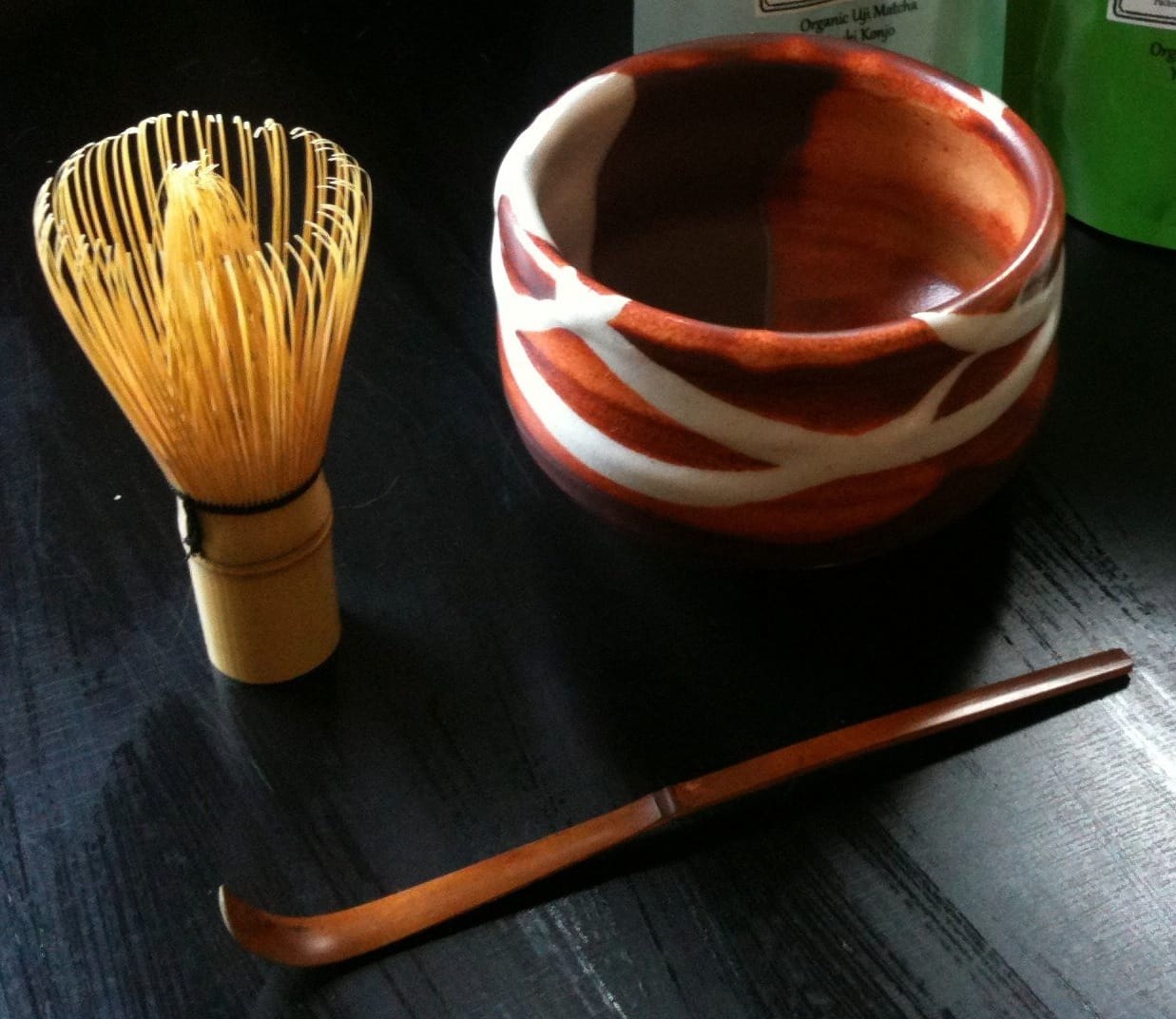
The three essentials:
- Chasen (bamboo whisk): the heart of matcha preparation, and not something you can replace with an electric whisk or spoon. A standard whisk with 80–100 tines (kazuho) creates good foam and costs around 1.500–3.000 yen. It’s also worth getting a whisk holder (kusenaoshi) to help it keep its shape.
- Chawan (tea bowl): a wide-mouthed bowl with enough room at the bottom for the whisk to move freely. For beginners, an affordable ceramic bowl costing 1.000–3.000 yen is more than sufficient. An artisan bowl can cost tens of thousands of yen, but that can come later.
- Chashaku (bamboo scoop): used to measure the powder; one level scoop is approximately 1 gram.
The fourth tool worth investing in is a small tea strainer. Sifting the powder before whisking eliminates 90% of the risk of lumps—the simplest and most effective trick for beginners.
Water ratio and whisking technique
The standard recipe for one bowl of usucha (thin tea) is: 2 grams of powder (2 chashaku scoops) + 60–70 ml of water at 75–80 degrees C. Fully boiling water will “burn” the tea and bring out harsh bitterness first. The simplest approach is to boil the water and let it cool for 2–3 minutes, or pour it into an intermediate cup first.
The steps: sift the powder into the bowl → pour in the water → hold the chasen upright and whisk rapidly from the wrist in a W or M motion (not in circles) for 15–20 seconds → once a fine foam covers the surface, gently lift the whisk from the center to create a beautiful peak. Tiny bubbles are the sign that you’ve done it correctly: they make the tea taste noticeably rounder and smoother. Drink it immediately after whisking—matcha never waits.
What’s the difference between usucha and koicha?
Usucha (thin tea) is what most of us picture: light, frothy, and suitable for everyday drinking. Koicha (thick tea) is the pinnacle of the tea ceremony: around 4 grams of powder with only 30–40 ml of water. It is not whisked into a foam, but slowly kneaded until it becomes a glossy, sauce-like liquid. Koicha requires the highest-grade matcha because every flaw in the powder is magnified. Its flavor is intense and lingeringly sweet, and it is almost something you “eat” rather than “drink.” At home, master usucha first. Koicha is best experienced for the first time at a tea room in Japan, with guidance from a tea master—tea ceremony experiences are often already included in the itinerary of OlaChill’s Japan tours.
Where to buy tea tools and matcha in Japan
- Kyoto: Teramachi Street and the area around Nishiki Market are home to many tea shops that also sell tea-making tools. Ippodo (a tea house with nearly 300 years of history) is a reliable place to buy both powder and chasen, and its staff offer excellent English-language assistance.
- Uji: Buy matcha at its source for good prices and the highest freshness. Many shops offer tastings before you buy.
- Tokyo: The Ippodo branch in Marunouchi and the tea counters in the depachika food halls of Isetan and Mitsukoshi are good options. Kappabashi’s kitchenware district has affordable bowls and strainers.
- Nara – Takayama: Japan’s most famous village for handmade chasen. If you can visit, a whisk carved by an artisan makes a truly unforgettable gift.
- On a tight budget: Daiso and 100-yen shops carry basic chasen and bowls that are perfectly adequate for practice—the total starter set costs less than 1.000 yen.
Start with one bowl of tea each morning
Don’t wait until you own an expensive set of tools to begin. A good tin of powder, a chasen, and fifteen seconds of whisking each morning are enough to let this small ritual take root in your everyday life—just as it has taken root in Japanese culture over eight centuries. Once you’ve grown attached to your own bowl of tea, your next trip to Japan will take on another layer of meaning: go to taste the standard at its source, then return home and recreate that memory. Find more stories about Japanese tea and cuisine on the OlaChill blog.