
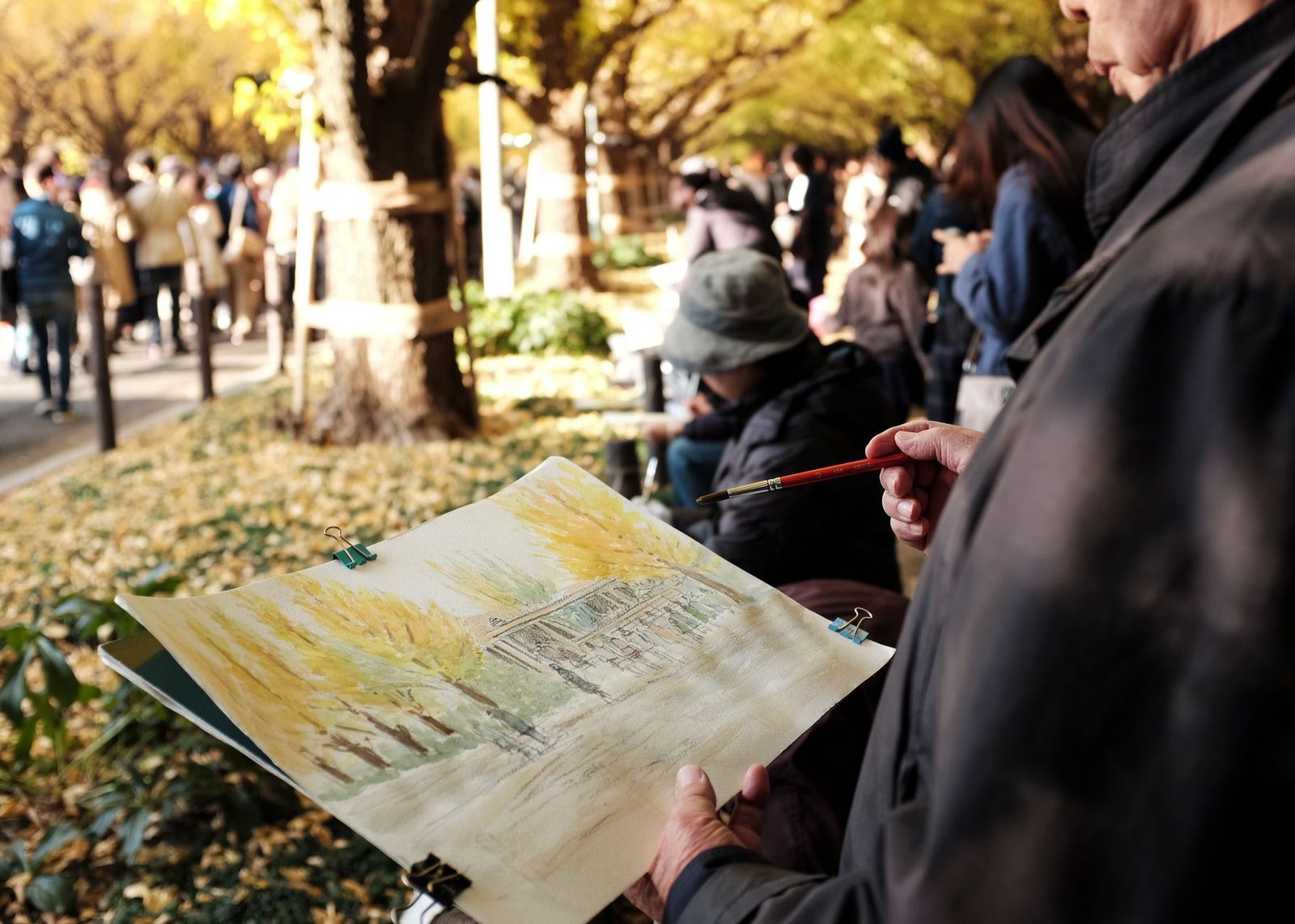
Tokyo in Fall: 10 Photo Spots and Golden-Hour Times
Where to stand, how to frame your shot, and when to find the best light at Icho Namiki, Rikugien, Showa Kinen, plus phone-photography tips to make your autumn foliage photos stand out from the crowd.
Aug 12, 2026·✍️ olablog·⏱ 16 min read
Where to stand, how to frame your shot, and when to find the best light at Icho Namiki, Rikugien, Showa Kinen, plus phone-photography tips to make your autumn foliage photos stand out from the crowd.
Tap a region to browse articles
There’s one thing many first-time autumn-leaf hunters in Tokyo forget: the sun sets incredibly early this time of year. By late November, daylight is already fading around 16:30, which means your afternoon “golden hour” starts at about 15:30—right when many people are still sitting in cafés waiting for “the perfect afternoon light” before heading out to take photos. I once lost an entire afternoon at Rikugien because I planned around Vietnamese time; by the time I arrived, the best light had already passed by half an hour.
The great thing about autumn in Tokyo is that you don’t need a fancy camera or a long trip out of the city. Golden ginkgo and red momiji leaves are scattered everywhere, from the chic boulevards of Aoyama to historic gardens beside baseball stadiums. You need just three things: stand in the right place, arrive at the right time, and know a few unspoken rules of Japanese gardens—especially when it comes to tripods.
In this guide, I’ve gathered 10 photo spots I’ve personally visited and timed for the light, along with specific shooting positions, camera directions, lighting windows, and the best weekdays to avoid the crowds. There’s also a section of phone-photography tips at the end—because honestly, 80% of the beautiful autumn photos you see online these days are taken with phones anyway.
Before You Shoot: Understanding Tokyo’s Autumn Light
Three things to remember at every spot below:
- The sun rises late and sets early. In late November–early December, sunrise is around 6:30 and sunset around 16:30. Morning golden hour is roughly 6:30–8:00, while afternoon golden hour runs from about 15:00–16:30.
- Leaves look best in backlight or side light. Ginkgo and momiji leaves are both thin, so sunlight passing through them makes them glow like lanterns. Shooting with the light behind you makes the leaves look much flatter and duller.
- Peak seasons don’t always overlap. Momiji (red leaves) in central Tokyo usually peaks from late November to early December. Ginkgo typically turns golden from mid-November to early December, but a “golden carpet” on the ground looks best once quite a few leaves have fallen—which is about a week after the peak on the trees. The timing varies by a few days each year, so do a quick search for that week’s foliage conditions before you go.
10 Photo Spots and Specific Shooting Angles
1. Icho Namiki (Meiji Jingu Gaien) — Tokyo’s Iconic Ginkgo Avenue
Four rows of ginkgo trees stretch for about 300m, all pruned into evenly spaced pointed shapes—the famous “golden tunnel” shot, one of Tokyo’s most recognizable autumn scenes. Nearest stations: Gaienmae or Aoyama-itchome. The approximate area coordinates are 35.673, 139.718.
- Shooting angle: Stand at the Aoyama-dori end of the avenue and look straight down toward the Meiji Memorial Picture Gallery at the far end as your vanishing point. Use a telephoto zoom (2x–3x on a phone) to compress the two rows of trees; the golden tunnel will look much denser and deeper than it does with a wide-angle shot.
- Best time: Early morning, 7:00–8:30, when angled sunlight comes from the left, making the leaves glow while the sidewalks are still quiet. The afternoon light is beautiful too, but the crowds are unbelievable.
- Quietest days: Tuesday to Thursday, before 9:00. During peak season, the area hosts a ginkgo festival with food stalls, and weekends feel like a huge fair; pedestrian traffic may also be restricted at certain times, so check that year’s festival information before going.
- Note: This is an active road. Never step into the roadway to get the centered composition—the police really do warn people.
2. Rikugien — Stone Bridge and Red Leaves Reflected on the Pond
This Edo-style historic garden in Komagome is one of Tokyo’s best-known spots for momiji reflected in the water. Admission is around 300 yen. The most photogenic area is around the central pond and the Togetsukyo stone bridge.
- Shooting angle: Stand on the pond bank opposite Togetsukyo and lower your camera close to the water to capture the full reflection of the bridge and the red momiji canopy behind it. On a windless day, the pond becomes mirror-flat—this is the garden’s most rewarding shot.
- Best time: 8:00–10:00 in the morning, when the sun is still low and the wind hasn’t picked up, keeping the water at its calmest. If the garden holds a nighttime light-up during the autumn foliage season, the evening scenery is also well worth seeing—but the event takes place some years and not others, so check the garden’s official website.
- Quietest days: Monday to Wednesday. On peak-season weekends, visitors walking around the pond form an almost continuous line.
- Note: The garden bans tripods, including mini tripods—we’ll cover this in detail at the end.
3. Showa Kinen Park (Tachikawa) — A Golden Ginkgo Carpet Underfoot
This enormous national park west of Tokyo is accessible by the JR Chuo Line to Tachikawa or Nishi-Tachikawa. Admission is around 400–500 yen. There are two ginkgo avenues, but the most famous is the row along the canal near the Tachikawa Gate: fallen leaves are left in place as a thick golden carpet, something rarely found in central Tokyo.
- Shooting angle: Option one—stand at the end of the tree-lined avenue and shoot along the canal to create a leading line. Option two—lower the camera close to the carpet (10–20cm above the ground), focus on a nearby cluster of leaves, and let the trees behind gradually blur. For portraits, place the subject 3–4m from the camera and have them gently kick up the leaves for a dynamic shot.
- Best time: 9:00–11:00 in the morning, when angled sunlight filtering across the canal makes the whole carpet shimmer. Go early because the park is far from central Tokyo, and it’s worth setting aside the whole morning.
- Quietest days: Weekdays are much more relaxed; the park is so large that you can still find breathing room on weekends. The ginkgo avenue is the one exception—you may have to quietly queue for your turn in the center of the frame.
- Note: The Japanese garden inside the park also has beautiful momiji, so you can photograph both in the same visit.
4. Roppongi Hills & Mori Garden — Red Leaves Against the Skyline
This is the spot for anyone who likes “Tokyo’s two worlds in one photo”: a traditional Japanese garden tucked beneath a glass skyscraper. Mori Garden is a small, free garden directly below Roppongi Hills, with a pond and several momiji trees that change color remarkably reliably.
- Shooting angle: Stand on the southern bank of the pond and point the camera upward to frame the red momiji canopy in the foreground with Mori Tower rising behind it—switch to portrait orientation to emphasize the height. Afterwards, walk to Keyakizaka: stand on the pedestrian overpass and shoot along the slope, with Tokyo Tower at the end of the axis and orange-leaved keyaki trees on both sides.
- Best time: Mori Garden looks best around 14:00–15:30, when afternoon light falls between the buildings. For Keyakizaka, aim for blue hour, around 16:45–17:15, when Tokyo Tower’s lights have just come on but the sky is still deep blue.
- Quietest days: Weekday afternoons. Weekend evenings are busy with people out enjoying Roppongi, not necessarily with photographers.
5. Zojoji and Shiba Park — An Old Temple Beneath Tokyo Tower
This classic combination features Zojoji’s main hall with Tokyo Tower rising directly behind it, enhanced in autumn by the gold and red trees across the temple grounds and neighboring Shiba Park. Free admission; nearest stations: Onarimon or Shibakoen.
- Shooting angle: Stand in the courtyard in front of the main hall and step back far enough to fit the entire temple roof and tower in one portrait frame. For a different composition, circle around to Shiba Park behind the temple, find a momiji or ginkgo tree, and use its canopy as a natural frame around the tower.
- Best time: In the morning, 8:00–10:00, sunlight hits the front of the temple directly, making both the paintwork and foliage look rich. A second good window is twilight, when the tower glows orange against the dark temple roof for a very cinematic contrast.
- Quietest days: You can usually take photos at almost any time because the grounds are spacious; avoid weekend lunchtime if you don’t want to wait for a clear frame.
6. Shinjuku Gyoen — Three Kinds of Autumn in One Ticket
This national garden in the middle of Shinjuku costs around 500 yen to enter and is one of the few places that brings together three distinct autumn settings: a French-style avenue of brilliant yellow plane trees, a Japanese garden with momiji reflected in the pond, and ancient ginkgo trees standing alone across the lawns.
- Shooting angle: For the plane-tree avenue in the French-style garden, stand in the middle of the path and shoot symmetrically down the two rows of trees, like a European postcard. In the Japanese garden, look for a viewpoint from the Taiwan Pavilion across the pond, using momiji on both sides as a frame.
- Best time: This is a place to visit in the morning right at opening, because the garden closes in the afternoon during this season—it usually admits visitors until around 16:00 and closes around 16:30, so check the official hours. The best light through the plane trees is from 9:00–11:00.
- Quietest days: The garden is usually closed on Mondays (check the calendar before going). Tuesdays after the closing day are somewhat busy; Wednesday–Thursday are the calmest.
- Note: Tripods and alcoholic drinks are prohibited, and bags may be checked at the entrance.
7. Koishikawa Korakuen — Tsutenkyo Red Bridge and Classic Momiji
One of Tokyo’s oldest historic gardens, located right next to Tokyo Dome, with admission around 300 yen. The autumn highlight is the red Tsutenkyo Bridge spanning a small ravine lined with momiji.
- Shooting angle: Stand in the ravine and angle the camera upward so the red bridge sits between two banks of red foliage—a frame with almost no trace of the city. Alternatively, go out to the large pond and point northeast to capture momiji canopies with Tokyo Dome or the Bunkyo Civic Center in the background—a distinctive “Edo meets Tokyo” composition.
- Best time: 14:00–15:30, when afternoon sunlight cuts diagonally through the momiji canopy around the ravine.
- Quietest days: Weekdays. The garden is smaller than Rikugien, so it feels noticeably cramped on peak-season weekends.
8. The University of Tokyo (Hongo Campus) — Ginkgo Trees Alongside a Century-Old Lecture Hall
Few tourists know about this spot: an avenue of mature ginkgo trees leads straight to the European-style Yasuda Auditorium. Walking around the campus is free; nearest stations: Todaimae or Hongo-sanchome. The ginkgo trees here are not pruned, so their canopies spread naturally, covering both the path and students’ bicycle roofs in yellow leaves.
- Shooting angle: Stand in the middle of the main avenue, using Yasuda Auditorium as the vanishing point, with the two rows of ginkgo trees framing either side. For a candid scene, wait for students to cycle past—a little movement instantly brings the frame to life.
- Best time: 7:30–9:00 in the morning, before classes begin, when the campus is quiet and the sun is low.
- Quietest days: Paradoxically, weekends are quiet in terms of students but busy with photographers; early weekday mornings offer the best balance.
- Note: This is an active university campus—keep your voice down, avoid pointing your camera into classrooms, and don’t set up a full fashion-shoot lineup in the middle of the path.
9. Yoyogi Park — A Natural Ginkgo Forest for Candid Photos
If Icho Namiki is ginkgo “for admiring,” the ginkgo grove on the west side of Yoyogi Park is ginkgo “for rolling around in”: huge trees with broad canopies, a thick carpet of fallen leaves, free admission, and no one will say anything if you lie right down to take a photo. Nearest stations: Yoyogi-koen or Harajuku.
- Shooting angle: Style one—place the subject beneath the canopy and shoot from a distance with a telephoto lens so they appear tiny inside the mass of gold. Style two—place the phone almost on the ground and shoot upward through the foreground leaves. For a leaf-tossing shot, have a companion throw leaves from behind the subject, shoot continuously in burst mode, and choose the frame with the best airborne leaves.
- Best time: 15:00–16:30, when afternoon light cuts horizontally through the trunks, creating long streaks of light—the most “anime” scene on this entire list.
- Quietest days: Weekday mornings are almost completely empty. Weekends are busier but lively, with plenty of dogs wearing autumn clothes; candid shots often turn out great.
10. Chidorigafuchi and Kitanomaru — The Imperial Palace Moat in Autumn
Famous for cherry blossoms but surprisingly quiet in autumn. Trees along the moat turn golden and orange, their colors reflected in the still water, with the Imperial Palace’s old stone walls in the distance. Nearest station: Kudanshita.
- Shooting angle: Walk along the Chidorigafuchi promenade and look for a bend in the moat so the curve of the water leads the eye into the frame. If the boats are operating in autumn (some years they run through the end of November, so check), row out to the middle of the moat and shoot back toward the bank for an almost completely unique angle. In nearby Kitanomaru Park, several large momiji clusters near the Tayasumon Gate make beautiful photos of red leaves against the castle walls.
- Best time: 15:00–16:30, when afternoon light falls along the moat. Early morning is also beautiful, but part of the moat is shaded by the castle walls.
- Quietest days: It’s comfortable almost every day—this is the crowd-escape spot on the list.
Autumn Phone-Photography Tips
Recent phones are more than capable of handling all 10 spots above; the important thing is using them properly:
- Clean the lens before shooting. It sounds silly, but this is the number-one reason autumn photos look hazy—the lens gets covered in finger oil throughout the day.
- Use 2x–3x telephoto instead of wide angle. Wide angle makes the trees look tiny and distorts the edges. Telephoto compresses the perspective, making the leaf tunnel look much denser and more dramatic. Step back and zoom in rather than standing close and shooting wide.
- Tap to focus on the leaves and lower the exposure. When shooting into the light, tap the bright leaves and drag the exposure slider down slightly—the leaves will retain their vivid color instead of blowing out to white.
- Lower the camera for leaf carpets. Turn the phone upside down so the lens is close to the ground, then use portrait mode to focus on nearby leaves—the background blur can rival a dedicated camera.
- Use burst mode for falling leaves. Hold the shutter button to shoot continuously when tossing leaves or when the wind picks up; choose the best frame later.
- Shoot RAW if your phone supports it and make light adjustments in Lightroom Mobile or Snapseed: warm up the white balance, emphasize orange and yellow tones, and don’t raise saturation across the whole image or the red leaves may become garish.
- Don’t be discouraged by overcast skies. Clouds make leaf colors richer and the light more even—just crop out the blank white sky and the photos will still have plenty of atmosphere.
Tripods and Etiquette in Japanese Gardens
This is where many visitors run into trouble. Most admission-based gardens in Tokyo—Rikugien, Koishikawa Korakuen, and Shinjuku Gyoen—ban tripods, monopods, and even mini tripods, with some places also prohibiting selfie sticks. The reason is simple: paths are narrow and crowds are heavy, so one extended tripod can block everyone’s way. During nighttime light-up events, the rules are even stricter, and staff will remind you as soon as you unfold the legs.
Ways to manage without a tripod:
- Rest your phone or camera on a railing, flat rock, or wooden post—as long as you don’t climb beyond the barrier.
- At night, turn on night mode and brace your elbows against your body, holding your breath as you press the shutter; modern phones handle light-up scenes remarkably well.
- Raise the ISO instead of using a longer exposure—slightly noisy photos are still better than blurry ones.
A few general etiquette rules: don’t step onto moss or into flowerbeds to “get the angle,” don’t bend branches or pull leaves down toward your face, don’t occupy a particularly beautiful frame for more than a few minutes when others are waiting, and drones are out of the question—they’re banned in nearly every central-city park. Japanese people rarely say anything directly, but being considerate makes the shoot more comfortable for everyone.
Suggested Itineraries for Busy Travelers
If you only have two weekday sessions:
- Morning: 7:30 Icho Namiki (beautiful light, few people) → 9:30 Shinjuku Gyoen → lunch in Shinjuku.
- Afternoon and evening: 14:00 Koishikawa Korakuen or Rikugien → 16:30 head to Zojoji or Keyakizaka for blue hour with Tokyo Tower.
If you have a full free day, devote it entirely to Showa Kinen Park—go early, bring some snacks, and don’t schedule anything afterward because you’ll inevitably get back later than planned.
Frequently Asked Questions
Which week is best for autumn photography in Tokyo?
Usually, the last week of November through the first week of December is peak season for both ginkgo and momiji in central Tokyo. However, the timing shifts by a few days each year depending on the weather, so check a quick autumn foliage forecast (kouyou forecast) shortly before your trip—Japanese news sites update them weekly.
Can I still take photos on weekends, or do I have to go on weekdays?
You can absolutely shoot on weekends; you just need to change your strategy: arrive right at opening time or during the final 1–2 hours before closing, prioritize spacious spots such as Showa Kinen, Yoyogi, and Chidorigafuchi, and avoid Icho Namiki and Rikugien around lunchtime and weekend afternoons.
Should I go if it’s raining or overcast?
Yes—there can even be advantages. Overcast skies make leaf colors look richer and more even, while wet pavement reflects beautiful golden and red tones. Just keep the white sky out of the frame and focus on close-ups of leaves, leaf carpets, and reflections in puddles.
Is it worth bringing a tripod to Tokyo in autumn?
If your itinerary centers on admission-based gardens and crowded public spots, you’ll hardly be able to use it—it’s either prohibited or inconvenient. A tripod is only worth bringing if you plan to shoot night scenes in places where they’re allowed; otherwise, a phone with night mode is enough.
Do the gardens open at night for light-up events?
It depends on the year and the garden. Rikugien has hosted a famous autumn foliage light-up for many years, but the event has also been paused during certain periods. Before your trip, check each garden’s official website or the Tokyo metropolitan park website for that year’s event schedule.
More from this region — Tokyo & Kanto
View all →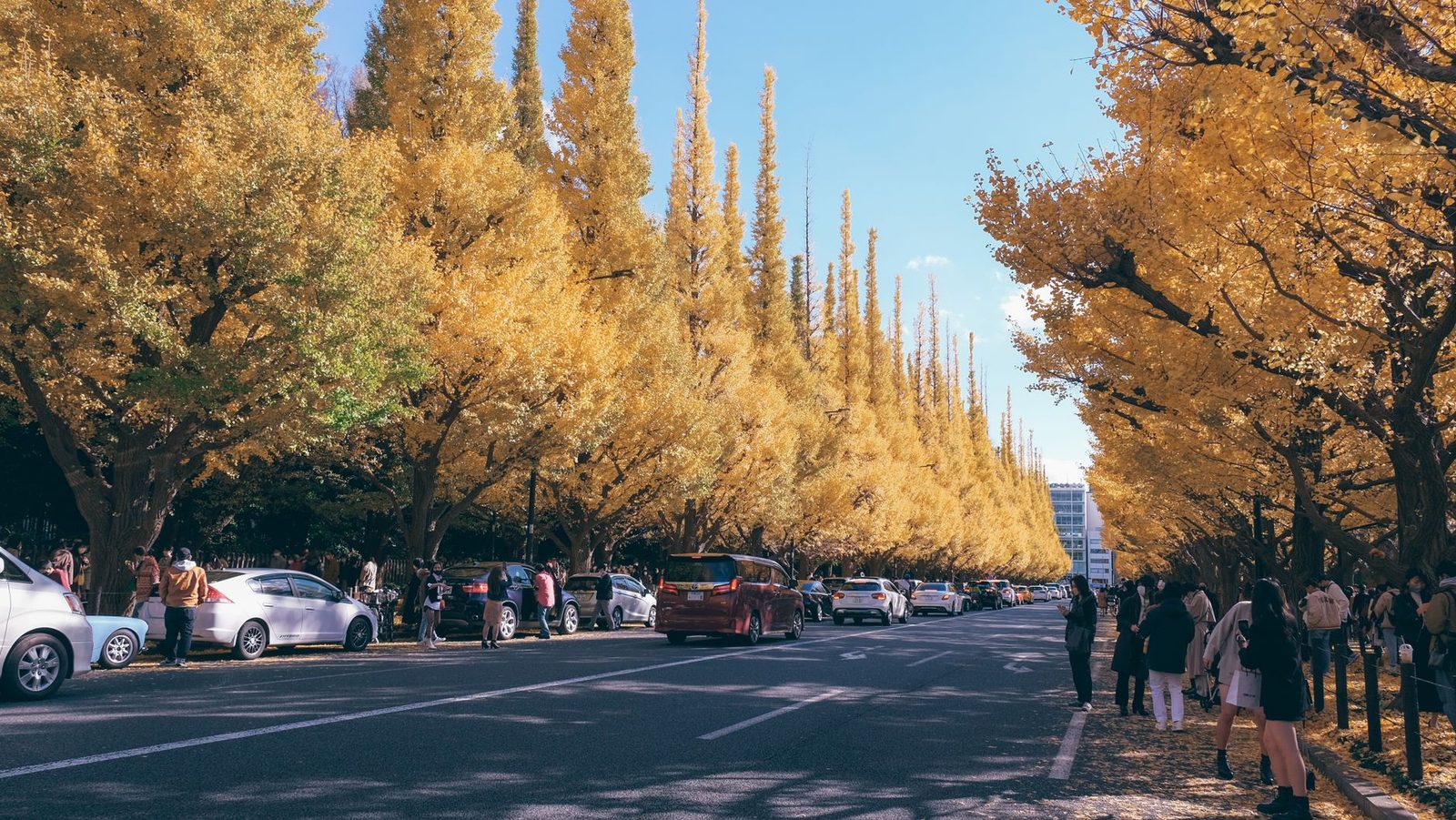
A Golden Autumn Day in Tokyo: Early-Morning Rikugien, Slanting Sun on the Ginkgo Trees, and Nighttime Light-Up
17 min · tips

See Tokyo’s Autumn Leaves Without the Crowds: Avoid Peak Weeks and Budget for a Full Day
18 min · tips
Tokyo to Nikko by Coach: A Practical Group Day Trip
8 min · tips
Mount Takao in November: Choose a Hike That Matches Your Fitness, Avoid the Cable Car Crowds
20 min · tips