
A Golden Autumn Day in Tokyo: Early-Morning Rikugien, Slanting Sun on the Ginkgo Trees, and Nighttime Light-Up
An hour-by-hour itinerary for a perfect autumn-leaves day: a quiet Japanese garden in the early morning, sunlit ginkgo trees in the afternoon, and nighttime illuminations — plus rainy-day alternatives and a half-day version.
Aug 12, 2026·✍️ olablog·⏱ 17 min read
An hour-by-hour itinerary for a perfect autumn-leaves day: a quiet Japanese garden in the early morning, sunlit ginkgo trees in the afternoon, and nighttime illuminations — plus rainy-day alternatives and a half-day version.
Tap a region to browse articles
There’s a persistent misconception about autumn in Japan: if you want to see truly spectacular fall foliage, you have to leave Tokyo — head to Nikko, go into Hakone, or go all in and fly down to Kyoto. I used to think the same thing, until a late-November work trip left me stuck in Tokyo. Not wanting to miss the foliage season, I tried combining three central Tokyo spots into a single day. The result was one of the most memorable autumn days I’ve ever had in Japan — without taking a Shinkansen, without waking up at 4 in the morning, and with total transportation costs less than a bowl of ramen.
The secret is that Tokyo’s autumn colors peak late — usually from mid-November to early December, when Nikko and the mountain regions have already lost most of their leaves. The three best foliage spots in central Tokyo — Rikugien, Koishikawa Korakuen, and the ginkgo avenue at Meiji Jingu Gaien — are all connected by a handful of metro lines, just 10–30 minutes apart by train. The only problem is that all three are famous, and if you arrive at the wrong time, you’ll spend more time looking at the backs of other people’s heads than at the leaves.
So this isn’t another list of “where to see autumn leaves in Tokyo” — the generic 3-day and 5-day itineraries have already covered that. This is a carefully timed one-day itinerary designed specifically around fall foliage and the changing light: enter Rikugien early, right when it opens, to avoid the crowds; take a leisurely lunch break at Koishikawa Korakuen; arrive at Jingu Gaien’s ginkgo avenue just as the low afternoon sun turns it golden; and finish the day with a light-up. I’ve also included a rainy-day plan and a shortened half-day version for anyone who only has one free part of the day.
Why This Order Matters (and Why You Shouldn’t Reverse It)
With just a few train stations between the three spots, many people assume that any order will work. In reality, the order used here follows two important principles, and reversing it can seriously reduce the quality of the entire day.
The first is crowds. Rikugien is Tokyo’s most famous garden for autumn foliage, and from around 10 in the morning onward during peak season, there may be long lines at the entrance. At the garden’s best viewpoints, you may even have to queue to take photos. Arrive right when it opens (usually 9 in the morning — you should check the Tokyo Metropolitan Parks official website before you go), and you can have roughly an hour with the garden almost entirely to yourself: morning dew still clinging to the leaves, with early sunlight cutting across the maple canopy. At Rikugien during foliage season, the difference between 9 and 11 is the difference between two completely different experiences.
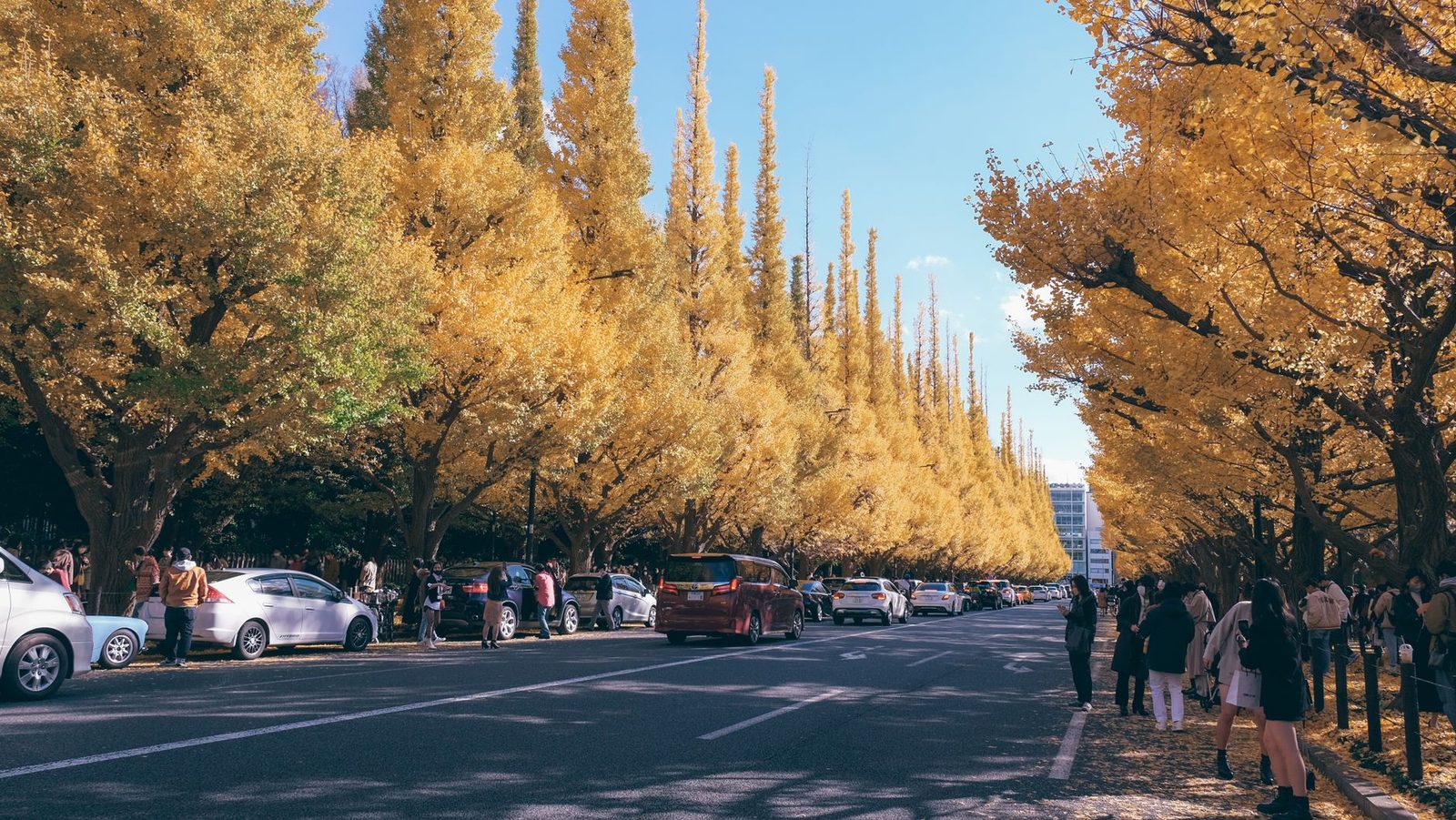
The second is light. The ginkgo avenue at Jingu Gaien runs roughly along a north–south axis, with two rows of tall golden trees on either side. Under the high midday sun, the leaves look flat and harsh. But from around 14h30 to 16h, the low afternoon sunlight filters through the canopy, making the whole avenue seem to glow from within — this is the time photographers stake out their spots. In late November, the sun sets very early in Tokyo, around 16h30, so the “golden hour” actually begins in the middle of the afternoon. Putting Jingu Gaien in the afternoon isn’t just convenient routing; it’s simply when the avenue looks its best.
Koishikawa Korakuen sits between the other two spots both geographically and in terms of pace: it’s a more subdued Edo-era garden that stays beautiful throughout the day, making it ideal for a midday pause. That gives us a day that follows the sun — and now, let’s get into the details.
8h30 – 11h: Rikugien Right When It Opens
Getting There and Tips for Entering
Rikugien is right next to Komagome Station, which is served by both the JR Yamanote Line and the Namboku subway line, so it’s fairly easy to reach from anywhere in Tokyo. The entrance is just a few minutes’ walk from the station. One small tip: arrive at the gate about 10–15 minutes before opening time. It may sound a little “too early,” but on peak autumn weekends, people start lining up before the gates open. The first group inside is often the only one able to photograph the stone bridge and pond before they’re filled with people.
Admission is around 300 yen — practically symbolic compared with what awaits inside. At certain times, Tokyo offers a combined ticket for Rikugien and Koishikawa Korakuen at a price slightly higher than either individual ticket; if you’re following this itinerary, it’s worth asking at the ticket counter. For current information, check the official website.
How to Explore the Garden
Rikugien is a kaiyu-shiki garden, designed to reveal a series of changing scenes as you walk: a large pond at the center, a path circling around it, and a new view opening up at every turn. In autumn, the maple clusters around the pond and the area near Togetsukyo Bridge are the main highlights — red leaves reflected in the still morning water create the kind of scene you’ll want to linger over.
My advice: don’t rush. You have nearly two hours, and the garden isn’t so large that you need to run. Walk a full loop around the pond in whichever direction seems quieter, then save the central area for a second pass when the sun is a little higher — the same garden view can have two completely different color palettes at 9 and 10h30. The garden also has tea-house-style rest areas. Sitting with a cup of hot tea, looking out over the pond in the crisp late-autumn air, is one of Tokyo’s most affordable forms of luxury.
Around 11h, when the crowds begin to noticeably thicken, it’s a good time to leave. You’ll be departing just as the garden starts to lose its tranquility — the feeling of staying one step ahead of the crowds will repeat throughout the day.
11h30 – 14h: Koishikawa Korakuen and Lunch
Getting There: One Direct Train
This is the smoothest connection in the entire itinerary: from Komagome Station, the Namboku subway line runs directly to Korakuen Station. It’s only a few stops, requires no transfer, and takes about 10 minutes. From Korakuen Station, walk for nearly 10 minutes around the Tokyo Dome complex to reach the garden entrance.
One of Tokyo’s Oldest Edo-Era Gardens
Koishikawa Korakuen is one of Tokyo’s oldest gardens. It was built by the Mito branch of the Tokugawa family at the beginning of the Edo period, nearly four centuries ago. Compared with Rikugien, it has a smaller social-media profile — and that’s exactly its advantage: even during peak season, the pace here is much more relaxed, making it perfect for slowing down at midday.
In autumn, the garden’s main highlight is the area around the red-painted wooden Tsutenkyo Bridge, which crosses a small ravine filled with maple leaves. Red bridge, red leaves, layers upon layers — it’s the garden’s most photographed spot. Nearby, the semicircular stone Engetsukyo Bridge casts a complete circle-shaped reflection on the water — the “full-moon bridge” — against a backdrop of autumn foliage. One detail I particularly love about Koishikawa Korakuen is its sense of “landscape painting in miniature.” The garden was designed to recreate famous scenic spots from Japan and China, so walking a single circuit feels like flipping through a book of landscape paintings. Admission is also around 300 yen.
About an hour to an hour and a half is just right here. There’s also an amusing detail that many visitors miss: from several points in the garden, you can see the white dome of Tokyo Dome and even part of a Ferris wheel peeking out behind the trees — an old Edo garden layered over a backdrop of modern entertainment, which feels very “Tokyo.”
Lunch Around Tokyo Dome
When you leave the garden, you’ll be right beside Tokyo Dome City, an entertainment complex with countless dining options, from gyudon chains, ramen, and soba to restaurants inside LaQua. Its biggest advantages are speed, warmth, variety, and not having to search for somewhere to eat. If you want something more traditionally Japanese, the nearby Iidabashi Station area — especially Kagurazaka — has plenty of good soba and teishoku restaurants at reasonable prices, though getting there will take a little extra walking time. For today’s itinerary, I recommend keeping lunch quick around Tokyo Dome so you can conserve both energy and time for the afternoon — the afternoon is the day’s main “battle” when it comes to light.
14h30 – 16h30: Jingu Gaien’s Ginkgo Avenue in the Slanting Afternoon Sun
Getting There
From Korakuen Station, take the Marunouchi Line and transfer to the Ginza Line to reach Gaienmae Station — around 20–25 minutes in total. Walk for a few minutes after exiting the station and you’ll find yourself at the start of Japan’s most famous ginkgo boulevard: Icho Namiki.
Why This Time Slot Matters
Jingu Gaien’s ginkgo avenue is a roughly 300-meter boulevard lined with nearly 150 towering ginkgo trees. They are carefully pruned into evenly spaced pointed shapes, drawing the eye toward the Meiji Memorial Picture Gallery at the far end — one of Tokyo’s most beautiful urban perspectives. From late November to early December, the entire avenue turns a brilliant yellow, and once the leaves begin to fall, the pavement becomes covered in a thick golden carpet.
The 14h30 – 16h window is when the low afternoon sun shines through the canopy. The yellow no longer looks flat as it does at midday; instead, it glows like a lantern, with long tree shadows stretching across the carpet of leaves. This is also why I’ve placed this stop at the end of the afternoon rather than in the morning, as many other itineraries do — in the morning, the avenue is backlit and noticeably less vivid.
A warning so you can prepare yourself: it’s crowded. Very crowded, especially on weekends. But unlike at Rikugien, the crowds here don’t ruin the experience. The boulevard is wide, the atmosphere is festive, and people taking photos amid a shower of golden leaves are part of the scene itself. During peak season, the area sometimes hosts a ginkgo festival with food stalls along the park; whether it takes place and how large it is varies from year to year, so check the latest information before you go. A photography tip: instead of squeezing in at the Aoyama-dori end, where it’s busiest, walk farther into the avenue and turn back, or wait at a crosswalk when the light is red and traffic is stopped to capture the two rows of trees converging into a single point.
Stay until around 16h15 – 16h30 and you’ll get an extra “act”: sunset turns orange behind the golden trees, while the sky quickly deepens into blue. Tokyo gets dark early at this time of year — and that’s your signal to move on to the final leg.
From 17h: Finish with a Light-Up
There are two ways to spend an autumn evening in Tokyo, depending on the year and your energy levels:
Option A: Return to Rikugien for the Night Illumination
Rikugien has a tradition of holding nighttime autumn-leaf illuminations during peak season. The garden you visited in the morning becomes a completely different world: brilliant red maple canopies against a black sky, with the pond turning into a mirror reflecting the lights. Visiting the same garden twice in one day, morning and night, is a particularly worthwhile “two-in-one” experience. However, in recent years the event has taken place some years but not others, and when it does happen, it usually requires a separate timed ticket; in some years, advance reservations are necessary. You must check the park’s official website before your trip. If the event is being held during your visit, I consider it the most beautiful ending to this itinerary: getting back to Komagome from Gaienmae takes about half an hour.
Option B: Illuminations in Central Tokyo
If Rikugien doesn’t open at night, don’t be disappointed — mid-November is also when Tokyo’s illumination season begins. From Gaienmae, you’re close to several major illumination areas: Tokyo Midtown and Roppongi Hills in Roppongi (by train or even a leisurely 20–30-minute walk), or Marunouchi near Tokyo Station, where Naka-dori glows between two rows of trees. The major advantage of this option is that you can combine it with dinner, since Midtown, Roppongi Hills, and Marunouchi are all packed with restaurants at every price point. A hot bowl of ramen or an izakaya dinner after a full day walking outside in the cold — I don’t think any further persuasion is needed.
A Rainy-Day Plan
Tokyo’s autumn rain is usually light and drizzly — and the good news is that this itinerary handles rain better than you might expect, with only a few adjustments.
If it’s lightly raining: follow the plan as written; you may even be rewarded for it. Japanese gardens in a light rain have a beauty all their own: wet leaves become darker and glossier, stone and moss deepen in color and make the reds stand out, and most importantly, the crowds disappear. Rikugien on a lightly rainy morning is its most peaceful version. Bring a compact umbrella, wear waterproof shoes, and take care: fallen ginkgo leaves become surprisingly slippery when wet, especially on stone pavements.
If it’s raining heavily or very windy: don’t feel bad about skipping the garden in the morning — strong winds after rain may strip away even more leaves. An alternative is to spend the morning at an indoor attraction near the route, such as one of the museums around Ueno Park (just a few stops from Komagome) or the many indoor facilities at Tokyo Dome City, then monitor the rain radar. People living in Japan often use weather apps with hourly radar, which can be astonishingly accurate. As soon as the rain stops, head to Jingu Gaien: ginkgo trees after rain, with sunlight breaking through clearing clouds, can create a rare and beautiful scene. If it rains all day, reverse the plan: spend the daytime indoors and go out for illuminations at night — reflections on wet pavement can actually look even more magical than they do on a dry evening.
A Shortened Half-Day Version
Not everyone has a full day free — especially people living in Japan who only have one weekend afternoon available, or travelers who want to fit a half-day of autumn foliage into an existing itinerary.
Morning Half-Day: The Komagome–Korakuen Garden Pair
Keep the first part of the itinerary unchanged: enter Rikugien at 9, move on to Koishikawa Korakuen around 11, have lunch around Tokyo Dome, and finish around 13h30 – 14h. This version is for true Japanese-garden lovers: two of Tokyo’s finest historic gardens, connected by a direct train, while avoiding Rikugien’s busiest hours entirely.
Afternoon–Evening Half-Day: Ginkgo and Lights
Start at 14h30 at Gaienmae, enjoy the ginkgo avenue through the full period of slanting sunlight and sunset, then walk or take the train to Roppongi or Marunouchi for dinner and illuminations. This version suits people who prefer a vibrant urban atmosphere to quiet gardens, and it’s also the most photogenic option if you only have a few hours. The one thing to remember: don’t move it to the morning just to “avoid the crowds.” As mentioned earlier, this avenue is at its best in the afternoon light, so changing the time also changes the quality of the experience.
A Few Final Tips for a Perfect Day
- Timing within the season: The safest window for all three spots is usually from around the last week of November to the first week of December — when the maples in the gardens and the street-side ginkgo trees overlap at their color peak. The leaves may change earlier or later depending on the year (the recent trend has been later), so check the latest koyo forecast about a week before your visit.
- Weekdays beat weekends, hands down. If you have a choice, go from Tuesday to Thursday; the difference in crowd levels at all three spots is obvious compared with Saturday and Sunday.
- Wear comfortable shoes. It sounds obvious, but over the course of the day you’ll walk much more than you expect — around ponds, through gardens, and along boulevards — easily reaching more than ten thousand steps.
- An IC card (Suica/Pasmo) is all you need for every train ride in this itinerary; the total train fare for the day is only a few hundred yen. There’s no need to consider a complicated pass.
- Dress in layers. Your hands may feel chilly in the gardens early in the morning, walking at midday can warm you up, and standing around looking at illuminations at night will make you cold again — an easy-to-remove jacket is the perfect companion.
- Bring a lens or use a backlit shooting mode. Both early-morning Rikugien and afternoon Jingu Gaien offer beautiful backlighting challenges — shooting into the sun as it filters through the leaves is the day’s most rewarding kind of photo.
Frequently Asked Questions
What time of year is this itinerary best?
The last week of November through the first week of December is the ideal “sweet spot,” when the maples in both gardens and the ginkgo avenue at Jingu Gaien are all looking their best. Go earlier, in mid-November, and the ginkgo trees may already be yellow while the garden maples are still green; go later, into mid-December, and the opposite may be true, with many trees already bare. Since the timing varies from year to year, check the latest foliage forecast before finalizing your date.
Do I need to buy tickets in advance?
Daytime admission tickets for Rikugien and Koishikawa Korakuen are sold at the gates and cost around 300 yen per garden; advance reservations are usually unnecessary. The nighttime illumination at Rikugien, if it takes place that year, may require a separate timed ticket and should be booked early — check the Tokyo Metropolitan Parks official website. Jingu Gaien’s ginkgo avenue is a public road and completely free.
Is this itinerary suitable for young children or older adults?
Yes, with one adjustment: drop one of the morning stops to reduce the total amount of walking. My suggestion is to keep Rikugien in the morning and Jingu Gaien in the afternoon — the two “peaks” of the day — and skip Koishikawa Korakuen in favor of a long lunch and some rest at Tokyo Dome City, which has plenty of activities for children. The paths in both gardens consist of gravel and natural stone; strollers can manage them, but the ride may be a little bumpy. The ginkgo boulevard, on the other hand, is completely flat.
I’m only in Tokyo for 3–5 days. Where should I fit this day into my trip?
Leave this day flexible and decide late: check the weather forecast around 3–4 days in advance, choose the sunniest day during your stay in Tokyo, and schedule this itinerary then. The other parts of your trip — shopping, museums, and dining — handle bad weather much better than a day that depends so heavily on light and foliage. That’s also the overall philosophy of this article: autumn leaves won’t wait for anyone, but if you know how to wait for the right time and the right sunlight, Tokyo can give you an autumn day every bit as memorable as Kyoto.
More from this region — Tokyo & Kanto
View all →
See Tokyo’s Autumn Leaves Without the Crowds: Avoid Peak Weeks and Budget for a Full Day
18 min · tips
Tokyo to Nikko by Coach: A Practical Group Day Trip
8 min · tips
Mount Takao in November: Choose a Hike That Matches Your Fitness, Avoid the Cable Car Crowds
20 min · tips
US to Tokyo Flights: 8 Nonstop Routes Compared, Real Prices from $850
7 min · tips