Mount Takao in November: Choose a Hike That Matches Your Fitness, Avoid the Cable Car Crowds
Compare three routes to the summit by fitness level and time, the best departure time to avoid weekend lines, a detour through Yakuoin Temple, a hot bowl of soba, and an onsen right by the station.
Aug 12, 2026·✍️ olablog·⏱ 20 min read
Compare three routes to the summit by fitness level and time, the best departure time to avoid weekend lines, a detour through Yakuoin Temple, a hot bowl of soba, and an onsen right by the station.
Tap a region to browse articles
Anyone who has visited Mount Takao on a Sunday in mid-November remembers the scene: you step out of Takaosanguchi Station at 10 a.m., the air is crisp, brilliant red maple leaves overhead—and then you see the snaking line at the cable car ticket counter, winding around the plaza and all the way toward the walking path. An employee is holding a sign that says, “Estimated wait: about 60 minutes.” An entire hour spent standing in line while the mountain is at its most beautiful just above you.
I stood in that line exactly once. After that, I learned my lesson: Takao is not a difficult mountain, but it is a mountain that requires planning. It is only 599 meters high, the Keio train runs directly from Shinjuku to the foot of the mountain in about an hour, and a one-way ticket costs less than 500 yen—which means practically anyone in Tokyo can visit. Precisely because it is so accessible, the mountain draws so many visitors in November that it is considered one of the “most visited mountains in the world.” Crowds do not mean it is a bad destination. They simply mean that with the right route and timing, you get a picture-perfect autumn day; go spontaneously, and you may get a day of waiting in line.
I wrote this article specifically about the things that “best fall foliage spots near Tokyo” guides often overlook: choosing a route that suits your fitness level, deciding between the cable car and hiking, figuring out what time to start to avoid bottlenecks, and ending the day properly—with a hot bowl of soba and an onsen right by the station entrance. It is especially useful if your group includes young children or older parents, because Takao is one of the few mountains around Tokyo where everyone in the group can choose a different way up and still meet at the summit.
Understand the Mountain’s Layout Before Choosing a Route
Takao has nearly a dozen numbered trails, which may sound confusing, but you really only need to understand three key points.
The first is the foot of the mountain—the area around Takaosanguchi Station, home to Kiyotaki Cable Car Station, the chairlift, food stalls, a small museum, and the onsen.
The second is the mid-mountain area, where the cable car and chairlift drop you off. From here, there is a lookout, a few snack shops, and a paved path leading through Yakuoin Temple.
The third is the 599-meter summit, a wide open area with restaurants, restrooms, and a viewpoint facing Mount Fuji.
All the routes, regardless of where they begin, eventually merge near Yakuoin and continue together to the summit. That means you can have grandparents and babies take the cable car while younger members hike, then meet in the temple grounds. This is what makes Takao feel so much more family-friendly than many other mountain routes around Tokyo.
Three Main Routes: Choose Based on Your Fitness, Not the Scenery
Trail 1 (Omotesando) — Paved and Safe, but Steeper Than You Think
Trail 1 is the main pilgrimage route, paved with concrete from start to finish. It is about 3,8 km long and takes roughly 90–100 minutes of continuous walking from the foot of the mountain to the summit. Because the surface is smooth and paved, it is the “safest” option: ordinary sneakers are fine, there are restrooms spaced along the way, vending machines, rest areas, and almost continuous mobile reception.
But do not confuse “paved” with “easy.” The section from the foot of the mountain to the upper cable car station is the steepest part of the entire route, with a steady incline and almost nowhere level to catch your breath. Many fit people manage the climb, only to find their knees crying on the way down, because concrete does not absorb impact the way a forest floor does. My advice: if your group includes older adults, take the cable car to skip this steep section, then walk the upper part of Trail 1—the most beautiful section, with a traditional temple gate, towering old cedar trees, and a distinctly temple-like atmosphere.
Trail 1 is also the only route I would confidently recommend in light rain.
Trail 6 (Biwa Waterfall) — Cool and Scenic, but Slippery
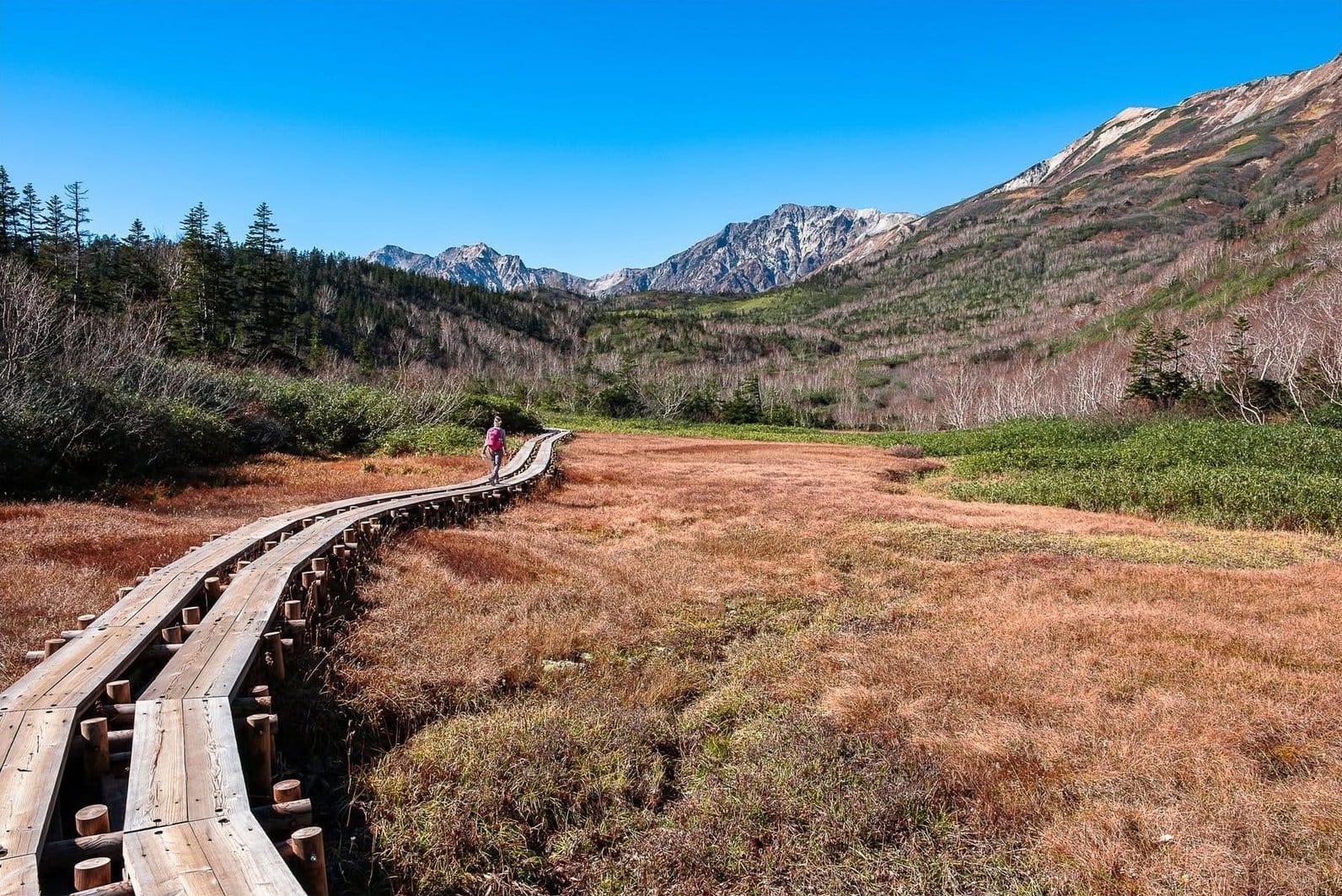
Trail 6 follows a stream for about 3,3 km. It takes roughly the same amount of time as Trail 1, but feels completely different: green moss, the sound of running water, sunlight filtering through the canopy, and, near the end, a section where you have to step across stones in the stream bed. Photographers especially love this route during autumn, when the red leaves are reflected in the water.
There are two things to know before choosing this trail. First, the surface is dirt and rock, and after rain it is genuinely slippery—not just “a little slippery.” Tree roots, wet rocks, and worn earthen steps make an unexpected slip quite likely, so shoes with good traction are essential. Second, during peak autumn foliage weekends in November, the authorities often enforce a one-way rule: uphill traffic only, with no downhill travel on Trail 6, to prevent congestion in the narrow stream section. This rule varies by year and by day, so check the official Mount Takao website or the notice board at the trailhead before entering.
There are virtually no restrooms along Trail 6. If you have a young child who is at the “suddenly needs the bathroom” stage, this detail matters more than the incline.
Inariyama Trail — A Ridge Route for People Who Want to Really Hike
Inariyama runs along the western ridge. It is about 3,1 km long, but it is the most demanding of the three routes: the climb begins immediately, there are many staircases, and the final stretch is a long flight of steps that everyone remembers afterward. In return, it is the quietest route, passing through genuine forest and occasionally opening onto views of the Kanto Plain.
If you work out regularly, or simply want to feel that you have “actually climbed a mountain” rather than “taken a walk,” choose Inariyama. For someone with moderately good fitness, the actual ascent usually takes around 90–110 minutes. It is still manageable for energetic elementary-school children, but allow extra time and bring plenty of water, since there are almost no shops along the route.
Quick Comparison of the Three Routes
| Criteria | Trail 1 | Trail 6 | Inariyama |
|---|---|---|---|
| Surface | Paved throughout | Dirt, rocks, light stream crossing | Dirt, tree roots, many steps |
| Length | ~3,8 km | ~3,3 km | ~3,1 km |
| Ascent time | ~90–100 minutes | ~100 minutes | ~90–110 minutes |
| Difficulty | Moderate (steep at the start) | Moderate | Most demanding |
| Facilities along the way | The most | Very few | Almost none |
| Best for | Families, older adults, rainy days | Stream scenery lovers, dry weather | People seeking a real workout |
A combination I often use and find ideal for mixed groups is: go up via Trail 6 or Inariyama, then take the cable car down (if you head down early) or return via Trail 1 if you are willing to put up with sore knees. For groups with grandparents, take the cable car both ways and walk only the section in between.
Cable Car or Hiking?
What Is the Difference Between the Cable Car and the Chairlift?
There are two parallel forms of transport at the foot of the mountain. The cable car is a covered car that travels on rails, carries many passengers at once, and is famous for having the steepest section of track in Japan—the sensation of standing at an angle is surprisingly fun. The chairlift is open-air, like a ski lift, with two people per chair. It takes longer, but you sit among the red autumn leaves with no windows between you and the scenery.
The prices are similar: about 500 yen one way and roughly double that for a round trip. However, fares and operating hours change with the season, so check the official website before your visit. Keio also sells a combo ticket that includes a round-trip train ticket and a cable car discount for passengers traveling from Shinjuku, which is worth considering if you do not use a commuter pass.
Which should you choose? If you are traveling with a baby under three or someone afraid of heights, choose the cable car. If you want views and photos, choose the chairlift—but remember that it is outdoors, the mountain wind can make your hands painfully cold at the end of November, and it often stops operating in rain or strong winds. Older adults dressed warmly can ride the chairlift comfortably; just avoid carrying an oversized backpack on your lap.
When to Skip the Cable Car Entirely
There are three situations in which I recommend hiking both up and down. First, if you arrive after 9 a.m. on a peak Sunday—the wait may be as long as the hiking time, and standing around is more tiring than walking. Second, if you are visiting on a weekday and want to save money, since round-trip cable car tickets for a family of four add up quickly. Third, if you want the full forest experience rather than simply taking a photo at the viewpoint and heading home.
Departure Time: November’s Most Important Calculation
This is the part I most want you to remember from the entire article.
Peak Weekends (Around Mid- to Late November)
Takao’s crowd patterns are fairly predictable. Visitors start arriving at Takaosanguchi Station around 9 a.m., with cable car lines peaking from around 10 a.m. until noon. In the afternoon, the flow reverses: from around 2 p.m. to 4 p.m., the line for the downhill cable car in the mid-mountain area becomes the most brutally congested, as everyone wants to get back before dark.
The strategy I find most effective is to leave home early and arrive at the foot of the mountain before 8 a.m. At that time, the cable car is usually nearly queue-free, the air is cold and clear, and the sunlight filtering through the leaves is at its most beautiful. Reach the summit around 9:30 to 10 a.m., eat an early lunch at 11 a.m. while the summit restaurants still have seats, and start descending before 1 p.m. You will reach the foot of the mountain in the early afternoon, leaving the rest of the afternoon to enjoy the onsen before the baths fill up around dusk.
If you are not a morning person, the second option is to go against the usual rhythm: start late, hike up after 1 p.m., enjoy the sunset around the summit, and take the cable car down later in the day. But remember that at the end of November, the sun sets around half past 4, and it gets dark even earlier in the forest. This option is only for people carrying headlamps and using Trail 1.
Weekdays
If you can take a weekday off, Takao in November feels like a completely different mountain. It is still busy with school groups and groups of older adults, but cable car waits are usually only a few minutes, there are still tables at the summit restaurants, and you can actually hear the leaves falling. Tuesday through Thursday are the best days. Just avoid the days immediately after public holidays, since substitute holidays sometimes push the crowds into the following weekday.
Yakuoin Temple: Do Not Just Walk Past
Located midway up the mountain along Trail 1, Yakuoin is not merely a temple to stop by if you happen to be passing—it is the reason the mountain has been regarded as sacred for more than a thousand years. The temple belongs to the Shingon tradition and is associated with ascetic mountain practice. The long-nosed, red-faced tengu statues here are the “mascots” of the entire Takao area.
A few details are worth pausing for: the main gate with its two guardian tengu statues; the area with prayer wheels and stacks of wooden votive plaques; and especially the two parallel stairways—a steep “men’s” route and a gentler “women’s” route that follows the slope. According to tradition, completing the men’s route brings good fortune, but if your knees disagree, simply take the women’s route. The scenery is just as lovely, and the two paths meet farther up.
The temple also often holds fire rituals during the day. Times change with the season and the temple calendar, so check the notice board in the temple grounds or the official website if you want to attend a particular session. One small point of etiquette: this is an active place of worship, not merely a tourist attraction. Do not stand in the middle of the main hall entrance to take photos, and lower your voice when people are praying.
Once You Reach the Summit, Walk Another 15 Minutes
On a clear day, the 599-meter summit offers views of Mount Fuji rising behind the lower mountain ranges—a sight worth hiking for. But that same open area is also the busiest spot on the mountain at lunchtime on weekends, and finding somewhere to put down your lunch box can feel impossible.
My tip: continue west for another 15–20 minutes to Momijidai. The name says it all: this ridge is densely planted with red maples, and it has a few small tea shops and benches facing Mount Fuji. The number of people drops noticeably compared with the summit, simply because most visitors stop at the sign marked “599m” and turn back. If you still have the energy and time, the ridge trail continues to Shiroyama, but for families, Momijidai is the ideal stopping point.
What to Eat: Tororo Soba, Dango, and Tengu Cakes
Takao’s signature dish is tororo soba—soba noodles in hot broth topped with a layer of grated Japanese yam that is thick and refreshingly smooth. The story goes that restaurants began serving it to give pilgrims energy for the climb, and one bite explains why: it warms you up, goes down easily, and is not too heavy.
Soba restaurants are scattered from outside Takaosanguchi Station up to the mid-mountain area and the summit. The restaurants at the foot of the mountain are generally tastier and more spacious, while the summit restaurants have the advantage of letting you step outside to a view of Mount Fuji after eating. On weekends, plan to have lunch before 11:30 or after 1:30, or you may be waiting a long time for a table. Many small restaurants prefer cash, so it is safest to carry a few thousand yen in smaller bills.
For snacks, there are three classics: goma dango (rice cakes filled with black sesame paste, sold near the upper cable car station), tengu-yaki (tengu-face-shaped cakes filled with black beans), and soy-sauce-glazed grilled dango at the tea shops along the route. Children can usually walk much farther if you promise them a stick of dango at the next rest stop—tested in the field.
One important point: there are almost no trash cans on the mountain. Whatever you bring up, bring back down with you, and keep a plastic bag in your backpack.
An Onsen Right by the Station Entrance
What sets Takao apart from almost every other hiking destination around Tokyo is that you can bathe in hot spring water right beside the ticket gates at Takaosanguchi Station—literally just a few dozen steps away. The bathing facility is operated by Keio and has outdoor baths, mineral baths, saunas, a dining area, and relaxation spaces. After a day of descending the mountain, soaking your feet in hot water and then stepping straight onto the train home is a luxury that is dangerously easy to get hooked on.
A few practical notes: admission is usually somewhere from several hundred to more than a thousand yen, depending on whether you visit on a weekday or weekend, with an additional charge for towel rental—you should check the official website because prices and opening hours change with the season. The busiest period is from mid-afternoon until dusk on November weekends, and at times there is even a line for lockers. If you descend before 2 p.m., you can usually walk straight in. As with most public bathing facilities in Japan, there are rules regarding tattoos, so anyone with tattoos should confirm the policy in advance. And if you are traveling with young children, remember the basic onsen rules: wash before entering the baths, and do not let children run on the wet floor.
Traveling with Young Children and Older Adults
Takao is one of the few mountains I genuinely feel the whole family can enjoy, provided you accept one principle: do not force everyone in the group to take the same route.
Here is the gentle itinerary I often recommend for three-generation families: arrive at the foot of the mountain early, take the cable car together, and spend 20 minutes at the upper viewpoint while the grandparents rest. Then walk slowly along Trail 1 to Yakuoin, choose the gentler staircase, and stop for dango. Anyone who still has energy can continue to the summit (another 20–30 minutes), while those who are tired can relax at the tea shop in the temple grounds. Have an early lunch, take the cable car down before 1 p.m., enjoy the onsen, and head home. The actual walking time for the day is only about an hour and a half, divided into several short sections.
I honestly recommend leaving the stroller at home. Although Trail 1 is paved, it is steep and has stairs around the temple, making a stroller exhausting to push and a nuisance to other visitors on busy days. A baby carrier is much more practical.
For a group with older adults and young children, bring shoes with good traction (not ballet flats or backless sandals), a light windproof layer because the temperature at the summit is noticeably different from downtown, a scarf for the early morning, drinking water from home (water sold on the mountain is more expensive), some cash, adhesive bandages, and a trash bag. Hiking poles can be rented or purchased at the foot of the mountain, and they make a big difference for your knees on the descent down the concrete slope.
Common Mistakes
The most common mistake is underestimating the descent. People use all their strength on the way up, only to discover that a steep concrete slope is the enemy of their knees. If you have ever had knee problems, go ahead and take the cable car down.
The second mistake is choosing Trail 6 after a rainy day. The stream stones are slippery, and because the trail is narrow, it is difficult to avoid oncoming hikers.
The third mistake is going at midday on a weekend and getting frustrated by the crowds. Crowds are a defining feature of Takao in November, not an accident. The only way to avoid them is to shift your schedule.
The fourth mistake is miscalculating sunset. The sky gets dark quickly in late autumn, and the forest becomes dark about half an hour earlier than open areas. Set a goal of reaching the foot of the mountain before 4 p.m. to stay safe.
Finally, many visitors forget that the best foliage timing at the summit and at the foot of the mountain is different. The leaves change earlier at higher elevations, usually around mid-November, while the area around the station and along the river at the foot of the mountain may not reach its peak until late November to early December. That means Takao’s best season lasts longer than you might expect, and if you visit a little later, you can enjoy colorful leaves at lower elevations with fewer people.
Frequently Asked Questions
How long does it take to hike Mount Takao without using the cable car?
People of average fitness usually need around 90–110 minutes for the ascent, depending on the route, and about 70–90 minutes for the descent. If you are traveling with young children or stopping frequently for photos, add 30–50% more time for a comfortable pace.
Which route is best for first-time hikers?
Trail 1. It is paved, has restrooms and rest stops along the way, and is easy to turn back from if you find it too demanding. If you want an even easier experience, take the cable car up the steep lower section and walk the upper part.
Do I need specialized hiking shoes?
Not necessarily. Sneakers with good traction are sufficient for all three routes in dry conditions. However, if you choose Trail 6 or Inariyama after rain, good traction is genuinely important, and smooth-soled canvas shoes are the most common reason people slip and fall.
How long do you have to wait for the cable car on November weekends?
It varies by day and weather, but during the 10 a.m. to noon and 2–4 p.m. periods, waits of several dozen minutes are normal. Arriving before 8 a.m. or accepting the need to walk one way are the most effective ways to avoid the crowds.
Can I fit in anything else on a day trip to Takao?
Yes, if you descend in the early afternoon. Many people add an onsen visit at the foot of the mountain and then head to Shinjuku for dinner, since the Keio train runs directly there. I would not recommend adding a more distant attraction on the same day, because you will be rushing and lose the relaxing part of the experience.
Should I go if it is raining?
Light rain is still manageable if you choose Trail 1 and bring a rain jacket (an umbrella is inconvenient because you need both hands free). However, the chairlift usually stops in bad weather, views of Mount Fuji will effectively disappear, and the dirt trails become slippery. If your schedule is flexible, it is worth moving the visit to another day.
Is there luggage storage at the station?
Takaosanguchi Station has coin lockers, but during peak autumn foliage weekends they fill up very early. If you have a suitcase, the safest option is to leave it at the major station where you begin your journey before boarding the train.
What are the exact ticket prices, cable car operating hours, and onsen opening hours?
These figures change by season, event, and year, so I have deliberately not listed fixed numbers. Before your visit, check the official websites for the Takao cable car, Yakuoin Temple, and the station-adjacent onsen for the latest information, especially announcements about one-way restrictions on Trail 6 during peak weekends.