

Tokyo in Autumn from September to December: A Complete Guide
Monthly weather, outfit suggestions for each stage of the season, and 10 spots for golden and crimson leaves in central Tokyo — everything you need to plan a complete autumn foliage trip.
Aug 12, 2026·✍️ olablog·⏱ 18 min read
Monthly weather, outfit suggestions for each stage of the season, and 10 spots for golden and crimson leaves in central Tokyo — everything you need to plan a complete autumn foliage trip.
Tap a region to browse articles
If you have ever planned a “trip to Japan to see autumn leaves in October,” only to arrive and find Tokyo still lush and green, you are not alone. This is a classic disappointment for many Vietnamese travelers experiencing Japan’s autumn for the first time: we tend to think of autumn as September and October, while Tokyo’s leaves actually change much later — usually peaking from late November to early December. In other words, just as Hanoi is beginning to feel the cool monsoon winds, Tokyo is only entering its brightest golden season.
The good news is that once you understand Tokyo’s autumn rhythm, it becomes the easiest season of the year to visit: dry weather, beautiful sunshine, much less rain than in summer, and most of the best foliage spots are right in the city center — accessible by train, with no need to rent a car or go trekking. You can easily admire brilliant rows of golden ginkgo trees in the morning, eat hot ramen at noon, wander through a historic Edo garden in the afternoon, and watch a light-up in the evening, all in one day.
This article is the “backbone” of OlaChill’s Tokyo autumn series: an overview of the weather by month, what to wear, how Tokyo’s autumn differs from Kyoto and Nikko, and a map of the city’s 10 main foliage areas. Each destination and individual topic — Rikugien light-up, the Jingu Gaien ginkgo avenue, autumn food, day trips from Tokyo, and more — has its own detailed article. Think of this guide as the big map showing you what to read next.
What Tokyo’s autumn is like: the seasonal rhythm you need to know
Before getting into each month, remember one basic rule: in Japan, leaves change color from north to south and from high mountains down to the plains. Tokyo is a coastal metropolis in the Kanto region and is warmer than many other places, so its leaves “ripen” later than at almost any other popular tourist destination.
A typical Tokyo autumn follows roughly this pattern:
- September: lingering summer heat, hot and humid, with occasional typhoons. The leaves have not changed color yet.
- October: the weather gradually cools and becomes pleasant, but foliage in central Tokyo is still mostly green. To see autumn leaves in October, you need to head into the mountains (Nikko, the higher parts of Hakone, or farther afield).
- November: in the first half of the month, leaves begin changing here and there; from around the middle to the end of November, the scenery improves day by day.
- Late November – the first 10 days of December: peak autumn in Tokyo. Ginkgo trees turn brilliantly yellow, while momiji (red maple leaves) glow in the gardens. This is the “golden window” to target if foliage viewing is your main goal.
The timing shifts slightly each year depending on the weather — when warm weather lingers, the leaves change later — so as your trip approaches, check koyo (紅葉) forecasts on Japanese weather websites and fine-tune your itinerary.
Monthly weather and what to wear
September: summer refuses to leave
Don’t let the word “autumn” fool you. Daytime temperatures in Tokyo during September are still usually around 27–32 degrees, with high humidity that will leave you sweating after a short walk. This is also the peak of Japan’s typhoon season — not every year is affected, but there is a real possibility of encountering one or two days of heavy rain and strong winds, and typhoons can delay or cancel Shinkansen trains and flights.
What to wear: regular summer clothes — T-shirts, lightweight trousers, and breathable shoes. Bring a light jacket for air-conditioned rooms and the cooler evenings toward the end of the month. A compact folding umbrella is essential.
Who September suits: travelers who want to avoid crowds, enjoy more affordable room rates, and are not focused on seeing autumn leaves. In return, you can catch the higanbana (red spider lilies) toward the end of the month, as well as the atmosphere of autumn matsuri at shrines.
October: the most comfortable month to “live” in Tokyo
By October, humidity drops noticeably, daytime temperatures hover around 17–23 degrees, and many days are bright and clear — the kind of weather that lets you walk all day without getting tired. By the end of the month, early mornings and evenings begin to feel slightly chilly. There can still be several days of prolonged rain at the start of the month due to the edge of a typhoon, but overall conditions are much more stable than in September.
What to wear: the standard formula is “long sleeves + a light jacket.” Shirts, lightweight sweaters, cardigans, and jeans all work well. Toward the end of the month, add a thin warm layer for the evenings.
Important note: foliage in central Tokyo has usually not changed color yet in October. If you are visiting Japan in October and want to see red leaves, set aside a day for Nikko or a mountain area — I will cover this in more detail below.
November: the golden month for autumn foliage hunters
This is the month to target if you want autumn in the truest sense. Daytime temperatures are around 12–18 degrees, the weather is dry, and the warm, slanting sunlight is perfect for photography. Early mornings and evenings can drop to around 7–10 degrees, with colder conditions toward the end of the month. Rain is infrequent, but when rain comes with wind, the leaves fall quickly — so if your schedule is flexible, prioritize foliage viewing on sunny days rather than saving it for later.
What to wear: use the layering principle. Start with a thin thermal layer, add a sweater or hoodie, and finish with a medium-weight coat such as a trench coat, light wool coat, or lightweight down jacket. You may want to remove layers during a busy day of walking, but you will need enough warmth when standing outside for a light-up at night — a light scarf is one of the most useful things to bring. For shoes, wear comfortable-soled sneakers, since it is easy to walk 15,000–20,000 steps on these days without realizing it.
December: you can still catch the leaves early in the month, and Tokyo enters illumination season
Many people do not realize that during the first week to the middle of December, plenty of spots in Tokyo still have beautiful foliage — especially ginkgo and momiji in sheltered gardens. Daytime temperatures are around 8–13 degrees, the weather is very dry and clear, and evenings are distinctly cold. The major bonus is that December is illumination season — winter lights in Marunouchi, Roppongi, and Shibuya — so you get “two seasons in one trip”: leaves in the afternoon and lights at night.
What to wear: a genuinely warm coat such as a down jacket or wool coat, thermal layers, and a scarf. If you feel the cold easily, add a knit hat for the evenings. Disposable heat packs (kairo) are widely sold at konbini and 100-yen shops — a lifesaver when you are standing outdoors for a long time.
How is Tokyo’s autumn different from Kyoto and Nikko?
The question I receive most often every autumn is: “Should I go to Tokyo or Kyoto to see the leaves?” The answer depends on how much time you have and what kind of experience you prefer.
Nikko — an earlier autumn, surrounded by mountains and forests. Nikko lies in the mountains north of Tokyo, and its leaves change much earlier: the highlands around Lake Chuzenji and Kegon Falls are usually at their best from around mid-October to early November, while the lower-elevation Toshogu Shrine area peaks a little later. The scenery here is wild and mountainous — hillsides mottled with red and gold, and the winding Irohazaka road cutting through forests of autumn leaves. The downside is that weekends are extremely busy, and the road up Irohazaka is famously prone to traffic jams, so go early and prioritize weekdays. If you are staying in Tokyo in the second half of October, a day in Nikko is the most sensible way to get ahead of the autumn season.
Kyoto — autumn among temples, breathtaking and... packed. Kyoto’s peak foliage usually coincides with or comes slightly earlier than Tokyo’s, around the middle to the end of November. Brilliant red momiji against wooden temples, zen gardens, and torii gates create a scene Tokyo cannot replicate. The price, however, is enormous crowds: during peak season, famous spots such as Kiyomizu-dera and Tofukuji can be so crowded that visitors inch forward in queues, while hotel prices rise sharply and rooms sell out early. Visiting Kyoto in autumn requires booking accommodation several months in advance and being willing to wake up early.
Tokyo — autumn in gardens and tree-lined avenues, the most convenient and the latest. Tokyo’s autumn is not as “majestic” as Nikko’s or as “historic” as Kyoto’s, but it has three major advantages. First, convenience: all the main foliage spots are accessible by train and easy to fit around a normal schedule of dining, sightseeing, and shopping. Second, timing: if you miss peak foliage elsewhere, Tokyo in late November and early December can still save your trip. Third, ginkgo: straight avenues blazing with golden ginkgo trees are one of Tokyo’s signature sights, and Kyoto has few displays on a comparable scale.
The ideal strategy if you have around 7–10 days in late November is to fly into Tokyo, visit Kyoto (and possibly Nara) during the first half of the trip, then return to Tokyo for foliage viewing in the second half — following the direction in which the leaves mature.
Map of 10 main autumn foliage areas in central Tokyo
Below are the 10 areas I consider most worth your time, along with ideas for combining them into routes. Gardens that charge admission usually cost only a few hundred yen; opening hours and light-up schedules change from year to year, so check the official websites before you go.
1. Rikugien — Tokyo’s classic momiji garden
This Edo-period daimyo garden near Komagome Station (on the Yamanote Line) is famous for momiji reflected in the surface of its pond. Peak foliage usually arrives from late November to early December. In many years, the garden holds special evening openings with illuminations — red leaves beneath the lights look like an ink-wash painting — but the format varies from year to year, and advance tickets may be required, so be sure to check the official information. OlaChill has a separate detailed article on Rikugien and the light-up experience.
2. Koishikawa Korakuen — a quiet autumn retreat in the heart of the city
One of Tokyo’s oldest gardens, located right next to Tokyo Dome (Iidabashi or Korakuen Station). This strolling garden is built around a pond and contains many maple trees, including the small red Tsutenkyo Bridge surrounded by momiji — its most popular photo spot. Compared with Rikugien, it is usually a little quieter, making it ideal for anyone who enjoys a peaceful atmosphere.
3. Meiji Jingu Gaien — an iconic ginkgo avenue
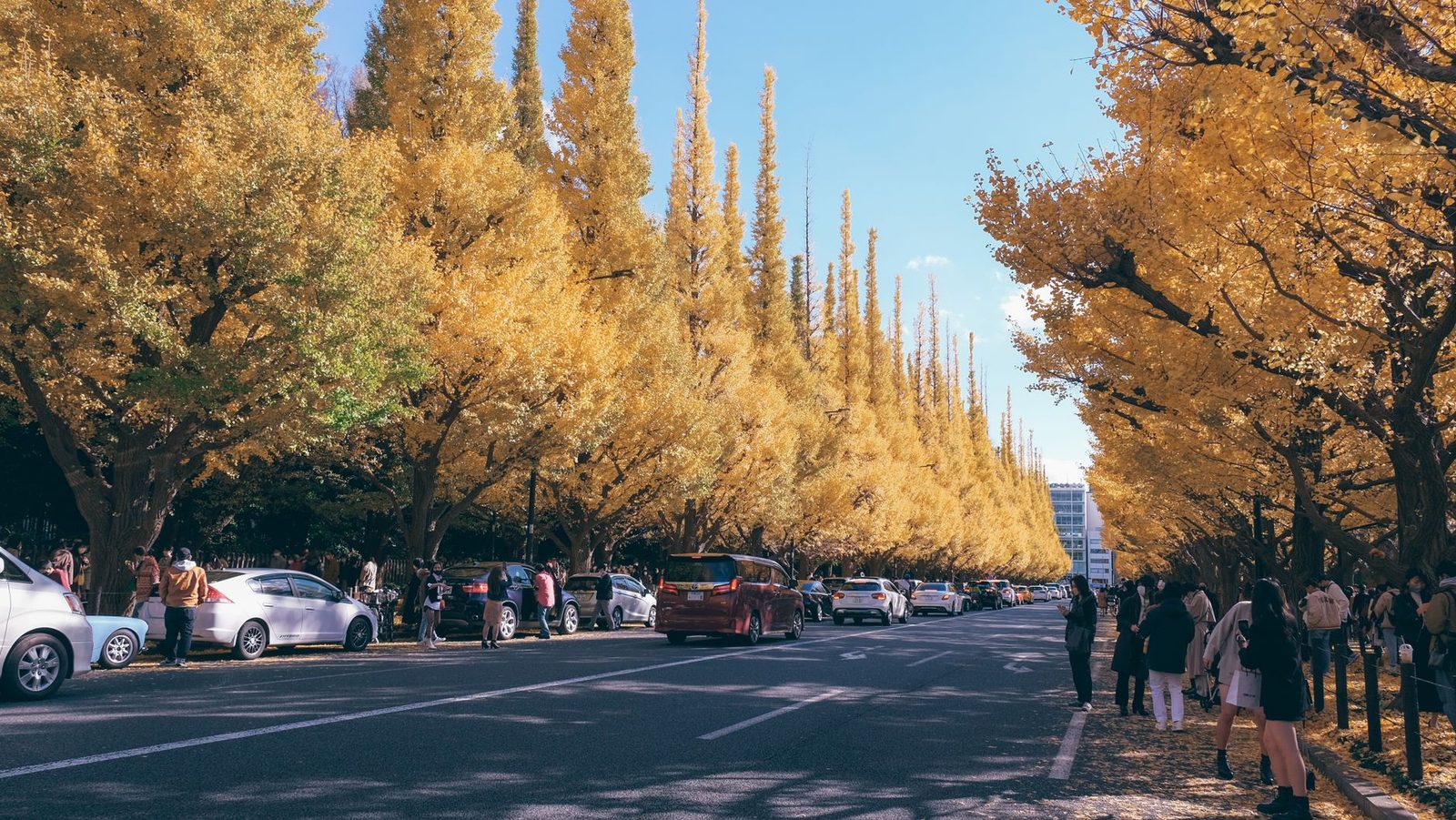
The ginkgo avenue in Aoyama (near Gaiemmae Station) has approximately 150 ginkgo trees planted in straight rows on both sides of the road, creating a “golden tunnel” toward the end of November. It is practically the defining image of autumn in Tokyo. Around this time, the area often hosts a ginkgo festival with food stalls and becomes extremely crowded on weekends — for photos with fewer people, arrive before about 8 a.m. The ginkgo is usually at its most golden from late November to early December, and the “golden carpet” that appears as the leaves begin to fall is just as beautiful as the trees in full leaf.
4. Shinjuku Gyoen — three types of garden with one admission ticket
This vast park next to Shinjuku Station combines Japanese, English, and French-style gardens. Its greatest strength is its variety: ginkgo, maple, and even rows of yellow-brown suzukake trees, which means the foliage season lasts a long time — from mid-November to mid-December, there is always a beautiful corner to find. Admission costs a few hundred yen, and the park usually closes on Mondays (so check in advance). It is ideal for a light picnic or for visiting with older travelers because the paths are flat and there are plenty of benches.
5. Showa Kinen Park — a ginkgo paradise in Tachikawa
Administratively, this is still part of Tokyo, around 30 minutes by Chuo Line train from Shinjuku (Tachikawa or Nishi-Tachikawa Station). This enormous national park is famous for two ginkgo avenues: one along a water channel and another running in a perfectly straight line near the plaza — both create some of the most spectacular golden canopies in the Tokyo area. There is also a Japanese garden with momiji, and renting a bicycle is a convenient way to explore the park. Plan to spend at least half a day here, especially if you are traveling with children, since the park has a large play area.
6. Yoyogi Park — free and relaxed autumn viewing
Next to Harajuku, with free admission. The ginkgo grove in one corner of the park turns brilliantly yellow toward the end of November. The atmosphere is much more down-to-earth than that of the historic gardens: people picnic, play music, and walk their dogs. It is easy to combine with a Harajuku–Shibuya shopping itinerary, and it is a good choice when you want to see autumn leaves without waiting in line for a ticket.
7. Ueno Park — golden leaves plus museums
The ginkgo trees and larger trees along the park’s main paths become especially beautiful from mid- to late November. Ueno’s appeal is the combination of activities: after viewing the leaves, you can visit the Tokyo National Museum, the zoo, or browse Ameyoko Market for snacks. An afternoon here passes quickly. From this area, you can also walk to nearby Yanaka, a historic neighborhood whose old-Tokyo atmosphere surprisingly suits the autumn season.
8. The University of Tokyo (Hongo Campus) — ginkgo trees on a century-old campus
Few tourists know about this spot: the University of Tokyo’s Hongo Campus has old ginkgo-lined paths leading to Yasuda Auditorium, with classic red-brick architecture that looks fantastic in photos. Ginkgo is traditionally associated with the university. Visitors can enter freely through the public access routes, but remember that this is an active campus — keep your voice down and be considerate. Entry rules may change, so check the university’s notices before visiting. It is near Hongo-sanchome Station and can be combined with Koishikawa Korakuen for a half-day outing.
9. Kyu-Furukawa Gardens — autumn roses beside a momiji garden
An interesting “two-in-one” destination in the Komagome–Nishigahara area: a Western-style stone mansion with a rose garden that blooms again in autumn (usually from October to early November), alongside a Japanese garden with a pond and momiji that peak later (late November to early December). Located within walking distance of Rikugien, the “Rikugien + Kyu-Furukawa” route is an excellent half-day combination for garden lovers.
10. Mount Takao — high-altitude autumn leaves, still within Tokyo
If you want a little “light hiking,” Takao-san on the western edge of Tokyo is the classic choice: about 50 minutes by Keio Line train from Shinjuku, with a cable car that takes you partway up the mountain. On clear days, the summit offers views of Mount Fuji. Because it is higher than central Tokyo, the leaves change earlier here — usually from around mid- to late November — making it suitable for travelers who arrive in Tokyo slightly before the city’s peak foliage. An honest warning: on weekends during the autumn leaf season, Takao becomes incredibly crowded and the cable car line can be very long; go on a weekday and start early if possible.
Suggested routes to avoid crisscrossing the city
- Northern historic garden route (1 day): Rikugien (morning) → Kyu-Furukawa (noon) → Koishikawa Korakuen (afternoon) → return in the evening if Rikugien has a light-up.
- Central Tokyo route (1 day): Meiji Jingu Gaien early in the morning → coffee in Omotesando → Yoyogi → Shinjuku Gyoen in the afternoon (remember that the garden usually closes fairly early, around the end of the afternoon).
- Western Tokyo route (1 day): Showa Kinen Park from the morning through early afternoon → return to Kichijoji and visit Inokashira Park at sunset.
- “Change of scenery” day: Mount Takao or a day trip to Nikko, depending on which month you visit.
A few hard-earned tips
Don’t pack everything into the weekend. The difference in crowd levels between Saturday and Tuesday at Jingu Gaien or Rikugien is enormous. If your schedule allows, save foliage spots for weekdays and go shopping on the weekend.
Early mornings are your secret weapon. The slanting morning light makes golden leaves “burn” brightly in photos, and you can get empty frames that are impossible to find again after 10 a.m.
Follow koyo forecasts the way you follow weather forecasts. Japanese autumn foliage websites update their predictions weekly for individual locations. The best plan is one that leaves 1–2 flexible days so you can “chase” the leaves.
Public gardens close earlier than you think. Many gardens stop admitting visitors around the end of the afternoon, except during special evening openings. Don’t save a garden for “the romantic end of the day” only to end up frustrated outside its locked gates.
Bring a bottle of hot tea from a konbini. It may sound minor, but strolling through a garden in 10-degree weather with a warm bottle of hojicha in your hand is one of the quintessential pleasures of autumn in Japan, and I want you to try it.
What should you read next in the Tokyo autumn series?
This article is an overview; each piece of the puzzle has its own in-depth OlaChill article: Rikugien light-up and how to visit, the Jingu Gaien ginkgo avenue and the food festival around it, a full day at Showa Kinen Park, autumn day trips from Tokyo (Nikko, Hakone, and Kamakura), seasonal specialties from roasted sweet potatoes to Pacific saury, sample itineraries by trip length, and autumn foliage photography tips. Whatever you need, jump to that article — but if you are just starting to plan, remember one sentence: from late November to early December, Tokyo is at its most beautiful time of year.
Frequently asked questions
When is the best time to see autumn leaves in Tokyo?
Late November through the first 10 days of December is the peak period for both ginkgo and momiji in central Tokyo. The timing shifts slightly each year depending on the weather, so check koyo forecasts close to your trip and finalize the schedule for each location.
Can I see red leaves in Tokyo in October?
In central Tokyo, almost certainly not yet. To see red leaves in October, take a day trip to a mountain area such as Nikko (around Lake Chuzenji), where the leaves mature a month earlier than in Tokyo.
Do I need to buy admission tickets for the gardens?
Historic gardens such as Rikugien, Koishikawa Korakuen, Kyu-Furukawa, and Shinjuku Gyoen charge admission, usually only a few hundred yen per person. Yoyogi, Ueno, and the Jingu Gaien area are free. Check prices and opening hours on the official websites before visiting.
What should I wear in late November?
Dress in layers: a thin thermal layer, a sweater, and a medium-weight coat, along with a scarf. The sun can make the daytime warm enough to remove a layer, but temperatures can quickly fall below 10 degrees in the evening, especially when you are standing outside for a light-up.
Is Tokyo or Kyoto better in autumn?
If you love historic temples and shrines and do not mind crowds, Kyoto is an irreplaceable experience. If you want convenience and flexibility, love golden ginkgo avenues, and hate waiting in line, Tokyo is much more comfortable. If you have 7–10 days in late November, visiting both in the order of Kyoto first and Tokyo afterward is ideal.
Is the Rikugien light-up held every year?
Not necessarily — the format and schedule for evening illuminations change from year to year, and advance tickets may be required. Before your trip, check the notices on the official website of the Tokyo Metropolitan Park Association.
More from this region — Tokyo & Kanto
View all →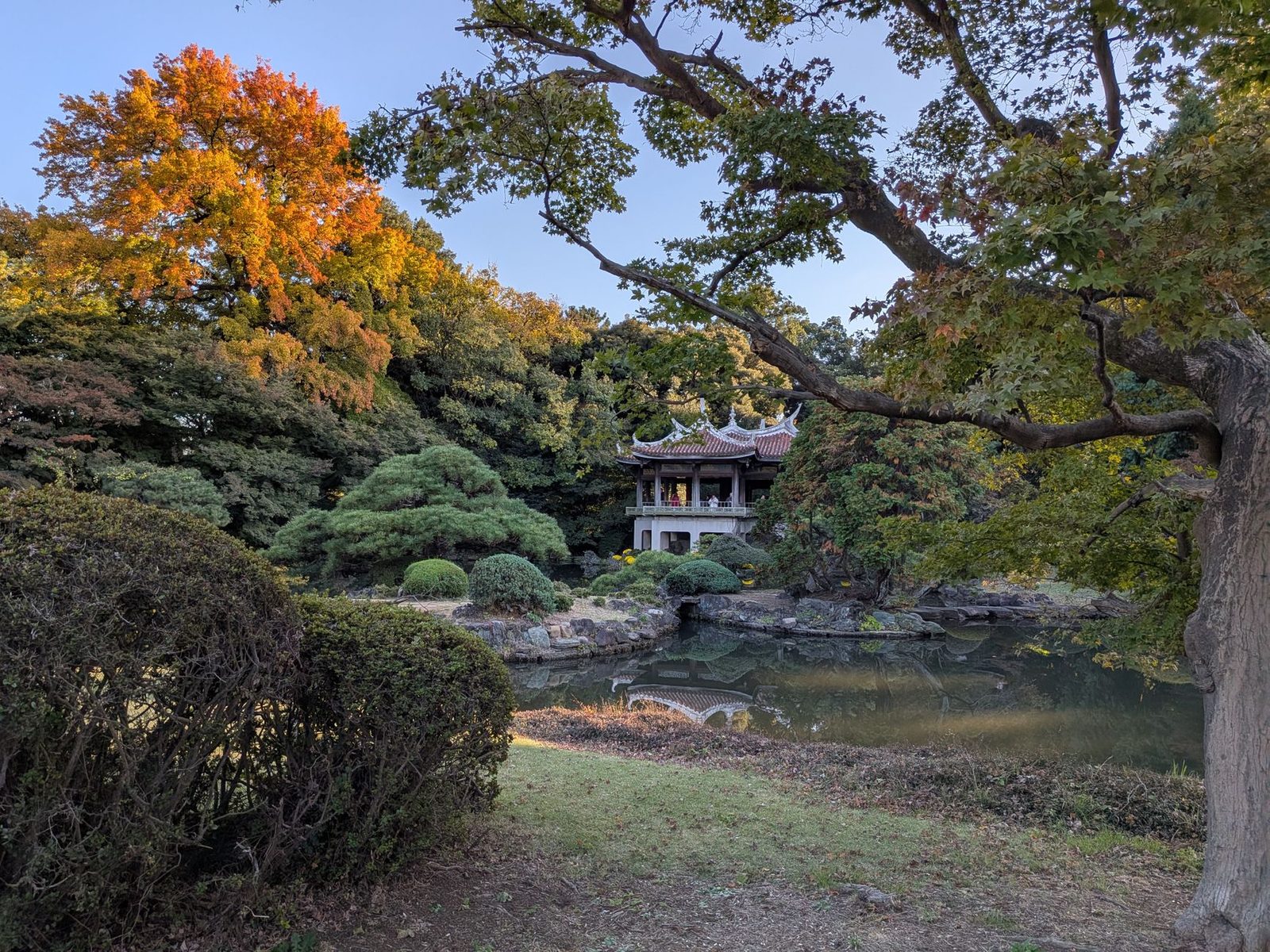
Chasing Tokyo’s Autumn Colors: Choosing Train Passes and Garden Tickets Wisely
15 min · tips
Tokyo in Fall: 10 Photo Spots and Golden-Hour Times
16 min · tips
A Golden Autumn Day in Tokyo: Early-Morning Rikugien, Slanting Sun on the Ginkgo Trees, and Nighttime Light-Up
17 min · tips

See Tokyo’s Autumn Leaves Without the Crowds: Avoid Peak Weeks and Budget for a Full Day
18 min · tips