

Setagaya: “Little Kyoto” in Tokyo and How to Escape into Autumn Without Leaving the City
Setagaya in autumn: a quiet residential neighborhood one stop from Shimokitazawa, streets covered in maple leaves, and weekend markets in architect-designed housing complexes — how to get there and practical tips.
Aug 12, 2026·✍️ olablog·⏱ 18 min read
Setagaya in autumn: a quiet residential neighborhood one stop from Shimokitazawa, streets covered in maple leaves, and weekend markets in architect-designed housing complexes — how to get there and practical tips.
Tap a region to browse articles
There is a kind of Tokyo afternoon that almost no one sells tickets for: less than ten minutes after the train leaves Shibuya, the doors open at a tiny station with only two exits, and the noise disappears as soon as you step off. No LED screens, no advertising announcements, no crowds dragging suitcases. Just a small hill, low fences, a few potted plants tucked against house walls, and a layer of red maple leaves covering the asphalt before anyone has had a chance to sweep them up.
That is Setagaya in late November.
People often call this corner “Little Kyoto in Tokyo.” The comparison is both accurate and slightly overdone, and the interesting part is understanding where it falls short. This article is for anyone who has already visited Tokyo once or twice, found Asakusa too crowded and Shinjuku too exhausting, and wants to slow down for an autumn day without having to take the shinkansen anywhere.
Where Setagaya Is, and Why It Feels Different from the Rest of Tokyo
Setagaya is one of Tokyo’s 23 special wards, located in the southwest and bordering the Tama River. It is Tokyo’s most populous ward — about 900,000 people, meaning it alone has roughly the population of a small province in Vietnam. But being densely populated does not mean feeling crowded in the way Shibuya does. Setagaya has almost no office skyscrapers, no major nightlife district, and no enormous shopping malls. It is a residential ward: low-rise houses, narrow alleys interwoven like a spider’s web, elementary schools, supermarkets, laundromats, and dental clinics on the second floor.
This creates a very different rhythm of life. In central Tokyo, people walk quickly because they are on their way somewhere. In Setagaya, people walk slowly because they are already home. On a weekday afternoon, you will see mothers riding electric bicycles with two children seated in front and behind, an elderly man walking his dog twice around the same block, and middle school students fiddling with their phones as they walk. No one is in a hurry. That unhurried atmosphere, combined with the autumn leaves, is what makes people think of Kyoto.
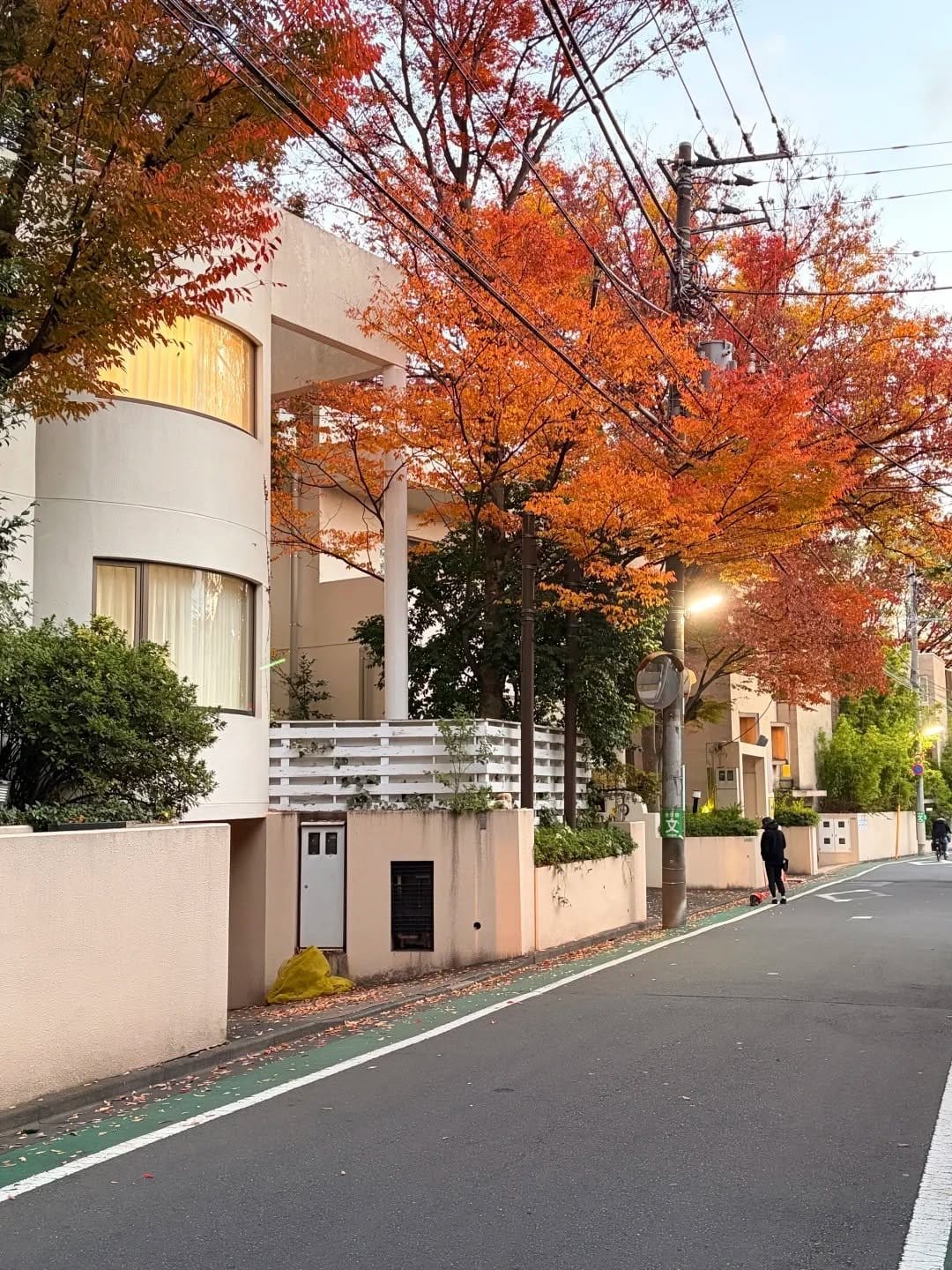
“Little Kyoto” — Right About Half of It
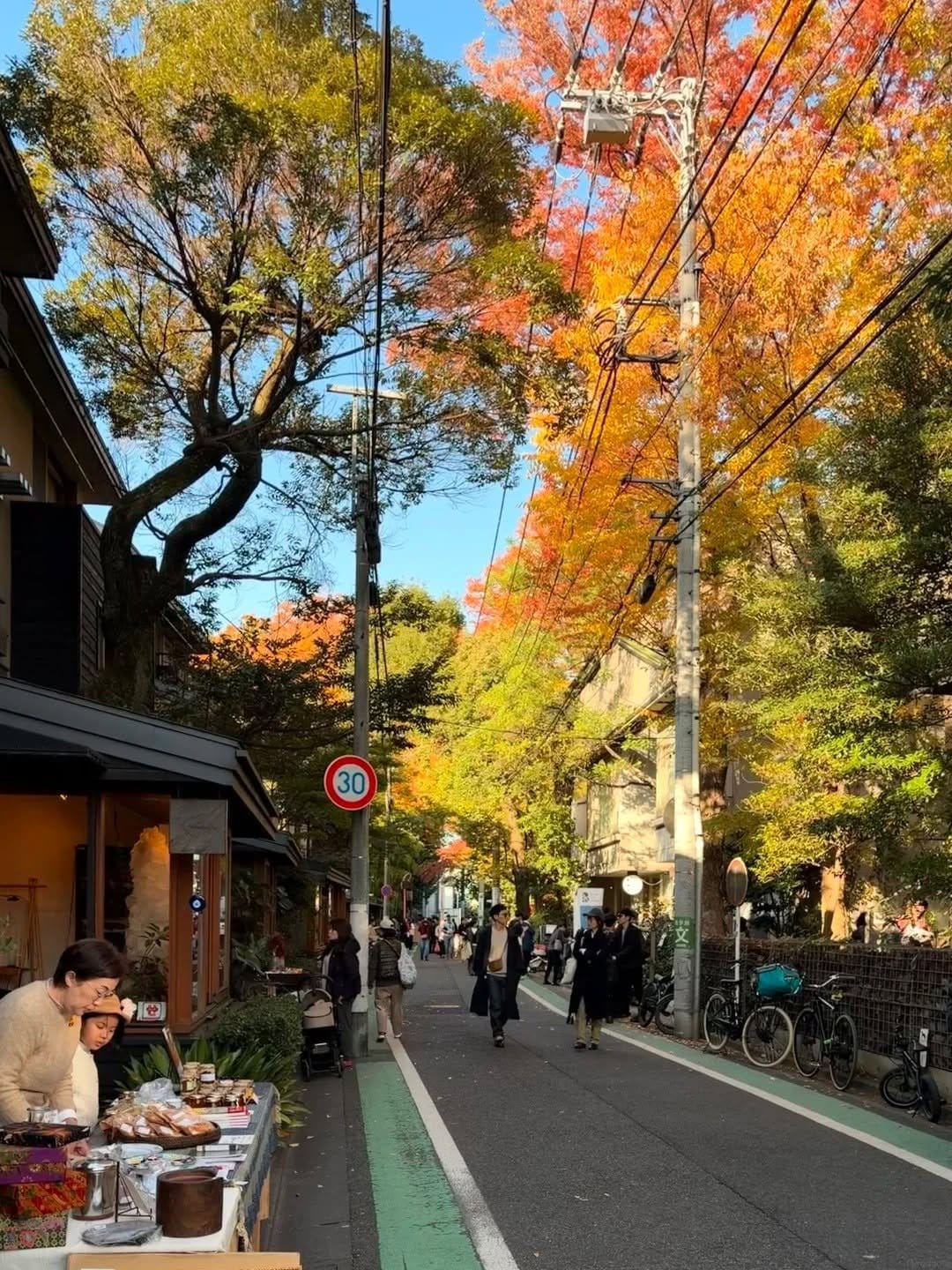
What resembles Kyoto here is the scale: low houses, narrow streets, wooden or waist-high concrete fences, and trees planted close to the buildings so their canopies spill over the sidewalks. When the maples turn red, the leaves do not remain neatly inside a temple or shrine compound. They fall directly onto manhole covers, onto the seats of bicycles parked outside homes, and into the plant pots belonging to someone’s grandmother. The autumn sunlight in Tokyo sits low and takes on a golden hue, cutting across the alleys, and during the thirty minutes before sunset, the area really does have the stillness of a lane in Higashiyama.
What does not resemble Kyoto — and this is the part worth coming for — is the architecture. For several decades, Setagaya has been a playground for Japan’s young architects. Land is moderately expensive, homeowners are willing to experiment, and plots are often small and irregular, forcing people to be creative. Within a ten-minute walk, you might see a raw-concrete house with almost no windows on its façade, another clad in silver corrugated metal, and a third with a roof cut at an angle to comply with height and daylight regulations, creating a strangely skewed trapezoid. None of these houses is historic. They are modern, minimalist, and sharply defined — and next to a blazing red maple, they create a contrast Kyoto does not have: the stillness of an ancient capital with the geometry of contemporary Tokyo.
To be frank: if you come expecting temples with curved roofs, koi ponds, and red torii gates, you will be disappointed. This is not a budget version of Kyoto. It is something else, and you need to look at it differently.
Getting There: Shindaita Station, Exactly One Stop from Shimokitazawa
The starting point I recommend is Shindaita Station (新代田) on the Keio Inokashira Line.
From Shibuya, board the Inokashira Line near Mark City and take a train toward Kichijoji. The stations come in this order: Shibuya – Shinsen – Komaba-Todaimae – Ikenoue – Shimokitazawa – Shindaita. The journey takes about 7–8 minutes, and a single ticket costs just around 150 yên (the line is inexpensive because the distance is short). Tap a Suica or Pasmo card directly; there is no need to buy a paper ticket.
Here is an important warning, and a mistake many people make: the Inokashira Line’s express trains (kyuko) do NOT stop at Shindaita. They stop at Shimokitazawa and then speed straight through. You need to board a local train — the type marked 各駅停車 (kakueki teisha), which stops at every station. If you accidentally get on an express, it is not a disaster: get off at Shimokitazawa and walk back for about 10–12 minutes. That walk is actually quite pleasant.
From the Shindaita Station exit, it takes only about 3 minutes on foot to reach the strip of land running alongside the former railway tracks — an area locals collectively call “Senrogai” (線路街, railway street). This is the most noteworthy part of the trip, and I will go into more detail in the next section.
A few logistical notes: Shindaita is a small station with very limited facilities. Do not plan on storing your suitcase here. If you are coming from the airport or changing hotels, leave your luggage at Shibuya or Shimokitazawa before continuing. You should also use the restroom at a larger station or in a café where you have bought something — convenience stores in Japanese residential neighborhoods often do not let passersby use their toilets.
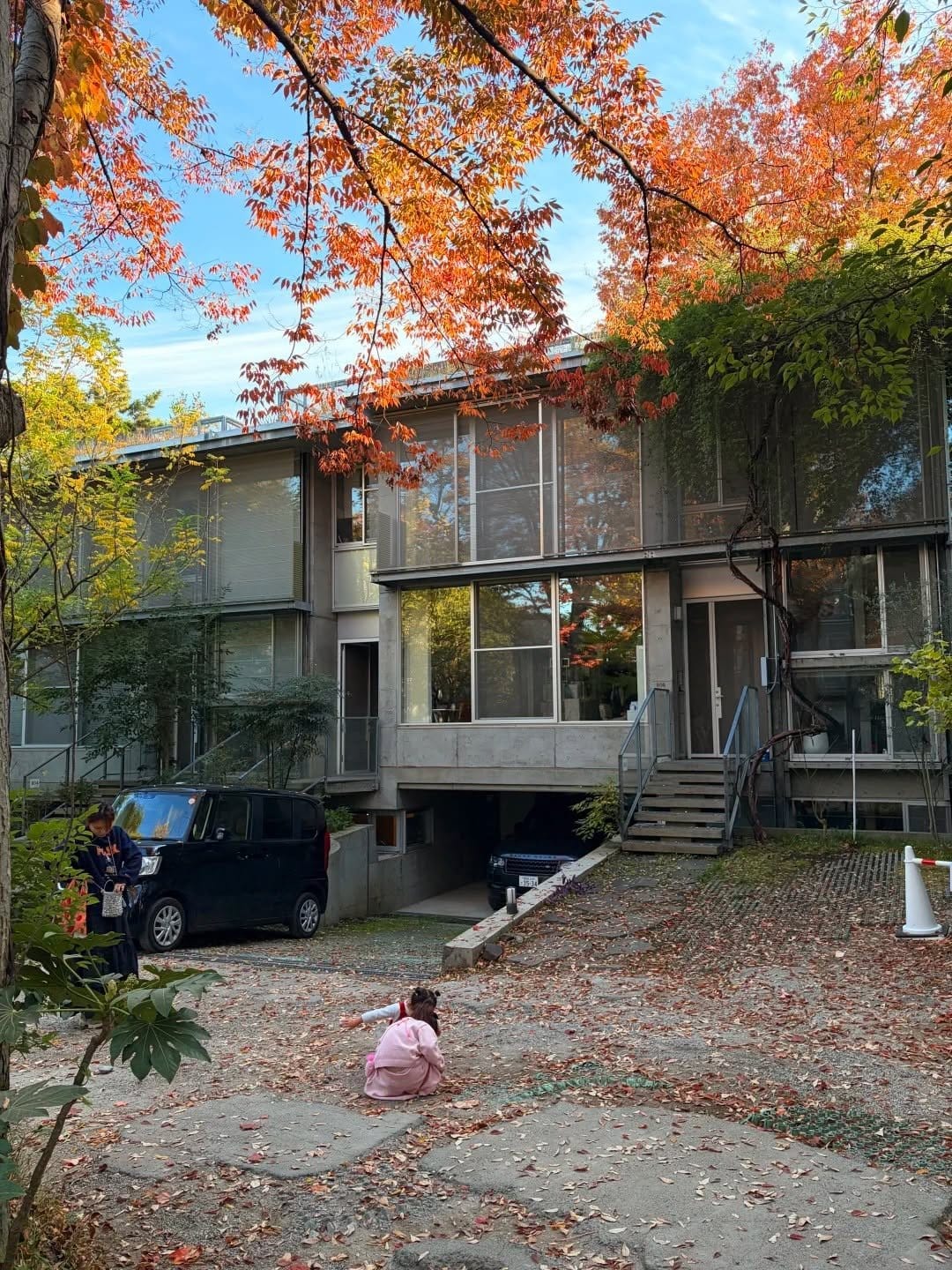
Architect-Designed Housing and the Weekend Market
This is the highlight of the entire outing.
When the railway line running through this area was moved underground, a long strip of land between Shimokitazawa and the neighboring stations became available. Instead of selling it outright to a corporation to build high-rise apartments, the land was divided into a series of low-rise structures: some for rental housing, some for shops, restaurants, and coworking spaces, with shared courtyards opening directly onto pedestrian paths in between. The entire development was designed by young architecture firms, following the idea the Japanese often describe as creating “a town people can stroll through.”
The result is a space that feels unusual to anyone familiar with Tokyo: tiny two-story roofs, white walls and unfinished wood, outdoor corridors, no massive glass façades, and no flashing signs. Shops occupy the ground floors, while residents live upstairs. In other words, you are walking among people’s homes, not through a shopping mall disguised as an old town.
On weekends, these shared courtyards become flea markets. They are not noisy night markets — they are closer to the European idea of a “marché”: a few dozen stalls set up on folding tables, selling organic vegetables, naturally leavened bread, specialty coffee, ceramics, dried goods, secondhand items, used books, and things that are difficult to categorize, such as soap made from used cooking oil. Most vendors are small independent producers who make and sell their own goods, and some live in the ward itself.
What makes the scene beautiful in autumn is how everything comes together: neutral-toned concrete and unfinished wood, courtyard trees turning red, people sitting on steps with paper cups of coffee, children running in circles, and leaves falling onto the vendors’ tables. Photos taken here look neither like Kyoto nor Shibuya. They are something distinct.
One important note: the market schedule changes from month to month and depending on the weather. Some weeks feature food stalls, some used-book markets, and some nothing at all; heavy rain can lead to cancellations. Before going, check the event calendar on the complex’s official website or Instagram — in Japan, event updates often appear on Instagram faster than on websites. Do not fly halfway around the world only to arrive on a quiet Wednesday morning and wonder where the market is.
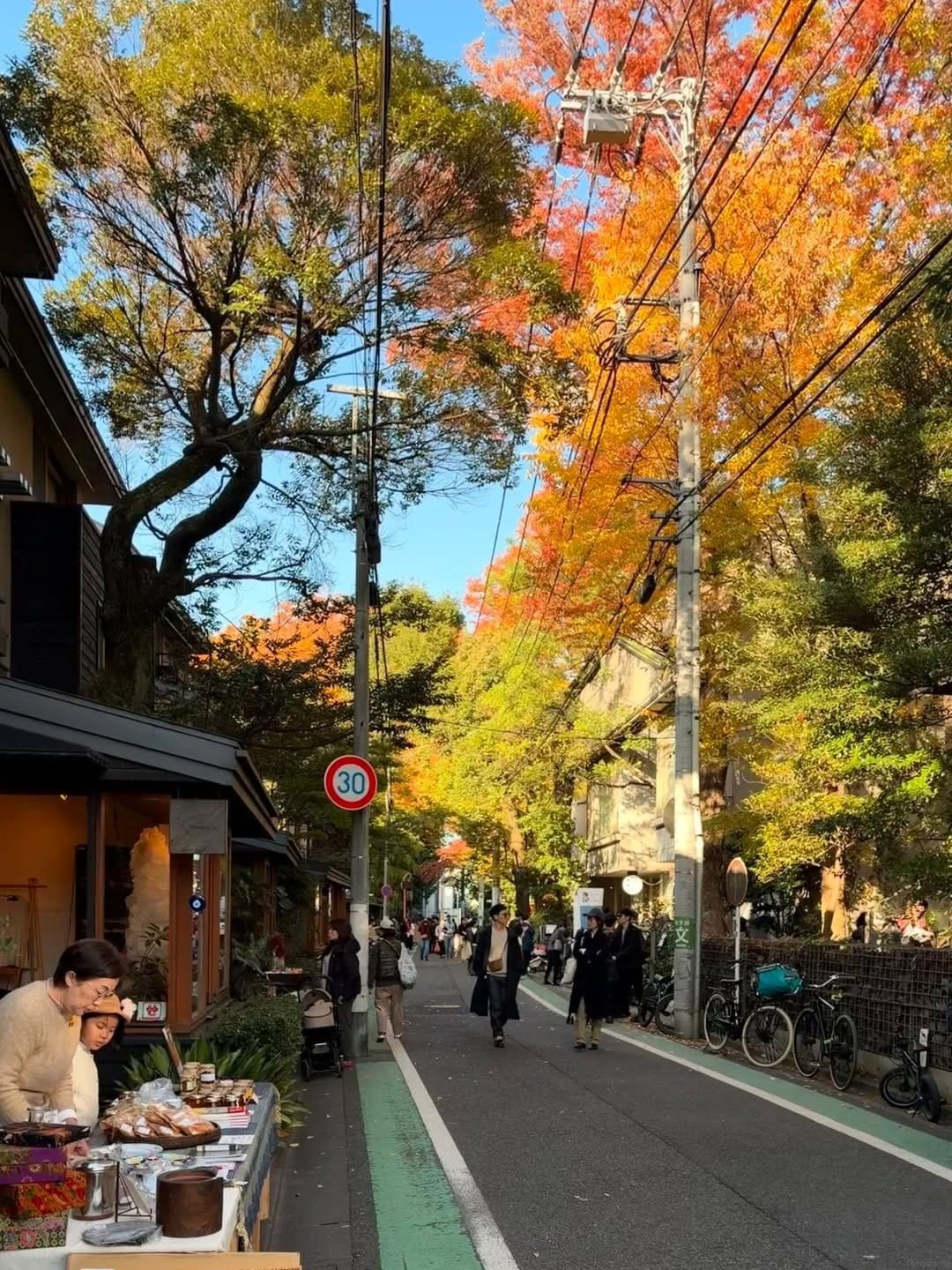
Tips for Enjoying the Market Properly
The best hours are 10 a.m. to noon. Most markets of this kind open around 10–11 a.m. and wrap up around 16–17, though some finish earlier. Arrive early and the selection will be better; arrive later and the best food may be gone, but the afternoon light will be beautiful and vendors will have more time to chat. If your priority is photography, I would choose around 14–15; if your priority is eating, go in the morning.
Bring cash in small denominations. This is where many Vietnamese visitors get caught out. Cashless payment is now extremely common in Tokyo, but weekend markets are an exception: small stalls run by a single vendor often have no POS terminal, and many accept only cash or domestic e-wallets, which can be difficult for visitors to register for. I recommend carrying about 5.000–10.000 yên in cash, including 1.000-yen notes and 100-yen coins. Withdrawing money from an ATM at 7-Eleven is the easiest option for foreign cards.
Bring a cloth bag. Japan has charged for plastic bags since 2020, and small stalls often do not provide them. A foldable bag tucked into your backpack will save you when you impulsively buy three loaves of bread and a jar of jam.
Do not haggle. Haggling is not part of Japanese market culture. Pay the marked price, even for secondhand goods. Trying to negotiate is considered rude, not clever.
Ask before photographing a stall. “Shashin, ii desu ka?” (May I take a photo?) accompanied by a gesture toward your camera is enough. Almost everyone agrees, and many vendors will even rearrange their displays to make them look better. But asking and not asking are two completely different things.
Do not eat while walking. At Japanese markets, people buy their food and then sit on a chair, a step, or in a shared seating area to eat. Walking and eating in a residential neighborhood is something locals almost never do.
When the Autumn Leaves Appear in Tokyo
This is the part where many people get their timing wrong.
Momiji (red maple leaves) move from north to south in Japan, and from higher elevations down to the plains. Hokkaido starts in late September. The mountain areas around Nikko, Kawaguchiko, and Hakone are usually at their best during November. But central Tokyo is significantly later because the city retains heat — the urban heat-island effect slows the change in foliage color.
In Tokyo, the most reliable period is late November through around the second week of December. In warm years, peak color can fall entirely in early December. Ginkgo leaves (ichou, yellow) usually reach their best color about a week before the momiji.
This has very practical consequences. If you schedule a Japan foliage trip for early November and spend most of your time in Tokyo, the city trees will probably still be green. Conversely, if you go in early December and assume you have missed the season, Tokyo may be looking its best. Before booking your tickets, check the autumn foliage forecast (kouyou yohou) published by Japanese weather websites from around September each year, then check again in mid-November.
A few weather figures to help you pack: in late November, Tokyo typically ranges from about 9–17 degrees, while early December falls to around 5–13 degrees. It can feel warm and pleasant in the sun, but the sun sets very early — around 16:30. That means the sky is already darkening at 16, and by 17 it is fully night. Anyone planning to take photos should make the most of the afternoon; do not sleep in and leave the hotel at 15. A light jacket with one extra layer is enough during the day, but bring a scarf for after sunset, because temperatures drop quickly.
One tip people rarely mention: go the day after rain. Wet leaves stick to the pavement in dark, rich patches, and the streets are quieter than usual.
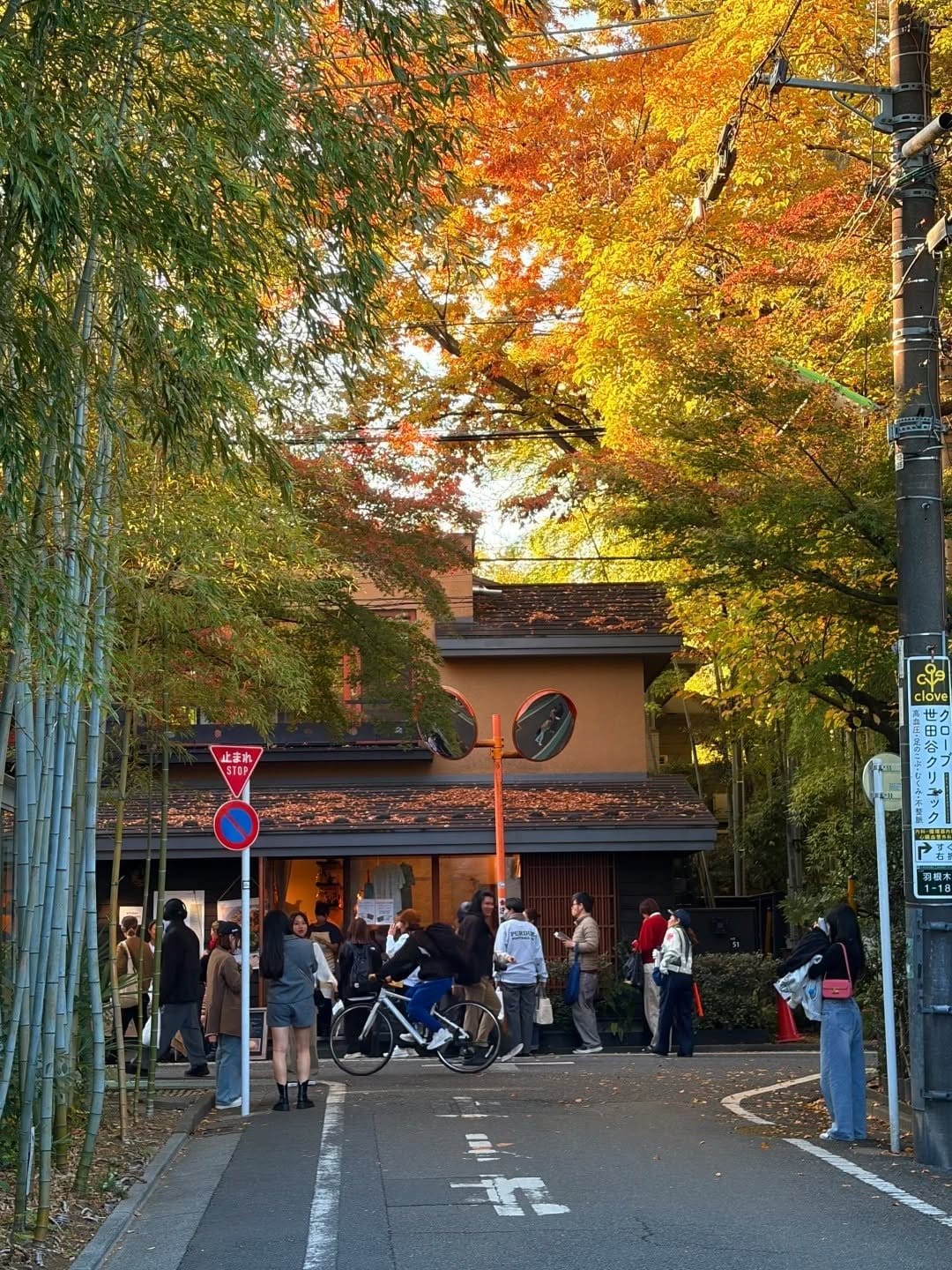
Other Places to See Autumn Leaves Around Setagaya
If you have made it this far, do not limit yourself to a single spot. Setagaya is large and has plenty of worthwhile places to visit, most of them free.
Todoroki Keikoku (Todoroki Valley) — Setagaya’s strongest contender for scenery. This is the only natural valley within Tokyo’s 23 wards, a roughly one-kilometer stream gorge with a walking trail beneath the tree canopy. The temperature in the valley is noticeably cooler than outside. At the end of the path is Todoroki Fudoson Temple and a teahouse overlooking the stream. Take the Tokyu Oimachi Line to Todoroki Station; the valley is just a few dozen meters from the station exit. Note: in recent years, some sections of the trail have occasionally been closed for inspections and the removal of trees at risk of falling, so check Setagaya Ward’s notices before you go.
Gotokuji Temple — famous worldwide for its thousands of beckoning cat statues (maneki-neko) arranged in rows on the steps. In autumn, Gotokuji also has brilliant yellow ginkgo trees and momiji around its three-story pagoda. Admission is free. Take the Odakyu Line to Gotokuji Station, or ride the Setagaya Line to Miyanosaka Station and walk for a few minutes. In the most literal sense, this is probably the most “Kyoto-like” place in the ward.
Kinuta Park (Kinuta Koen) — a large park with broad lawns, beautiful autumn foliage, and a distinctly Japanese family atmosphere: people spreading out picnic sheets, children playing soccer, and older residents exercising.
Komazawa Olympic Park — a legacy of the 1964 Tokyo Olympics, with its period concrete architecture still intact and rows of golden ginkgo trees along the running paths. A good choice for anyone who likes old-school modernist architecture.
Setagaya Line — a slow two-car tram running through residential neighborhoods, with a flat fare of around 170 yên per ride regardless of how far you travel. Riding it is an experience in itself: the tram runs close to people’s homes and stops at stations with only a single platform and a card reader.
If you visit in mid-December, there is one more special event: Setagaya Boroichi, a flea market with more than 400 years of history, held twice a year on December 15–16 and January 15–16. Hundreds of stalls line the streets, selling secondhand goods, farm produce, and snacks. It is unbelievably crowded and sometimes impossible to move through, but it is the kind of “crowded and festive” that is fun rather than exhausting. Check the ward’s website for the exact schedule and the arrangements for each year.
Combine It with Shimokitazawa for a Full Day
Shindaita is exactly one stop from Shimokitazawa, and the two places complement each other very well.
Shimokitazawa is a neighborhood for young people: secondhand clothing, specialty coffee shops, small theater venues, recording studios, and curry restaurants. It is livelier than purely residential Setagaya but still compact and pleasant, without the sea of people you find in Shibuya. The area is so well known for curry that it even has its own annual curry event, and I recommend having lunch here rather than trying to find a restaurant in the housing complex — the residential area around Shindaita has very few places to eat, and the ones that do exist are small and often full.
Here is the one-day itinerary I usually follow:
- 9:30: Take a local Inokashira Line train from Shibuya and get off at Shindaita.
- 10:00–12:00: Walk around the residential area near the station, then visit the weekend market. Have a light meal from something bought there.
- 12:30: Walk along the former railway corridor to Shimokitazawa (about 10–15 minutes, flat and easy, with benches along the way).
- 13:00: Have curry or noodles in Shimokitazawa, then get coffee at a place with a window table.
- 14:30–16:00: Wander through Shimokitazawa’s alleys, secondhand shops, and vinyl record stores.
- 16:00: Return to the residential area to photograph the late-day light, or take the train to Gotokuji if you still have energy.
- 17:30: Return to Shibuya or Shinjuku for dinner.
If you have two days, set aside Todoroki Keikoku for a separate half-day. Walking through the valley and visiting Todoroki Fudoson takes at least two hours, not including travel time.
Etiquette: People Actually Live Here
I want to emphasize this section because it matters more than any photography tip above.
The beautiful alley you just saw on Instagram is not a tourist attraction. There is no ticket, no security guard, no public restroom, and no one being paid to put up with visitors. It is the way home for someone’s family. In recent years, several residential neighborhoods in Japan have had to put up barriers, post photography bans, and even block beautiful views entirely because of visitors behaving badly. Do not help make that happen here.
Some specific guidelines:
Do not point your camera at windows, balconies, hanging laundry, or house nameplates (hyosatsu). A nameplate displays the homeowner’s family name — posting it online exposes someone’s personal information. The same goes for license plates.
Do not use a tripod on residential streets. The alleys in Setagaya are about 3–4 meters wide, and delivery vehicles and bicycles carrying children pass through constantly. A tripod blocking the middle of an alley is genuinely blocking traffic, not a minor inconvenience.
Do not step into a home’s yard, front steps, or planted area, even if the gate is open and there is no fence. In Japan, the boundary may be marked by nothing more than a differently colored paving stone, but it is still a boundary.
Keep your voice down, especially in the morning and after 20:00. Japanese homes are less soundproof than you might think. A group of four or five people speaking at a normal outdoor volume in an alley is already loud for the people inside.
Avoid the hours from 7:30 to 9 a.m. That is when adults commute to work, children go to school, and the narrow streets fill with bicycles. Standing in the middle of the morning rush to take photos is an unnecessary nuisance. After 10 a.m., the area becomes much quieter.
Do not pick up, rearrange, or stage fallen leaves in front of someone’s home. It may sound funny, but this really happens: many people sweep their leaves every morning, and raking them back into a pile to make things look “natural” undoes their work.
Take your trash with you. Setagaya has almost no public trash cans. Put plastic bags in your backpack and dispose of them at the station or your hotel. Also, do not leave coffee cups on fences or the steps of residential homes.
Do not fly a drone. Residential areas in central Tokyo fall within restricted flight zones, and even with a permit, it is not advisable.
In short: behave like a guest invited into someone’s home, not like someone who bought a ticket to a theme park.
Who Should Go and Who Shouldn’t
You should go if you: have visited Tokyo at least once and want something different; enjoy architecture, coffee, and handmade goods; are traveling with older adults or young children and want an easy, low-effort day; or simply want an afternoon without crowds.
You should not go if you: have only three days in Tokyo and have not yet visited Asakusa, Meiji Jingu, or Toyosu; are expecting a “wow” view like Kinkakuji; or are visiting in the middle of the week with the market as your main goal — the market is held only on weekends, and not every weekend has one.
And one final honest note: this is a place whose beauty only reveals itself when you slow down. If you get off the train, walk around for ten minutes, see nothing that seems “worth photographing,” and leave, then there really is not much to see. The charm of Setagaya in autumn lies in sitting on a step with a cup of coffee, watching leaves fall onto a manhole cover, hearing a bicycle bell at the end of the alley, and realizing that you are in the middle of one of the biggest cities in the world without being able to hear it. That feeling cannot be captured in a photo. But it is the reason to come.
Before setting out, remember to check three things on the official websites: the weekend market schedule, the opening status of the Todoroki Keikoku trail, and that year’s updated autumn foliage forecast. All three change every year, and nothing is more frustrating than going to the right place one week too early or too late.
More from this region — Kyoto, Nara & Kansai
View all →
Solo Kyoto in 2 Days — A Quiet Itinerary for Independent Travelers
6 min · tips
Visiting Sake Breweries in Japan: Fushimi, Nada, and the Magic of the Winter Brewing Season
6 min · food
Kimono Rental in Kyoto: A Complete A-to-Z Guide for First-Time Visitors
7 min · culture
Tokyo to Kyoto by Charter Bus: Route Time, Stops and When It Makes Sense
9 min · tips