
Kimono in Saga: Where to Wear It, Best Photo Spots and How to Plan the Day
Kimono in Saga: Yutoku Inari's vermilion stage, Arita's porcelain torii, Karatsu Castle by the pines, and the yukata onsen towns of Ureshino and Takeo, with a day plan.
Sep 14, 2026·✍️ olablog·⏱ 8 min read
Kimono in Saga: Yutoku Inari's vermilion stage, Arita's porcelain torii, Karatsu Castle by the pines, and the yukata onsen towns of Ureshino and Takeo, with a day plan.
Tap a region to browse articles
Saga is the prefecture people cross between Fukuoka and Nagasaki without stopping, and the people who do stop tend to come back. It has one of the three great Inari shrines, built on stilts up a hillside; the town that made Japan's first porcelain and still fires it; a castle on a headland framed by a five-kilometre pine grove; and two hot-spring towns that treat a yukata as the correct outfit for an evening walk. For kimono, it is uncrowded, flat in the right places, and photogenic in colours other than Kyoto's.
Yutoku Inari: the stage on the hill
Yutoku Inari Shrine (祐徳稲荷神社) in Kashima is counted with Fushimi Inari and Kasama among the three great Inari shrines. The main hall is a vermilion structure raised eighteen metres above the valley on wooden pillars, like Kiyomizu-dera in Kyoto, and the approach crosses a bridge over a stream lined with lanterns. Behind the hall, a path of red torii climbs to the inner shrine with a view over the Ariake Sea plain. It is the most dramatic kimono backdrop in Saga and visitor numbers are a fraction of Fushimi's. The approach street sells fried tofu and yokan sweets.
Arita and Imari: porcelain towns
Arita (有田) is where Korean potters discovered kaolin in the early 1600s and made the first Japanese porcelain. The old town along the main street is a preservation district of merchant houses and kiln chimneys, with the Tozan Shrine (陶山神社) whose torii, lanterns and guardian dogs are all made of blue-and-white porcelain. Photograph a kimono in front of a porcelain torii and you have a picture nobody will recognise, in the best way. Okawachiyama (大川内山) near Imari is the "village of secret kilns" where the Nabeshima lords made their finest ware behind guarded gates; the lane of kilns up the narrow valley is steep at the end but the lower part is easy.
Karatsu: castle, pines, festival
Karatsu Castle (唐津城) stands on a headland where the Matsuura River meets the sea, and from the keep the Nijinomatsubara (虹の松原) pine grove runs along the beach for five kilometres. The castle is a rebuild, but its position makes it one of the most photogenic in Kyushu, especially with wisteria in the grounds in late April. In early November the Karatsu Kunchi (唐津くんち) festival pulls fourteen giant lacquered floats, a lion, a sea bream, a samurai helmet, through the town; the pullers wear happi and the crowd wears whatever keeps them warm.
Ureshino and Takeo: the yukata towns
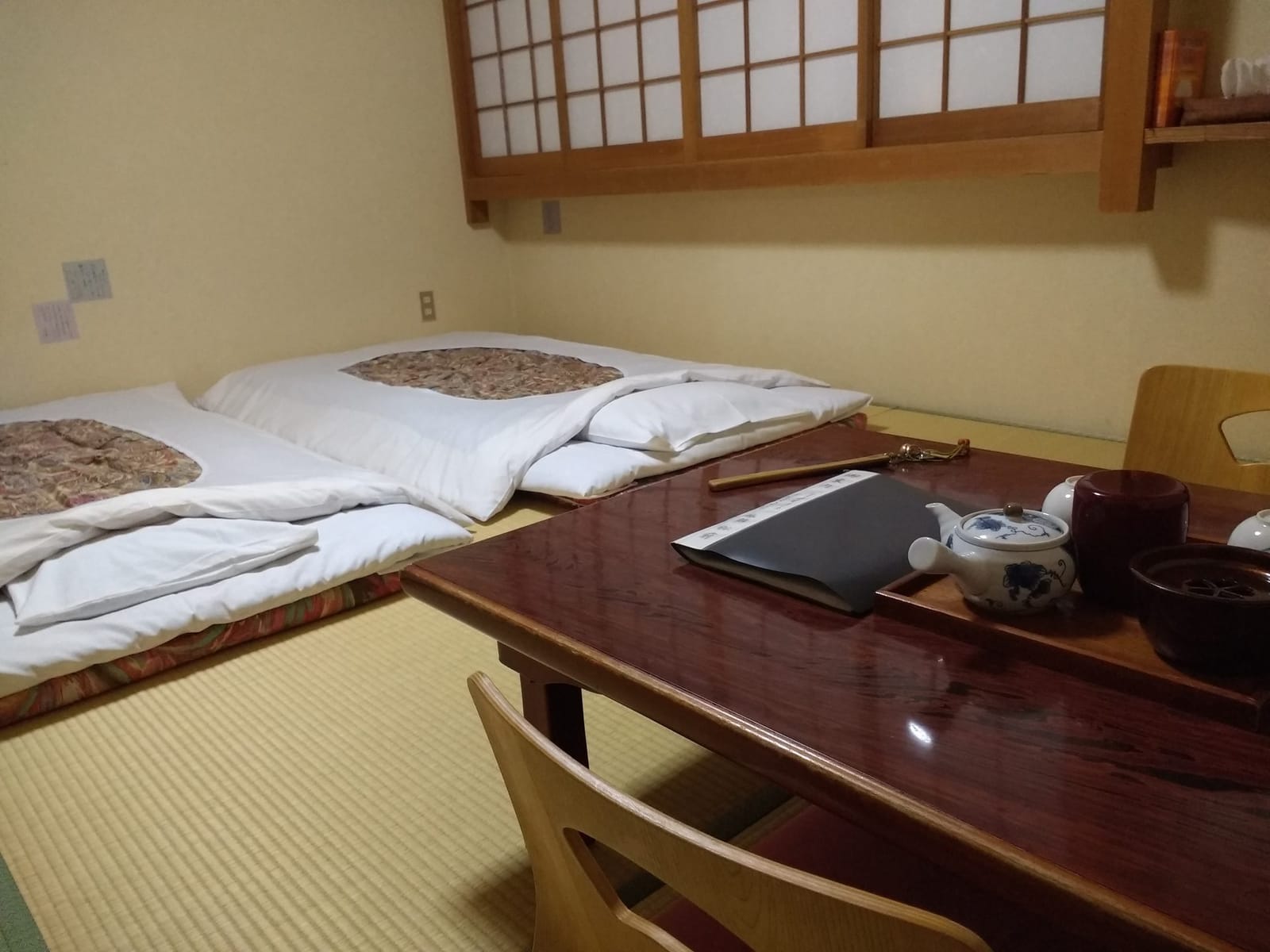
Ureshino Onsen (嬉野温泉) has soft alkaline water that leaves the skin smooth, hence its "beauty bath" reputation, and it is also a tea town; the local green tea is served everywhere and the hot water is used to make tofu that half dissolves. Takeo Onsen (武雄温泉) has a vermilion two-storey gate from 1915 and public baths behind it that lords once used. In both towns the inns hand you a yukata and the evening walk in it, between foot baths and the river, is the whole experience. This is the realistic kimono life of Saga, and it costs nothing extra.
Best kimono photo spots in Saga
| Spot | Best time | Access | Crowd level |
|---|---|---|---|
| Yutoku Inari main hall and torii path (祐徳稲荷神社) | Morning; azaleas in spring | Bus from JR Hizen-Kashima, 10 min | Low to moderate |
| Tozan Shrine porcelain torii, Arita (陶山神社) | Any time | 15 min walk from JR Arita | Very low |
| Arita old town main street | Morning; Golden Week ceramics fair is packed | JR Arita | Very low |
| Okawachiyama kiln village (大川内山) | Morning | Bus from JR Imari, 15 min | Very low |
| Karatsu Castle and the pine grove (唐津城) | Late afternoon; wisteria late April | 20 min walk from JR Karatsu | Low |
| Takeo Onsen gate (武雄温泉楼門) | Evening, lit | 10 min walk from JR Takeo-Onsen | Low |
| Ureshino river promenade in yukata | Evening | Bus from JR Takeo-Onsen or Ureshino-Onsen Station | Low |
| Mifuneyama Rakuen garden (御船山楽園) | Azaleas in April, foliage in November, both lit | Taxi from Takeo-Onsen | Moderate in season |
Mifuneyama Rakuen is a 19th-century lord's garden under a cliff, famous for its azalea slopes in spring and for a summer digital art show that turns the pond and trees into light. A kimono in the November illumination is one of Kyushu's best photographs.
Seasons
- Spring: azaleas at Mifuneyama and Yutoku in April, wisteria at Karatsu. The Arita ceramics fair over Golden Week is enormous and not a kimono event.
- Summer: hot; Ureshino and Takeo in yukata in the evening, and the Mifuneyama light show from July.
- Autumn: the Saga International Balloon Fiesta in early November fills the sky above the city, and Karatsu Kunchi follows. Foliage at Mifuneyama late in the month. Best kimono weather.
- Winter: cool and often clear; the porcelain towns are empty and the baths are the point.
Plan your kimono day in Saga
- Base at Takeo or Ureshino. Both have the Nishi Kyushu Shinkansen to Nagasaki and the Sasebo Line to Arita, and the inns are the reason to come.
- Morning: Arita. Twenty minutes by train. Tozan Shrine first, then the main street, then a kiln or gallery. Buy a cup; you will use it.
- Lunch in Arita. Several restaurants serve a set meal on a five-piece Arita porcelain set, which is the most photogenic lunch in the prefecture.
- Afternoon: Yutoku Inari or Karatsu. Yutoku is about 45 minutes by train and bus; Karatsu is further, so pick one. Yutoku for vermilion, Karatsu for sea and pines.
- Evening: back to the inn. Yukata, foot baths, the river or the gate. Early dinner in the inn.
- Day two: Okawachiyama in the morning, then on to Nagasaki by Shinkansen from Takeo-Onsen in under 30 minutes.
Where OlaChill fits in
OlaChill's kimono shops are in Tokyo Asakusa and Kyoto Kiyomizu; we do not have a shop in Saga.
Saga is far enough from both that carrying a rental kimono here with the next-day return option (¥1,100) does not make sense for most itineraries; Kyoto to Takeo is over four hours. Our advice is to wear the kimono where the dressing room is, at one of our shops with hair styling (¥1,500) and make-up (¥5,000) on hand and a 10 percent online discount on any of the 14 plans, and to treat Saga as yukata territory: inn yukata at Ureshino or Takeo, and a walk between the baths.
For a day that links Arita, Okawachiyama, Yutoku and Karatsu, which no single train line does, a private car with driver from Fukuoka or Takeo makes it a comfortable loop. We quote by route and hours.
FAQ
Is Yutoku Inari a hard climb in a kimono? The main hall is reached by stairs from the courtyard, about five minutes and manageable in zori. The torii path to the inner shrine is longer and steeper; go halfway for the view and the photograph.
Can I photograph inside the Arita kilns? Galleries and shops, yes. Working kilns vary; ask at the door. The Tozan Shrine and the main street are open air and free.
Are the onsen towns fine for walking in yukata at night? Yes, that is what everyone does. Ureshino's river path is lit, Takeo's gate is lit, and inns lend geta as well as the robe. Carry the inn's small towel and a phone; nothing else.
When is Karatsu Kunchi? 2 to 4 November every year, with the main float parade on the 3rd. The town fills up; book an inn in Karatsu months ahead, or day-trip from Fukuoka, which is about 80 minutes by train.
How do I get to Saga from Fukuoka? JR limited express from Hakata to Saga in about 40 minutes, to Takeo-Onsen in about 65. Arita is another 25 minutes on the Sasebo Line, Karatsu about 80 minutes on the subway-through-train from Tenjin.
Ready to plan it?
Saga is the quiet kimono prefecture: porcelain, vermilion and hot water. Wear the kimono in Kyoto or Tokyo at OlaChill Kiyomizu or OlaChill Asakusa, come to Saga for the yukata evenings, and use our 7-day Kyushu itinerary to stitch it together. Book your kimono online for the discount.
More from this region — Kyushu
View all →
Kurokawa Onsen Bath-Hopping Pass: 7 Open-Air Baths and Kumamoto Day Plans
15 min · destinations
Kyushu Travel Guide: The Land of Onsen, Volcanoes, and Famous Ramen
9 min · destinations
What to Eat in Miyazaki: Chicken Nanban, Jitokko Chicken and More
9 min · destinations
Obi: Kyushu’s Little Samurai Castle Town
8 min · destinations