
Kimono in Gunma: Where to Wear It, Best Photo Spots and How to Plan the Day
Kimono in Gunma: Kusatsu's steaming Yubatake, Ikaho's 365 stone steps, Tomioka Silk Mill and Haruna Shrine, onsen-town yukata culture and OlaChill options.
Sep 14, 2026·✍️ olablog·⏱ 7 min read
Kimono in Gunma: Kusatsu's steaming Yubatake, Ikaho's 365 stone steps, Tomioka Silk Mill and Haruna Shrine, onsen-town yukata culture and OlaChill options.
Gunma: where the yukata is streetwear
In most of Japan a yukata outside a festival draws a second look. In Gunma's hot-spring towns it draws none, because everyone else is wearing one too. Kusatsu and Ikaho are built around the evening stroll: bathe, put on the inn's yukata and haori, clatter down the street in geta, eat, soak again. If you have ever wanted to wear Japanese dress without feeling watched, this is the prefecture.
Gunma also has the mill that put Japanese silk on the world market, and the mountain shrine that looks like it grew out of the rock. Both are proper kimono backdrops.
The spots
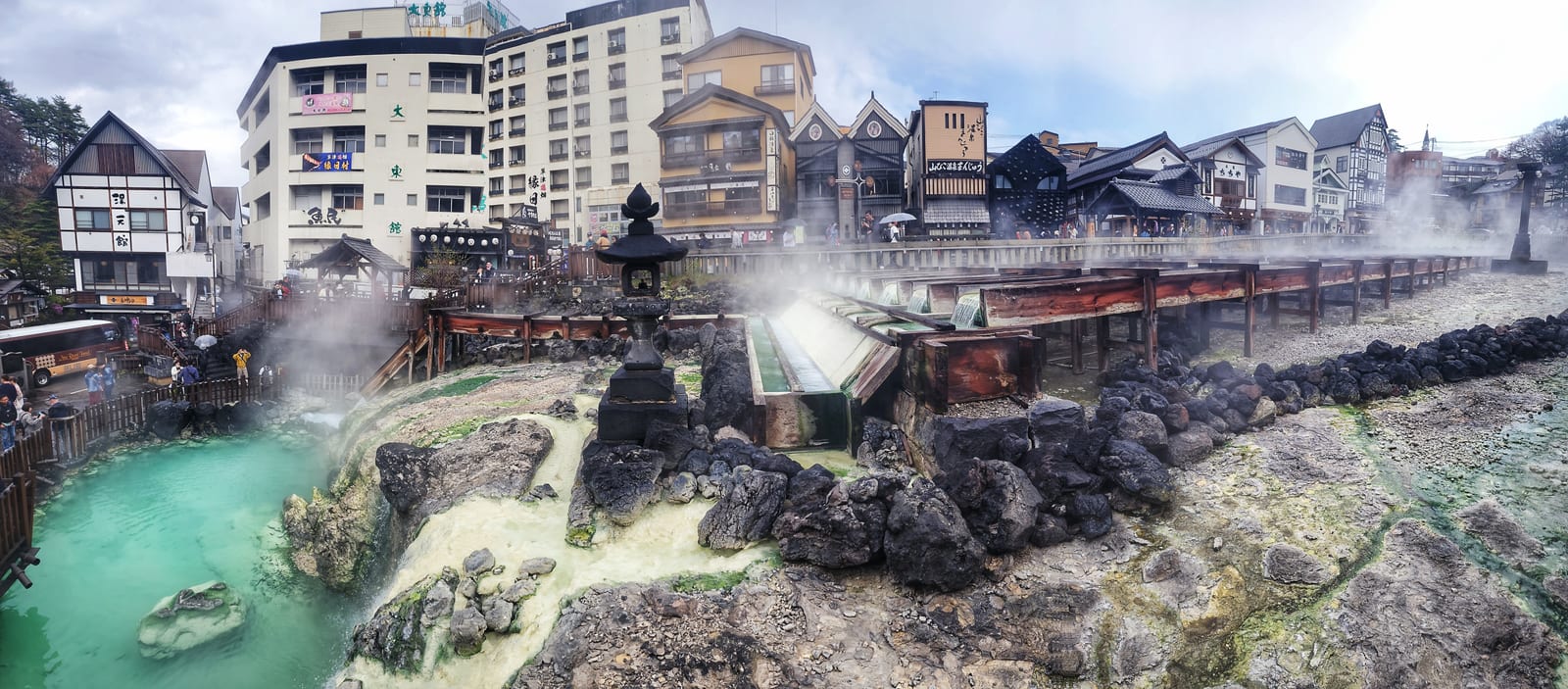
Kusatsu Onsen Yubatake (草津温泉 湯畑)
The "hot water field" in the middle of town is a steaming pool where 4,000 litres a minute of spring water pour through wooden channels. It is lit at night, ringed by inns and shops, and the whole square is a paved, level stage. Sainokawara Park, ten minutes up the hill, has a river of hot water running through rocks and a large open-air bath at the top. The Netsu-no-yu hall by the Yubatake stages yumomi, the water-cooling paddle dance, several times a day; the performers wear kimono and you can join a session.
Ikaho Onsen stone steps (伊香保温泉 石段街)
The town is a staircase: 365 stone steps from the bottom of the street to Ikaho Shrine at the top, with inns, game parlours and manju shops on both sides. Descending in geta is the tradition and it photographs beautifully at dusk under the lanterns. It is a real climb, though; do the up in shoes if your inn is at the top. Below the town, the vermilion Kajika Bridge sits in a maple gorge that turns red in early November.
Tomioka Silk Mill (富岡製糸場)
A World Heritage site, the 1872 mill has brick cocoon warehouses and a long reeling hall with French machinery. Silk is what the kimono is made of, so a silk kimono against the brick warehouses closes the circle. Paths are level; a 15-minute walk from Joshu-Tomioka Station.
Haruna Shrine (榛名神社)
Between Ikaho and Takasaki, a 700-metre approach climbs through cedars past waterfalls to a shrine wedged beneath a rock pinnacle. The path is stone steps and slopes, better in shoes with a change to zori at the top plaza.
Kiryu (桐生) textile town
Old weaving sheds with sawtooth roofs, and a Meiji main street. Kiryu wove obi for centuries and still does. Low crowds, flat streets, very local.
| Spot | Best time | Access | Crowd level |
|---|---|---|---|
| Kusatsu Yubatake | Evenings, year-round; winter steam is best | Limited express Ueno to Naganohara-Kusatsuguchi 2 h 30, then bus 25 min | High at dusk |
| Ikaho stone steps | Dusk; early Nov maples at Kajika Bridge | Train to Shibukawa, bus 25 min | Medium |
| Tomioka Silk Mill | Any season, weekdays | 15 min walk from Joshu-Tomioka Station | Low |
| Haruna Shrine | June green, Oct colour | Bus from Takasaki 70 min | Low |
| Kiryu | Any season | JR Ryomo Line | Very low |
Seasons and what to wear
Kusatsu sits at 1,200 metres and has snow from December to March; the Yubatake steam against snow is the classic image, and the inn's padded haori over a yukata is genuinely warm for the short walk. Spring is late, with cherry in early May. Summer is cool in the mountains and the Kusatsu Onsen Festival in early August brings yukata dancing to the square. Ikaho's maple gorge peaks in early November.
Where OlaChill fits in
OlaChill has no shop in Gunma. Our shops are Tokyo Asakusa and Kyoto Kiyomizu, open 09:00 to 18:00, and dressing and return happen only there. Kusatsu is about three hours from Tokyo by train and bus, so a same-day loop in our kimono does not work; Tomioka is closer at roughly 90 minutes via Takasaki, but a return by 18:00 would be a rush I would not sell you.
The sensible pattern:
- Kimono day in Tokyo, inn yukata in the onsen town. The inns dress you for the evening stroll; that is the outfit Kusatsu is designed for. Keep our Komongi (¥5,500, ¥4,950 online) or a Houmongi (¥12,000) for Asakusa.
- Next-day return, ¥1,100, to keep the kimono for a Tokyo evening and return before 10:00 the next morning.
- A chauffeured car for a long Kanto day without trains, quoted per trip; useful for a Tomioka and Haruna loop in kimono.
Read our Kusatsu Onsen guide for the town and baths, and the Karuizawa, Kusatsu and Yokokawa route if you are combining destinations.
Plan your kimono day
- Stay one night in Kusatsu or Ikaho. The dusk stroll is only for overnight guests.
- Check in by 15:00, bathe, then change into the inn's yukata and haori.
- Kusatsu: Yubatake at 17:30 as the lights come on, Sainokawara at 18:30, yumomi show if there is an evening slot.
- Ikaho: climb the steps in shoes in daylight, then descend in geta at dusk for the photo.
- Next morning: Tomioka Silk Mill or Haruna Shrine on the way back, in your own clothes or a rented kimono from a counter near Tomioka Station.
- Tokyo kimono day at Asakusa on either side of the trip.
A few local courtesies
At the Yubatake, the wooden channels are hot to the touch and the railings are for leaning only lightly; do not dip a hand or a sleeve. Inns expect their yukata back at check-out and their geta at the door. On Ikaho's steps, uphill traffic keeps right and shop staff will tell you if you drift. Tomioka's reeling hall is a museum: no touching the machines, and the brick floor is uneven near the doors, so take it slowly in zori.
FAQ
Are the 365 Ikaho steps walkable in geta? Down, yes, slowly, holding the rail on the steeper sections. Up is a workout; use shoes.
Can I wear a yukata to the Yubatake at night? It is what everyone wears. Add the inn's haori; Kusatsu evenings are cold even in summer.
Does OlaChill offer kimono rental at Kusatsu or Ikaho? No. Our two shops are Tokyo Asakusa and Kyoto Kiyomizu. Your inn's yukata is the right choice in the onsen towns.
Is Tomioka Silk Mill worth a kimono visit? Yes. Flat grounds, brick warehouses, and the story of silk itself. Weekday mornings are near-empty.
Is the Haruna Shrine approach fine in zori? No. Stone steps and slopes for 700 metres; walk it in shoes and change at the top.
Tokyo for the kimono, Gunma for the yukata
Do the full kimono day at Asakusa, then let the inn dress you in Kusatsu. Plans, hair and makeup add-ons and next-day return are all at OlaChill Kimono Rental, with 10% off online.
More from this region — Other
View all →
Kimono in Hyogo: Where to Wear It, Best Photo Spots and How to Plan the Day
7 min · culture
Kimono in Ibaraki: Where to Wear It, Best Photo Spots and How to Plan the Day
6 min · culture
Kimono in Ishikawa: Where to Wear It, Best Photo Spots and How to Plan the Day
8 min · culture
Kimono in Iwate: Where to Wear It, Best Photo Spots and How to Plan the Day
6 min · culture