Kimono in Fukushima: Where to Wear It, Best Photo Spots and How to Plan the Day
Kimono in Fukushima: Aizu-Wakamatsu's red-roofed castle, Ouchi-juku thatched post town, Hanamiyama spring, samurai history, seasons and where OlaChill fits.
Sep 14, 2026·✍️ olablog·⏱ 6 min read
Kimono in Fukushima: Aizu-Wakamatsu's red-roofed castle, Ouchi-juku thatched post town, Hanamiyama spring, samurai history, seasons and where OlaChill fits.
Tap a region to browse articles
Fukushima: samurai country in the west
Fukushima is three prefectures in one. The coast, the central corridor with the shinkansen, and the Aizu basin in the west, walled in by mountains. For a kimono day it is Aizu you want. Aizu-Wakamatsu was the last castle town to hold out for the shogun in 1868, and the town still carries itself that way: a red-tiled keep, sake breweries, lacquerware, and a thatched post town an hour south that looks like an Edo woodblock print.
I have taken guests through Aizu in October in a dark komon and through Ouchi-juku in February in a borrowed padded coat over a yukata. Both were among the best kimono photos they took in Japan.
The spots
Tsuruga Castle (鶴ヶ城), Aizu-Wakamatsu
The keep was rebuilt in the 1960s and re-roofed with red tiles in 2011, making it the only red-roofed castle in Japan. The grounds are wide lawns and stone walls, flat and easy in zori. Cherry blossom in mid to late April and the autumn colour in early November are the two peaks; the keep is lit at night in both seasons.
Ouchi-juku (大内宿)
A post town on the old Aizu-Nishi highway with about 30 thatched houses along a single unpaved street, a stream running down each side. Shops sell negi soba, eaten with a whole leek as the chopstick. The lookout at the top of the street is the photo. In February the snow festival lights snow lanterns along the road. The street is dirt and gravel; fine in zori when dry, boots in snow.
Sazaedo (さざえ堂) and Iimoriyama (飯盛山)
A wooden pagoda of 1796 with a double-helix ramp inside: you go up one spiral and down another without meeting anyone. The hill it sits on is where the teenage Byakkotai samurai took their lives in 1868. Steps are steep; there is a paid escalator.
Oyakuen (御薬園)
A daimyo's medicinal herb garden with a pond, a tea house and almost no visitors. The classic strolling-garden frame, ten minutes by bus from the castle.
Hanamiyama Park (花見山), Fukushima city
A private hillside opened to the public each spring, where cherry, peach and magnolia bloom together from early to mid April. Paths are gentle earth; a pale kimono against the pink hill is the prefecture's spring postcard.
| Spot | Best time | Access | Crowd level |
|---|---|---|---|
| Tsuruga Castle | Mid to late April, early November | Loop bus 20 min from Aizu-Wakamatsu Station | Medium |
| Ouchi-juku | Feb snow festival, Oct colour | Train to Yunokami-Onsen, then bus or taxi 15 min | High at midday |
| Sazaedo | Any season | Loop bus | Low |
| Oyakuen | May green, autumn | Loop bus | Very low |
| Hanamiyama | Early to mid April | Shuttle bus from Fukushima Station | High in peak week |
Seasons and festivals
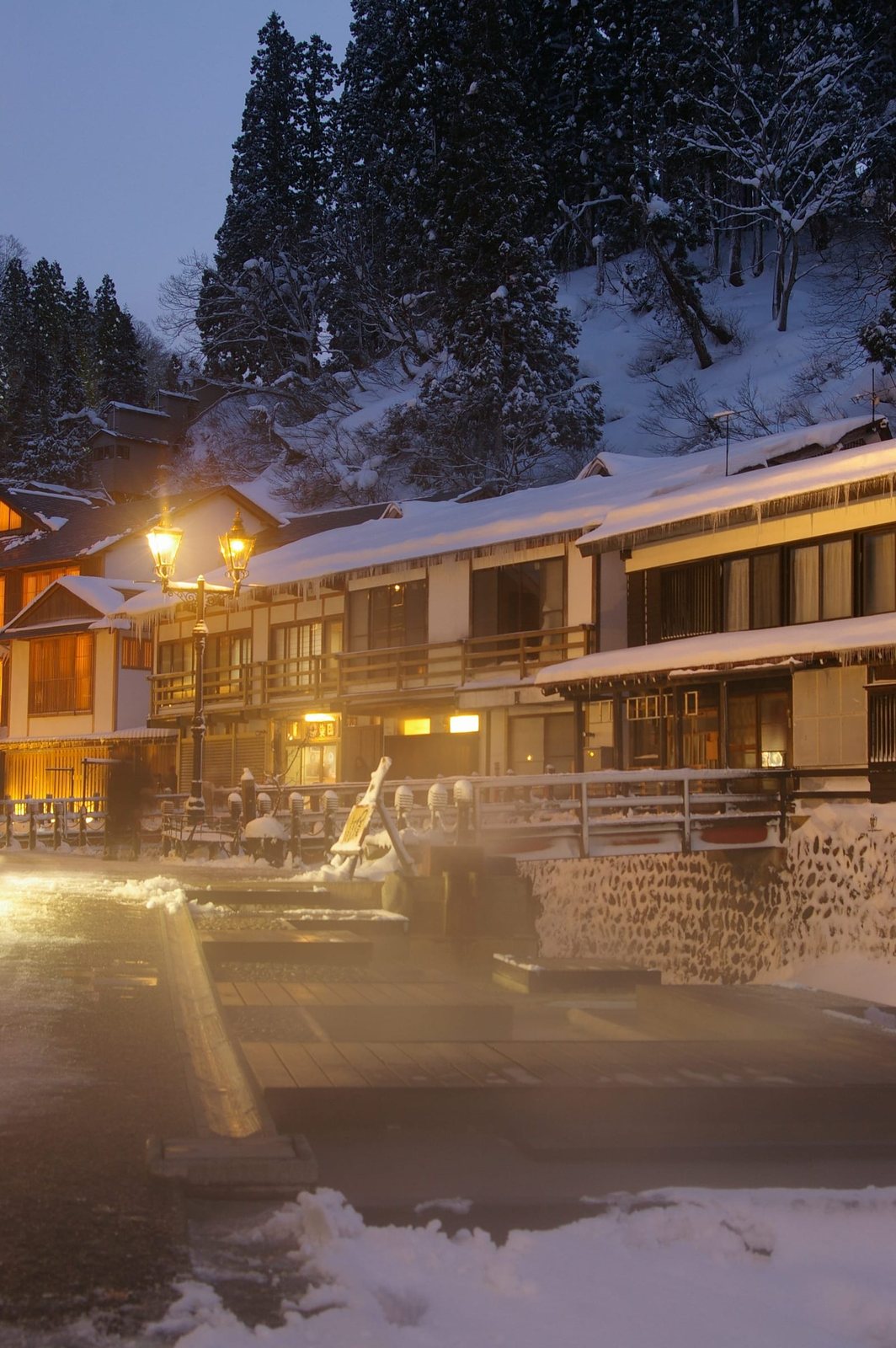
Aizu is snow country from December to March, and Ouchi-juku under snow is one of the great winter images of Japan. Dress for it: thermals, a haori or padded coat over the kimono, and boots for the street with zori only for the frame. Spring comes in mid April to the castle and Hanamiyama. The Aizu Festival in late September parades hundreds of townspeople in samurai armour through the streets, with kimono-clad participants alongside; it is the week to be dressed. Autumn colour is early November, and the castle grounds and Oyakuen both light up.
Where OlaChill fits in
OlaChill has no shop in Fukushima and no photographer here. Our shops are in Tokyo Asakusa and Kyoto Kiyomizu, open 09:00 to 18:00, with dressing and return only on site. Tokyo to Aizu-Wakamatsu is about 3 hours: Yamabiko to Koriyama, then the Ban-etsu West Line. Ouchi-juku is another hour beyond. A same-day loop in our kimono is not realistic.
What works:
- Kimono day in Tokyo before or after Aizu. Komongi ¥5,500 (¥4,950 online); the men's traditional set is ¥5,000 and suits the samurai-town mood if you want a matching couple look on the Tokyo day.
- Next-day return, ¥1,100, to keep the kimono for a Tokyo evening and return before 10:00 the next morning.
- Chauffeured car for a long dressed day around Kanto; quoted per trip.
In Aizu, rental counters operate near the castle and in the Nanokamachi-dori shopping street in season. For background, read our Aizu-Wakamatsu samurai city guide and the Ouchi-juku post town piece.
Plan your kimono day
- Base in Aizu-Wakamatsu for two nights. Castle day, then Ouchi-juku day.
- Castle day: dress by 09:30, castle grounds and keep, Oyakuen, then Nanokamachi-dori for lacquer shops and a sake tasting, all on the loop bus.
- Ouchi-juku day: first train to Yunokami-Onsen (the station itself has a thatched roof), taxi up, be on the street by 10:00 before the coaches.
- Climb to the lookout in shoes, change to zori for the top-of-street frame.
- Negi soba lunch, then back before the 15:00 light goes flat.
- Return by 17:00 to the local shop.
A few local courtesies
Ouchi-juku is a lived-in village, not a set. Stay on the road, do not open gates, and buy something from the house you photograph most; the negi soba and the grilled river fish are the usual thanks. Tsuruga Castle asks that zori come off at the keep entrance, so choose a pair that slips on and off. Aizu's sake breweries will pour tastings in kimono, but hold the cup with both sleeves back; a rented obi with sake on it costs a cleaning fee.
FAQ
Is the Ouchi-juku street walkable in zori? When dry, yes; it is gravel and packed earth with a gentle slope. In snow, wear boots and swap for a photo only.
Can I take the Ban-etsu West Line to Aizu in kimono? Yes. It is a local train of about 75 minutes from Koriyama, rarely crowded outside sakura weekends.
Does OlaChill have a shop in Aizu-Wakamatsu? No. Our two shops are Tokyo Asakusa and Kyoto Kiyomizu only.
When is the best time for a kimono photo at Tsuruga Castle? Mid to late April, when the cherry trees around the moat bloom against the red roof; second choice early November.
Is Hanamiyama a good kimono walk? Yes, in early to mid April. The lower loop is gentle; the upper loop is steeper and better in shoes.
Dress in Tokyo, then go west
Aizu is a three-hour trip from Tokyo, so plan the kimono day in the capital. All 14 plans, hair and makeup, and next-day return are at OlaChill Kimono Rental, with 10% off when you book online.