
Capsule Hotels & Hostels in Japan — The Smart Choice for Solo Travelers
Aug 8, 2026 · ✍️ olablog · ⏱ 7 min read
A complete solo traveler's guide to capsule hotels and hostels in Japan: costs, privacy, female-only floors, best neighborhoods in Tokyo and Osaka, and essential etiquette.
For solo travelers, accommodation is often the single most painful expense: standard hotels charge by the room, leaving a single person to foot the entire bill. Japan solves this dilemma better than anywhere else on earth — in fact, the Japanese invented the capsule hotel back in 1979 for office workers who missed the last train home. Today, capsule hotels and hostels across Japan are clean, safe, and so thoughtfully designed that many travelers choose them not merely to save money, but because they genuinely enjoy the experience. This guide will help you understand both accommodation types, pick the right neighborhood in 東京(Tokyo) and 大阪(Osaka), and navigate shared spaces without any awkward missteps.
What Is a Capsule Hotel and How Much Does It Cost?

A capsule hotel rents out an individual "sleeping pod" — a box measuring roughly 1m x 1m x 2m (3.3ft x 3.3ft x 6.5ft) containing a comfortable mattress, reading light, power outlet, and sometimes a small TV and climate controls. Pods are stacked in two tiers along a hallway, while bathrooms, toilets, and luggage storage areas are shared. Many modern capsule hotels also feature a 銭湯(Sento / Japanese public bath) or even a sauna for guests.
Price reference: Expect to pay around 2,500–5,000 JPY per night (approx. $17–$33 USD) for a standard capsule. "Luxury capsule" brands like Nine Hours or First Cabin (which feature larger pods resembling mini-rooms) run around 4,000–8,000 JPY ($27–$53 USD). Compared to standard single rooms in budget hotels, which cost 8,000–15,000 JPY ($53–$100 USD), you will easily save half or more.
Regarding privacy: Pods are enclosed with a roll-down screen or curtain rather than a lockable door (due to Japanese fire safety regulations), but your valuables can be secured in a private locked locker. Soundproofing is the main trade-off — you will likely hear the person in the adjacent pod tossing and turning. Earplugs are virtually mandatory.
How Are Japanese Hostels Different From Hostels Elsewhere?

Hostels (bunk-bed lodgings) in Japan are famous for three distinct features: cleanliness, quietness, and curtained beds. Most Japanese hostels design each bed as a "semi-capsule" with full privacy curtains, individual reading lights, charging outlets, and small shelves. The communal kitchen and lounge are fantastic places to meet fellow solo travelers if you choose to socialize; if not, drawing your curtain creates your own private sanctuary.
Price reference: Dorm beds cost around 2,000–4,500 JPY per night ($13–$30 USD) in 東京(Tokyo) or 大阪(Osaka). Many hostels also offer small private single rooms for 5,000–8,000 JPY ($33–$53 USD) when you want absolute personal space. A major difference from Western hostels: there is virtually no "party culture," and common areas are quiet by 10:00 PM.
Female-Only Floors — Essential Info for Solo Female Travelers
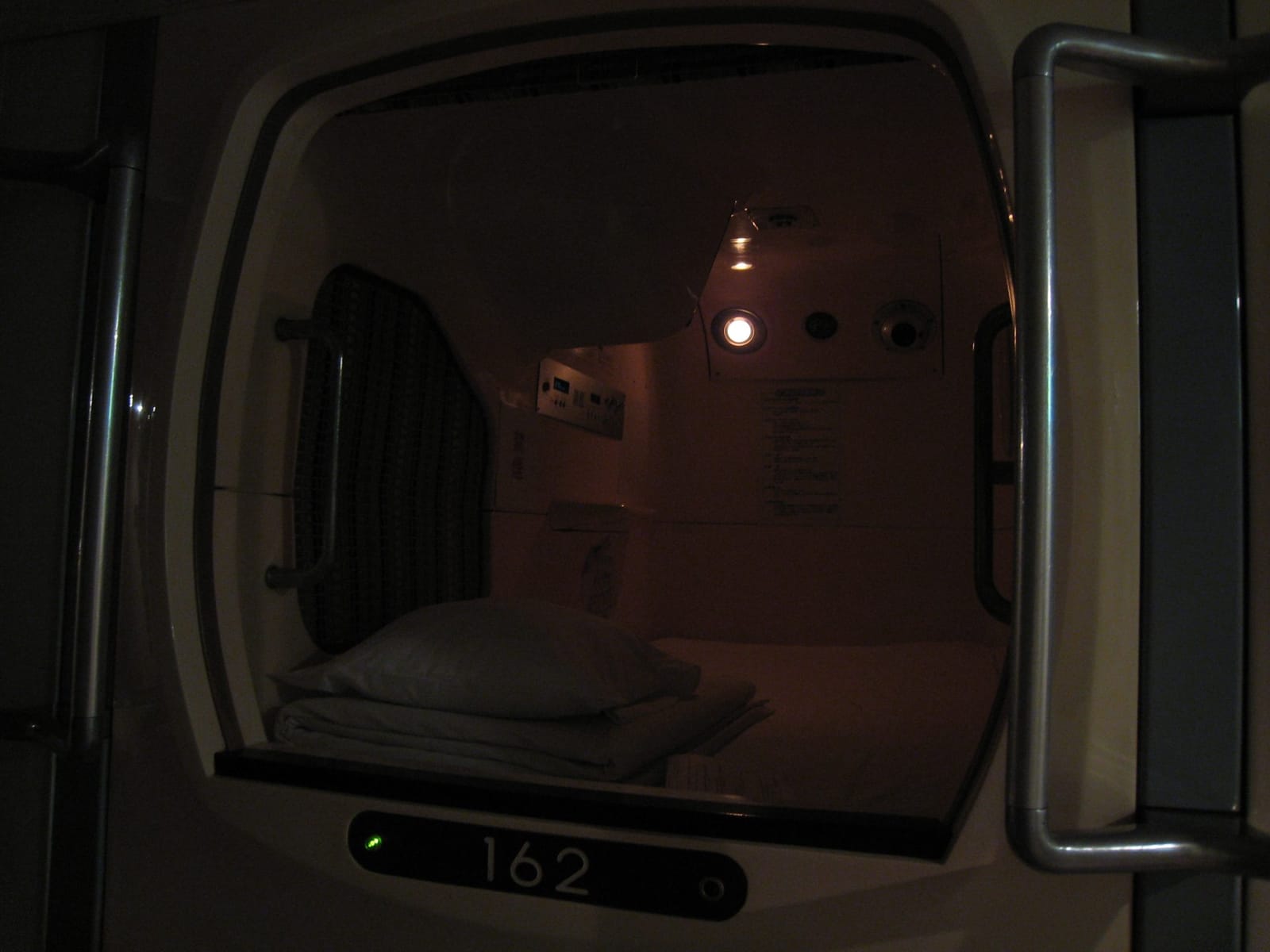
This is one of Japan's biggest advantages for solo travelers. Many capsule hotels feature dedicated women-only floors accessible only via keycard elevators, complete with completely separate shower and restroom facilities; some chains are even 100% female-only capsule hotels. Hostels also commonly offer female dorms, usually costing an extra 200–500 JPY ($1.30–$3.30 USD) compared to mixed dorms, but worth every penny for added comfort.
When booking, look for keywords like "women-only floor," "female dorm," or "ladies' floor." Be sure to read listings carefully, as some traditional capsule hotels (especially older establishments tied to public baths for salarymen) still cater exclusively to male guests — booking the wrong one will lead to non-refundable mistakes.
Which Neighborhoods Should You Stay in Tokyo and Osaka?
東京(Tokyo):
- 上野(Ueno) / 浅草(Asakusa) — The top choice for first-timers: the most budget-friendly rates in the central area, direct access from 成田国際空港(Narita International Airport) via the 京成電鉄(Keisei Line) (easily paid for using a Suica or Pasmo IC card), and close to 浅草寺(Senso-ji Temple) and the Ueno museum cluster. Many beautiful hostels line the 隅田川(Sumida River).
- 日本橋(Nihonbashi) / 神田(Kanda) — Quiet corporate districts at night with plenty of modern capsule hotels. Within walking distance of 東京駅(Tokyo Station), making it convenient if you plan to take the 新幹線(Shinkansen bullet train) to 京都(Kyoto) using your JR Pass.
- 新宿(Shinjuku) — Unbeatable transit connections and 24/7 energy. However, stick to the south or west sides of 新宿駅(Shinjuku Station), avoiding the area right next to 歌舞伎町(Kabukicho) if you want a quiet night's sleep.
- 渋谷(Shibuya) — Ideal for nightlife enthusiasts, though prices run slightly higher.
大阪(Osaka):
- 難波(Namba) / 心斎橋(Shinsaibashi) — The heart of food and entertainment, walking distance to 道頓堀(Dotonbori), with many new hostels and stylish capsules. Best choice for first-time visitors.
- 梅田(Umeda / Osaka Station area) — Convenient for taking regional trains to 京都(Kyoto), 神戸(Kobe), and 奈良(Nara). Capsules here cater heavily to business professionals, ensuring consistent quality.
- Around 新今宮(Shin-Imamiya) / 西成(Nishinari) — Surprisingly cheap (some under 2,000 JPY / $13 USD) because of its history as a working-class district. While reasonably safe and popular with backpackers, first-time solo travelers will likely feel more comfortable in Namba.
Etiquette for Shared Spaces
Japanese capsule hotels and hostels remain pleasant because everyone adheres to a few unwritten rules:
- Silence is the default. After 10:00 PM, talking on the phone in the sleeping area is a major faux pas. Take phone calls to the main lobby or lounge.
- Pack before going to bed. The sound of a zipper on a hard suitcase at 6:00 AM is the most common tourist offense. Prepare your clothes and gear for the next day the night before, keeping them in a soft cloth bag.
- Footwear: Most places require you to remove your shoes in the entrance hall and switch to indoor slippers — follow the instructions provided at the front desk.
- Shared baths: Shower and rinse thoroughly before stepping into the 銭湯(Sento) tub. Never submerge your towel in the bathwater, and tie up long hair.
- Keep belongings in your locker. Leaving luggage sprawling across common hallways is considered rude and increases the risk of losing items.
- Alarm clock: Set your alarm to vibrate mode only. The entire sleeping pod floor will thank you.
Conclusion: Affordable Without Sacrificing Comfort
Staying in a capsule hotel or hostel in Japan is not about sacrificing comfort to save money — it is a genuine cultural experience best enjoyed by solo travelers. For 2,500–5,000 JPY ($17–$33 USD) per night, you get a spotlessly clean, comfortable bed in central Tokyo or Osaka, and the money saved can easily cover a couple of fantastic sushi meals. One final tip: book your first and last nights in advance, but feel free to keep your middle nights flexible — that is the ultimate privilege of traveling solo.
For more budget tips and solo travel itineraries, check out our OlaChill blog, or explore OlaChill's Japan tours if you prefer combining a few days of guided touring with independent exploration.
More from this region — Other
View all →
Kimono in Aichi: Where to Wear It, Best Photo Spots and How to Plan the Day
7 min · culture
Kimono in Fukui: Where to Wear It, Best Photo Spots and How to Plan the Day
7 min · culture
Kimono in Gunma: Where to Wear It, Best Photo Spots and How to Plan the Day
7 min · culture
Kimono in Hyogo: Where to Wear It, Best Photo Spots and How to Plan the Day
7 min · culture