
Kamikochi in One Autumn Day: Catch the Early-Morning Mist and Make the Afternoon Bus
Mist lifting from the lake at 6 o'clock, the wooden boardwalk through Tashiro, grilled iwana at Myojin, and the turnaround time you must stick to — plus a condensed half-day plan from Matsumoto or Takayama.
Aug 12, 2026·✍️ olablog·⏱ 20 min read
Mist lifting from the lake at 6 o'clock, the wooden boardwalk through Tashiro, grilled iwana at Myojin, and the turnaround time you must stick to — plus a condensed half-day plan from Matsumoto or Takayama.
Tap a region to browse articles
The first time I visited Kamikochi in autumn, I arrived at 11 in the morning on a leisurely bus from Matsumoto, had lunch, and only then wandered over to Kappa Bridge. The weather was beautiful, the Hotaka Mountains were sharp against the sky, with every streak of early-season snow visible, and I thought, “That’s enough.” It wasn’t until I was sitting on the bus home, looking at a photo taken by the Japanese man next to me of Taisho Lake at six in the morning — the water smooth as glass, mist rising white between the bare tree trunks, with Mount Yakedake faintly visible behind them — that I realized I had missed the most valuable part of the entire valley.
The problem with Kamikochi isn’t that it’s difficult or expensive to visit. It’s that the most beautiful time of day is when almost no one is there: roughly an hour and a half after sunrise, when vapor rises from the lake and the first sunlight touches the mountain range. After 9 in the morning, the mist is gone, busloads of visitors arrive, and Kamikochi becomes a very beautiful but very... ordinary national park.
This is a one-day itinerary I’ve refined over several autumns: get off the bus at Taisho Lake while the air is still bitterly cold, walk upstream along the Azusa River through Tashiro to Kappa Bridge, have a late breakfast, then head to Myojin Lake around midday for grilled fish, before turning back in the afternoon to catch the bus down the mountain. I’ve also included a condensed half-day option for anyone visiting on a day trip from Matsumoto or Takayama — because, honestly, that’s how most Vietnamese travelers in Japan do it.
Why follow this exact order?
Kamikochi is a long valley running alongside the Azusa River at an elevation of around 1,500 meters, inside Chubu Sangaku National Park. Private cars are completely prohibited, so visitors enter by bus or taxi via Sawando (from the Matsumoto side) or Hirayu Onsen (from the Takayama side). The valley’s three main landmarks are arranged from downstream to upstream: Taisho Lake → Kappa Bridge (the bus terminal) → Myojin Lake.
There are three reasons to follow this direction:
First, the mist only appears early in the day and is only truly beautiful at Taisho Lake. Taisho Lake was formed after an eruption of Mount Yakedake at the beginning of the 20th century blocked the river, leaving bare, dead tree trunks standing in the middle of the lake — a sight you can hardly find anywhere else in Japan. In autumn, the temperature difference between the water and the early-morning air is substantial, causing vapor to rise into a thin layer of mist drifting across the lake. This usually lasts from first light until around 7–8 o'clock, depending on the day.
Second, the walking route runs gently “downstream.” From Taisho Lake to Kappa Bridge is about 3.5 km along wooden boardwalks and flat trails. Although you are walking against the current, there is almost no incline. Going this way, the morning sun stays behind you, lighting up the Hotaka range ahead — easier on the eyes and better for photos.
Third, Myojin is best saved for the middle of the day. The route between Kappa Bridge and Myojin Lake is about 3–3.5 km each way and passes through the forest, so it doesn’t depend on perfect sunlight. This is also where you’ll find the best food in the valley, making it the most practical place to stop for lunch.
If you do it in reverse — heading to Myojin in the morning and only going down to Taisho Lake in the afternoon — you’ll find a lake washed out by sunlight, crowded with people, and completely free of mist.
General timetable
This is the schedule I follow during peak autumn foliage season (usually from around mid-October to early November). Bus times change by season and year, so use this as a reference and check the official Alpico Kotsu / Nohi Bus websites again before you go.
- Around 5:00 – 5:30: first shuttle from Sawando or Hirayu Onsen
- Around 6:00 – 6:15: get off at the Taishoike stop (Taisho Lake)
- 6:15 – 7:15: Taisho Lake, watching the mist and waiting for sunlight to reach the mountains
- 7:15 – 9:00: walk through Tashiro Marsh – Tashiro Lake – the Weston Memorial Plaque to Kappa Bridge
- 9:00 – 10:15: late breakfast around Kappa Bridge, warm up, and visit the Visitor Center
- 10:30 – 11:40: walk up to Myojin Lake (choose one riverbank)
- 11:40 – 13:10: Myojin Lake, Hotaka Okumiya Shrine, and lunch of grilled iwana
- 13:10 – 14:30: return to Kappa Bridge along the opposite riverbank
- 14:30 – 15:15: coffee, souvenir shopping, and walk to the bus terminal
- Around 15:30 – 16:00: take the bus down the mountain
The total walking distance is around 10–11 km, and the route is almost entirely flat. That may sound like a lot, but it’s actually easier than a full day visiting temples in Kyoto, since there are no stairs and no crowds to push through.
6 in the morning — Taisho Lake: one hour worth the entire trip
To be at Taisho Lake at 6, you’ll almost certainly need to stay overnight near one of the gateways: Sawando, Hirayu Onsen, Norikura Kogen, or inside Kamikochi itself if you can get a reservation (there are very few rooms, and autumn rooms are often booked a month in advance). Even if you stay in Matsumoto and take the earliest bus, it’s difficult to arrive before 8.
One very practical note: not every bus stops at Taishoike. Shuttle buses from Sawando and Hirayu usually stop there, while highway buses running directly from Tokyo or Osaka go straight to the Kamikochi bus terminal. When you board, simply tell the driver, “Taishoike de orimasu,” to be safe.
After getting off the bus, it’s only about a 2–3-minute walk to the lakeshore. October temperatures at this hour are usually around 0–5 degrees, while November can fall below 0, with frost on the grass. I’m serious: a lightweight down jacket, gloves, and a knitted hat are the three things you’ll be most grateful for. Standing still for half an hour taking photos in the mountain wind feels much colder than you might expect.
Where should you stand, and what should you wait for?
Taisho Lake has two main viewing areas: the shore near the bus stop (facing Mount Yakedake and its dead tree trunks) and the upper section of the shore, where the water narrows and reflections are clearer. I usually start near the bus stop and wait for the first sunlight to sweep across the slopes of Yakedake — the mountain changes from blue-gray to pink and orange within a few minutes, while the lake remains dark and full of mist. That is the most valuable shot.
Then walk about 200–300 meters upstream, where the water is flatter and you may be able to capture reflections of the Hotaka range. If it’s windy, forget about reflections and focus on the mist — moving mist is more beautiful than a perfectly still mirror.
There is a seasonal rowboat tour on Taisho Lake operated by a hotel in the area, but its schedule and booking conditions change from year to year, so check the official website if you’re interested.
7:15 — The wooden boardwalk through Tashiro: the section people rush through most
This is the part I see the most people get wrong: many race the 45 minutes from Taisho Lake to Kappa Bridge just to “get it over with,” even though this is the stretch that feels most like Kamikochi.
The nature trail runs along the river, and much of it consists of wooden boardwalks crossing wetlands, making it extremely easy to walk, even in ordinary sneakers (as long as the soles have good grip, because dew-covered boards are slippery early in the morning). Along the way, you’ll encounter:
- Tashiro Marsh (Tashiro Shitsugen): an open wetland that is often covered in mist in the morning and lightly frozen toward the end of the season. From here, the view of the Hotaka range is almost completely unobstructed.
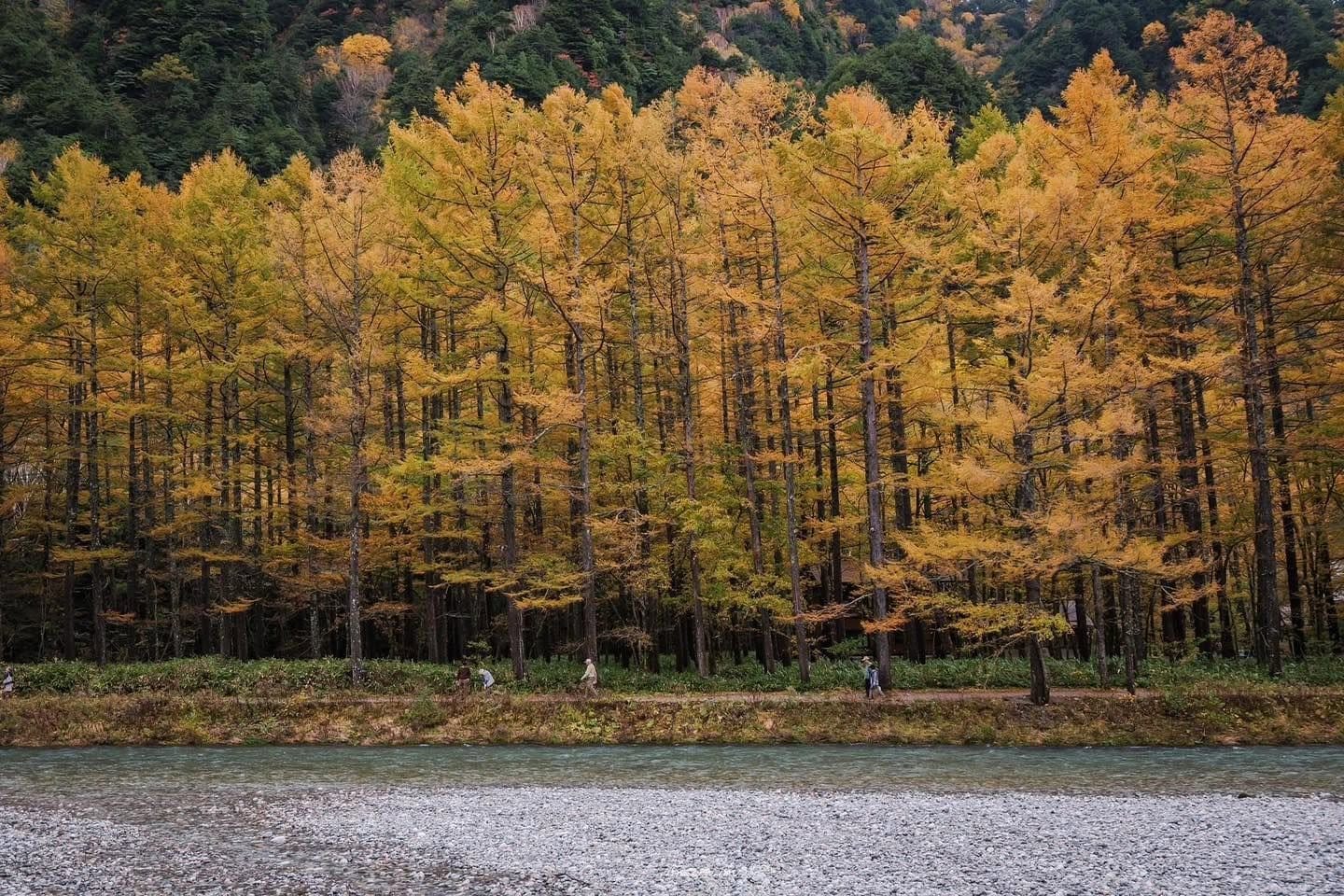
- Tashiro Lake (Tashiro-ike): a shallow, crystal-clear lake fed by underground springs, so it rarely freezes completely. In the early morning, vapor rises gently from the surface, surrounded by birch trees and brilliant golden karamatsu larches.
- The Weston Memorial Plaque: erected in memory of Walter Weston, who popularized the concept of sport mountaineering in Japan and helped establish the name “Japan Alps.” It isn’t the most photogenic spot, but it’s a landmark telling you that Kappa Bridge is close.
There are two routes around Tashiro: one follows close to the river (more open, with better mountain views), while the other passes through the forest (sheltered from the wind, warmer, and filled with moss and mushrooms). On cold mornings I choose the forest route; on sunny days I take the riverside path. They meet up again, so there’s no need to worry about getting lost.
Allow 1 hour 15 minutes to 1 hour 45 minutes for the whole section if you want to stop and take proper photos. Don’t force yourself to finish it in 45 minutes.
9 in the morning — Kappa Bridge: a place to warm up, not linger
Kappa Bridge is Kamikochi’s iconic suspension bridge and also where nearly all the services are concentrated: hotels, restaurants, pastry counters, souvenir shops, the Visitor Center, restrooms, and luggage lockers. By this point, you’ll have walked 3.5 km in the cold, your hands will be numb, and what you need is a hot breakfast.
Some familiar options around the bridge include the restaurants at Gosenjaku Hotel and Kamikochi Shokudo, which serve hot Japanese-style dishes, as well as small stalls selling oyaki filled with Nagano specialties such as vegetables, hot coffee, and apple pastries. Prices are generally 20–30% higher than in town because everything has to be transported up here — consider it a delivery fee.
There are three things you should do during your stop:
- Take a photo of the afternoon bus timetable at the terminal. This is the most important task of the day. You need to know the exact last bus heading in your direction (Sawando or Hirayu, or the connecting bus/train to Matsumoto or Takayama).
- Visit the Visitor Center to check the latest updates: foliage conditions, bear warnings, and any trail closures.
- Leave some belongings in the lockers at the bus terminal if you’re carrying a suitcase or a large backpack. The walk to Myojin is much more comfortable with a lighter pack.
Mobile reception in Kamikochi is patchy, and some areas have no signal at all. Don’t rely on checking bus times on your phone at 3 in the afternoon.
10:30 — Head to Myojin Lake: either bank works, but don’t walk back and forth along the same one
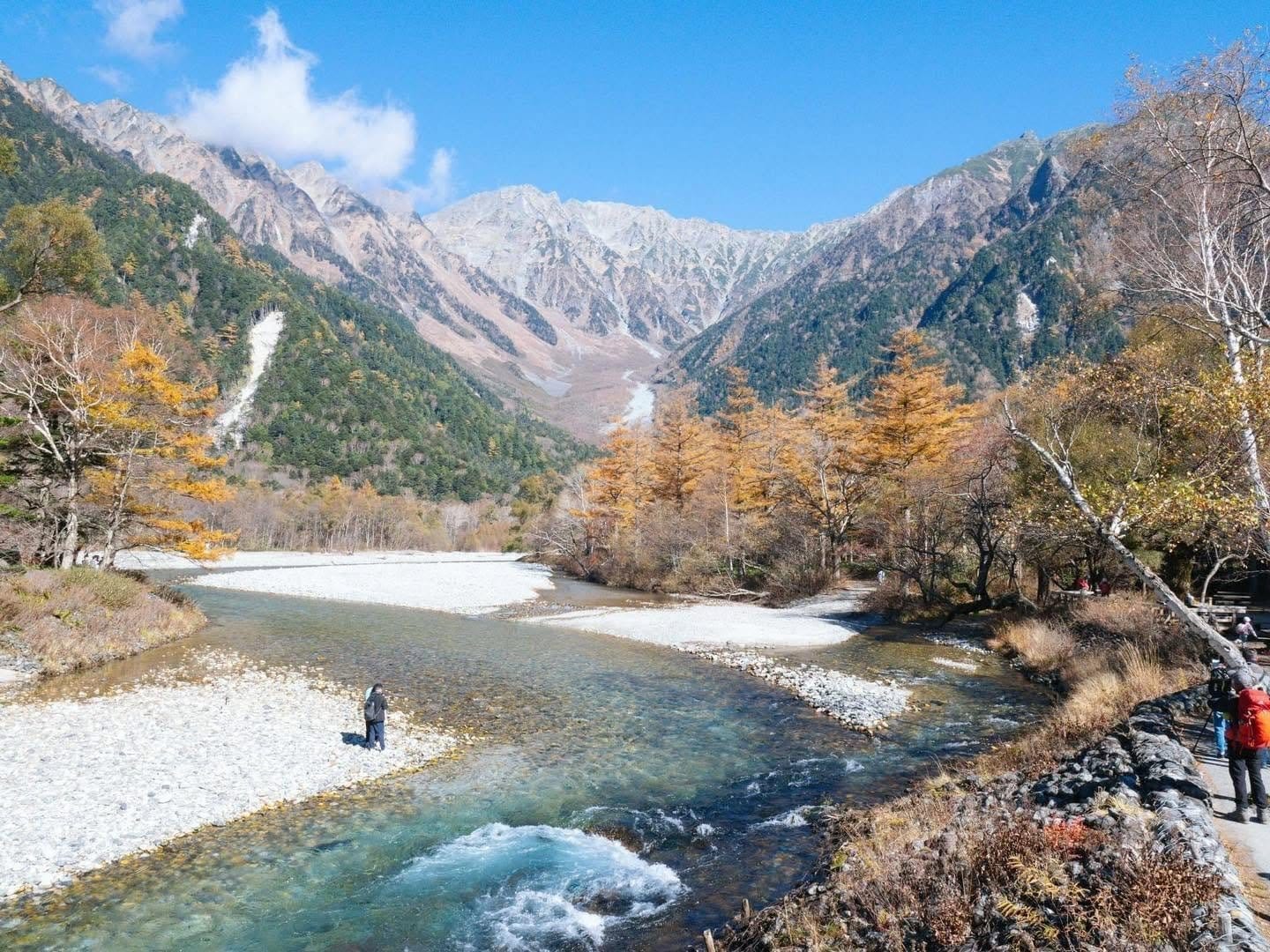
There are two routes from Kappa Bridge to Myojin Lake, one on each bank of the Azusa River. Each is about 3–3.5 km long, and they connect via Myojin Bridge at the far end. The walk takes around 60–70 minutes each way.
- The bus-terminal side (left bank): the widest and flattest route, and the easiest to walk, making it suitable for older travelers or children. The trade-off is that the scenery is somewhat monotonous, consisting mainly of forest.
- The opposite bank (cross Kappa Bridge and turn off): this route has more wooden boardwalks through wetlands and primeval forest, along with some rougher sections covered in tree roots, but the scenery is much better and the trail is quieter.
The best approach is to go along one bank and return along the other — making a loop of around 7 km without repeating any scenery. I usually go up along the opposite bank (scenic and cool) and return along the bus-terminal side (faster and easier on tired legs).
You’ll often encounter Japanese macaques along the way. They’re used to people and will almost completely ignore you — just keep walking, don’t feed them, don’t make direct eye contact, and keep food inside your backpack. There are bears in this area too; the risk is low on the busy main trail, but if you’re walking early in the morning or late in the afternoon, wearing a bear bell can give you peace of mind.
What is there to see at Myojin Lake?
Myojin Lake is located within the grounds of Hotaka Jinja Okumiya, so entering the lake area requires an admission fee of around 500 yen (the fee may have changed, so check the posted price on site). Many people skip it to save money — I think that’s a mistake.
The lake consists of two connected sections, with water so clear you can see the bottom. It is surrounded by the steep cliffs of Mount Myojin and forest. Several old-fashioned wooden boats are moored along the shore, and in autumn golden leaves drift onto the surface, creating an incredibly still atmosphere — completely different from the “park” feeling around Kappa Bridge. This is the place where I think you should sit quietly for 20 minutes and do nothing at all.
Right beside the lake is Kamonji-goya, a historic mountain lodge famous for iwana (Japanese char) skewered and grilled with salt over the charcoal fire in the middle of the building. The fish takes about 40 minutes to grill, so you may have to wait when it’s busy; one skewer costs around 1,000 yen. Add a bowl of hot soba and you’ll have enough energy for the return journey. It’s the most memorable lunch you can have in Kamikochi.
13:10 — Turn back: the time rule you must not break
This is the point I want to emphasize most, because Kamikochi itineraries usually fail not because people walk slowly, but because they turn back too late.
The rule is simple: take the departure time of the bus you want to catch, subtract 90 minutes for the walk from Myojin to Kappa Bridge, then subtract another 30 minutes as a buffer for queuing, using the restroom, and buying souvenirs. Whatever time you arrive at is the cutoff time for leaving Myojin Lake, no matter how much fun you’re having.
On peak autumn-foliage weekends, the line for buses down the mountain at the Kamikochi bus terminal can be long, and you may have to wait for several buses. The bus companies usually add extra services, but if you still need to connect to a bus or train at Sawando/Hirayu to return to Matsumoto or Takayama, missing one departure can cause you to miss the entire chain. Don’t cut it too close.
One more note: if you’re thinking of boarding at the Taishoike stop on the way back because it’s closer, reconsider — buses leaving the main terminal in the afternoon are often already full, and you may have to wait for quite a while. It’s safer to return directly to the Kamikochi bus terminal and board from the start of the route.
Kamikochi also closes seasonally, usually opening around mid-April and closing around mid-November before hibernating until the following year. Autumn is therefore a very short season, and the final days can be bitterly cold, with trails freezing in the early morning.
A half-day option for day trips
If you’re traveling from Matsumoto or Takayama in a single day, you’ll probably only be in Kamikochi from around 9 in the morning until 15–16 in the afternoon — roughly 5–6 real hours. Don’t try to cram in the entire itinerary above, or you’ll rush the walks, miss a proper meal, and never see the mist.
From Matsumoto
The usual route is to take an Alpico train from Matsumoto Station to Shin-Shimashima Station, which takes around 30 minutes, then connect to a bus to Kamikochi, which takes about 1 hour. Round-trip train + bus combination tickets are available, with the total fare each way usually around 2,500–3,000 yen; check the Alpico website for the exact figure, as prices are adjusted seasonally. There are also direct buses, but these usually require advance reservations.
If you take the earliest departure from Matsumoto, you’ll usually arrive in Kamikochi around 8:30 – 9:00. A half-day plan prioritizing scenery:
- Get off at Taishoike and walk Taisho Lake → Tashiro → Kappa Bridge (around 1.5 hours)
- Have an early lunch around Kappa Bridge (1 hour)
- Walk up to Myojin Lake and return along the two different banks (around 2.5 hours including a stop at the lake)
- Return to the bus terminal around 15:00, leaving enough buffer for the afternoon departure
This schedule is doable but fairly tight, and you won’t see the early-morning mist. For a more relaxed visit, skip Myojin and spend the time sitting beside the Azusa River.
From Takayama
The popular route is a bus from Takayama to Hirayu Onsen, taking around 1 hour, followed by a connecting bus from Hirayu to Kamikochi, taking around 25–30 minutes. Direct connecting services may run during peak season. The one-way cost is usually around 2,500–3,000 yen, so check the Nohi Bus website.
Because you have to change buses, arrival in Kamikochi is usually a little later than from Matsumoto, around 9:30 – 10:00. With that amount of time, I recommend choosing one option rather than trying to do both:
- Option A (for lakes and mountain reflections): get off at Taishoike, walk Taisho Lake → Tashiro → Kappa Bridge, have lunch, relax by the river, and return early. It’s gentle and works well for travelers with parents or young children.
- Option B (for forest walks): go straight to the bus terminal, walk the Kappa Bridge – Myojin loop using both banks, eat grilled fish at Kamonji-goya, then return to Kappa Bridge for coffee.
One more tip for travelers coming from Takayama: if your schedule allows, stop at Hirayu Onsen for a footbath or a daytime soak at the public bathhouse while waiting for your connection. After a day of walking in the mountain wind, it’s a very well-deserved reward.
Estimated cost for one day
The figures below are estimates for budgeting purposes, not official listed prices — bus fares and admission fees change by season and year:
- Round-trip bus/train from Matsumoto or Takayama: around 5,000 – 6,000 yen
- If driving to Sawando/Hirayu: parking around 700 yen/day plus a round-trip shuttle around 2,000 – 3,000 yen
- Myojin Lake admission: around 500 yen
- Late breakfast + grilled-fish lunch + coffee: around 3,000 – 4,500 yen
- Luggage lockers and restrooms (many charge a nominal fee of around 100 yen): a few hundred yen
The total comes to around 9,000 – 13,000 yen/person when using public transportation. It isn’t cheap, but it’s difficult to find scenery like this elsewhere in Japan.
Things I wish someone had told me beforehand
Kamikochi has no convenience stores. Prepare everything you need — water, snacks, a power bank, and cash — before you arrive. Many small stalls accept cash only.
The weather in the valley changes very quickly. Clear skies in the morning, a rain shower at noon, and sunshine again in the afternoon are all perfectly normal. A compact rain jacket is always in my backpack, and I don’t use an umbrella — the wooden boardwalks are windy, and umbrellas are awkward and dangerous there.
Finally, a note on the foliage: Kamikochi has two waves of color. Broadleaf trees such as rowan, maple, and birch usually change first, around mid-October. The second wave is karamatsu — deciduous larches — which turn a deep golden yellow and cover the mountain slopes from late October to early November, just before the valley closes. Many people prefer the second wave, when the whole valley seems to be painted gold. Before you go, check the latest foliage updates on Kamikochi’s official website so you can time your visit for the right week.
Frequently asked questions
Do I really need to stay overnight near Kamikochi to see the early-morning mist?
Almost certainly. During peak season, the first buses from Sawando or Hirayu usually depart around 5 in the morning, so you can only catch them if you stay in Sawando, Hirayu Onsen, Norikura Kogen, or Kamikochi itself. If you travel from Matsumoto or Takayama that day, you’ll almost certainly miss the mist window. First-bus times change by season, so check again before booking your accommodation.
Can I wear regular sneakers?
Yes, if you’re only walking the three routes in this article — they’re all flat and have wooden boardwalks. Just make sure the soles still have good grip, since the boards are quite slippery with morning dew. If you plan to go farther than Myojin, toward Tokusawa, Yokoo, or Hotaka, proper high-cut hiking boots and serious equipment are essential.
What should I cut if I’m traveling with elderly parents or young children?
Cut Myojin. Keep the Taisho Lake → Tashiro → Kappa Bridge section, which is the most beautiful and easiest part. Even at a leisurely pace, it takes only 2 hours, with benches and restrooms along the way. Having lunch in the Kappa Bridge area in the afternoon while looking out at the Hotaka range is enough for a complete experience.
Do I need to reserve buses in autumn?
Shuttle buses from Sawando and Hirayu usually don’t require reservations and run continuously. However, highway buses traveling directly from Tokyo or Osaka, as well as direct connecting services from Matsumoto/Takayama, usually require advance reservations, and seats sell out easily on peak October weekends. Book early if you’re using one of these services.
Should I go if it’s raining?
Yes, as long as you adjust your expectations. Light rain brings out deep colors in Kamikochi’s forests, while mist hangs between the mountain walls, creating photos with a completely different mood from sunny days. What you lose are views of the Hotaka range and reflections on the lakes. If the forecast calls for heavy rain and strong winds, move your visit to another day — the valley is exposed to the wind and has few places to take shelter.
What other places can I combine with Kamikochi during the same trip?
It pairs very well with Matsumoto (Matsumoto Castle and Nawate Street), Takayama (the historic Sanmachi district), or the Shinhotaka Ropeway on the Gifu side — a two-level cable car ascending to nearly 2,100 meters, along the same bus route as Hirayu Onsen. Spending one day in Kamikochi and one day at Shinhotaka is an excellent autumn combination for the Northern Alps region.
More from this region — Chubu (Nagano, Kanazawa)
View all →
Kamikochi in Fall: Avoiding the Crowds and Calculating the Full Cost for 1–2 Days
17 min · tips
Kamikochi in Autumn: A Golden Valley Along the Azusa River
19 min · tips
Sore Legs in Kamikochi—Which Onsen Should You Choose: Hirayu, Sawando, or Shirahone?
17 min · tips
Kamikochi Summer Hiking Trails: The Complete Guide from Kappa Bridge to Myojin Pond, Tokusawa, and Yokoo
12 min · ハイキング