
Hakuba in Autumn and the “Three-Tiered Fall Foliage” Phenomenon: Catch the Right Two Weeks in Late October
In late October, Hakuba offers “three-tiered fall foliage”: snow-covered peaks, red hillsides, and a still-green valley. Viewpoints, warnings about the Happo-one lifts closing, and how to get there from Tokyo.
Aug 12, 2026·✍️ olablog·⏱ 20 min read
In late October, Hakuba offers “three-tiered fall foliage”: snow-covered peaks, red hillsides, and a still-green valley. Viewpoints, warnings about the Happo-one lifts closing, and how to get there from Tokyo.
Tap a region to browse articles
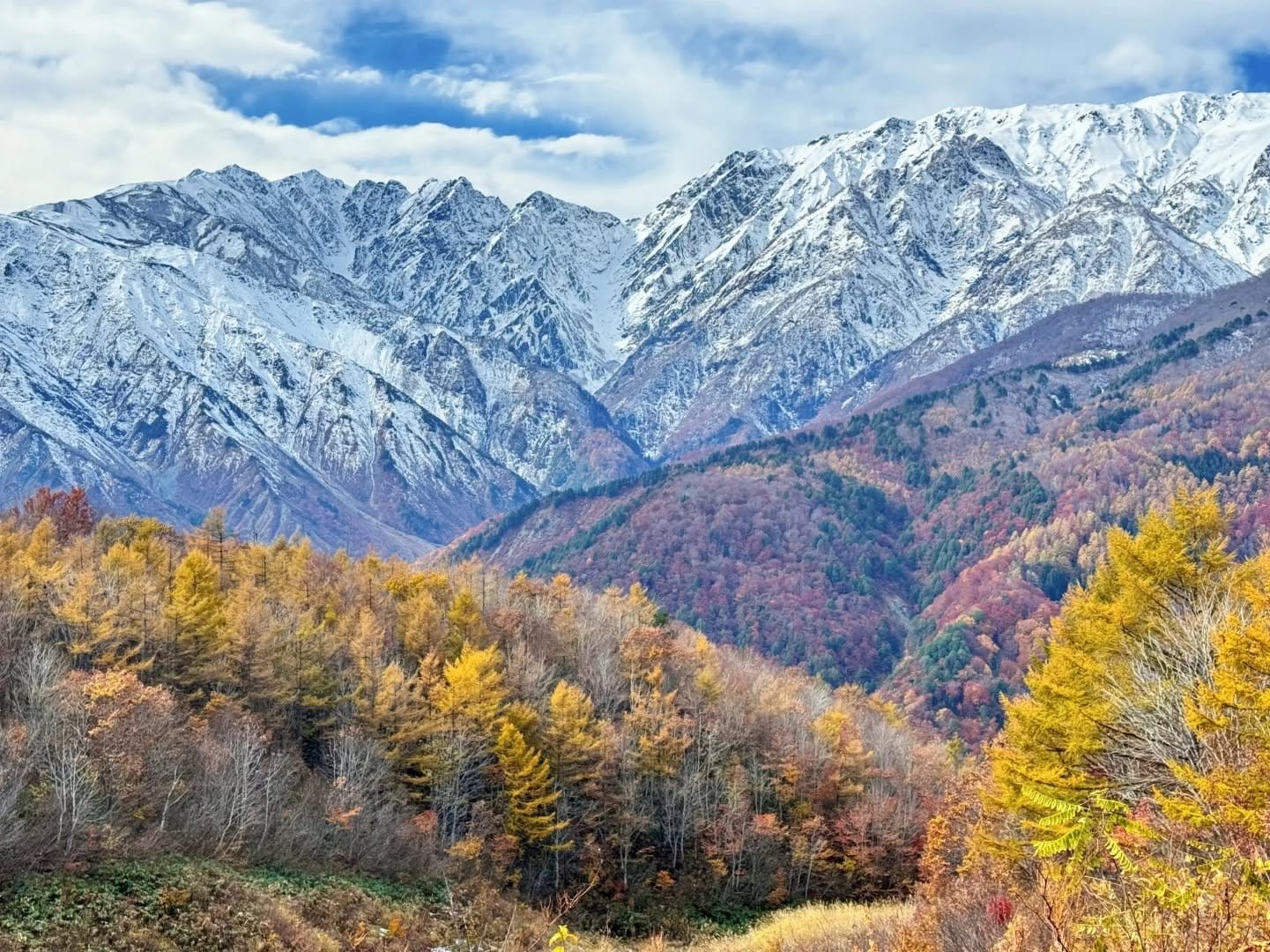
Some landscapes in Japan are beautiful year-round, while others exist for only a few days. Hakuba in late October belongs to the second category. This small village at the foot of the Northern Alps in Nagano Prefecture is best known among Vietnamese travelers as a ski destination—it hosted the alpine events of the 1998 Nagano Winter Olympics. But during the roughly two-week transition between autumn foliage and snow season, Hakuba puts on something very few places in Japan can offer at the same time: three seasons layered into a single view.
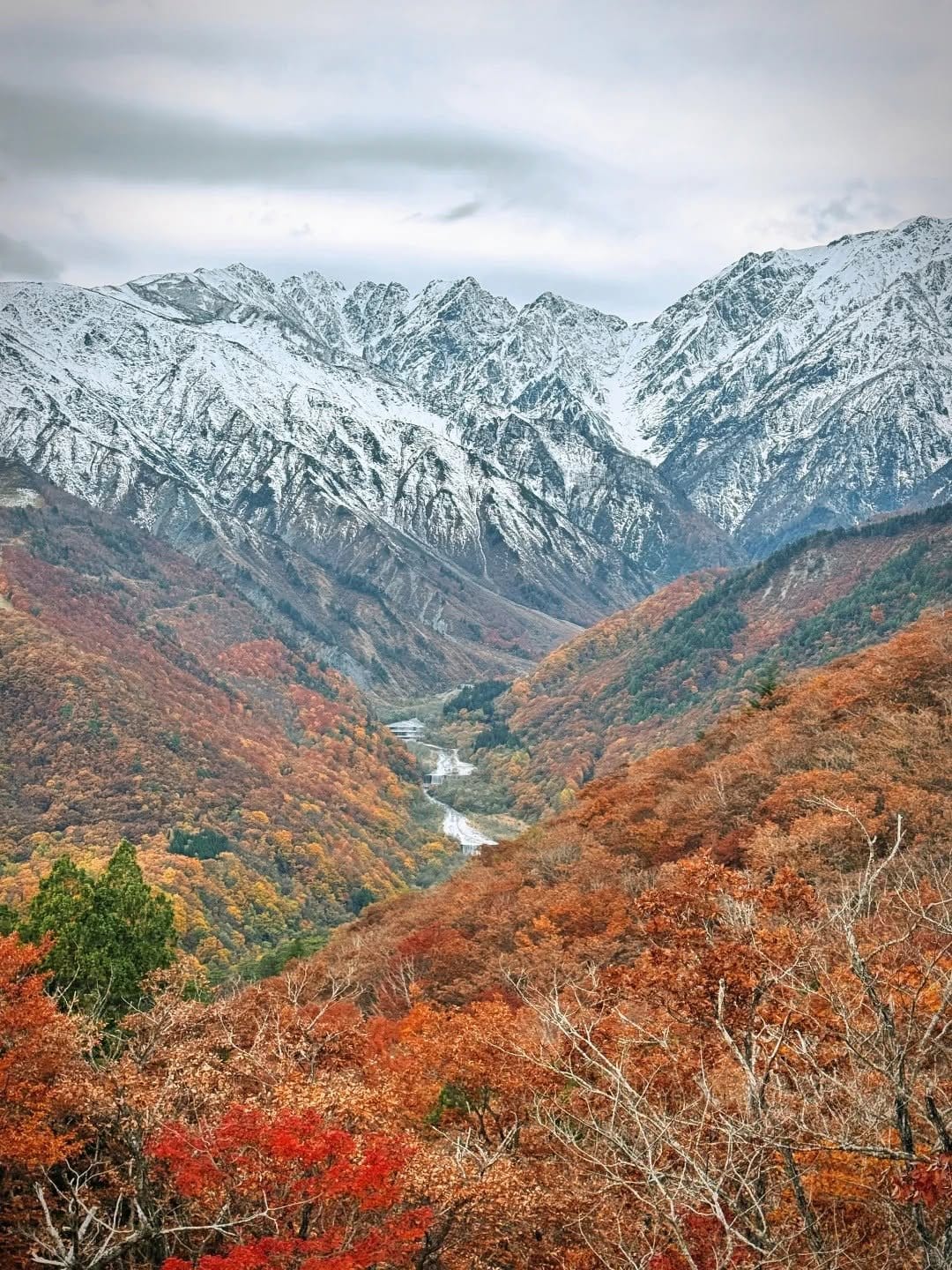
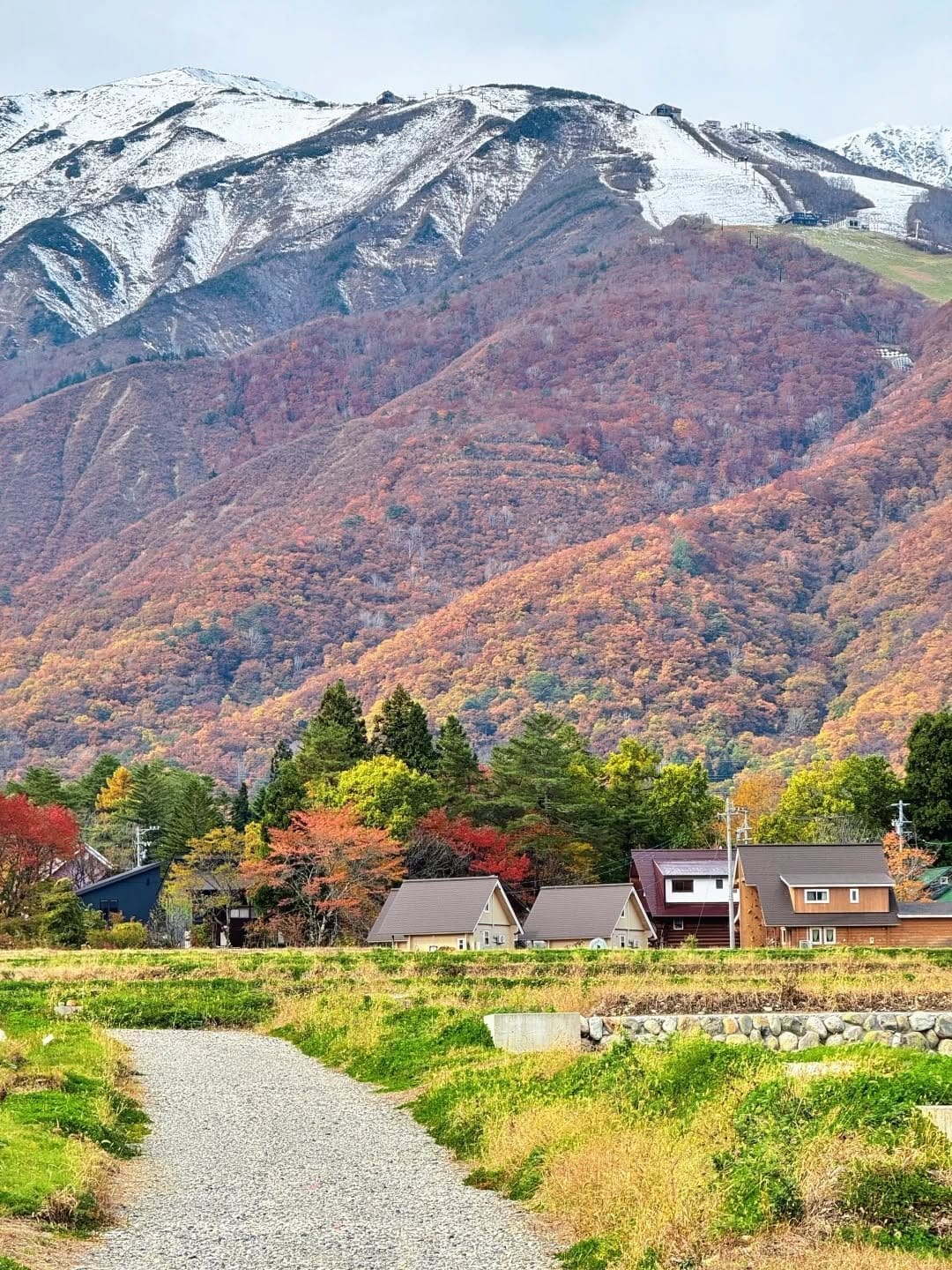
The Japanese call this phenomenon sandan kouyou (三段紅葉), loosely translated as “three-tiered fall foliage.” At the top, peaks approaching 3,000 meters are already covered in white snow. In the middle, the mountain slopes at elevations of 1,000–2,000 meters blaze with red, orange, and yellow forests at their peak. At the bottom, the Hakuba Valley, at around 700 meters, is still lush and green; the rice fields have just been harvested, and the maples in the village have barely begun to change color. Three bands of color, three different seasons, visible in a single glance upward.
This article is for anyone considering spending 2–3 days in Hakuba during an autumn trip: how to time your visit, where to stand for the best views, and—most importantly—the biggest trap many people discover only after arriving at the foot of the lift: the fact that the Happo-one lifts do not operate in autumn.
What “three-tiered fall foliage” actually is
This phenomenon is not local marketing; it is the very physical result of differences in elevation. The Hakuba Sanzan range—including Shirouma-dake (approximately 2.932 m), Shakushi-dake, and Yarigatake—rises directly behind the village. From the valley floor to the summits, the elevation increases by more than 2.200 meters over a horizontal distance of just a few kilometers. For every 100 meters of elevation gain, the temperature drops by about 0.6 degrees Celsius, meaning the peaks are roughly 13–14 degrees colder than the village.
That is why autumn does not arrive here all at once. It moves downward like a wave. In late September, the leaves begin changing in high-altitude areas above 1.800 meters. By early October, the band of color spreads down to plateaus at 1.200–1.700 meters. Around the middle and end of October, when the highlands have shed most of their leaves and the first snowfall of the season (what the Japanese call hatsukansetsu—the first snow visible on the summits) has covered the mountaintops in white, the red foliage settles neatly across the middle slopes while the valley has only just begun turning yellow. That is the moment when all three bands exist simultaneously.
The phenomenon is fragile because it requires three conditions to occur at once: snow on the summits, the middle slopes at peak color, and the valley not yet past its prime. If the snow arrives just two weeks late, or a late-season storm strips the middle slopes of their leaves, the opportunity is essentially lost for that year. In practice, Hakuba locals often say this window lasts “less than a month,” with the most beautiful period usually lasting only 7–10 days.
Timing your visit: which dates are best
Based on patterns over many years, the period with the best odds is from around October 20 to early November. The first snow on Hakuba’s peaks usually appears during the second half of October; some years it comes earlier, while in others it does not arrive until early November.
A few ways to improve your chances:
- Follow the fall foliage reports (kouyou joukyou) on the Hakuba village website and the websites of individual resorts. Areas such as Iwatake and Tsugaike post real-time photos almost daily during the season, along with assessments such as “starting to change / looking its best / past peak.” This is a more reliable source than any pre-written blog post, including this one.
- Check the live webcams. Many of Hakuba’s ski areas keep cameras pointed toward the mountain range year-round. Two or three days before your trip, the webcams will tell you whether the summits have turned white.
- Do not make your schedule too rigid. If your trip allows, leave room to shift your visit by 2–3 days. In Hakuba, a three-day difference can mean the difference between “three tiers” and “two tiers.”
- Keep Culture Day (3/11) in mind. This is a long domestic holiday, so the roads to Nagano and the parking lots at scenic spots are much busier than usual. If possible, choose a weekday.
One more detail that few people notice: the three-tiered view is best early in the morning. By afternoon, clouds often rise and obscure the summits, leaving you with only the lower two bands. During your three days in Hakuba, plan on getting up before dawn on at least two mornings.
Hakuba Iwatake: the main stage for seeing all three tiers
If you can choose only one viewpoint, choose Hakuba Iwatake Mountain Resort. The reason is simple: Iwatake is a standalone mountain in the middle of the valley rather than part of the main range. From the summit of Iwatake (approximately 1.289 m), you look across the valley directly at the walls of Hakuba Sanzan—meaning you can see all three tiers at once instead of standing at the foot of the mountains and craning your neck upward.
The gondola is an enclosed cabin with seats, and the ride to the summit takes about 8 minutes. Round-trip autumn tickets are usually around ¥2.500–3.000 per adult. Prices change in some years, and packages including drinks may be available, so check the official website before you go. The gondola generally operates from around 8:30 a.m. until late afternoon, but autumn operating hours are shorter than in summer, and both the hours and maintenance closure dates vary from year to year.
There are several things worth spending time on at the summit:
- The viewing deck extending beyond the mountainside (the area is commonly known as Mountain Harbor), with a bakery and café right beside it. This is the photo angle you often see online: a cup of coffee on a wooden railing, with a wall of snowy mountains and autumn foliage behind it.
- The swing and photo spots along the summit slopes, arranged along a short walking loop.
- The summit walking trail, which takes around 20–40 minutes. The path is gentle, and sneakers are usually sufficient in dry weather. After rain, it becomes slippery, so wear shoes with good traction.
A practical tip: take the first gondola of the day. From around 10 a.m. onward, the ticket queue gets longer, the viewing deck becomes crowded with people waiting to take photos, and clouds begin to cover the peaks. Take the first ride and you may have nearly an hour with the place almost to yourself, along with the day’s most beautiful slanting light and crisp cold air that brings out the mountains’ contours.

Oide Park: Hakuba’s most worthwhile early morning
If Iwatake offers a view “from above,” Oide Park (Oide Park, 大出公園) is the classic view “from below”—and has been Hakuba’s signature photograph for decades.
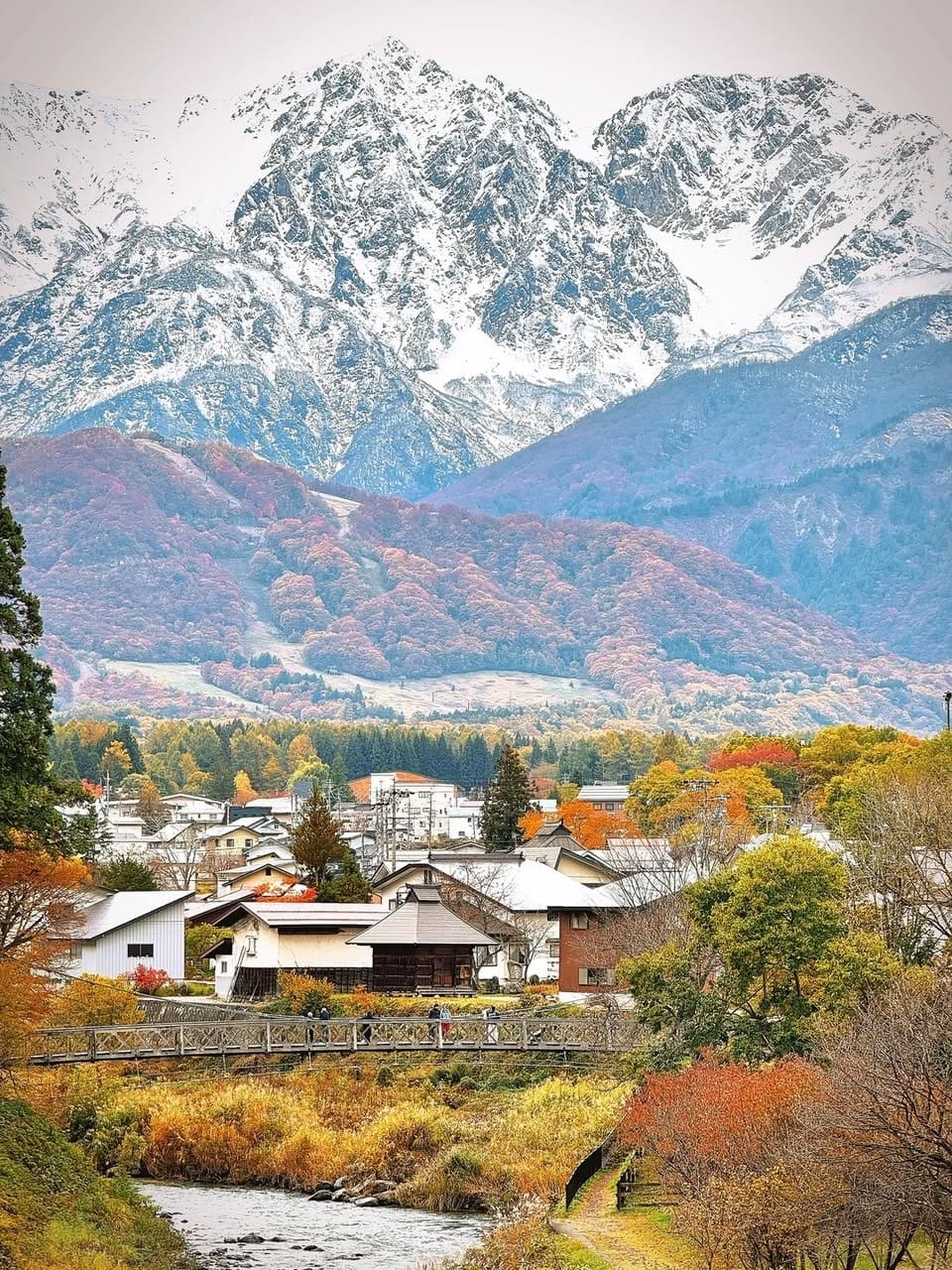
The scene has three layers: a wooden suspension bridge crossing the Hime River (Himekawa), an old thatched-roof house on the bank, and the snow-covered Hakuba Sanzan range behind them. In autumn, both riverbanks glow red and gold. On still mornings, the water reflects almost the entire bridge and forest. The river mist in the early mornings of late October is one of the area’s specialties, gradually lifting within about an hour after sunrise.
A few practical details to know:
- Admission is free, and there are no opening or closing hours. This is a public park with no entry fee.
- It is walkable from Hakuba Station, about 1.5–2 km away, or roughly 25–30 minutes on foot along village roads. If you drive, there is a small parking lot at the entrance, but it holds only a few dozen cars. On busy weekend mornings, it fills up before 7 a.m.
- The best photo spot is on the hill above the bridge; climb a few dozen steps to reach it. Only from there can you fit the bridge, thatched-roof house, and mountains into a single frame.
- This is a lived-in residential area, not a film set. There are homes and fields. Do not enter the fields, block passageways, or speak loudly in the early morning.
Late afternoon at Oide is beautiful in a different way, with golden light falling across the mountain walls, but the mist and still water are a morning-only experience.
The biggest trap: the Happo-one lifts may be closed right when the three-tiered foliage is at its best
This is the most important section of the entire article, and the reason many visitors leave Hakuba disappointed.
The internet is full of photos of Happo Pond (Happo Pond, 八方池)—a small lake at an elevation of around 2.060 meters on the Happo-one ridge, with mirror-like water reflecting the entire snowy mountain range. It is one of Japan’s most famous landscape photographs. Many people assume that if they visit Hakuba in autumn, they will automatically be able to go there.
That is not the case. The gondola and chairlift system up Happo-one operates during the “green season” and usually ends before or right at the beginning of the three-tiered foliage period, then closes completely to prepare for ski season. In many recent years, visitors arriving in Hakuba during the second half of October have found the Happo gondola station locked, even though other areas in the village are still operating normally.
The consequence is very specific: if the lifts are closed, there is no Happo Pond. In theory, you can still hike up from the foot of the mountain, but that is an entirely different undertaking—with more than 1.300 meters of elevation gain, a long route, and snow, ice-covered rocks, and biting winds at elevations above 2.000 meters in late October. This is not a day hike for tourists wearing a light jacket and sneakers. To be blunt: if the lifts are closed, remove Happo Pond from your itinerary. Do not try to force it.
That is why the number-one rule when planning an autumn trip to Hakuba is: check the operating schedule for EACH lift for the CORRECT year of your visit. Hakuba has multiple resorts (Happo-one, Iwatake, Tsugaike, Goryu, Norikura...), each operated by a separate company with its own schedule, prices, and maintenance closures. The fact that Iwatake is running does not mean Happo is running. Just because it operated until a certain date last year does not mean it will do the same this year. Bad weather and strong winds can also cause lifts to stop unexpectedly during the day.
The safest way to check is to visit each resort’s official website and look for the green-season operating period and service status (営業期間 / 運行状況). If you are still unsure, ask your hotel to confirm 1–2 days before your visit. Ten minutes spent checking can save an entire day of your itinerary.
Backup options when the lifts are closed
Hakuba is not short of places to visit; it is short on clear information. Here are a few options worth considering:
Tsugaike Kogen and Tsugaike Nature Park. Take a gondola and ropeway up to highland marshes at around 1.900 meters, where wooden boardwalks loop through the wetlands and forest. The problem is that the fall foliage arrives much earlier at that elevation—usually peaking from late September to early October—and the nature park closes for the season around the end of October. This means Tsugaike and the “three tiers” do not line up perfectly: visit in early October and Tsugaike will be brilliant, but the summits may not yet have snow; visit in late October and you may get the three tiers, but Tsugaike may already be closed or past its peak. You have to choose.
Lake Aoki and the Omachi lakes. South of Hakuba, along National Route 148, lies the Nishina trio of lakes (Aoki, Nakatsuna, and Kizaki). Lake Aoki has deep blue, clear water surrounded by forest, and its autumn reflections are beautiful without the crowds. Driving is the easiest option; if you take the Oito Line, get off at one of the small stations and walk.
Hakuba Olympic Ski Jumping Stadium (Hakuba Jump Stadium). A 1998 Olympic site with an elevator/chairlift to the top of the jumping tower. Admission is usually a few hundred yen. Looking down from the athletes’ starting point is quite a dizzying experience, and the views over the valley are excellent. It works well as a half-day stop.
Onsen. Hakuba Happo’s hot springs are known for their high alkalinity and silky water, which locals call “beauty water.” Several public baths in the village accept walk-in visitors, with admission usually ranging from a few hundred to around one thousand yen. After a morning spent taking photos in 3 degrees Celsius, this is the most rewarding thing you can do all day.
Getting there from Tokyo and Matsumoto: the practical options
From Tokyo, the fastest route is via Nagano. Take the Hokuriku Shinkansen from Tokyo Station to Nagano, which takes around 1 hour 20 minutes to 1 hour 40 minutes depending on the service (Kagayaki is the fastest but requires reserved seating, while Hakutaka makes more stops). Highway buses run directly from outside Nagano Station to Hakuba, taking around 1 hour to 1 hour 15 minutes, with one-way fares of around ¥2.000–2.500. The buses stop at Hakuba Station and several points around the village. Total door-to-door travel time is usually about 3–3.5 hours.
From Tokyo, the cheapest option with the fewest transfers is a direct highway bus. Services from the Shinjuku bus terminal run to Hakuba, taking around 4.5–5 hours, with fares generally around ¥5.000–7.000 depending on the date and operator. The ride is long, but you can sleep through it without having to drag your luggage through a station.
From Matsumoto. This is the natural choice if you are combining Hakuba with Kamikochi or Matsumoto Castle. Take the JR Oito Line from Matsumoto Station to Hakuba Station; the journey takes around 1 hour to 1 hour 40 minutes depending on the train type. The scenery along the way is beautiful, following rivers and passing lakes. The major drawback is the infrequent service. Some departures are more than an hour apart, and missing one train can throw off your entire morning. Take a photo of the timetable as soon as you arrive at the station.
A few limited-express Azusa services from Shinjuku run directly to the Hakuba area without a transfer, but there are very few of them and schedules change depending on the operating period. If you are interested, check the timetable for your specific travel date.
Regarding the JR Pass: the Shinkansen to Nagano and the Oito Line are part of the JR network, but the Nagano–Hakuba bus is privately operated and is not covered by the JR Pass. Do not accidentally include it in your pass budget.
Should you rent a car?
In Hakuba, having a car makes everything much easier: Oide at 6 a.m., Lake Aoki at midday, and the foot of Iwatake in the afternoon. Without a car, you have to rely on the village buses and the limited taxi service during the off-season.
But there are two warnings. First, late October in the mountains of Nagano is when winter tires become a consideration. You usually will not need them in the village, but roads can freeze in the early morning if you plan to cross mountain passes or encounter an early cold snap. When renting a car, ask whether it has winter tires. Second, parking lots at scenic spots are very small. Go early or be prepared to park farther away and walk.
If you do not rent a car, choose accommodation within walking distance of Hakuba Station or the Happo area, and use the local buses for the remaining distances. The three main spots in this article—Oide, Iwatake, and Happo—are all accessible without a car; they simply take more time.
Where to stay: affordable, but watch out for closures
Autumn is Hakuba’s off-season, between summer and ski season. The good news is that room rates are far more reasonable than in winter, and a night at a family-run pension or small lodge with breakfast is often much cheaper than peak January–February prices. The main accommodation areas are Happo, Wadano, Echoland, and around Hakuba Station.
The bad news: many businesses close during this transition period. Pension owners, restaurants, and bars in Hakuba often take a few weeks off in October–November for maintenance before snow season begins. More than a few guests have arrived with a confirmed room reservation, gone out to Echoland for dinner, and found half the restaurants closed for the break, leaving them to eat at a konbini.
The solution is to choose accommodation that serves dinner if you are visiting in late October, or at least ask the front desk in advance which restaurants will be open that evening. And book earlier than you might expect: because fewer properties are open, the actual supply in autumn is much smaller than what booking sites seem to suggest.
Late-October weather and temperatures: what to wear
At the bottom of the Hakuba Valley (around 700 m), daytime temperatures in late October are usually around 13–17 degrees Celsius, while nighttime and early-morning temperatures fall to around 3–7 degrees. During a cold snap, temperatures can reach 0, with frost forming over the fields. At the summit of Iwatake, subtract another 4–6 degrees and add wind chill—the actual feel can be around 0 in the early morning.
That means the temperature difference within a single day can be enormous: standing in the village at noon under the sun, a long-sleeved shirt may be enough, but waiting for the mist to lift at Oide Bridge at 6 a.m. can leave you shaking. The sensible approach is to wear several thin layers: a thermal base layer, a sweater or fleece mid-layer, and a windproof outer jacket. Add a wool hat, thin gloves, and thick socks—these three small items determine whether you can stand taking photos for 40 minutes or only 10.
Other useful items include shoes with good traction (mist-wet trails are very slippery), a portable charger (cold weather drains phone batteries quickly), and a light rain jacket—mountain weather can bring sudden showers, and the day after the rain is often the clearest of all.
Combining Hakuba with Kamikochi: sensible, but remember the 15/11 cutoff
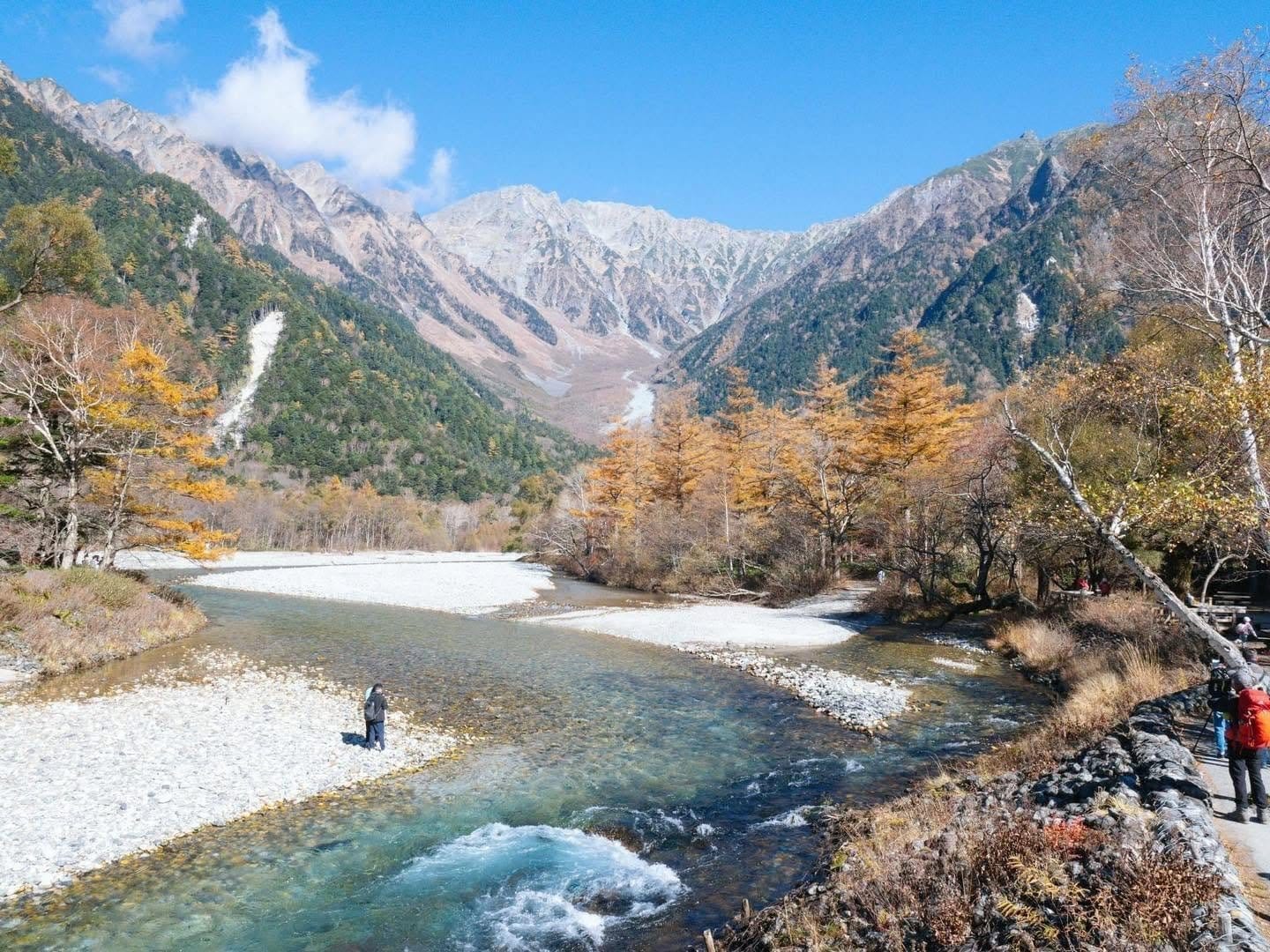
Hakuba’s natural companion is Kamikochi—the famous Azusa River valley in Matsumoto, known for Kappa Bridge, Taisho Pond, and forests of deciduous karamatsu larches that turn golden from late October to early November.
Three essential things to know:
- Kamikochi closes seasonally, usually ending its season around 15/11 and reopening in mid-April the following year. A late-October visit is still fine, but do not plan on going in late November.
- Private cars are prohibited from entering Kamikochi year-round. Even if you rent a car, you must leave it at one of the transfer parking areas (Sawando on the Matsumoto side or Hirayu on the Gifu side) and continue by bus or taxi. This is a fixed rule with no exceptions for tourists.
- Traveling from Hakuba to Kamikochi takes about half a day. The usual public-transport route is to take the Oito Line from Hakuba to Matsumoto, transfer to the Alpico Line to Shin-Shimashima, and then take a bus into Kamikochi. Including transfer times, the journey usually takes 3–4 hours each way. Do not try to fit Hakuba and Kamikochi into the same day.
The most streamlined arrangement is 2 nights in Hakuba, followed by 1 night in Matsumoto or the Sawando/Hirayu area, then a full day in Kamikochi. Seasonal buses sometimes connect Hakuba directly with Kamikochi or Takayama during certain periods. If available, they can save considerable time, but check the schedule for the exact year and date.
Suggested 3-day, 2-night itinerary
Day 1. Leave Tokyo in the morning, take the Shinkansen to Nagano, then the bus to Hakuba, arriving in the early afternoon. Check in, walk or take the bus around the village, visit a public onsen, and have an early dinner. Before bed, check the weather forecast and webcams to decide where to go the next morning.
Day 2. Get up before dawn and head to Oide Park for the mist and first light of the day. Return for breakfast, then take the earliest gondola to Iwatake—this is your day for seeing all three tiers. Spend 2–3 hours at the summit and have a light meal on the viewing deck. In the afternoon, visit Lake Aoki or the Olympic ski-jumping stadium, depending on whether you have a car. Finish the day with another onsen visit.
Day 3. Take a leisurely morning; if the weather is good, return to Oide once more for a different kind of light. Then take the Oito Line down to Matsumoto: either finish your trip in Matsumoto Castle town and continue to Tokyo, or proceed to Kamikochi for another day if you have time.
If you only have 2 days, cut Lake Aoki—not the morning at Oide.
Final things to check before confirming your plans
- Check the operating schedule for each lift for the correct year. It is worth repeating because this is the most common mistake: Happo-one, Iwatake, and Tsugaike are three separate operators with three separate schedules, and the higher-altitude areas close early.
- Do not bet the entire trip on one iconic view. The three-tiered colors depend on the weather. Some years you get the perfect combination, and some years you do not. Plan so that even without all three tiers, your two days in Hakuba are still worthwhile—with onsen, lakes, and a peaceful mountain village.
- Withdraw cash in advance. In a mountain village during the off-season, not every business accepts cards, and foreign-card-compatible ATMs are limited. Konbini are the safest places to withdraw money.
- Be prepared for limited services. Hakuba is much quieter in autumn than in winter. That is part of the appeal—no crowds and lower prices—but it also means fewer restaurants, fewer buses, and fewer dinner options.
- Bears. The mountains of Nagano are home to Asiatic black bears, and autumn is when they forage to build up food reserves. On little-used trails, wear a bell or make noise, do not walk alone at dusk, and pay attention to local warning signs.
Hakuba’s three-tiered colors are not the kind of lavish scenery, like Kyoto’s temples and shrines, that you can see year-round. They are a phenomenon of timing—something that appears only when winter has touched the mountain peaks but autumn has not yet left the valley. Visit on the right day and it will be one of Japan’s most memorable mountain landscapes; arrive a week too early or late and it will still be a beautiful mountain village, just a more ordinary one. Prepare carefully, leave room for flexibility, and remember to check the lifts—that is enough to make the trip worthwhile despite the early mornings.
If you are adding Hakuba to a longer autumn itinerary through Nagano, Matsumoto, and the Japanese Alps, you can also see suggested itineraries on the OlaChill Japan travel blog.
More from this region — Chubu (Nagano, Kanazawa)
View all →
Hakuba Valley Guide to 10 Ski Resorts: Happo-One, Tsugaike, and Top Picks for Advanced Skiers
18 min · スキー
Kamikochi Hiking Guide: Valley Trails, Access and Seasons
6 min · experiences
Tateyama Kurobe Alpine Route: Hiking Trails from Murodo
6 min · experiences
Hot-Air Balloon in Japan — 5 Minutes Over the Alps at a Surprising Price
2 min · tips