
Comiket Guide for First-Timers: Dates, Venue, Tickets and What to Wear
First time at Comiket? When it runs, getting to Tokyo Big Sight, tickets, cash, summer and winter kit, cosplay rules and an easy plan for your first day.
May 4, 2026·✍️ olablog·⏱ 14 min read
First time at Comiket? When it runs, getting to Tokyo Big Sight, tickets, cash, summer and winter kit, cosplay rules and an easy plan for your first day.
It is four o'clock on an August morning and Tokyo is barely awake, yet a steady stream of people is already heading towards the bay, water bottles in hand and empty backpacks waiting to be filled. They are not catching an early flight or queuing for a new phone. They are on their way to コミックマーケット (Comic Market), better known as Comiket, the world's largest event for 同人誌 (doujinshi, self-published works). With hundreds of thousands of visits at every edition, it is the event that best represents Japan's anime and manga culture, and it draws fans from across Japan and around the world.
If you think of Comiket as "just a comic fair", your first visit will change your mind. It is a sea of people that stays astonishingly orderly, tens of thousands of "circles" (creator groups) selling work they made themselves, a cosplay area that feels like a festival of its own, and a set of official and unwritten rules that everyone follows. Comiket is not a commercial show with organisers serving customers. Its philosophy is that everyone who comes is a participant (sankasha) who helps make the event happen. Understanding that is the first step to a great Comiket.
This guide is for first-timers: when and where the event takes place, how to get there, how to prepare for a scorching summer or a biting winter, what it costs, and the cosplay rules that trip up newcomers more than anything else. It is all practical advice, so you can join the crowd with confidence even on your very first visit.
What Comiket is and why it's so special
Comiket began in the 1970s as a small marketplace where amateur creators exchanged doujinshi, and it has grown into the enormous cultural event it is today. Its heart is the circles: groups or individuals who create their own comics, novels, illustrations, music and games and sell them directly to fans. The work ranges from derivative pieces (fan works based on popular anime, manga and games) to completely original creations. Many well-known Japanese professional artists and writers started out at a small table at Comiket, and plenty of them still come back to sell as ordinary circles.
That is why going to Comiket is about much more than shopping. It is a chance to meet the creators you admire face to face, to buy works released only at the event and sold nowhere else, and to feel the creative energy of Japan's doujin culture in its purest form.
When Comiket takes place
Comiket is held twice a year. The summer edition usually runs in mid-August (fans call it Natsukomi), and the winter edition usually falls in the last days of December (Fuyukomi). Each edition lasts several days (in recent editions, usually two), and each day features a different group of circle genres. If a circle you want to visit is selling only on day one, you won't find it on day two. The exact dates, the number of days and the genres assigned to each day are published on the official Comiket website, and that is the only source you should trust: information on social media often mixes up different editions.
Plan ahead for one more thing. The summer edition coincides with Japan's Obon holidays and the winter edition comes just before New Year, so flights and hotels around Tokyo Bay get more expensive and sell out early. Once you decide to go, book your accommodation as soon as possible, ideally as soon as the dates are announced.
The venue: Tokyo Big Sight and how to get there
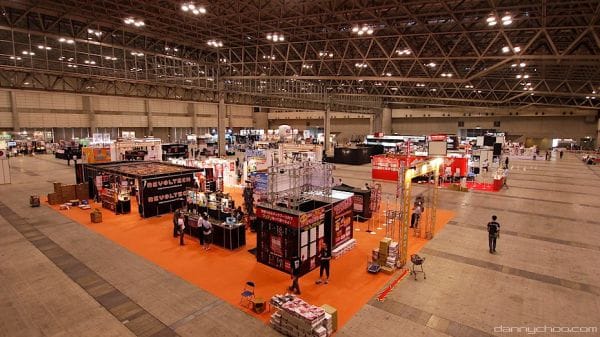
Comiket takes place at Tokyo Big Sight (Tokyo International Exhibition Center) in Ariake on Tokyo Bay, the building with the distinctive upside-down pyramids that you have almost certainly seen in anime. It is one of the largest exhibition centres in Japan, and Comiket uses almost all of its halls.
Trains to Tokyo Big Sight
There are two main rail routes:
- Rinkai Line: get off at Kokusai-Tenjijo Station and walk a short way. This is convenient if you are coming from Shibuya, Shinjuku or Osaki.
- Yurikamome: this automated line runs from Shimbashi or Toyosu to Tokyo Big Sight Station, right in front of the venue. It runs on an elevated track with lovely views of the bay, but its capacity is small, so it is extremely crowded on event days.
There are also bus routes from Tokyo Station and a few other points in the city.
Getting there on the day
On Comiket days, both lines are packed in the morning. Load plenty of credit onto an IC card (Suica or Pasmo) the day before, and don't leave buying a ticket until you reach the station. When the event closes in the afternoon, the rush to the stations is even worse than the morning. If you are not in a hurry, stay in the area, eat and rest until the crowds thin out, then take the train. Ariake and nearby Odaiba have plenty of shopping centres where you can take refuge while you wait.
Tickets and admission
Comiket used to be free to enter, but in recent years it has moved to a system of tickets or admission wristbands, with different types for early entry and timed entry. The system changes from edition to edition, so the only advice that is always right is this: read the admission guide on the official website for the edition you plan to attend, and get your ticket in advance exactly as it describes. Never assume that this edition works like the last one. That mistake has left more than one fan who flew halfway around the world standing outside.
The other essential tool is the Comiket catalogue, available in print and online. It lists every participating circle and its location on the floor plan, together with the event rules. For first-timers the web version is far more convenient, because you can search by title or genre and bookmark favourite circles to plan your route.
Before you go
Make a list and plan a route
Tokyo Big Sight is vast and there are tens of thousands of circles. If you turn up and "just wander around to see what's there", you will be exhausted within an hour without having bought anything you really wanted. Use the catalogue to list circles in order of priority, note the hall and table number for each, and plan a sensible route between them. The general rule: go first to the popular circles that are likely to sell out, and leave smaller ones for later.
What to bring: summer and winter are two different battles
Summer Comiket is notorious for the heat. In mid-August in Tokyo, queuing outdoors in the sun can make even the fittest person unsteady, and at every edition some people need the first-aid team because of heatstroke. Essentials:
- Summer: more water than you think you'll need, salt sweets or electrolyte tablets, a sweat towel, a hat, a hand fan and breathable clothes.
- Winter: cold wind blows straight off the bay into the outdoor queues, so bring a windproof jacket, a scarf and disposable heat packs.
- Both seasons: comfortable trainers (you will walk and stand almost all day), a backpack or large bag for your haul, plastic bags to keep books dry in the rain, a power bank, and a few snacks, because food outlets in the area have very long queues on event days.
Cash is king
The vast majority of circles accept cash only. Doujinshi usually cost from a few hundred to just over a thousand yen each, so what you need is plenty of ¥1,000 notes and coins rather than a few ¥10,000 notes. Handing a large note to a small circle makes things difficult for them and slows down the whole queue behind you. Get your change the day before: ATMs near the venue tend to have long queues on the day, so don't count on them.
What a day at Comiket looks like
Morning: queues and entry
Whether you arrive early or on time, you will almost certainly queue. Comiket queues are unbelievably long, but they keep moving and stay perfectly orderly: no pushing, no saving places for friends, and you follow the volunteers' directions. The wait outside can be long, which is exactly when your heat or cold gear earns its place. When the gates open, do not run. "No running" is Comiket's most famous rule and is repeated constantly over the loudspeakers, because in a crowd this dense one person tripping can set off a chain of accidents.
Inside the halls: islands, walls and how to buy
Most circles sit at rows of tables in the middle of the halls, nicknamed "islands" (shima). The most popular circles, which draw big crowds, are placed along the walls (kabe) where there is room for their own queues, and the very largest are put next to the loading shutters so their lines can stretch outside. When you buy, have the right money ready, say clearly which titles you want and how many copies, take your books, say thank you and move on. If you are a long-time fan, a quick "I really love your work" will make the creator's day, but don't stop for a long chat when dozens of people are waiting behind you.
The corporate booths
Besides the circles, Comiket has an area for companies from games, anime and publishing, which sell event-limited goods and hold mini events. Queues work differently here and limited items sell out very quickly. If corporate goods are your main goal, decide your priorities from the start, because covering both the corporate area and the circles in a single morning is hard.
Cosplay at Comiket: the rules you must know
Cosplay is one of the most colourful parts of Comiket, but it is also the area with the strictest rules, and the organisers enforce them seriously.
Where to change and what you can wear
The most important rule: you may not travel to or from the venue in costume. Arrive in ordinary clothes, register at the dedicated cosplayer changing room, pay the registration fee, change there, and change back into ordinary clothes before you leave at the end of the day. Heavy character make-up should also be done in the changing room, not on the train. There are further rules on how revealing a costume can be and on props (long replica weapons and sharp objects are restricted or must be checked), and they are set out in detail in the official documents for each edition. Read them at home, so you don't discover at the door that the prop you spent weeks on can't come in.
Cosplay areas and photo etiquette
Once changed, cosplayers use the designated cosplay areas, usually plazas and outdoor spaces around the venue. If you want to photograph a cosplayer, ask them directly and only shoot if they agree. Taking photos secretly, following someone to photograph them, or shooting from low angles is prohibited, and the community reacts strongly to it. Afterwards, a thank-you with a slight bow is the proper courtesy. If you plan to post your photos online, ask the cosplayer whether they are happy with that and how they would like to be credited.
A suggested plan for first-timers
If this is your first time and there is no must-buy circle you absolutely cannot miss, our honest advice is not to arrive at dawn. Choose a later timed-entry ticket or come in the early afternoon. Entry is much faster, the halls are easier to breathe in, most circles still have stock, and you will have the energy to see the cosplay area and the corporate booths too.
A manageable day looks like this:
- Arrive in the late morning or early afternoon.
- Spend about two hours working through your circle list.
- Spend about one hour in the cosplay area.
- Spend about one hour wandering freely and making discoveries.
- Leave a little before closing time to beat the crowds heading home.
Save the queue-at-dawn experience for a later edition, when you know the event and exactly what you want.
Estimated costs
A typical participant's day at Comiket includes:
| Item | Rough cost |
|---|---|
| Admission ticket or wristband | Varies by edition and ticket type (see the official website) |
| Trains around Tokyo | A few hundred to about ¥1,000 |
| Food and drink | About ¥1,000–2,000 |
| Doujinshi | Up to you; first-timers usually spend about ¥5,000–10,000 and go home with a respectable stack |
| Cosplay (if you take part) | Add the changing room registration fee |
All in, a moderate day at Comiket costs roughly ¥10,000–15,000, not counting accommodation.
Common first-timer mistakes
- Not researching in advance. Searching your phone for "where is this circle?" in the middle of the crowd is close to hopeless.
- Bringing too little water in summer. Heatstroke at Comiket is real and happens every year. Don't assume you'll be fine because you are young and fit.
- Bringing only large notes or planning to pay by card.
- Travelling to the venue in costume. It breaks the event's most basic rule.
- Trying to do everything in one day. Comiket is so big and so crowded that even veterans have to choose.
- Forgetting that you are a participant, not a customer. Everything works because everyone cooperates, so follow the instructions, queue properly and keep the venue clean.
Frequently asked questions
Can I go if I don't speak Japanese?
Yes, but prepare more carefully than someone who does. Comiket provides guidance for international visitors, and buying from a circle is actually very simple: point to the book you want, hand over the money and say thank you. The biggest hurdle is reading the catalogue and the rules, so use a translation tool or ask a Japanese-speaking friend to help with your preparation beforehand.
Should I bring children, or companions who aren't fans?
Comiket is extremely crowded and tiring, and it is not an ideal environment for small children or for people with no interest in doujin culture. Some areas selling age-restricted works are also controlled separately. If your family wants a taste of the atmosphere, an afternoon visit on the final day is the gentlest option.
Can I take doujinshi home from Japan?
Most ordinary publications are no problem, but if you buy adult titles, check your own country's customs rules for adult material. Books are also heavy: many seasoned participants use a delivery service within Japan to send their haul to their hotel or the airport instead of carrying it themselves.
What if I can't get a ticket or miss Comiket?
Japan has many other doujinshi events throughout the year. They are smaller and more relaxed, which makes them friendlier for newcomers. If your goal is to experience doujin culture in general rather than Comiket specifically, they are a great place to start before taking on the big one. In Tokyo, Akihabara and Ikebukuro's Otome Road are also worth exploring year-round.
Is it worth going on both days?
If your stamina and schedule allow, absolutely: each day features different circle genres, so it is almost like two separate events. But know your limits, because a day at Comiket takes as much energy as a day in the mountains. Many people spend one day working through their list and the other exploring at a relaxed pace, which we think is the best formula for a first visit.
Comiket is the kind of event you have to stand in the middle of to understand why people happily queue from dawn in the August heat. It isn't just about buying a few comics. It is the feeling of being inside a huge creative community, where the line between the people who make the work and the people who love it almost disappears. Prepare well, follow the rules, look after yourself, and your first Comiket will be one of your most memorable experiences in Japan.
More from this region — Other
View all →
Aoi Matsuri in Kimono: Procession Route, Viewing Spots and Dress Tips
6 min · culture
Esports at Aichi Sky Expo, Tokoname: Group Transport and Timing
7 min · events

Athletics Week at Paloma Mizuho Stadium: Group Transport Planning
6 min · events
When to Book a Charter Bus for the Asian Games (and What Happens If You Wait)
7 min · tips