
Shinjuku Gyoen: Seasonal Highlights and Visitor Guide
Shinjuku Gyoen is a national garden where you can enjoy abundant nature despite its location in central Tokyo. This in-depth guide covers the latest information as of July 2026, including the best times to see the cherry blossoms and autumn foliage, admission fees, reservation procedures, and ways to enjoy the expansive lawns.
Jul 24, 2026·✍️ olablog·⏱ 10 min read
Shinjuku Gyoen is a national garden where you can enjoy abundant nature despite its location in central Tokyo. This in-depth guide covers the latest information as of July 2026, including the best times to see the cherry blossoms and autumn foliage, admission fees, reservation procedures, and ways to enjoy the expansive lawns.
Tap a region to browse articles
Shinjuku Gyoen is a vast, lush oasis within walking distance of Shinjuku Station, offering a peaceful escape from the hustle and bustle of the city. With beautiful scenery in every season, this garden has become a popular destination for visitors from Japan and around the world.
In this article, we take an in-depth look at the appeal of Shinjuku Gyoen, the best times to see its cherry blossoms and autumn foliage, the latest admission fees and reservation procedures as of July 2026, and ways to spend time on its spacious lawns.
What Is Shinjuku Gyoen? The Appeal of an Urban Oasis
Shinjuku Gyoen traces its origins to the estate of Naitō Kiyonari, a retainer of Tokugawa Ieyasu, during the Edo period. During the Meiji period, it was developed as an imperial garden. It was later opened to the public as a national garden in 1949 and remains so today. Covering approximately 58.3 hectares with a perimeter of 3.5km, the expansive grounds skillfully combine three distinct garden styles: a Japanese garden, a French Formal Garden, and an English Landscape Garden. Each has its own unique beauty.
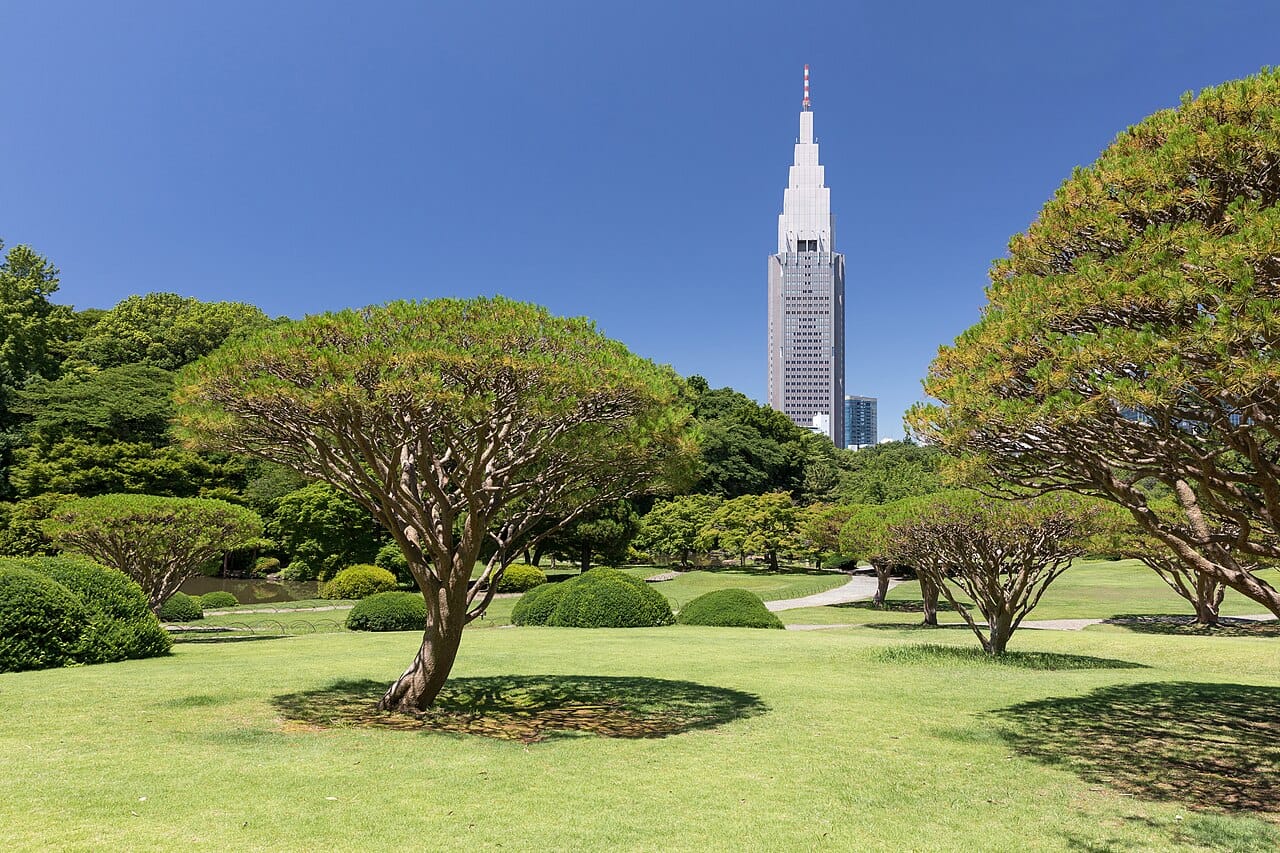
The Japanese garden follows the traditional stroll garden style, centered around a large pond where visitors can admire a variety of plants, including Tagyōshō and Kanzakura. The Former Imperial Rest House, standing beside the pond, is another highlight that evokes the atmosphere of traditional Japan. The French Formal Garden is characterized by symmetrical rows of plane trees and flowerbeds filled with approximately 500 roses of 110 varieties, enveloping visitors in an elegant fragrance in early summer and autumn. The spacious lawns and naturally grown giant trees of the English Landscape Garden create a sense of openness that makes it easy to forget you are in the heart of the city. Shinjuku Gyoen’s iconic tulip tree, standing approximately 30m tall, also rises above this landscape garden.
Seasonal Highlights: Cherry Blossom and Autumn Foliage Calendar
Shinjuku Gyoen offers beautiful scenery throughout the year, but its cherry blossoms in spring and autumn foliage are particularly spectacular.
Cherry Blossoms (Spring)
Approximately 900 to 1,100 cherry trees representing around 65〜70 varieties are planted at Shinjuku Gyoen. Because the garden includes varieties ranging from early- to late-blooming trees, visitors can enjoy cherry blossoms over an extended period from mid-February through late April.
- Early-blooming cherry blossoms (mid-February to mid-March): Varieties such as Kanzakura, Shuzenji Kanzakura, and Kawazuzakura begin to bloom, heralding the arrival of spring.
- Somei Yoshino (late March to early April): Pale pink Somei Yoshino cherry blossoms add color throughout the garden, making this the busiest time of year. Approximately 300〜400 Somei Yoshino trees are planted in the garden.
- Late-blooming double-flowered cherry blossoms (mid-April to late April): Showy double-flowered varieties with layers of petals, including Ichiyō, Kanzan, Fugenzo, Ukon, and Gyoikō, reach their peak.
Autumn Foliage (Fall)
The autumn foliage at Shinjuku Gyoen typically begins to change color in mid-October and reaches its peak from late November through early December. A wide variety of trees, including ginkgo, maple, plane trees, metasequoia, dogwood, tulip trees, and cherry trees, transform the garden with vibrant colors.
- Top foliage-viewing spots:
- Maples near Shinjuku Gate: Welcome visitors with a beautiful arch of autumn leaves.
- Maples in the Japanese garden: Enjoy atmospheric foliage set against the elegant backdrop of the stroll garden and its pond.
- Momijiyama: Especially impressive are the maples that are the last in the garden to change color.
- Ginkgo avenue: The ginkgo trees near the Central Rest House and Shinjuku Gate shine golden yellow.
- Plane tree avenue: The approximately 200m-long avenue in the French Formal Garden displays beautiful yellow foliage.
During the autumn foliage season, the Chrysanthemum Bed Exhibition, associated with the imperial family, is usually held in early November, offering a chance to appreciate traditional Japanese beauty.
Admission Fees and Reservations: Latest Information as of July 2026
The latest information about admission to Shinjuku Gyoen as of July 2026 is as follows.
Opening Hours
Opening hours vary by season. Check the official website for the latest information.
| Period | Opening hours | Last admission | Greenhouse hours |
|---|---|---|---|
| October 1~March 14 | 9:00~16:30 | 16:00 | 9:30~16:00 (last entry 15:30) |
| March 15~June 10 | 9:00~18:00 | 17:30 | 9:30~17:30 (last entry 17:00) |
| August 1~September 30 | 9:00~18:00 | 17:30 | 9:30~17:30 (last entry 17:00) |
| June 11~July 31 | 9:00~19:00 | 18:30 | 9:30~18:30 (last entry 18:00) |
Closed: Every Monday (if Monday is a holiday, the following weekday), and the year-end/New Year holiday period (December 29~January 3). However, the garden is open every day during the special spring opening period (March 25~April 24) and the special autumn opening period (November 1~November 15).
Admission Fees
| Category | Individual | Group (30 people or more) | Annual passport |
|---|---|---|---|
| Adults | 500 yen | 400 yen | 2,000 yen |
| Age 65 and over | 250 yen | 250 yen | - |
| Students (high school and above) | 250 yen | 250 yen | 1,000 yen |
| Children (junior high school and under) | Free | Free | - |
※Admission is free for visitors with a Physical Disability Certificate, Rehabilitation Certificate, or Mental Disability Certificate, as well as one accompanying caregiver. ※Annual passports are sold at the ticket counters at each entrance and are valid for 1 year from the date of purchase. It is also possible to transfer from a previous passport.
Advance Reservations
Advance reservations may be required on certain days expected to be particularly crowded, such as during the cherry blossom season. In 2026, advance reservations were required between 10:00 and 16:00 on specified days from Saturday, March 28, through Sunday, April 5.
- Outside the reservation period: No advance reservation is required.
- During the reservation period: You must purchase a date- and time-specific electronic admission ticket in advance.
- Visitors not required to reserve: Annual passport holders, visitors eligible for free admission (children of junior high school age and under, visitors with a disability certificate and one accompanying caregiver), guardians accompanying children (junior high school age and under), and pregnant visitors may enter without an advance reservation. However, they must purchase an admission ticket at the ticket counter on the day or tap a transportation IC card to enter. The use of transportation IC cards is recommended to help reduce congestion.
Free Admission Days
The following free admission days have been scheduled for fiscal 2026.
- April 29 (Wednesday): Shōwa Day
- May 4 (Monday): Greenery Day
- May 5 (Tuesday): Children's Day
- June 6 (Saturday), June 7 (Sunday): The weekend closest to Environment Day (June 5)
These days are expected to be extremely crowded, so allow plenty of time for your visit.
Admission tickets to Shinjuku Gyoen can also be purchased on the day of your visit, but securing your ticket in advance is recommended for smoother entry. If you would like to conveniently reserve tickets for various attractions online, take advantage of Book sightseeing tickets and passes. More than 300 types of admission tickets, cruises, and passes can be arranged with instant confirmation.
Spending Time on the Expansive Lawns: Picnics and Relaxation
One of Shinjuku Gyoen’s greatest attractions is the English Landscape Garden, with its vast expanses of lawn. You can spread out a picnic sheet and enjoy a meal, read beneath the shade of a tree, or simply lie back and gaze at the sky—the choice is yours.
Why not spend a relaxing moment in this open space that makes you forget you are in the middle of the city? In the lawn areas, taking off your shoes and enjoying the sensation of grounding is also recommended.
However, there are several rules governing activities in the garden.
- Prohibited activities:
- Bringing in or drinking alcohol and smoking are prohibited.
- Playing with equipment or sporting goods such as balls and badminton gear, as well as group running, is not permitted (except for the use of safe play equipment in the children's area).
- Tents and open flames are prohibited.
- Commercial photography and drone photography are not permitted.
- During the cherry blossom season, please refrain from using equipment such as tripods and reflectors that may obstruct walkways.
Some areas of the garden may be temporarily closed to visitors for lawn maintenance, so check the official website for the latest information before your visit.
Access to Shinjuku Gyoen and Nearby Information
Shinjuku Gyoen has three entrances—Shinjuku Gate, Okido Gate, and Sendagaya Gate—and each is closest to different stations.
- Shinjuku Gate:
- Approximately 10 minutes on foot from the South Exit of Shinjuku Station on the JR, Keio, and Odakyu lines
- Approximately 5 minutes on foot from Shinjuku-gyoemmae Station on the Tokyo Metro Marunouchi Line (Exit 1)
- Approximately 5 minutes on foot from Shinjuku-sanchome Station on the Tokyo Metro Fukutoshin Line and Toei Shinjuku Line (Exits E5/C1/C5)
- Okido Gate:
- Approximately 5 minutes on foot from Shinjuku-gyoemmae Station on the Tokyo Metro Marunouchi Line (Exit 2)
- Sendagaya Gate:
- Approximately 5 minutes on foot from Sendagaya Station on the JR Sobu Line
- Approximately 5 minutes on foot from Kokuritsu-kyogijo Station on the Toei Oedo Line (Exit A5)
You can reach Shinjuku Gyoen from Shinjuku Station in approximately 8 minutes by train. Take the Marunouchi Line from Shinjuku Station to Shinjuku-gyoemmae Station, just 1 stop and approximately 3 minutes, then walk for about 5 minutes from the station to reach Shinjuku Gyoen. By bus, you can take the Toei Bus route “品97” from the west exit of Shinjuku Station and reach the Shinjuku-sanchome bus stop in approximately 10 minutes.
The garden also has parking for 200 standard-size vehicles and 5 large vehicles.
Rest areas, restaurants, cafés, and shops are scattered throughout the garden, providing places to take a break when you get tired of walking or to purchase souvenirs.
When visiting Shinjuku Gyoen as a base for sightseeing in Tokyo, it is recommended that you also explore the appealing attractions in the surrounding area. Tokyo has many other highlights to discover, so why not look for a guided day trip at See day tours departing from Tokyo? Enjoy Tokyo at a great value for a flat ¥6,900.
Frequently Asked Questions
Q. How long should I plan to spend at Shinjuku Gyoen? A. Since Shinjuku Gyoen covers a vast area, allow 2〜3 hours for a leisurely walk, or at least 1〜2 hours even if you are visiting only the main highlights. You can take your time enjoying seasonal flowers, historic buildings, and the three gardens in distinct styles.
Q. Can I eat and drink at Shinjuku Gyoen? A. Picnics are permitted on the expansive lawns, but bringing in or drinking alcohol is prohibited. There are also cafés, restaurants, and shops within the garden where you can purchase light meals and drinks and take a break.
Q. Can I bring a pet into the garden? A. Pets are not allowed, except for assistance dogs such as guide dogs, hearing assistance dogs, and service dogs.
Q. Are there any precautions regarding photography in the garden? A. Personal photography is permitted, but commercial photography and drone photography are prohibited. Also, during busy periods such as cherry blossom season, please refrain from using equipment such as tripods and reflectors that could obstruct other visitors’ passage.
Q. Is the garden wheelchair accessible? A. The main walking paths are paved and accessible by wheelchair. While some areas, such as gravel paths, can be difficult to navigate, most steps and steep slopes have been eliminated. Accessible restrooms are available, and wheelchairs can be borrowed at each entrance and the service center (same-day application, free of charge).
More from this region — Tokyo & Kanto
View all →
How to Explore Isetan Shinjuku: A Guide to the World's Greatest Department Store
12 min · tips
Tokyo Skytree Guide: Tickets, Observation Decks, and How to Enjoy Solamachi
8 min · destinations

Tokyo Sneaker Shop Guide: How to Find Exclusive Models
11 min · tips
Tokyo Soba: A Guide to Long-Established Restaurants for Savoring Edo-Style Elegance
11 min · food