
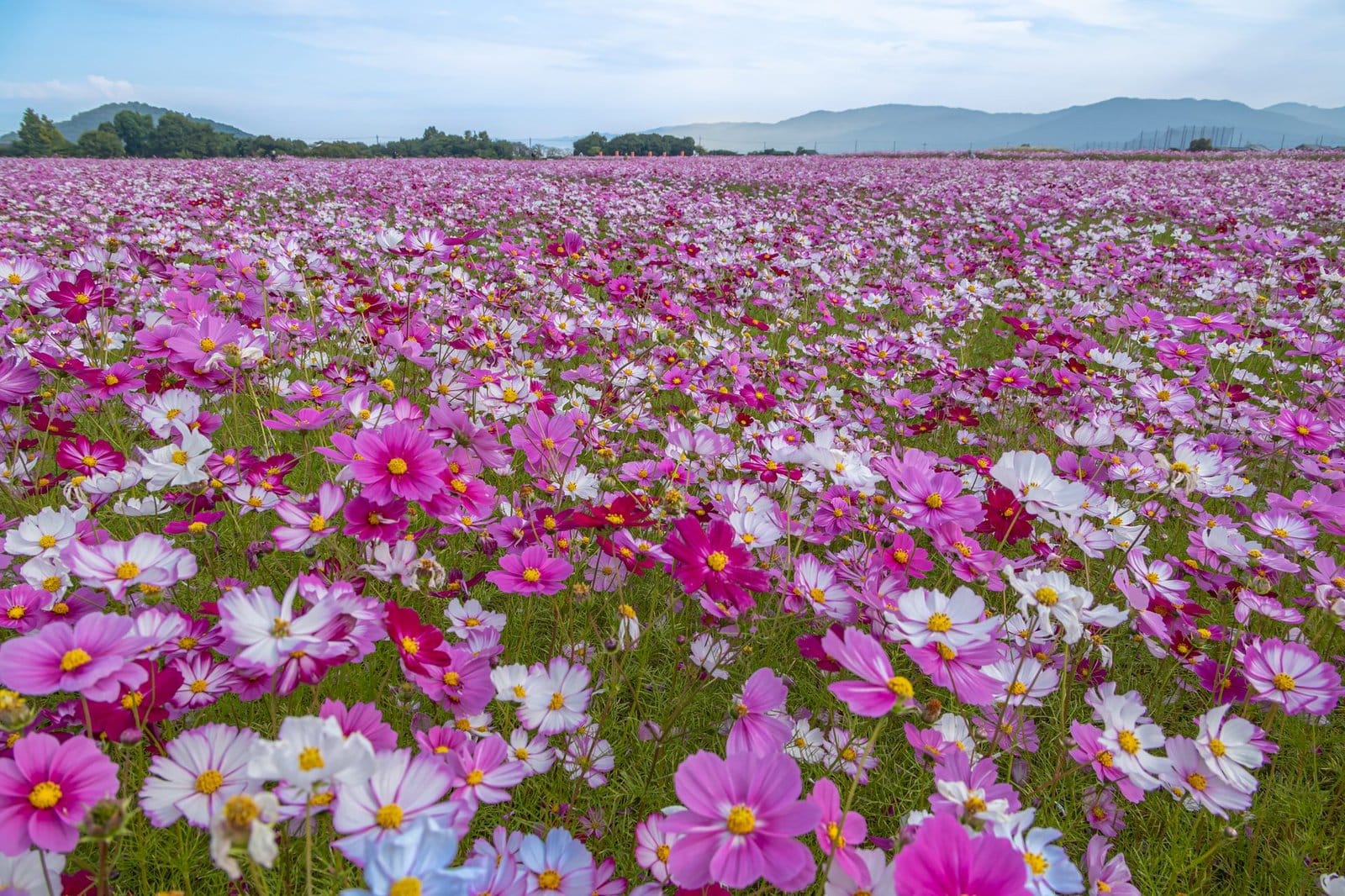
Cosmos Flowers in Autumn – Japan's Sweeping Pink-and-Purple Fields
Japan's cosmos fields explode in shades of pink, white, purple, and gold from September through November. Here's your guide to the best spots and how to plan the perfect autumn trip.
Mar 3, 2026·✍️ olablog·⏱ 6 min read
Japan's cosmos fields explode in shades of pink, white, purple, and gold from September through November. Here's your guide to the best spots and how to plan the perfect autumn trip.
Cosmos: Japan's Unofficial Flower of Autumn
If cherry blossoms own spring, cosmos flowers own fall. The Japanese call them Akizakura (秋桜) — literally "autumn cherry blossoms" — and it's an apt nickname. From mid-September through November, vast fields of pink, white, purple, and amber cosmos roll across the Japanese countryside, from the wide-open plains of Hokkaido in the north all the way down to the warmer hills of Kyushu.
Here's the thing sakura fans don't want to hear: cosmos are actually the better deal. While cherry blossoms give you roughly a week before they're gone, cosmos hang around for nearly two months — plenty of time to actually plan a trip without obsessively refreshing a bloom forecast. Better still, they're typically planted in enormous field-scale plantations on the city outskirts, creating those sweeping, painterly landscapes where pretty much any photo you take looks like a magazine cover.
Best Cosmos-Viewing Spots Across Japan
🌸 Kanto (Greater Tokyo Area)
- Showa Kinen Park (Tachikawa, Tokyo): Around 550,000 cosmos plants bloom from mid-September through late October. Catch the JR Chuo Line from Shinjuku — you'll be there in about 30 minutes. Entry is $3 (¥450).
- Kuragi Park (Saitama): Cosmos fields with Mt. Fuji framed in the distance — a firm favorite on the landscape photography circuit.
- Hitachi Seaside Park (Ibaraki): Famous for its scarlet kochia (burning bush) in October, but hidden right next door are 2 million cosmos blooming simultaneously. Entry $3 (¥450).
🌸 Kansai (Kyoto · Osaka · Nara)
- Hannyaji Temple (Nara): Nicknamed "the cosmos temple," this centuries-old Buddhist site is ringed by over 150,000 blooms. Take a 15-minute bus ride from JR Nara Station. Entry $3.50 (¥500).
- Fujiwara-kyo Village (Asuka, Nara): Cosmos fields spread across the ruins of a 1,300-year-old imperial capital. Free entry.
- Kameoka Dream Park (Kyoto): Eight million cosmos — the single biggest display in the Kansai region.
🌸 Hokkaido & Tohoku
- Taiki-cho Cosmos Park (Hokkaido): Blooms earlier than anywhere else in Japan — mid-August through September — making it a natural add-on if you're already up north for the tail end of lavender season.
- Miyagi Zao Cosmos no Sato: Hillside fields on the slopes of Mt. Zao with panoramic views of the Tohoku valley below. Pair a visit here with the early autumn koyo (fall foliage) season for a serious double hit of color.
When to Go: Japan's Cosmos Bloom Calendar
Depending on latitude and variety, cosmos across Japan fall into three main bloom windows:
| Region | Peak Bloom | What to Expect |
|---|---|---|
| Hokkaido | Mid-August – September | Early bloomers; crisp, cool air |
| Tohoku & Kanto | Mid-September – late October | Peak season; plenty of local festivals |
| Kansai & Kyushu | October – early November | Late bloomers; pleasant, mild weather |
For photography, aim for 6:30–9:00 AM when morning dew still clings to the petals, or 3:30–5:00 PM when low-angle golden-hour light makes the whole field glow. Avoid midday — harsh overhead sun washes out the colors, and cosmos petals are thin enough that they'll actually droop in the heat.
Getting There: Practical Transport Tips
Unlike Tokyo's major sights, most cosmos fields sit well outside city centers. The nearest train station is often 2–3 miles away, and you'll usually need a local bus connection on top of that.
Option 1 – JR trains + local bus: Works well for well-connected spots like Showa Kinen Park, Hitachi Seaside Park, and Hannyaji Temple. If you have a JR Pass, the train leg is covered — but rural bus schedules can be painfully thin (sometimes just one or two buses per hour), so plan ahead using OlaChill's Japan train search tool.
Option 2 – Rental car or private driver: The smarter move if you want to hit multiple spots in a day, especially in Nara, Ibaraki, or Hokkaido. Driving also means you can pull over for any roadside field that catches your eye — the kind of spontaneous detour that's simply impossible on public transit. Remember: Japan drives on the left.
✨ Tip: Book a private car through OlaChill — driver options with English-speaking chauffeurs are available, ideal for families or anyone who'd rather not navigate left-hand traffic on unfamiliar rural roads.
Sample 2-Day Itinerary: Kansai Cosmos Loop
Day 1 – Ancient Nara:
- 7:30 AM: Depart from Osaka or Kyoto toward Asuka (Nara)
- 9:00 AM: Fujiwara-kyo cosmos fields — shoot against the atmospheric backdrop of 7th-century imperial ruins
- 11:30 AM: Lunch in Asuka village — try kakinoha-zushi (sushi wrapped in persimmon leaves), a regional specialty that's earthy, subtly sweet, and nothing like the conveyor-belt stuff back home
- 2:00 PM: Hannyaji Temple for cosmos-meets-Buddha-statue shots, then a leisurely bike loop around Nara Park with the famous free-roaming deer
- 5:00 PM: Head back to Osaka for dinner — okonomiyaki (savory Japanese pancakes) on Dotonbori is practically mandatory
Day 2 – Kyoto in Bloom:
- 8:00 AM: Travel to Kameoka Dream Park (about 50 minutes from central Kyoto)
- 9:00 AM – noon: Wander through eight million cosmos at your own pace; kimono rentals are available on-site if you want the full picture-perfect experience
- 1:00 PM: Kaiseki set lunch near Arashiyama — splurge-worthy and surprisingly filling
- 3:00 PM: Stroll the bamboo grove at Arashiyama and cross the iconic Togetsukyo Bridge
- Evening: Return to Kyoto
Quick Tips to Get the Most Out of Your Visit
- 📸 Shoot wide-open (f/1.8–f/2.8): Cosmos are tailor-made for a shallow-depth-of-field shot — throw the background out of focus and let the flowers pop. Your phone's Portrait Mode works in a pinch, but a mirrorless camera will absolutely deliver.
- 👗 Wear white, cream, or navy: These tones contrast beautifully against the pink-and-purple backdrop. Avoid wearing pink — you'll disappear into the flowers.
- 🌬️ Pack a light jacket: Late September through October mornings in the Kanto and Kansai regions can dip to the low-to-mid 50s°F (12–15°C) even when afternoons hit a comfortable 72°F (22°C).
- 🚗 Book rental cars early for October weekends: Cosmos season overlaps with koyo (fall foliage) season — the two most popular autumn draws in Japan. Rental car availability in Kansai and Kanto disappears fast.
- 📱 Get a Japan eSIM before you fly: Many cosmos fields are in rural areas with limited or no public Wi-Fi. Check out OlaChill's Japan eSIM guide for reliable data across the whole trip.
- 🌧️ Check the forecast the night before: Heavy rain flattens cosmos fields badly. Give it one or two sunny days to recover before visiting — it's worth the patience.
Cosmos don't have sakura's cultural hype or Instagram omnipresence, but that's honestly part of the appeal. There's something quietly extraordinary about standing in the middle of a hillside field in October — flowers stretching to the horizon, a cool breeze off the mountains, the kind of stillness that's hard to find anywhere else. It's the sort of experience that turns a first-time Japan visitor into someone who starts planning their return trip on the flight home.
More from this region — Other
View all →
A Cricket Fan's Guide to Japanese Sports
17 min · culture
Registering Your Juminhyo in Japan — Your Address Must Be Registered Within 14 Days
10 min · tips

Japan's Most Famous Shrines and Temples and the Best Seasons to Visit
7 min · culture
Mount Haguro: Walking the Sacred Pilgrimage of Dewa Sanzan
8 min · destinations