
Blue Pond, Biei: Best Season, Winter Illumination and Access
Biei's Blue Pond in Hokkaido: why the water is cobalt blue, the best season and hour, winter illumination, parking fees and bus, taxi or car access.
Feb 6, 2026·✍️ olablog·⏱ 10 min read
Biei's Blue Pond in Hokkaido: why the water is cobalt blue, the best season and hour, winter illumination, parking fees and bus, taxi or car access.
Tap a region to browse articles
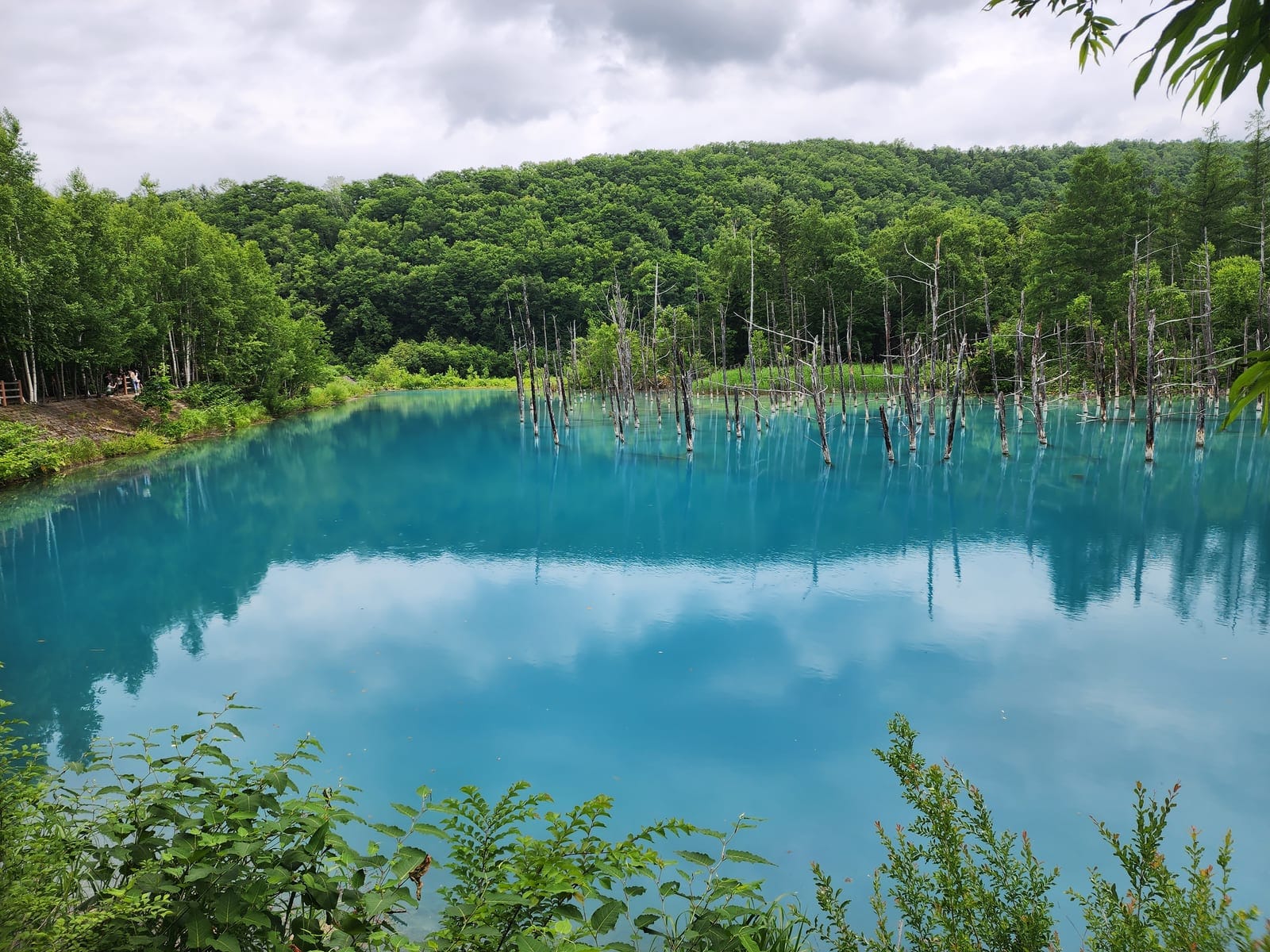
Tucked away in Biei Town (美瑛町), Kamikawa District, Hokkaido, the Blue Pond (青い池, Aoi-ike) lives up to its name with water of a startling cobalt blue. It became known around the world after it was used as a MacBook Pro wallpaper, and it now draws visitors from all over Japan and abroad. This guide explains how the pond came to be, why it is blue, how it changes through the year, when to catch it at its best and how to get there.
1. How the Blue Pond was born, and why it is blue
The Blue Pond's great appeal lies in its distinctive color, known as "Biei Blue" (美瑛ブルー), and in the dreamlike scene created by the dead larch and white birch trees standing in the water. Surprisingly, the pond is not natural. It is a man-made pond that came into being by accident, as a side effect of erosion-control work designed to protect the area from volcanic mudflows from Mount Tokachi (十勝岳, Tokachi-dake).
After Mount Tokachi erupted in 1988, a concrete sediment-control dam (堰堤, entei) was built on the main stream of the Biei River (美瑛川) as a disaster-prevention measure. The dam held back the river, water collected on its upstream side, and a pond formed. Trees that had been growing on the riverbed were submerged, and their bare, weathered trunks are now the pond's signature image.
The water looks blue because the Biei River carries substances such as sulfur and aluminum that flow in from the Shirogane Onsen (白金温泉) hot-spring area upstream. In the water these form tiny particles too small to see (colloidal particles). When sunlight strikes them, the shorter blue wavelengths are scattered most strongly, and that scattered blue light is what reaches our eyes. The sulfur and lime in the water are also said to turn the rocks on the bottom white, which makes the blue stand out even more.
2. The Blue Pond through the seasons
The pond changes dramatically with the season, the time of day and the weather, so each visit leaves a different impression.
Spring (April to June)
Around April, in early spring, meltwater can give the pond a slightly greenish tint. From mid-May to late June, however, the weather settles and sunny days follow one another, and this is considered the best season to see the pond at its most vivid cobalt blue. Fresh green leaves are just coming out at this time of year, the contrast between the blue water and the surrounding nature is lovely, and the cool, clear air makes for a pleasant walk.
Summer (July and August)
In summer the strong sunlight lights up the surface and makes the blue shine even more brightly, and with the sun setting later you can enjoy the cobalt scenery for longer. This is also Hokkaido's peak tourist season, though, and the pond's busiest time. On weekends in July and August and during the Obon (お盆) holiday in particular, expect waits for parking and traffic jams on the roads nearby, and leave plenty of time in your plans.
Autumn (September and October)
In autumn the larches and white birches around the pond begin to change color, and the red and yellow leaves make a striking contrast with the blue water. The foliage season is fairly short, but the combination of that deep, mesmerizing blue with fiery reds and yellows is well worth the trip.
Winter (November to March)
In winter the pond freezes and snow settles on top, so the blue water cannot be seen. Instead the whole area turns silver-white, and the dead trees, dusted with snow, create a dreamlike landscape completely different from the blue-water months. At night the illumination described below lights up this snowy world, making for a special experience.
The best time of day and weather
To see the most vivid cobalt blue, visit on a sunny day around 1:00 to 2:00 PM, when the sun is high. At that time sunlight reaches the bottom of the pond most easily, and the scattering of blue light is at its strongest.
In the early morning (around 6:00 to 9:00 AM), the surface can mirror the surrounding trees, giving the pond a quiet, mystical atmosphere quite different from midday. There are also relatively few visitors then, so it suits anyone who wants to take in the view slowly. If you are driving, note that the car park opens at 7:00 AM from May to October. In the late afternoon and evening the pond is often in shade, and the blue tends to look more muted.
As for the weather, the cobalt blue is at its most vivid on sunny days. On the day after rain, the swollen river can carry in mud and sand, which may make the water paler or cloudy. The best plan is to aim for a visit after a spell of fine weather, or a few days after rain, once the water has settled.
3. The Blue Pond illumination
In winter, when snow hides the blue water, the pond is lit up every year instead. The illumination uses light to bring out the frozen pond and the snow-covered trees, creating a mysterious world quite unlike the daytime view.
- Season: Usually from late October or early November until around late April of the following year. The dates are set each season (the 2024–25 run, for example, was scheduled from Friday 25 October 2024 to Wednesday 23 April 2025), so check them for your trip.
- Hours: Lighting times vary by month but are generally from 5:00 PM to 9:00 PM. For example, lighting starts at 4:30 PM in December, 6:00 PM in March and 6:30 PM in April. From 31 December to 3 January there is a special extension, with the lights on until 2:00 AM the next morning.
- The show: The water is frozen and covered in snow during the illumination period, so the blue cannot be seen, but a subtle lighting program tells a story over roughly 10 minutes. The shadows of the larches and snowflakes glowing as they fall in the light make a piece of natural art you can only experience in Biei in winter.
The illumination may be cancelled in bad weather, so check the latest information on the official website of the Biei Town Tourism Association (美瑛町観光協会) before you go. The ground can be hard to see when walking at night, so bring a flashlight or other portable light.
4. Getting there from JR Biei Station
The Blue Pond is about 18 km from JR Biei Station, and the usual ways to get there are by car, bus or taxi.
By car
The drive from JR Biei Station takes about 20 to 25 minutes. Take Hokkaido Prefectural Road 543 (Maruyama-dōri), then turn onto Prefectural Road 966 and follow the almost straight road to the pond.
Parking
The Blue Pond has a paid car park.
- Location: Shirogane, Biei Town, Kamikawa District, Hokkaido
- Parking fees (revised 21 March 2024), per visit:
- Standard, compact and kei cars: ¥500
- Motorcycles (including mopeds): ¥100
- Large vehicles (6 m or longer): ¥2,000
- Payment: Automatic gate payment was introduced on Thursday 21 March 2024. To ease congestion at the exit, please use the pre-payment machines.
- Opening hours:
- May to October: 7:00 AM to 7:00 PM
- November to April: 8:00 AM to 9:30 PM
- Parking fees are used for environmental improvement and upkeep in the Shirogane area.
Avoiding the crowds
From late morning through the afternoon (roughly 10:40 AM to 4:00 PM), the road to the car park gets congested, and it can take 30 minutes to an hour just to get in. Entry is usually smoother early in the morning, from about 7:00 to 9:00 AM, or after about 4:30 PM. Weekends and the summer holidays are busier still, so leave plenty of time.
This busy window includes the 1:00 to 2:00 PM slot when the blue is at its most vivid, so you may have to choose: accept the wait for the strongest color, or come early for still, mirror-like water and fewer people.
By bus
You can also take the Dōhoku Bus (道北バス) Shirogane Line from JR Biei Station.
- Boarding stop: JR Biei Station (south side)
- Get off at: Shirogane Aoi-ike Iriguchi (白金青い池入口, "Shirogane Blue Pond Entrance")
- Journey time: About 22 to 27 minutes
- Fare: ¥800 one way
- Note: There are only about 10 buses a day, so check the timetable in advance and take care not to miss your bus. From the bus stop it is about a 7-minute walk to the pond.
By taxi
A taxi from JR Biei Station reaches the Blue Pond in about 22 minutes. It is a comfortable option, and an efficient one if you would rather not work around public transport schedules. A sightseeing taxi can also stop at scenic viewpoints along the way.
By rental car
The Blue Pond is only one of many sights scattered around Biei and Furano, so a rental car lets you tour them efficiently without watching the clock. You can rent a car near JR Furano Station or JR Biei Station, or make a day trip by car with Asahikawa Airport or Sapporo as your base.
✨ Planning to see more of Biei? Rent a car with OlaChill and explore at your own pace.
5. More to see around Biei
The Blue Pond lies in the Shirogane area of Biei Town, and a few other sights pair naturally with it.
- Shirogane Onsen: The hot-spring area upstream of the pond, where the minerals that give the water its color come from.
- The Patchwork Road: Biei's rolling hills of multicolored fields and famous lone trees, northwest of the town center. Our Patchwork Road guide covers the Ken and Mary Tree, the Seven Star Tree and a driving loop from JR Biei Station.
- Daisetsuzan National Park: Mount Tokachi, whose 1988 eruption led to the dam that created the pond, belongs to the park's Tokachidake area. Our Daisetsuzan guide covers the park's seasons, trails and hot springs.
- Winter driving: If you are coming for the illumination and plan to drive, read our guide to renting a car in Hokkaido in winter before you set out.
Summary
Born by accident from disaster-prevention work after Mount Tokachi's 1988 eruption, Biei's Blue Pond has become one of Hokkaido's most famous views. For the most vivid blue, come on a sunny day between mid-May and late June, around 1:00 to 2:00 PM, and avoid the day after heavy rain. In winter the frozen pond takes on a new life under the evening illumination. Whether you come by car, bus or taxi from JR Biei Station, expect the car park to be busiest from late morning to mid-afternoon, and either build the wait into your plans or come early for calm water and a quieter pond.
More from this region — Hokkaido
View all →
Cape Erimo, Hokkaido: Wind Museum, Wild Seals and the Golden Road
11 min · tips
Chartering a 45-Seat Bus in Sapporo: A Complete Group Travel Guide
9 min · tips
Daisetsuzan National Park: Hikes, Autumn Leaves and Onsen in Hokkaido
14 min · destinations

Furano's Lavender Fields – Hokkaido's Most Breathtaking Purple Landscape
5 min · seasonal