
Aso Caldera, Kumamoto: Crater, Kusasenri, Daikanbo and Onsen
Aso Caldera in Kumamoto — Nakadake crater rules, Kusasenri horse rides, the 936 m Daikanbo lookout, Aso Shrine, onsen, akaushi beef and how to get there.
Feb 15, 2026·✍️ olablog·⏱ 16 min read
Aso Caldera in Kumamoto — Nakadake crater rules, Kusasenri horse rides, the 936 m Daikanbo lookout, Aso Shrine, onsen, akaushi beef and how to get there.
Tap a region to browse articles
In eastern Kumamoto Prefecture, the land opens into one of the largest volcanic calderas on Earth. Aso Caldera (阿蘇カルデラ) is not a single sight but a whole landscape: the Five Peaks of Aso at its center, one of them still steaming, grasslands where cattle and horses graze, clear spring water and hot-spring towns tucked inside ancient crater walls. This guide covers the main sights with their hours and prices, what to eat, when to go, what to wear, and how to get around by car or by public transport.
1. Aso Caldera by the numbers
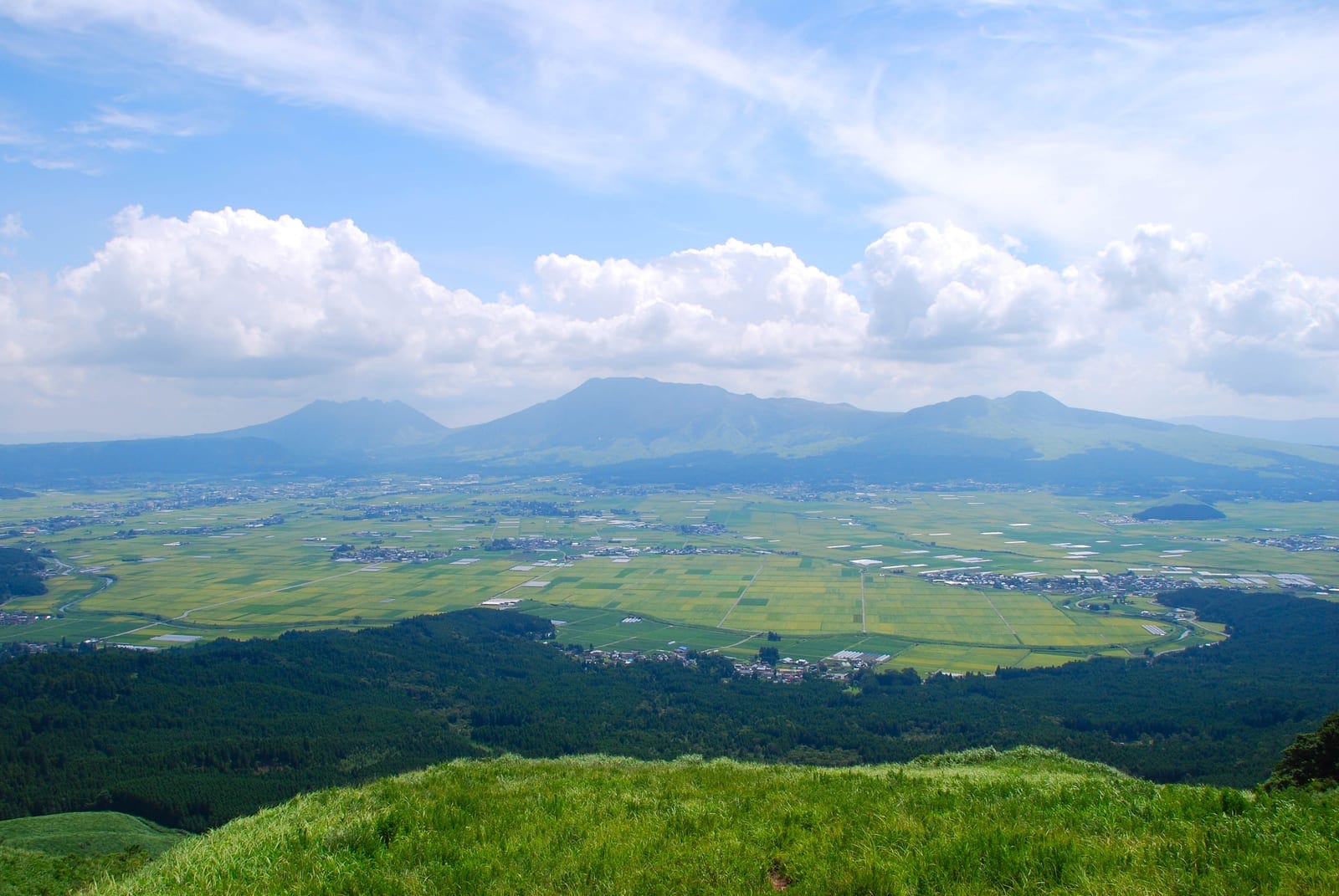
Aso is a volcano with one of the world's largest calderas: about 25 km from north to south, 18 km from east to west and roughly 128 km around. The caldera floor covers some 350 km² and holds three entire municipalities, Aso City, Takamori Town and Minamiaso Village, home to around 40,000 people. Drive in and you are, quite literally, driving around inside a volcano.
The caldera is thought to have formed about 100,000 years ago, when an enormous eruption caused the ground to collapse. The Five Peaks of Aso (阿蘇五岳, Aso Gogaku) rose afterwards: Takadake (高岳), Nekodake (根子岳), Nakadake (中岳), Eboshidake (烏帽子岳) and Kishimadake (杵島岳).
What makes Aso unforgettable is the scale. The active Nakadake crater still sends up plumes of smoke, the Kusasenri meadow looks like a pastoral painting, and from Daikanbo on the rim you can take in the entire caldera at once. The landscape changes character with every season, so a second visit never looks quite like the first.
2. The main sights
The sights range from the smoking volcano itself to a shrine said to be more than 2,500 years old and parks where you can get close to animals.
Nakadake Crater (阿蘇山中岳火口)
The Nakadake crater at the heart of Mt. Aso is an active volcano that still sends up smoke. Standing at its rim, when it is open, is as close as most visitors will get to feeling the planet breathe.
- Access restrictions: Crater viewing is often restricted, and at our most recent check it was closed until further notice. The crater area gives off volcanic gas (sulfur dioxide), so even when it is open, people with asthma, bronchial conditions or heart disease, anyone with a pacemaker and anyone feeling unwell are not allowed in. Always check the latest status with the Aso Volcano Disaster Prevention Council (阿蘇火山防災会議協議会) before you go.
- Getting up there: The crater is reached on the Aso-san Park Road (阿蘇山公園道路), a toll road costing ¥1,000 for cars and ¥400 for motorcycles. Large buses and some other vehicles cannot use it and must transfer to the Aso-san Crater Shuttle (阿蘇山火口シャトル), which was also suspended at our last check.
- Safety: Emergency shelters stand around the crater. Volcanic gas strongly irritates the airways: if you notice the smell, cover your nose and mouth with a damp tissue or cloth and head back down right away.
Kusasenri (草千里ヶ浜)
Kusasenri spreads across the northern foot of Mt. Eboshi: a vast, open meadow with a large pond in the middle and horses grazing around it. It is one of Aso's defining views, and the sight of the horses quietly cropping the grass is wonderfully calming.
- Address: Kusasenrigahama, Aso City, Kumamoto
- Hours: Open to walk at any time, though access can be limited by weather or volcanic activity.
- Cost: Free entry. Parking costs ¥500 for cars, ¥200 for motorcycles and ¥2,000 for buses. The parking payment system changed on 16 July 2024, so follow the instructions on site.
- Time needed: 30 to 60 minutes for a walk. Walk all the way to the edge of the pond and you leave the car-park bustle behind for a much quieter view.
- Horse riding: Rides with a handler leading the horse are popular. Approximate prices: Course A (about 5 minutes) ¥1,500, Course B (about 20 minutes) ¥4,000, Course C (about 30 minutes) ¥5,000. No reservation is needed, but there may be height limits, so check on site.
- Also good to know: Near the car-park entrance, Kusasenri Coffee Roastery (草千里珈琲焙煎所) is popular for its house-roasted coffee. Do not approach or feed the grazing horses, and avoid sudden movements and loud noises around them.
Daikanbo (大観峰)
At 936 m, Daikanbo is the highest point of Aso's northern outer rim and the classic place to see the Five Peaks lying together like a reclining Buddha (涅槃像, nehanzō). The 360-degree panorama takes in the whole caldera, the fields on its floor and, far in the distance, the Kuju mountains (くじゅう連山).
- Address: 2090-8 Yamada, Aso City, Kumamoto
- Hours: The lookout is open 24 hours, so you can visit at night or at dawn. The shops and teahouse open from 8:30 to 17:00.
- Cost: Free, and parking is free too.
- Time needed: 40 minutes to 1 hour.
- Best time: On early mornings from autumn into winter, you have a chance of seeing a magical sea of clouds below. Clear mornings and late afternoons also bring beautiful, low-angled light.
- Crowds: Golden Week, the autumn-foliage season, weekends and holidays get very busy, and it can take a while just to get into the car park. For a smooth visit, arrive before 10:00 or after 16:00.
Aso Shrine (阿蘇神社)
With a history said to span more than 2,500 years, Aso Shrine is the head shrine of about 500 Aso shrines across Japan and has long been revered as the ichinomiya, the foremost shrine, of the old Higo Province. The 2016 Kumamoto earthquake badly damaged its two-story gate (楼門, rōmon) and worship hall (拝殿, haiden). The restoration uses the original building techniques and as much of the original material as possible, and seeing the rebuilt structures is a moving reminder of how much the shrine means to the people of Aso.
- Address: 3083-1 Miyaji, Ichinomiya-machi, Aso City, Kumamoto
- Hours: Worship 6:00 to 18:00; amulet office 9:00 to 17:00; car park 6:00 to 18:00.
- Cost: Free to visit. Parking is free for the first 30 minutes, then ¥100 per hour.
- Access: About 15 minutes on foot or 5 minutes by car from JR Miyaji Station. By car, about 1 hour from Kumamoto IC on the Kyushu Expressway via Route 57.
More to see nearby
- Aso Farm Land (阿蘇ファームランド): A large resort themed on "health and healing", with the Genki no Mori (元気の森) outdoor adventure course, the Fureai Animal Kingdom (ふれあい動物王国) petting zoo, hands-on craft workshops and hot-spring baths. Its dome-shaped lodges are a popular place to stay.
- Address: 5579-3 Kawayo, Minamiaso Village, Aso District, Kumamoto
- Hours: 9:00 to 17:00 (varies by facility, so check before you go)
- Cost: Some areas are free to enter, but each facility charges separately. Genki no Mori, for example, costs ¥1,450 for junior-high and high-school students and ¥750 for elementary-school children.
- Aso Cuddly Dominion (阿蘇カドリー・ドミニオン): An animal park centered on bears from around the world. You can hold a bear cub, play with the dogs in Wanwan Dōbutsu Mura (わんわん動物村) and watch animal shows.
- Address: 2163 Kurokawa, Aso City, Kumamoto
- Hours: Summer season (mid-March to mid-October) 9:30 to 17:00, until 17:30 on weekends and holidays; winter season (mid-October to mid-March) 10:00 to 16:30.
- Closed: Wednesdays from December to February, except during the winter school holidays and on public holidays.
- Cost: Adults (high-school age and over) ¥2,600; elementary and junior-high students ¥1,400; children aged 3 and over ¥800.
- Access: About 3 minutes by taxi from JR Aso Station.
3. Things to do in Aso
Scenic drives
Driving is the best way to feel how big Aso really is. The Milk Road (ミルクロード), which runs along the outer rim, and the Yamanami Highway (やまなみハイウェイ), which links Aso with Beppu, are the two classic routes, with grassland rolling to the horizon and the Five Peaks in view. Open the windows, feel the wind and watch the scenery change around every bend. In winter, snow and icy roads are possible, so you will need winter tires. For viewpoints, food stops and route details, see our Aso Milk Road guide.
Hot springs
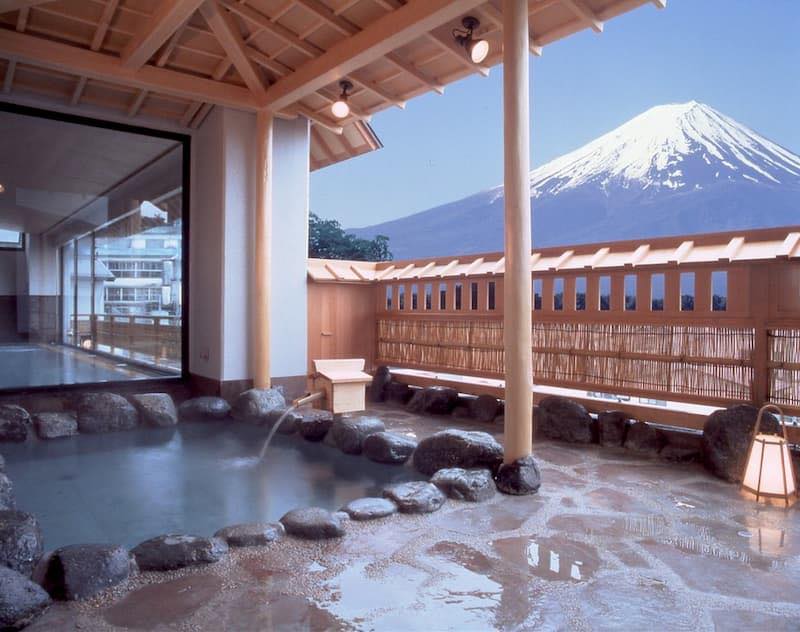
As a volcanic region, Aso has an abundance of good hot springs. Uchinomaki Onsen (内牧温泉) is the area's leading spa town, and many of its ryokan and hotels welcome day bathers. Unwind in an open-air bath facing the Five Peaks, or in water that flows straight from the source.
- Main hot-spring areas: Uchinomaki Onsen and the Minamiaso Onsen area (南阿蘇温泉郷).
- Places to stay (examples): Yumeguri Oisō (湯巡追荘), Sozankyō (蘇山郷) and Yu no Yado Irifune (湯の宿 入船) are among the distinctive hot-spring inns scattered around the area. Kurokawa Onsen is another popular base for a night in a ryokan.
Local food
Don't leave Aso without tasting dishes made from local produce.
- Akaushi (あか牛): Brown "red" cattle raised on Aso's grasslands. This brand beef has a good balance of lean meat and fat and a concentrated, savory flavor. Many restaurants serve it as akaushi-don (a rice bowl) or as steak.
- Takana-meshi (高菜めし): A local dish of Aso takana mustard greens stir-fried in oil and mixed through rice: simple, but full of flavor.
- Dago-jiru (だご汁): Also called dango-jiru. Hand-kneaded wheat-flour dumplings and seasonal vegetables simmered in a miso broth, a dish that warms you from the inside.
- Dairy: Fresh milk, yogurt and cheese from cows raised on the wide pastures are Aso's lesser-known specialty. You can buy them at michi-no-eki roadside stations and other shops.
4. When to go and what to wear
Season by season
- Spring (April to May): Once the grasslands have been burned off in the spring controlled burning (野焼き, noyaki), fresh green shoots cover the slopes. The green is at its most vivid from mid to late May, which makes it ideal driving weather.
- Summer (June to August): Cool highland breezes keep Aso relatively comfortable even in midsummer, and the deep-green grassland against a blue sky is beautiful. It is a popular escape from the heat.
- Autumn (September to November): Silver grass (susuki) turns the slopes gold. Around October the weather is especially settled, and early mornings bring a better chance of a sea of clouds, best seen from Daikanbo. You can enjoy autumn foliage too.
- Winter (December to March): Snow-covered peaks and white grasslands make for magical scenery, but snow and icy roads are likely, so prepare thoroughly.
If you can pick only one month, choose May for the freshest green or October for settled weather and the sea-of-clouds season. For photography, the best light comes in the early morning (roughly 6:00 to 9:00) and late afternoon (roughly 16:00 to 18:00).
What to wear
Aso sits high above the lowlands, so it is cooler than the surrounding plains and can feel chilly in the mornings and evenings.
- Spring and autumn: Pleasant during the day, but bring a light jacket or cardigan for the cold mornings and evenings.
- Summer: Short sleeves are fine by day, but a thin long-sleeved shirt or hoodie helps in the mornings, evenings and shade.
- Winter: You need serious cold-weather gear: a heavy coat or down jacket, gloves, a scarf and a knit hat. Wear shoes with good grip for icy surfaces.
5. Getting to Aso and getting around
There are two main ways to reach Aso: by car or by public transport.
By car
A rental car lets you roam Aso's vast landscapes freely and stop at viewpoints that public transport doesn't reach.
- From Kumamoto Airport: About 1 hour 30 minutes (via the Aso Panorama Line)
- From central Fukuoka: About 2 hours 10 minutes
- From central Kumamoto: About 1 hour 30 minutes
The main routes are Route 57, the Yamanami Highway and the Milk Road. The nearest expressway exit is Kumamoto IC on the Kyushu Expressway. Roads around the caldera are well maintained and clearly signposted, but gas stations thin out as you climb, so fill up in Aso town before heading into the mountains.
✨ Want to set your own pace? Rent a car with OlaChill and explore Aso on your own schedule.
By public transport
- Rail: The JR Hōhi Line runs to Aso Station, and JR Pass holders can use it. Sightseeing trains such as the limited express "Aso Boy!" (あそぼーい!) are popular, so check whether one is running on your dates.
- From Kumamoto Airport: Take a bus to Ōzu Station (about 15 minutes), the JR Hōhi Line to Aso Station (about 45 minutes), then a bus up to the Aso-san Sanjō Terminal (阿蘇山上ターミナル, about 40 minutes). Allow about 2 hours 30 minutes in total. Kyushu Sanko Bus (九州産交バス) also runs highway buses and airport limousine buses.
- From Aso Station to the sights: Route buses run from Aso Station to the Aso-san Sanjō Terminal (the crater shuttle from the terminal onward was suspended at our last check). For Kusasenri, get off at the "Kusasenri (Aso Volcano Museum)" stop (草千里(阿蘇火山博物館前)).
Buses to the crater area and the outlying viewpoints are infrequent, so check return times before you set off. Weigh up the pros and cons of a rental car and public transport, and choose whichever suits your travel style.
6. Tips for getting the most out of Aso
Check volcanic activity first
Mt. Aso is an active volcano, and access to the crater area can be restricted depending on activity. Before you set out, always check the latest volcanic restrictions on the Aso City website or the Aso Volcano Disaster Prevention Council website. Take extra care in winter and in the rainy season (June to July).
Book your accommodation early
Hotels and inns around Aso fill up in the best seasons and over Japanese holiday periods. Uchinomaki Onsen and the surrounding area have plenty of attractive hot-spring inns and hotels, so book as early as you can.
Plan a route in advance
Aso's sights are spread across a huge area, so planning a route in advance makes sightseeing far more efficient. Anything from a day trip to one or two nights works. A classic two-day plan looks like this:
- Day 1: Start early at Daikanbo, where autumn and winter mornings may bring a sea of clouds and you arrive before the car park fills. Drive the Milk Road around the rim, then head for Kusasenri to walk out to the pond or ride a horse. Visit the crater area if it is open, try an akaushi-don for lunch, and spend the evening soaking at Uchinomaki Onsen.
- Day 2: Visit Aso Shrine and stroll the shopping street in front of it, then spend the afternoon at Aso Farm Land, or at Aso Cuddly Dominion if you are traveling with children. Continue to Beppu along the Yamanami Highway, or head to Fukuoka or back to Kumamoto City.
On a day trip, focus on Daikanbo, Kusasenri and Aso Shrine.
What to pack
- Comfortable clothes and walking shoes: You will cover a lot of ground and do plenty of walking.
- An extra layer: Whatever the season, mornings, evenings and the higher areas can be cold, so bring something easy to put on and take off.
- Rain gear: The weather changes quickly in the mountains; a folding umbrella or raincoat helps with sudden showers.
- Sun protection: The sun is strong on clear days, so a hat, sunglasses and sunscreen are worth packing.
- Protection from volcanic gas: If crater visits reopen, carry damp tissues just in case.
- Offline maps: Download the Kumamoto area in Google Maps before you go, because signal can drop out on the upper slopes.
7. Aso's main sights at a glance
| Sight | Highlights | Hours | Cost |
|---|---|---|---|
| Nakadake Crater | Active crater rim | Depends on volcanic restrictions (closed at our last check) | Park Road toll ¥1,000 per car, ¥400 per motorcycle |
| Kusasenri | Meadow, pond, grazing horses, horse rides | Open access, weather and volcano permitting | Free; parking ¥500 per car; rides from ¥1,500 |
| Daikanbo | 936 m rim lookout, "reclining Buddha" view, sea of clouds | Lookout 24 hours; shops 8:30–17:00 | Free, free parking |
| Aso Shrine | Head of about 500 Aso shrines, restored gate and hall | 6:00–18:00 | Free; parking free for 30 minutes, then ¥100 per hour |
| Aso Farm Land | Adventure course, petting zoo, crafts, baths, dome lodges | 9:00–17:00 (varies by facility) | Priced per facility |
| Aso Cuddly Dominion | Bears, bear-cub cuddling, dog village, shows | 9:30–17:00 in summer; 10:00–16:30 in winter | Adults ¥2,600 |
| Uchinomaki Onsen | Aso's main spa town, day bathing | Varies by inn | Varies by inn |
Aso rewards travelers who slow down. Give yourself at least one full day, start early to beat the crowds and catch the best light, check the volcano's status on the morning you visit, and finish with a long soak in a hot spring beneath the Five Peaks.
More from this region — Kyushu
View all →
Aso Milk Road Drive Guide: Outer-Rim Lookouts, Food Stops and Onsen
12 min · tips
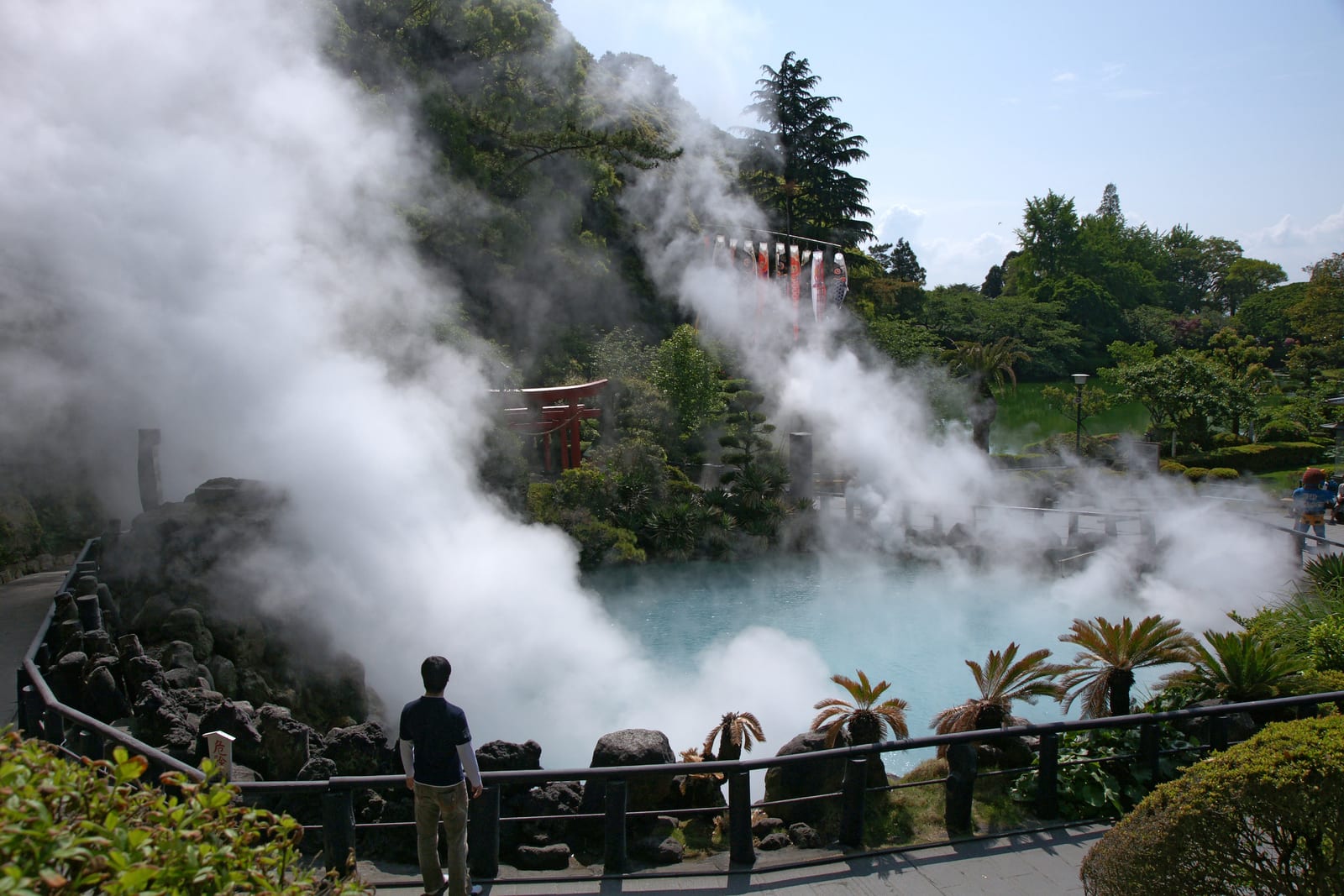
Beppu's Eight Hot Springs and Hell Tour: The Complete One-Day Course Featuring Umi Jigoku and Chinoike Jigoku
16 min · destinations
Chartering a 45-Seat Bus in Fukuoka: A Complete Group Travel Guide
8 min · tips
Fukuoka Airport Group Transfers by 45-Seat Charter Bus
8 min · tips