
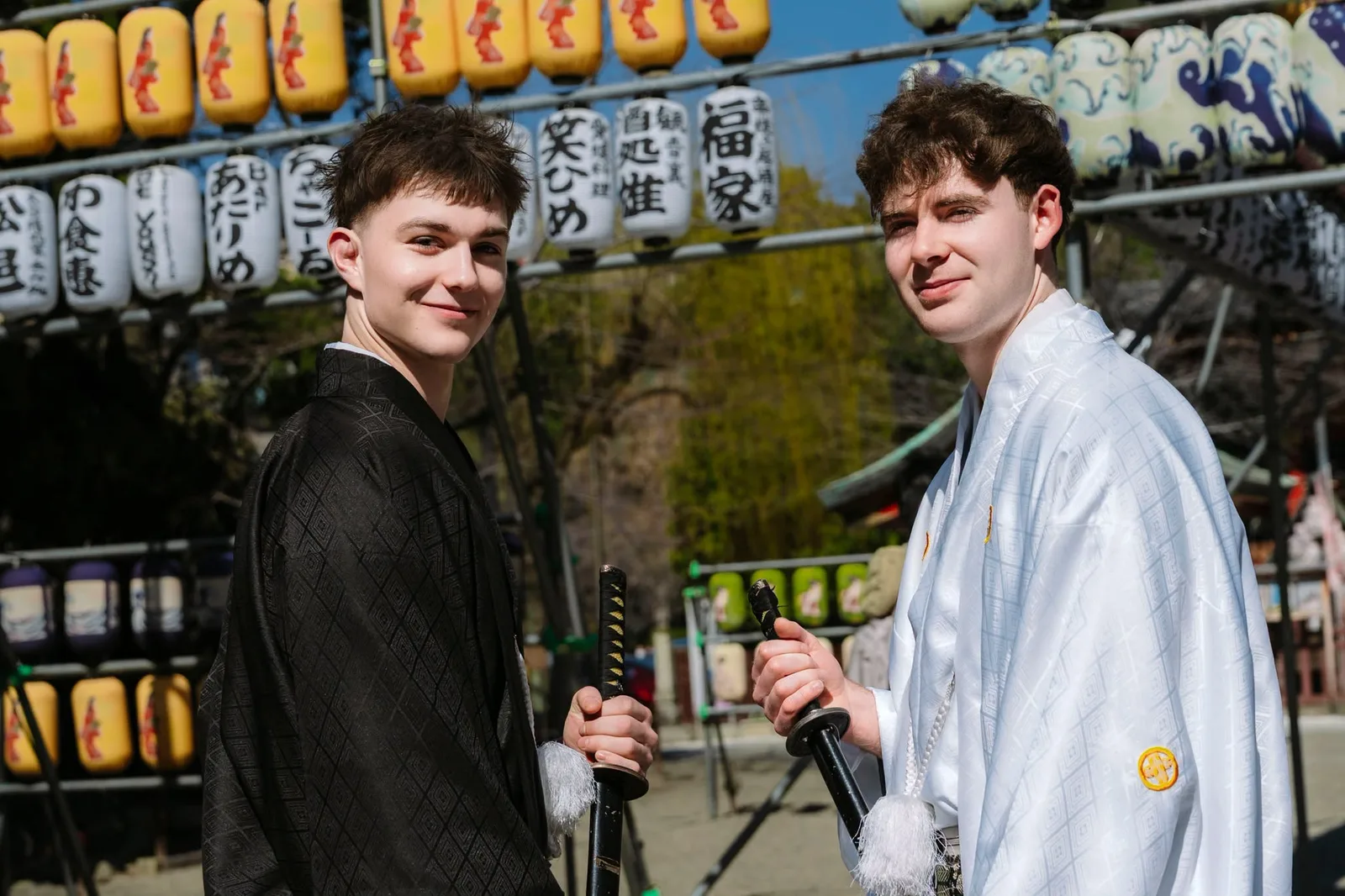
Men's Kimono Rental: Kinagashi or Montsuki Hakama, and When to Wear Each
How the two men's styles differ, which one suits a stroll and which one suits a formal photo, and exactly what the ¥5,000 and ¥10,000 plans at OlaChill include.
Sep 14, 2026·✍️ olablog·⏱ 9 min read
How the two men's styles differ, which one suits a stroll and which one suits a formal photo, and exactly what the ¥5,000 and ¥10,000 plans at OlaChill include.
Men tend to arrive at a kimono shop as the accompanying party — someone else wanted the photograph — and leave as the person who enjoyed it most. Part of that is the outfit itself: men's kimono are cut straight, tied low on the hips, and have none of the constriction that a women's obi brings. Part of it is how quickly the whole thing is done — about twenty minutes from rack to door. What men do need is a clear answer to one question, because the rack offers two very different silhouettes and the right choice depends entirely on the kind of day planned. This guide explains kinagashi and montsuki hakama, what each is for, how they are worn, and what the two men's plans at OlaChill include.
Kinagashi — the kimono on its own
Kinagashi is the everyday men's silhouette: a kimono worn without hakama trousers, closed with a narrow kaku obi tied at the hips, usually with a haori jacket over it and a pair of zori or geta on the feet. The word describes the look — literally "worn flowing" — and it is what a man in Tokyo or Kyoto would have worn to go out for the evening a century ago. In a photograph it reads relaxed and slightly rakish. On the body it is the most comfortable traditional outfit there is: the layers are few, the obi does not squeeze, and you can sit, climb steps and eat lunch without thinking about it.
Colours are usually restrained — indigo, charcoal, brown, grey — with the interest in the weave or a subtle pattern, and in the contrast between kimono and haori. Rental racks also carry bolder modern versions in denim-like fabrics and stripes.
At OlaChill this is the Men's Traditional Kimono plan at ¥5,000, tax included, with obi, footwear and bag. It is the plan for the man who is walking with a partner in Komongi or Kimono Ren, for couples, for groups, and for anyone whose day includes a meal and a lot of ground.
Montsuki hakama — the formal set
Montsuki hakama is the formal men's outfit and the only one with a fixed grammar: a black haori jacket bearing family crests (the mon) at five points, worn over a kimono, with pleated hakama — wide, skirt-like trousers — tied over the kimono at the waist and falling to the ankle. A white haori cord fastens the jacket at the chest. This is what a groom wears at a Shinto wedding, what a university graduate wears at the ceremony, what a man wears to receive an award. It is upright, architectural and unmistakably formal.
The hakama changes how you move. The pleats hang best when you stand straight and walk with a slightly longer stride than in kinagashi, and sitting on the floor needs a moment to arrange the fabric. It is not difficult — many graduates wear it for the first time on the day itself — but it rewards a little care.
At OlaChill this is the Montsuki plan at ¥10,000, tax included, with the crested haori, kimono, hakama, obi, footwear and bag. It is the plan for a formal portrait, for the father in a family photograph, for a groom-style couple shoot alongside a partner in Houmongi or Furisode, and for the man who simply wants the most complete version of the outfit.
Side by side
| Kinagashi (Men's Traditional Kimono) | Montsuki hakama (Montsuki) | |
|---|---|---|
| Pieces | Kimono, haori, kaku obi, footwear, bag | Kimono, crested black haori, hakama, obi, haori cord, footwear, bag |
| Formality | Casual, everyday | Formal, ceremonial |
| Ease of walking | Easiest of any traditional outfit | Easy on the flat; pleats need care on stairs and when sitting |
| Photo character | Relaxed, natural, "a man out for the day" | Upright, formal, strong silhouette from the front |
| Pairs well with | Komongi, Kimono Ren, Yukata (Women) | Houmongi, Tomesode, Furisode |
| Dressing time | About 15–20 minutes | About 20–25 minutes |
| Price | ¥5,000 | ¥10,000 |
Which one for which day
- A half-day walk with a partner or friends, lunch, photographs along the way: kinagashi. You will be more comfortable, and in candid photographs the relaxed silhouette looks better than a formal one.
- A formal portrait — engagement, anniversary, a family photograph with children in kimono: montsuki hakama. It is the outfit that makes the picture look like an occasion.
- A couple shoot where she is in Furisode: montsuki hakama, so the two garments match in formality. Kinagashi beside furisode looks underdressed.
- A tea ceremony afternoon: either works; montsuki is more correct, kinagashi is more comfortable on the tatami.
- Anything in July or August: the Yukata (Men) plan at ¥4,000 instead. A haori over a lined kimono in a Tokyo August is not something to do to yourself.
How a man is dressed
The sequence is short. Tabi socks go on first. Then the juban under-robe, then the kimono, wrapped left panel over right — the same rule as for women, and the one rule worth remembering, since the reverse wrap is used only to dress the deceased. The kaku obi is tied low, on the hip bones rather than the waist, which is why it never feels tight. For kinagashi, the haori goes on and is fastened with its cord. For montsuki, the hakama is stepped into and tied front and back over the kimono before the haori goes on. Staff do all of this; you stand still and hold your arms out when asked.
Two practical notes. Men's kimono are worn with no slack at the waist, so a large meal before dressing is fine — nothing squeezes. And the sleeves are wide but short, so a wallet in the sleeve pocket works perfectly well; this is where Japanese men have always carried things.
Walking, sitting and looking right
- Stand with weight even and shoulders back. A men's kimono is a straight column; slouching folds it.
- Take a normal stride in kinagashi, a slightly deliberate one in hakama so the pleats swing rather than bunch.
- Sit on the front of a chair to keep the obi knot and the back of the haori unwrinkled.
- On the floor, kneel first, then sit back — in hakama, sweep the pleats forward with one hand as you go down.
- Hands in the sleeves or one hand at the obi are the classic resting poses and photograph well. Hands in pockets you do not have is the classic tourist mistake.
- Do not remove the haori to cool down. The look depends on it, and a kimono without a haori reads as unfinished. If it is warm, ask for a fan.
For the full set of rules — front panels, obi, footwear, stairs — see our guide to kimono-wearing etiquette.
What's included, price, where, how to book
- Men's Traditional Kimono (kinagashi) — ¥5,000: kimono, haori, kaku obi, footwear, bag; dressing by staff; free locker. Tax included.
- Montsuki — ¥10,000: kimono, crested black haori with cord, hakama, obi, footwear, bag; dressing by staff; free locker. Tax included.
- Yukata (Men) — ¥4,000 for summer.
- Add-ons: hair styling ¥1,500 (a quick tidy is enough for most men), professional photographer from ¥15,000, next-day return ¥1,100, hotel return ¥1,100.
- Where: OlaChill Tokyo Asakusa (Taito-ku, Kaminarimon 2-3-7, 4F) or OlaChill Kyoto Kiyomizu (Higashiyama-ku, Kiyomizu 4-190-3, B1F). Open 09:00–18:00; return before closing.
- How to book: choose the plan, date and time on the product page, add options, enter your details, pay online (10% off) or at the shop. Free cancellation up to two days before.
Book it: OlaChill Tokyo Asakusa · OlaChill Kyoto Kiyomizu. Both plans appear on the same page as the women's and children's plans, so a couple or a family books in one go.
Frequently asked questions
I'm tall and broad — is there a men's kimono that fits? Yes. Men's kimono are worn to the ankle without the fold women use, so length is chosen from the rack; put your height and build in the booking notes and a suitable size is set aside. The shop stocks a range up to tall and large sizes.
Can I wear my own T-shirt under it? A plain crew-neck shows at the collar. A V-neck undershirt or nothing under the juban is the correct look; the juban itself is provided.
Are the crests on the montsuki a real family's crests? Rental haori carry a generic crest, so no, you are not borrowing someone's family identity. It is the standard practice for hired formal wear in Japan.
Do men get hair styling? It is available at ¥1,500 and most men do not need it. If your hair is long, a neat tie-back suits both styles.
Is montsuki hakama uncomfortable to sit in at a restaurant? Not at a table. On the floor it takes a moment to arrange the pleats; after that it is fine. A tea-ceremony host will show you how.
Can I mix — kinagashi with a hakama, or montsuki without the black haori? Ask on the day. A kimono with hakama and a coloured haori is a legitimate semi-formal look and the staff can sometimes assemble it from the rack; it is not a listed plan, so it depends on stock.
What if it rains? Umbrellas are lent free. Hakama hems clear the ground, so montsuki actually copes with wet streets slightly better than a women's kimono does.
More from this region — Other
View all →
Metasequoia Namiki – Japan's Most Breathtaking Tree-Lined Avenue
5 min · tips
Japan's Southern Alps – A Vast, Untouched Wilderness Most Tourists Never Find
6 min · tips
Must-Try Matcha Desserts on Your Trip to Japan
6 min · food
Morioka’s Three Great Noodles: A Delicious Guide to Wanko Soba, Jajamen and Reimen
8 min · destinations