Share House Business: Is Buying a Large House, Dividing It into Rental Rooms, and Making a Profit in Japan Possible?
An analysis of the share house business model in Japan: fire safety regulations, conversion to 寄宿舎, renovation costs, actual profit margins, and the risks of illegally dividing rooms.
Aug 7, 2026·✍️ olablog·⏱ 13 min read
An analysis of the share house business model in Japan: fire safety regulations, conversion to 寄宿舎, renovation costs, actual profit margins, and the risks of illegally dividing rooms.
Many Vietnamese people who have lived in Japan for years, after building up some capital or becoming eligible for a bank loan to purchase property, often consider the following idea: "Why not buy a spacious detached house (戸建て - kodate), divide it into multiple rooms, and rent them to international students, technical interns, or engineers?" In theory, the income from 4-6 individual rooms would be considerably higher than renting the entire house to a single family.
However, Japan's real estate market is known for its strict rules on zoning, fire safety, and resident management. Can this model really "make a fortune," or is it an expensive legal trap? Drawing on our experience working with the Vietnamese community in Japan, OlaChill examines the realities and economics as of August 2026 so that you can make the most informed decision before investing.
Share house vs. renting out the entire house: Which model optimizes cash flow?
When you own a detached or terraced house with a floor area of 100m² to 180m², you generally have two main business options: rent it out as a whole (戸建て賃貸) or renovate it into a share house (シェアハウス - share house).
Comparing occupancy performance and cash flow
With whole-house rentals, you only need a single lease agreement. The tenant pays for electricity, water, gas, and internet. You do not incur daily management or common-area cleaning costs. However, when the house is vacant (空室 - kushitsu), your revenue immediately drops to 0.
With a share house, you divide the property into 5-7 small, independent rooms. Operating costs are higher because they include utilities (光熱費 - konetsuhi - electricity, water, and gas), Wi-Fi, and cleaning fees, but the vacancy risk is spread across multiple rooms. In addition, total rental revenue from several individual tenants is usually 30% - 50% higher than renting out the entire house.
Comparison of share house and traditional rental models
(Average survey data for suburban areas of Tokyo, Kanagawa, and Saitama as of August 2026; estimated exchange rate: 1 JPY ≈ 160 VND)
| Criteria | Whole-house rental (戸建て賃貸) | Share House Business (シェアハウス) |
|---|---|---|
| Average monthly rent | 120.000 - 160.000 JPY (~19,2 - 25,6 million VND) | 40.000 - 55.000 JPY/room x 5 rooms = 200.000 - 275.000 JPY (~32 - 44 million VND) |
| Vacancy risk | High (vacancy means losing 100% of revenue) | Low (income from the remaining rooms offsets 1-2 vacant rooms) |
| Electricity, water, and Wi-Fi included | No (the tenant pays separately) | Yes (the owner covers everything or settles the costs separately) |
| Initial renovation costs | Low (basic cleaning, painting, and repairs are sufficient) | High (fire safety equipment, partitions, additional bathrooms) |
| Management workload | Low | High (handling conflicts and cleaning 共用部) |
| Gross yield (表面利回り) | 6% - 8%/year | 10% - 14%/year |
Legal trap 101: Fire safety regulations and the classification of "residential" vs. "dormitory"
This is the stage where many individual investors become overwhelmed and start losing money before the project even begins. An ordinary whole-house rental used as a share house will no longer be classified as a "family residence" (住宅 - jutaku).
Classification as 寄宿舎 (kishukusha) and 用途変更 (yoto henko) regulations
Under Japan's Building Standards Act (建築基準法 - kenchiku kijunho), a share house occupied by 2 or more unrelated people is classified as a dormitory (寄宿舎 - kishukusha), a type of special building (特殊建築物).
- Change-of-use procedures (用途変更 - yoto henko): Under the amended Japanese regulations in force as of August 2026, if the total floor area being converted is under 200m², you do not need to submit an application for building confirmation (建築確認 - kenchiku kakunin) to the urban planning authorities. However, the property must still comply with the technical standards for 寄宿舎, including structural safety and emergency escape routes.
- Zoning (用途地域 - yoto chiiki): You must carefully check with the local municipal office (市役所/区役所) to determine which zoning category the plot falls under. Certain low-rise residential conservation zones (第一種低層住居専用地域) impose strict bans or restrictions on 寄宿舎 operations.
Mandatory fire safety equipment and conversion costs
Under the Fire Service Act (消防法 - shoboho), share houses are subject to extremely strict inspections. You cannot simply hang up a few portable fire extinguishers and consider the job done. Mandatory requirements include:
- Automatic fire alarm system (自動火災報知設備 - jidou kasai houchi setsubi): Smoke/heat detectors must be installed in every bedroom and common area. For small houses, an interconnected wireless fire alarm system for small-scale facilities (特定小規模施設用自動火災報知設備) may be used.
- Emergency exit lights (誘導灯 - yudoto): These must be installed in central hallways, stairways, and entrances.
- Fire extinguishers (消火器 - shokaki): A sufficient number must be provided based on the floor area.
- Notification of commencement of use of a fire-protection property (防火対象物使用開始届 - bokataishobutsu shiyokaishitodoke): This must be submitted to the local fire department (消防署 - shobosho) before operations begin.
The cost of bringing the fire safety system of a 2-3-story house up to standard ranges from 300.000 JPY to 1.200.000 JPY (~48 - 192 million VND), depending on the existing structure.
Renovating and furnishing a share house: How much does it cost to turn a large house into divided rooms?
To attract tenants and encourage long-term stays, renovation involves much more than simply putting up a few drywall partitions.
Main renovation items and actual costs
(Construction market prices in Japan as of August 2026)
- Building room partitions (間仕切り壁 - majikiri kabe): Approximately 150.000 - 300.000 JPY per partition (~24 - 48 million VND), using fire-resistant materials that meet kishukusha standards.
- Installing wooden doors with keyed or combination locks (鍵付きドア - kagi tsuki doa): 60.000 - 120.000 JPY/set (~9,6 - 19,2 million VND).
- Adding toilets and sinks: A house occupied by 6 people needs at least 2 toilets (洋式トイレ) and 2 shower cabins (シャワールーム). Adding 1 shower cabin costs approximately 400.000 - 700.000 JPY (~64 - 112 million VND).
- Painting and replacing wallpaper (クロス張替え - kurosu harikae): 1.000 - 1.500 JPY/m².
Designing shared spaces and soundproofing between rooms
The biggest weakness of Japan's wooden-frame houses (木造 - mokuzo) is their poor sound insulation. If tenants can clearly hear snoring or conversations from the next room, they may move out after just 2-3 months.
- Soundproofing solution: When building partitions, you should fill them with soundproof glass wool (グラスウール - gurasu uru) and install 2 layers of fire-resistant gypsum board (強化石膏ボード).
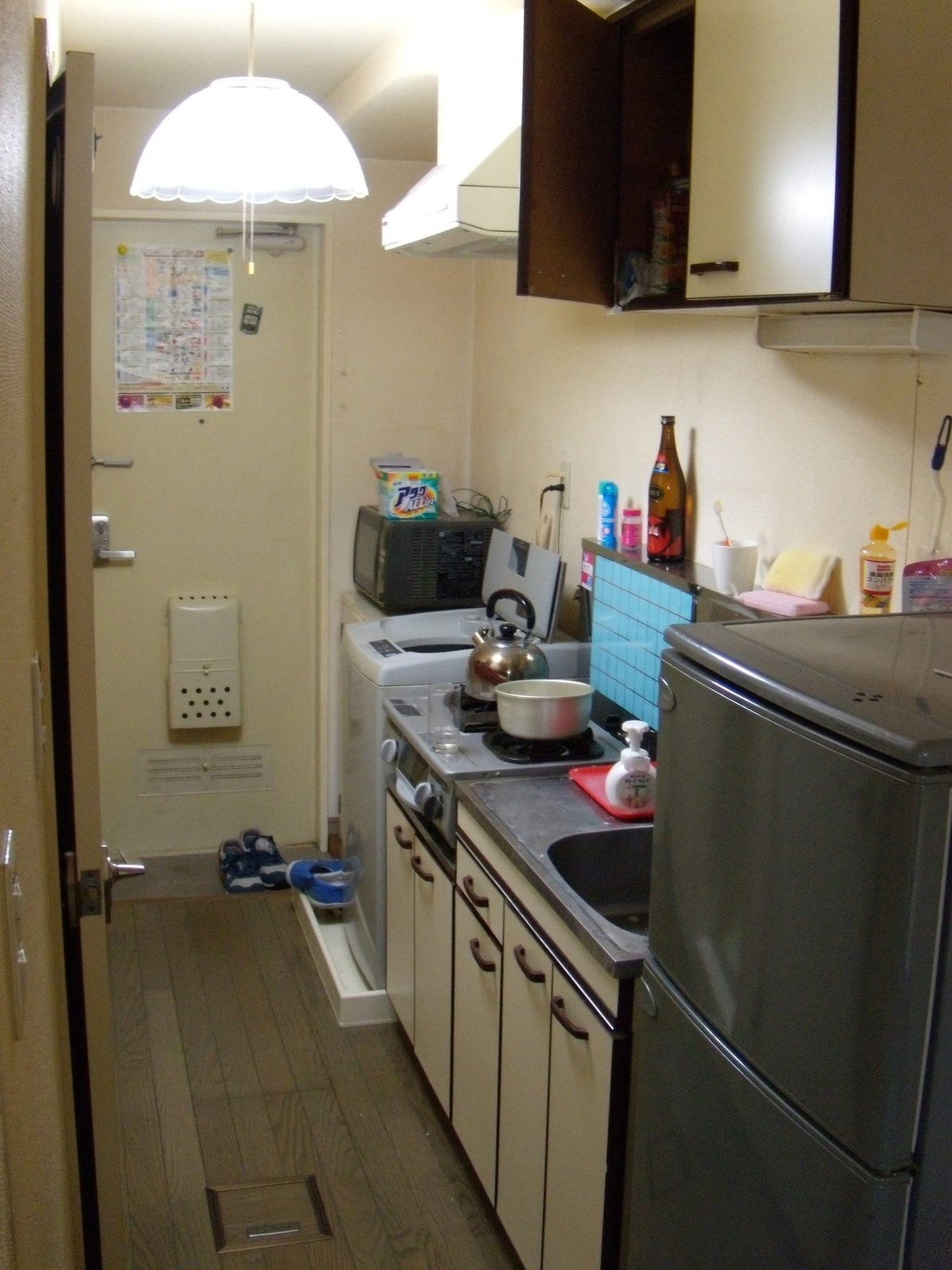
- Shared living area (LDK): Provide a large-capacity refrigerator (or 2 medium-sized refrigerators), 2 washing machines, a multi-burner IH cooktop, microwave, electric kettle, and a dining table with enough seating. The initial cost of purchasing furniture and appliances is approximately 600.000 - 1.000.000 JPY (~96 - 160 million VND).
Tips for community operations and tenant management
Unlike renting out independent apartments, the biggest challenge in running a share house is not technical—it is people.
Using 定期借家契約 (teiki shakya keiyaku) to control risk
In Japanese real estate, ordinary rental agreements (普通借家契約 - futsu shakya keiyaku) strongly protect tenants. If a tenant is dirty, late with rent, or frequently causes disturbances, it can be very difficult to evict them.
Therefore, for a share house, you should always sign a fixed-term rental agreement (定期借家契約 - teiki shakya keiyaku), typically for a period of 6 months to 1 year.
- When the contract expires, if the tenant has behaved well and followed the rules, both parties can sign a new agreement (re-contract).
- If the tenant causes trouble or negatively affects the household, the contract automatically ends, and the landlord does not need to prove a complicated "justifiable reason" (正当事由) under the law.
Establishing house rules and maintaining a respectful culture
To avoid conflicts among members—especially in houses with Vietnamese, Japanese, and other foreign residents:
- Cleaning responsibilities: Clearly set out the schedule for taking out the garbage (ゴミ出し - gomidashi), cleaning the kitchen, and cleaning the bathrooms. The best option is for the owner to come and clean once a week or hire a service, with the cost included in the monthly service fee.
- Rules on hours and outside guests: No overnight stays by romantic partners or other guests, and no loud music after 22h00.
- Resident registration procedures (住民票 - juminhyo): Guide tenants to the ward or city office to correctly register their address.
The financial equation: Profit margins and actual occupancy rates
Let's calculate a real-world example as of August 2026 in the Chiba/Saitama area bordering Tokyo:
- Purchase price of a 4LDK older house (25 years old): 18.000.000 JPY (~2,88 billion VND).
- Renovation + fire safety + furnishings: 4.000.000 JPY (~640 million VND).
- Total investment capital: 22.000.000 JPY (~3,52 billion VND).
The house is divided into 6 individual rooms.
- Rent/room: 45.000 JPY/month (including 8.000 JPY for utilities and service fees).
- Maximum revenue (100% occupancy): 45.000 x 6 = 270.000 JPY/month -> 3.240.000 JPY/year.
Distinguishing 表面利回り (hyomen rimawari) from 実質利回り (jisshitsu rimawari)
Gross yield (表面利回り): $$\frac{3.240.000}{22.000.000} \times 100% = 14,72%/year$$
Net yield (実質利回り): You must subtract actual operating expenses:
- Electricity, water, gas, and internet for 6 people: ~35.000 JPY/month.
- Fixed asset tax and city planning tax (固定資産税・都市計画税): ~100.000 JPY/year.
- Repair reserve and equipment depreciation: ~150.000 JPY/year.
- Vacancy allowance (calculated at 10% vacancy): ~324.000 JPY/year.
- Total operating expenses: ~994.000 JPY/year.
$$\text{Net revenue} = 3.240.000 - 994.000 = 2.246.000 \text{ JPY/year}$$ $$\text{Actual yield (実質利回り)} = \frac{2.246.000}{22.000.000} \times 100% = 10,21%/year$$
This remains an attractive level of profit compared with whole-unit rental apartments, which achieve only around 4% - 6% in actual returns.
The risks of an "illegal share house" (違法シェアハウス) and legal consequences
Some Vietnamese owners, hoping to save money, purchase or sublease a house without authorization and install thin drywall partitions to create 8-10 cramped "sleeping cubicles"—the so-called loophole houses (いわゆる脱法ハウス - dappou hausu)—for illegal rental.
Serious risks of operating illegally in Japan:
- Fines and suspension of operations: If neighbors complain about noise or garbage, the Building Guidance Division (建築指導課) and the fire department will conduct an unannounced inspection. You may be ordered to remove the partitions, restore the property to its original condition, and pay a heavy fine.
- Insurance claim denial: If a fire occurs, the fire insurance company (火災保険 - kasai hoken) may refuse 100% of the compensation if it discovers that the structure was altered without authorization and does not comply with 寄宿舎 regulations.
- Impact on residency status (ビザ - biza): If you hold Permanent Residency (永住権) or a Business Manager visa (経営・管理), serious legal violations may affect your visa renewal or result in the loss of your residency status.
Frequently asked questions
Q. Can a foreigner with an engineer visa or permanent residency get a bank loan to purchase a house for a share house business?
Answer: It is very difficult to borrow under a personal home loan (住宅ローン - jutaku ron), because this type of loan requires the owner to actually live in the property. If you buy the house, live in 1 room, and rent out the remaining rooms, some banks may accept the arrangement, but their requirements are very strict. If you are purchasing the property entirely for business purposes, you must apply for a real estate investment loan (アパートローン - apato ron), which has a higher interest rate (approximately 2,3% - 4,5%/year as of August 2026) and requires a down payment of 20% - 30%.
Q. Can I clean the common areas of my share house myself, or do I have to hire a management company (管理会社)?
Answer: You can absolutely manage the property yourself (自主管理 - jishu kanri) if you live nearby and have the time. This can save 8% - 12% in monthly management fees. However, if you are busy working for a company, it is advisable to hire a professional share house operator to handle emergencies 24/7 and perform regular cleaning.
Q. How is income from a share house business taxed in Japan?
Answer: Profit from renting out real estate is classified as real estate income (不動産所得 - fudosan shotoku). At the beginning of the following year (from 16/2 to 15/3), you must file a tax return (確定申告 - kakutei shinkoku). You may deduct eligible expenses such as bank loan interest, house depreciation (減価償却費), utilities, repair costs, and fire safety equipment expenses to reduce the amount of tax payable.
Running a share house business in Japan can generate excellent real cash flow if you comply with the law from the outset. The keys to success are carefully researching local zoning, strictly following the fire safety regulations for 寄宿舎 properties, and using 定期借家契約 to manage tenant-related risks.
For more useful information about legal matters, life, and real estate in Japan, you can read more articles on the OlaChill Blog or visit the OlaChill homepage for the latest guides for the Vietnamese community.
Comments
No reviews yet — be the first!