Tokyo to Kyoto by Charter Bus: Route Time, Stops and When It Makes Sense
Planning Tokyo to Kyoto for a group? Compare real coach travel times, scenic stops, luggage convenience and when a charter bus beats the train.
Aug 21, 2026·✍️ olablog·⏱ 9 min read
Planning Tokyo to Kyoto for a group? Compare real coach travel times, scenic stops, luggage convenience and when a charter bus beats the train.
Tap a region to browse articles
Traveling from Tokyo to Kyoto is one of the most popular journeys in Japan—and one of the easiest to underestimate. On a map, the route looks straightforward. In practice, your total travel time depends on traffic, rest stops, hotel access, luggage, and how smoothly a large group moves between locations.
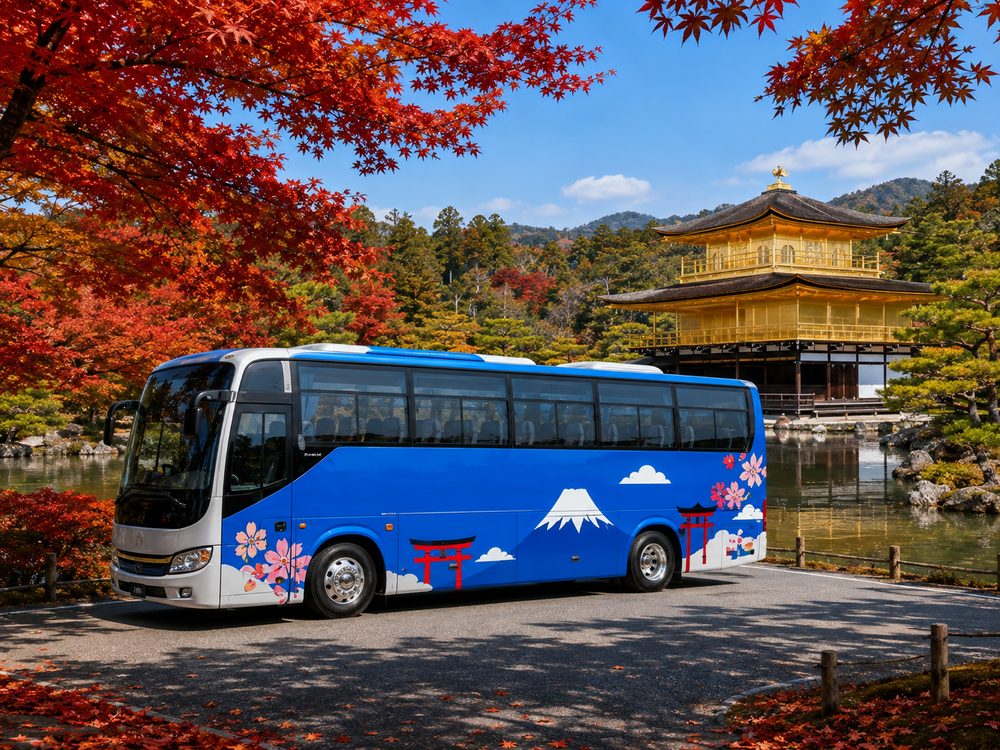
For groups traveling together, a 45–50-seat full-size coach offers a different experience from taking the train. You leave from your hotel or a selected meeting point, keep your luggage with you, and arrive in Kyoto without splitting into separate carriages.
The key question is not simply, “Is a bus cheaper than a train?” It is whether door-to-door convenience and a flexible itinerary are worth more to your group than the speed of the Shinkansen.
How long does Tokyo to Kyoto really take by coach?
A realistic planning window is around 6.5–8 hours on the road, depending on your departure point, traffic, weather, and the exact Kyoto destination.
That estimate refers to the driving journey itself. Once you include rest stops, boarding time, luggage loading, and possible congestion around Tokyo or Kyoto, many groups should allow roughly 8–10 hours from hotel departure to final arrival.
Several factors can change the timing:
- Tokyo departure location: A pickup in central Tokyo may take longer than one near the western side of the city because of urban traffic.
- Kyoto destination: Reaching a hotel in central Kyoto is different from dropping off near Arashiyama, Fushimi Inari, or a large group venue.
- Departure time: Morning congestion can affect the first part of the journey, while late afternoon traffic may slow the approach to Kyoto.
- Season and weather: Heavy rain, strong winds, or winter conditions can affect highway travel.
- Breaks: A full-size coach normally needs planned rest stops for passengers and professional driver operations.
- Group size: A large group takes longer to board, use facilities, and reorganize luggage than a few independent travelers.
For this reason, it is better to plan the route as a full travel day rather than promise a precise arrival hour. Your operator can recommend a practical departure time after reviewing the pickup point, travel date, and Kyoto drop-off.
Typical route through Shizuoka and Hamamatsu
The coach generally travels west from Tokyo along the main expressway corridor, passing through the Shizuoka region before continuing toward Hamamatsu, Nagoya, and Kyoto. On clear days, this route can offer views of Mount Fuji and the changing scenery between the Kanto and Kansai regions.
The scenery is one of the pleasures of traveling overland:
- Tokyo’s dense urban landscape gradually gives way to wider roads and suburban areas.
- Shizuoka is known for tea-growing country, mountain views, and the Pacific-side landscape.
- Hamamatsu sits in western Shizuoka and is a practical point for a longer break.
- Farther west, the route continues through the Chubu region before approaching Kyoto.
The precise road used may change according to traffic, road conditions, vehicle restrictions, or the operator’s route planning. A licensed Japanese operator will choose the safest and most practical route for the group.
Why stop at Shizuoka or Hamamatsu?
A planned stop makes a long coach journey more comfortable and can turn travel time into part of the itinerary.
Shizuoka-area stops can work well for a brief refreshment break, particularly when your group wants a chance to stretch, buy drinks, or enjoy regional food. Depending on the service area, travelers may also find local tea products and seasonal specialties.
Hamamatsu-area stops are useful for a more substantial break. The region is associated with eel, gyoza, and musical-instrument manufacturing, although what is available depends on the highway service area and schedule. A stop here can divide the journey into more manageable sections before the coach continues west.
A rest stop is not automatically a sightseeing visit. Highway service areas are designed for convenience, not always for a full cultural experience. If you want to visit a particular tea farm, viewpoint, restaurant, or attraction in Shizuoka or Hamamatsu, mention it during planning so the operator can check whether the detour is suitable for a large coach.
Charter bus or Shinkansen?
The Shinkansen is usually the fastest option for travelers moving between central Tokyo and central Kyoto. A charter bus becomes more attractive when the group values shared travel, direct hotel access, and control over the day.
| Consideration | 45–50-seat charter coach | Shinkansen |
|---|---|---|
| Travel time | A full travel day, including stops and traffic | Much faster station-to-station |
| Pickup and arrival | Flexible locations, subject to vehicle access and local rules | Fixed stations |
| Luggage | Stored together in the coach luggage compartment | Travelers manage luggage on and around the train |
| Group coordination | Everyone travels together | Large groups may be split across carriages |
| Route flexibility | Possible stops and sightseeing detours | No roadside stops |
| Best for | School groups, tours, families, events, and groups with substantial luggage | Independent travelers prioritizing speed |
A train ticket also does not represent the complete journey. Your group still needs to reach the station, navigate a busy terminal, board with luggage, and travel from Kyoto Station to the hotel or first attraction. For some groups, these transfers are simple. For others, especially those with children, older travelers, equipment, or many suitcases, a coach can remove considerable logistical stress.
When is a charter bus worth choosing?
A coach is often a strong choice in the following situations:
Your group is traveling together
A 45–50-seat full-size coach is designed for large groups that want one shared vehicle. It avoids coordinating multiple taxis or asking travelers to find their own way through major stations.
You are carrying bulky luggage or equipment
Large suitcases, sports equipment, musical instruments, event materials, or tour supplies are easier to manage when loaded directly into the coach. The operator can advise on luggage capacity and safe loading based on your group’s requirements.
Tokyo to Kyoto is part of a wider itinerary
The bus can be especially useful when the route includes planned stops, a regional lunch, a visit near Mount Fuji, or a transfer directly to a Kyoto accommodation. Instead of treating the journey as dead time, you can build a practical route around it.
Your arrival point is away from Kyoto Station
If your accommodation or event venue is difficult to reach with luggage, direct coach access may save time after arrival. Vehicle access must be confirmed in advance because some Kyoto streets have size, traffic, or parking restrictions.
Your group prefers a relaxed, private journey
A private coach gives your group its own space and allows the accompanying coordinator to share instructions without disturbing other passengers. It can also make the journey feel more social than traveling in separate train seats.
When should you choose the train instead?
The Shinkansen is usually the better fit when:
- You are traveling alone or as a small group.
- Your priority is reaching Kyoto as quickly as possible.
- Everyone can comfortably manage station transfers and luggage.
- Your itinerary has no planned stops between Tokyo and Kyoto.
- Your Kyoto destination is convenient to the station or public transport.
A charter bus is not a shortcut. It is a flexible, comfortable group-transfer solution. If speed is the only priority, the train will normally be more suitable.
Planning the coach journey
For a smooth Tokyo–Kyoto transfer, share these details when requesting a quote:
- Exact Tokyo pickup address and preferred departure time
- Kyoto drop-off address or list of possible destinations
- Number of passengers
- Number and approximate size of suitcases
- Desired rest stops or sightseeing breaks
- Whether the coach must remain available after arrival
- Any accessibility, child-seat, or special equipment requirements
As a broad planning guide, a one-way charter for a 45–50-seat coach may fall around ¥180,000–¥320,000 as an estimate, depending on the date, route, operating hours, vehicle requirements, stops, and availability. This is not a fixed fare; the exact quote comes from the booking form.
Request a free charter-bus quote from OlaChill—the team replies within 24 hours.
Final advice
For a group trip, compare the complete journey rather than the headline travel time. A Shinkansen offers speed between stations, while a full-size charter coach offers one pickup, one shared vehicle, flexible stops, and direct arrival options.
If your group has a full day available and values convenience over speed, the Tokyo–Kyoto route by coach can be an enjoyable and practical part of your Japan itinerary. Plan realistic travel time, choose a comfortable stop near Shizuoka or Hamamatsu, and confirm vehicle access at both ends before finalizing the schedule.
FAQ
How many hours does a charter bus take from Tokyo to Kyoto?
Allow around 6.5–8 hours of driving, with a total journey of roughly 8–10 hours after rest stops, traffic, boarding, and luggage handling. The operator can provide a more precise schedule after checking your addresses and travel date.
Can the bus stop in Shizuoka or Hamamatsu?
Yes, a planned stop may be possible at a suitable highway service area or another approved location. Tell the operator whether you want a short rest, a meal break, or a sightseeing detour so the route and schedule can be reviewed.
Is a 45–50-seat coach suitable for luggage?
It is generally suitable for large groups, with luggage stored in the vehicle’s designated compartment. The final capacity depends on the number and size of bags, so provide accurate luggage information when requesting your quote.
Is a charter bus cheaper than the Shinkansen?
There is no single answer because the total depends on the group size, date, route, stops, and vehicle operating time. Compare the complete group cost and convenience rather than comparing only one train ticket with the bus estimate.
Can the coach take us directly to a Kyoto hotel?
Often, yes, but access must be confirmed. Some Kyoto streets, hotel entrances, and historic districts may have restrictions for large vehicles, so the operator may recommend a nearby drop-off point if direct access is not possible.
Comments
No reviews yet — be the first!