🌐 Questo articolo non è ancora tradotto. Mostrato nell'originale in English.
Vedi originale →
Charter Bus vs Shinkansen for Groups: The Real Tokyo–Kyoto Math
Compare Shinkansen tickets and a 45–50-seat charter coach for Tokyo–Kyoto groups, including cost, door-to-door time, and luggage.
21 ago 2026·✍️ olablog·⏱ 8 min di lettura
Compare Shinkansen tickets and a 45–50-seat charter coach for Tokyo–Kyoto groups, including cost, door-to-door time, and luggage.
Tocca una regione per vedere gli articoli
The short answer
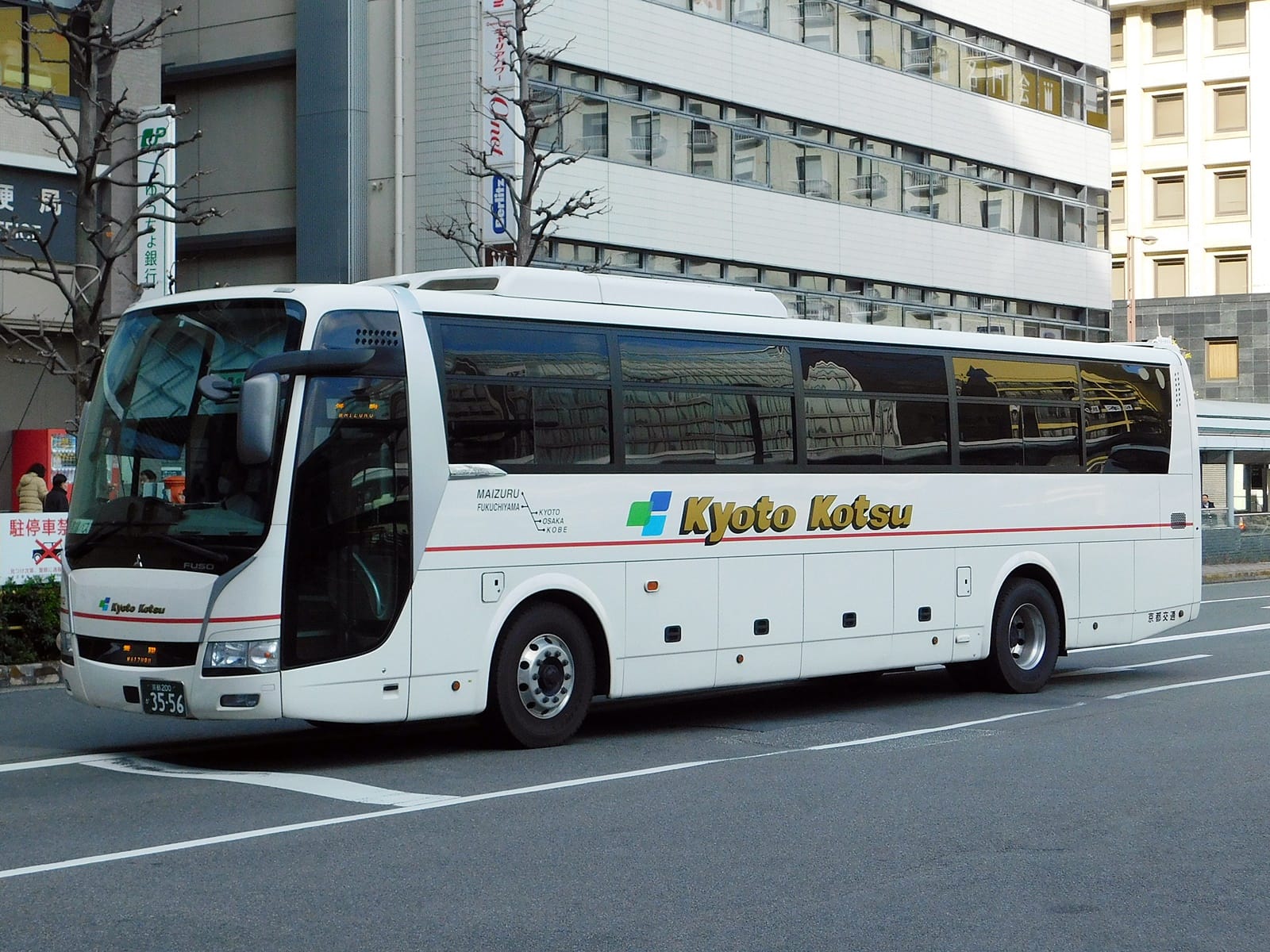
For a small group travelling between central Tokyo and central Kyoto, the Shinkansen is usually the fastest option. For a larger group—especially one carrying bulky luggage—a 45–50-seat charter coach can be more convenient and may cost less per person.
The important comparison is not simply “train fare versus bus fare”. You need to consider:
- The total cost for everyone
- Hotel-to-hotel travel time
- Transfers to and from stations
- Luggage handling
- Whether your itinerary includes stops outside the city centres
- The value of keeping the group together
The calculations below use round-trip Tokyo–Kyoto travel as a planning example. All prices are approximate estimates only. The exact charter price depends on dates, route, hours, tolls, parking, seasonal demand, and driver arrangements; the exact quote comes from the booking form.
The real cost for groups of 15, 25 and 40
A standard Shinkansen journey between Tokyo and Kyoto is quick, but every traveller needs a separate ticket. A full-size charter coach has one vehicle cost, so the per-person figure improves as your group becomes larger.
For planning purposes, use an estimated Shinkansen fare of approximately ¥28,000–¥32,000 per person for a round trip. A 45–50-seat coach travelling from Tokyo to Kyoto and back may fall around ¥440,000–¥760,000 for the round trip, depending on the operating plan.
| Group size | Shinkansen total, estimated round trip | 45–50-seat coach total, estimated round trip | Approximate coach cost per person | What the maths suggests |
|---|---|---|---|---|
| 15 travellers | ¥420,000–¥480,000 | ¥440,000–¥760,000 | ¥29,000–¥51,000 | Train often wins on price unless convenience is the priority |
| 25 travellers | ¥700,000–¥800,000 | ¥440,000–¥760,000 | ¥18,000–¥30,000 | Coach can become competitive, particularly with luggage or extra stops |
| 40 travellers | ¥1,120,000–¥1,280,000 | ¥440,000–¥760,000 | ¥11,000–¥19,000 | Coach is often the stronger value and logistics choice |
These are deliberately broad planning estimates rather than a promise of availability or price. A coach may need to stay with the group, wait during sightseeing, use paid parking, or include an overnight driver arrangement. Conversely, train costs can change with the class of service, reserved-seat requirements, and the final booking conditions.
For 15 people, the Shinkansen is often the economical choice if everyone is staying near Tokyo Station or Shinagawa Station and Kyoto Station. For 25 or 40 people, the coach calculation becomes much more attractive because you are dividing one vehicle cost among more passengers.
Door-to-door time: fast on the tracks, simple on the road
Shinkansen time
The train journey itself takes roughly 2 hours 15 minutes to 2 hours 40 minutes, depending on the service. That is only the time on the train.
A realistic hotel-to-hotel journey also includes:
- Travelling from the Tokyo hotel to the departure station
- Finding the correct platform and boarding area
- Arriving early enough for a large group to board smoothly
- Walking through Kyoto Station after arrival
- Transferring to taxis, local trains, or another vehicle
- Collecting and organising luggage
For hotels close to major stations, the total door-to-door journey may be around 4–6 hours. Hotels in Asakusa, Odaiba, Shinjuku, or other areas away from the most convenient station can add more transfer time.
Large groups should also avoid assuming that everyone will move at the same speed. A group of 40 can take significantly longer to gather, navigate station corridors, and board local transport than a couple travelling independently.
Charter coach time
The road journey from Tokyo to Kyoto commonly takes around 6–8 hours of driving, before allowing for traffic, service-area breaks, weather, and city congestion. In practice, a hotel-to-hotel trip may take approximately 7–10 hours.
That sounds slower than the train, and it is when the destination is simply Kyoto Station. However, the coach can usually collect passengers at an agreed hotel or meeting point and drop them close to the next accommodation. There is no need for the group to:
- Carry suitcases through multiple stations
- Change from an express train to local transport
- Split into several taxis
- Reassemble after arrival
A coach is also more useful when Tokyo or Kyoto is only one part of the route. You could build in a stop at Mount Fuji, a lakeside area, a service area, or another sightseeing destination, subject to the operating schedule and driver-hour limits.
The key trade-off is simple: the Shinkansen minimises intercity travel time; the coach can minimise travel friction.
Luggage: the detail that changes the decision
Luggage is often the deciding factor for families, school groups, wedding parties, sports teams, and tour groups.
On the Shinkansen, every traveller is responsible for moving their own bags through stations and onto the train. Medium suitcases are manageable, but a large group may create practical issues:
- Many bags require a coordinated boarding process
- Oversized baggage may require advance seat arrangements
- Luggage space is limited compared with a vehicle luggage hold
- Bags must be moved between the hotel, station, train, and onward transport
- Travellers may need to reserve taxis or arrange delivery services
A full-size coach normally offers a dedicated luggage compartment underneath the passenger cabin. That means travellers can hand over their bags at the hotel, board once, and collect everything at the destination. The luggage compartment has a practical capacity limit, so the operator should know the approximate number and size of suitcases before confirming the vehicle.
A coach is especially helpful when the group has large checked luggage, musical instruments, sports equipment, baby items, or shopping bags. It also keeps luggage with the group rather than requiring separate forwarding arrangements.
When the Shinkansen is the better choice
Choose the Shinkansen when:
- Your group is relatively small
- Everyone is staying close to major stations
- The priority is reaching Kyoto as quickly as possible
- You do not need sightseeing stops en route
- Travellers are comfortable handling their own luggage
- Your schedule is fixed around a specific train departure
The train is also easier when members of the group will separate after arrival. Each person can continue to a different hotel or onward destination without keeping a vehicle and driver on standby.
When a 45–50-seat coach makes more sense
Choose a full-size charter coach when:
- You have 25–40 travellers
- The group needs hotel pickup and drop-off
- Luggage volume is high
- You want to keep everyone together
- Kyoto is part of a multi-stop itinerary
- You need flexibility around sightseeing or meal stops
- Some travellers may find large stations difficult to navigate
A 45–50-seat coach is a practical fit for a large group, even if not every seat is occupied. It gives the group room to travel together without splitting across cars or trains. For a group of 15, the vehicle may be more space than necessary, but the added privacy and simpler luggage handling can still justify it.
Remember that the coach is not a teleportation service. Traffic around Tokyo, Kyoto, expressway bottlenecks, holiday periods, rain, and winter conditions can affect the schedule. Build in flexibility rather than planning a tight connection immediately after arrival.
How to make the final decision
Start with the actual shape of your trip, not just the headline fare:
- Count every traveller, including children and tour leaders.
- Estimate how many large suitcases the group will carry.
- Map each hotel’s distance from the nearest convenient station.
- Decide whether you need stops between Tokyo and Kyoto.
- Compare the full group total, not the price for one traveller.
- Allow extra time for station transfers and group assembly.
- Request a coach quote using the exact dates, pickup points, luggage details, and itinerary.
For a quick planning rule, the Shinkansen is usually the time winner. A 45–50-seat charter coach becomes increasingly compelling as the group grows, the luggage gets heavier, and the itinerary becomes more complex than a simple station-to-station transfer.
Request a free charter bus quote from OlaChill — complete the form and receive a reply within 24 hours.
FAQ
Is a charter bus cheaper than the Shinkansen for 15 people?
Not necessarily. For 15 travellers, estimated round-trip Shinkansen fares can be similar to or lower than a full-size coach. The coach may still offer better convenience if the group has substantial luggage, difficult hotel locations, or several planned stops.
How long does a charter bus take from Tokyo to Kyoto?
Plan for approximately 7–10 hours door to door, depending on the pickup location, traffic, breaks, weather, and drop-off arrangements. The exact schedule should be confirmed with the operator.
Can a 45–50-seat coach carry everyone’s luggage?
Usually, the underfloor luggage hold is designed for group travel, but capacity depends on the number and size of bags. Share your luggage estimate when requesting a quote so the operator can confirm the arrangement.
Is the Shinkansen always the fastest option?
It is usually fastest between Tokyo Station or Shinagawa Station and Kyoto Station. Once hotel transfers, station navigation, waiting time, and onward transport are included, the door-to-door advantage may be smaller than the onboard journey suggests.
Are the prices in this comparison guaranteed?
No. Every amount shown is an approximate estimate for planning only. The exact charter quote comes from the booking form and depends on the date, route, vehicle schedule, tolls, parking, driver arrangements, and other operating details.
Commenti
Nessuna recensione — sii il primo!